
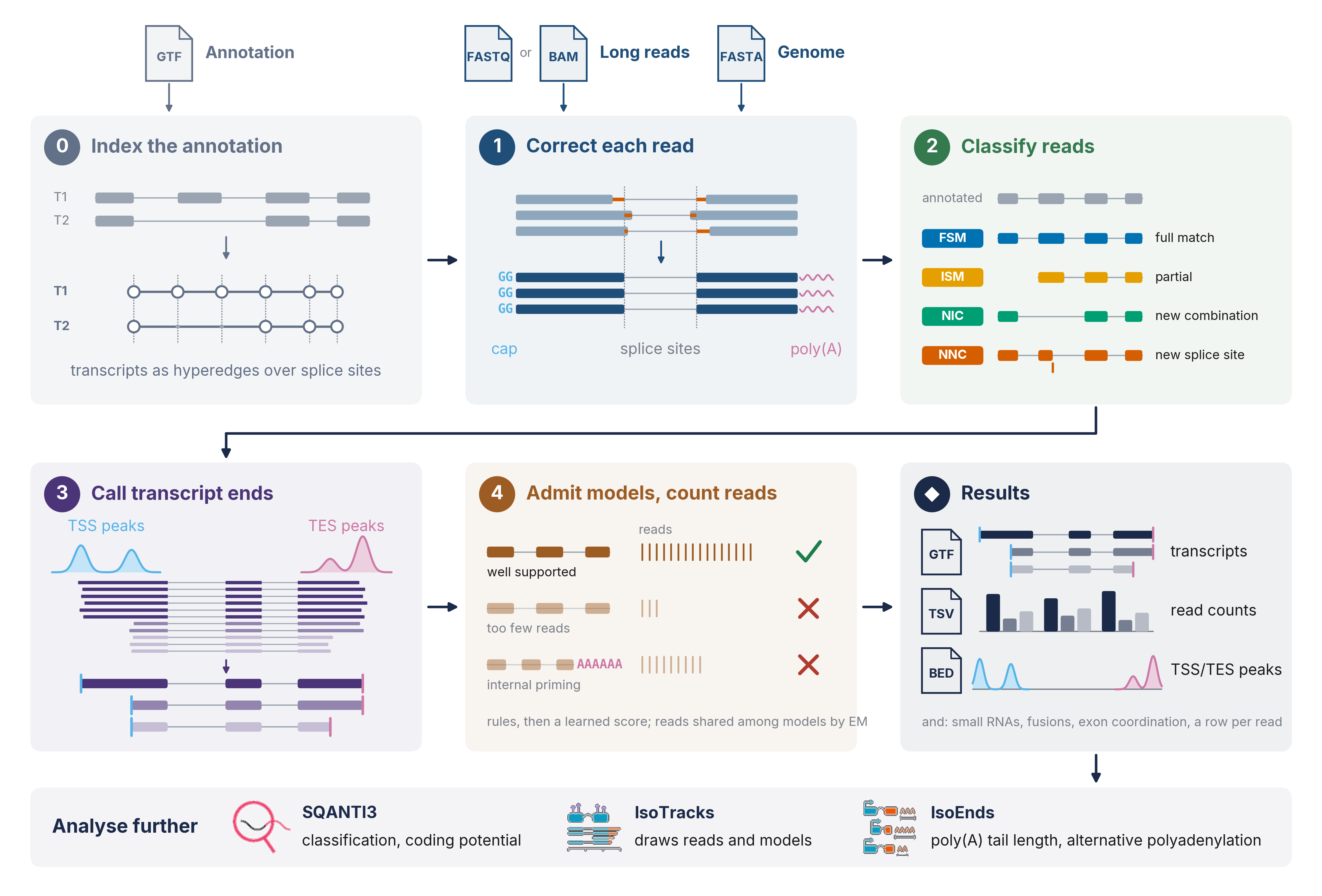
IsoForge uses a hypergraph, rather than a splice graph, to preserve transcript models and the reads behind them. Each long read is kept whole, with its intron chain and both ends, as one hyperedge. From Oxford Nanopore or PacBio RNA-seq, a single run reports annotated and novel isoforms with their transcription start and poly(A) sites, read counts per sample (annotated small RNAs included) and gene fusions.
Installation
pip install isoforge
IsoForge needs Python 3.10 or later and is tested on Linux (x86-64), where pip installs a ready-built package: minimap2 and htslib are compiled in, so there is nothing else to install. On other systems pip builds IsoForge from source, which takes a few minutes and needs Rust 1.85 or later and the C build tools (a compiler, make, cmake).
To build from this repository with conda:
git clone https://github.com/MustafaElshani/IsoForge.git
cd IsoForge
bash install.sh              # creates the conda environment "isoforge" and builds into it
conda activate isoforge
bash install.sh --help shows the other ways to call the script. The repository as it stands is installed with
pip install git+https://github.com/MustafaElshani/IsoForge.git; the conda environment of environment.yml has what
that build needs (conda env create -f environment.yml, then conda activate isoforge).
Quick start
IsoForge needs the reads, the genome and the annotation:
# from FASTQ
isoforge annotate --reads Control_1.fastq.gz Treated_1.fastq.gz \
    --genome hg38.fa --annotation gencode.v49.annotation.gtf --o results/project

# or from sorted BAM files
isoforge annotate --bam Control_1.bam Treated_1.bam \
    --genome hg38.fa --annotation gencode.v49.annotation.gtf --o results/project
FASTQ files are aligned with the minimap2 built into IsoForge. The annotation is indexed on the first run, beside the GTF, and the index is used again after that. Every output is written; nothing else has to be set.
If your genome has a minisplice score table
(human GRCh38: human-GRCh38.v4.tsv.gz), add
--splice_scores human-GRCh38.v4.tsv.gz. It is used to place and check novel splice sites.
| Command | Use |
|---|---|
isoforge annotate |
The run: from FASTQ or BAM to transcript models, counts and fusions |
isoforge post |
Filter and write the outputs again from a kept run, without reading the alignments again |
isoforge export |
Write coverage tracks or the read table again from a finished run |
isoforge index |
Build the annotation index ahead of a run, for example on a cluster |
isoforge <command> --help shows the main options of a command, and isoforge annotate --help-all every option.
Input
Reads
Give one file per sample: FASTQ or FASTA, gzipped or not, with --reads, or sorted BAM with --bam. The samples
are named after their files unless --names gives the names. For FASTQ, set the library type:
| Library | Options | minimap2, if you align yourself |
|---|---|---|
| Nanopore cDNA | none | -ax splice |
| Nanopore direct RNA, or cDNA oriented with pychopper | --oriented -k 14 |
-ax splice -uf -k14 |
| PacBio Iso-Seq | --platform hifi --oriented |
-ax splice:hq -uf |
--oriented (-uf) is only for reads that run in the transcript's direction. --write_bam keeps the alignments
IsoForge makes, which IsoTracks reads.
BAM files of your own must be aligned to the genome with minimap2, sorted and indexed:
minimap2 -ax splice --junc-bed annotation.bed hg38.fa reads.fastq.gz | samtools sort -o sample.bam
samtools index sample.bam
annotation.bed is made with paftools.js gff2bed annotation.gtf; --junc_bed gives the same file to the built-in
aligner.
Poly(A) tail lengths are read from the pt:i tag when the reads carry it, and measured in the soft clip otherwise.
To keep Dorado's tag, convert with samtools fastq -T pt and add --copy_comment (minimap2 -y).
Sample sheet
For many samples, --config takes a CSV in place of --reads or --bam, with one sample per line: name,
description, platform and file.
Control_rep1,Control replicate 1,ONT,/data/control_rep1.fastq.gz
Control_rep2,Control replicate 2,ONT,/data/control_rep2.fastq.gz
Treated_rep1,Treated replicate 1,ONT,/data/treated_rep1.fastq.gz
Treated_rep2,Treated replicate 2,ONT,/data/treated_rep2.fastq.gz
The part of a sample name before the first underscore is the condition (Control, Treated).
Output
With --o results/project:
| File | Content |
|---|---|
project_isoforge.gtf |
Transcript models that pass the filters, with their TSS, poly(A) site and poly(A) signal |
project_isoforge_abundance_filtered.tsv |
Read counts per transcript and dataset |
project_isoforge_read_annot.parquet |
Every read: its transcript, TSS, poly(A) site and signal, and tail length |
project_isoforge_read_annot.tsv |
The whole reads of the reported transcripts, as text; their other reads are in ..._unsupported.tsv |
project_isoforge_summary.tsv |
Genes, transcripts and reads per category and dataset |
project_filter.csv |
IDs of the transcripts that pass |
project_TSS_TES_Clusters/ |
TSS and poly(A) site clusters (BED and Parquet), and read-end coverage tracks per dataset |
project_isoforge_fusions.tsv |
Fusion candidates. The calls are the rows with PASS in the filter column, also written as .bedpe |
project_isoforge_fusion_* |
The reads, parts and transcripts of each fusion (TSV, Parquet, GTF) |
--hypergraph also writes the read hypergraph of the reported models (project_isoforge_hypergraph.tsv) and tests of
which exons are spliced together in the same molecules (project_isoforge_coordination.tsv).
Transcript categories
| Category | Meaning |
|---|---|
| Known | Full splice match to an annotated transcript |
| ISM | Incomplete splice match: a contiguous part of an annotated intron chain (Prefix, Suffix or Both) |
| NIC | Novel in catalogue: annotated splice sites in a new combination |
| NNC | Novel not in catalogue: at least one new splice site |
| Novel | An intron chain given a new ID because its reads have a start or poly(A) site of their own |
| Antisense | On the opposite strand of an annotated gene |
| Intergenic | Outside annotated genes |
| Genomic | Overlaps an annotated gene without sharing its splice structure |
| Fusion | Spans two or more annotated genes |
Columns of the tables and GTF attributes
Abundance table:
| Column | Content |
|---|---|
gene_ID, transcript_ID |
IsoForge gene and transcript numbers |
annot_gene_id, annot_transcript_id |
Annotation IDs; novel transcripts are ISOFORT…, novel genes ISOFORG… |
annot_gene_name, annot_transcript_name |
Gene and transcript names |
n_exons, length |
Number of exons and transcript length (nt) |
gene_novelty, transcript_novelty, ISM_subtype |
Categories, as above |
| one column per dataset | Read counts. A read that fits several transcripts is shared among them, so counts can be fractional |
Read table:
| Column | Content |
|---|---|
read_name, dataset, genome_build |
Read, dataset and genome build |
chromosome, read_start, read_end, strand |
5′ and 3′ end of the alignment (1-based) and transcript strand |
n_exons, read_length |
Exons of the assigned transcript, and length of the read |
gene_ID … ISM_subtype |
The assigned gene and transcript, as in the abundance table |
fraction_As |
A content of the 20 nt after the 3′ end |
custom_label, allelic_label |
The lC and lA BAM tags, if present |
start_support, end_support |
TSS and poly(A) cluster the read's ends joined |
tss_site, tss_feature |
TSS position and the annotated feature there |
polya_site, polya_feature, polya_signal |
Poly(A) site, the feature there and the poly(A) signal (a hexamer, or DSE) |
cluster_supported |
True for a whole read of its transcript: every exon, both ends at the transcript's, not internally primed |
polya_length |
Poly(A) tail length |
GTF transcript records carry transcript_status, tss_site, tss_Feature, polyA_site, polyA_Feature and
polyA_signal. A transcript that has the intron chain of an annotated one and another start or poly(A) site also
carries variant_of, the ID of that annotated transcript.
Options
The defaults are meant to be run as they are. These are the options most often changed:
| Option | Default | Effect |
|---|---|---|
--threads |
all cores | Threads |
--minCount |
5 | Reads per dataset a novel transcript needs |
--minCountKnown |
2 | Reads per dataset an annotated transcript needs |
--minDatasets |
1 | Datasets in which a novel transcript must pass (0: all) |
--no_polya_filter |
off | Accept 3′ ends without a poly(A) tail, for reads without tail information |
--known_ends_as_annotated |
off | Write annotated transcripts at their annotated ends; the read-derived ends stay in the GTF attributes |
--no-small_rna |
counted | Do not count annotated small RNAs |
--no-fusions |
called | Do not call fusions |
--sj_dir, --cage_peaks |
none | STAR SJ.out.tab files and CAGE peaks as further evidence for splice sites and starts |
--read_annot_format parquet, --no-end_tracks |
both, on | A smaller output: no read table as text, no coverage tracks |
--write_bam |
off | Keep the alignments made from FASTQ, in <prefix>_alignments/ |
--keep-db |
off | Keep the run database for isoforge post |
Filtering a run again
A run kept with --keep-db can be filtered with other settings without reading the alignments again:
isoforge post --database results/project_isoforge_db --annotation gencode.v49.annotation.gtf \
    --genome hg38.fa --minCount 10 --o results/project_min10
isoforge post takes the filtering options of isoforge annotate. Give it --genome and --splice_scores as in
the run.
Downstream analysis
| Tool | Use | Reads from a run |
|---|---|---|
| SQANTI3 v6 | Structural classification and quality control of the transcript models | The GTF |
| IsoForge_Sqanti3 | Runs SQANTI3 on a run and writes its classification, coding status and CDS back into the GTF, with a BED12 for genome browsers | The GTF |
| IsoTracks | Draws the isoform models of a gene with the reads behind them, their poly(A) tails and coverage, and gene fusions | The GTF, the read-annotation Parquet, the clusters, the fusion tables and the BAM files |
| IsoEnds | Statistics on poly(A) tail length, alternative polyadenylation and transcription start sites between conditions | The read-annotation Parquet, the GTF and the clusters |
IsoForge_Sqanti3, IsoTracks and IsoEnds are companion tools of IsoForge. SQANTI3 itself takes the GTF as it is:
python sqanti3_qc.py --isoforms results/project_isoforge.gtf \
    --refGTF gencode.v49.annotation.gtf --refFasta hg38.fa -d results/sqanti3 -o project
Citation
The IsoForge manuscript is in preparation. Until it is out, please cite this repository:
Elshani M, Zhang Y, Harrison DJ. IsoForge, version 1.0.0. https://github.com/MustafaElshani/IsoForge
License
MIT, see LICENSE.
1 maintainer

Metadata
1 maintainer
Release files for isoforge 1.0.0
For a detailed explanation of source distributions (sdists) and built distributions (wheels), please see the package formats documentation.
Source distribution (sdist)
| File | Size | Uploaded | |
|---|---|---|---|
| isoforge-1.0.0.tar.gz | 1.7 MB | Details |
Built distribution (wheel)
| File | Interpreter | ABI | Platform | Reset |
|---|---|---|---|---|
| isoforge-1.0.0-cp310-abi3-manylinux_2_17_x86_64.manylinux2014_x86_64.whl | CPython 3.10 | abi3 | Linux glibc 2.17+ x86-64 | Details |
Total release size: 8.8 MB
Release files / isoforge-1.0.0.tar.gz
| Download URL | isoforge-1.0.0.tar.gz |
|---|---|
| Size | 1.7 MB |
| Tags | Source |
|
SHA-256 checksum How to use checksums |
8c069f590a5843f6bac8b1f3f58a9f1661d3e3a83495af0ae683b9451f58cb68
|
|
BLAKE2b-256 checksum How to use checksums |
e1f978dad962f67cd172a4345d18a81433104f8fdef17059c256ca58824aa337
|
| Upload date | |
|
Uploaded using Trusted Publishing? What is trusted publishing? |
Yes |
| Uploaded via |
twine/7.0.0 CPython/3.13.14
|
Provenance
Provenance describes where a file came from. On PyPI, provenance is shared via attestations, which provide a verifiable record of the build or publishing details. View details, limitations and caveats.


PyPI Publish Attestation
PyPI verified that this artifact, at this checksum, originated from the publisher listed below.
Signed by GitHub Actions, verified by PyPI on Oct 10, 2026.
Transparency logRelease files / isoforge-1.0.0-cp310-abi3-manylinux_2_17_x86_64.manylinux2014_x86_64.whl
| Download URL | isoforge-1.0.0-cp310-abi3-manylinux_2_17_x86_64.manylinux2014_x86_64.whl |
|---|---|
| Size | 7.0 MB |
| Tags | CPython 3.10 Linux glibc 2.17+ x86-64 abi3 |
|
SHA-256 checksum How to use checksums |
b2fe2d385866009d15dd5a7d8e2f4e34634020b1699217809f74fbcf440ecda2
|
|
BLAKE2b-256 checksum How to use checksums |
e2959b4d996a99b7a4ba6c1c4f82c230f1847515bda5a2bfe05249ab448ff444
|
| Upload date | |
|
Uploaded using Trusted Publishing? What is trusted publishing? |
Yes |
| Uploaded via |
twine/7.0.0 CPython/3.13.14
|
Provenance
Provenance describes where a file came from. On PyPI, provenance is shared via attestations, which provide a verifiable record of the build or publishing details. View details, limitations and caveats.
PyPI Publish Attestation
PyPI verified that this artifact, at this checksum, originated from the publisher listed below.
Signed by GitHub Actions, verified by PyPI on Oct 10, 2026.
Transparency log












