
Sane orchestration for isolated environments

Project description
Jailrun
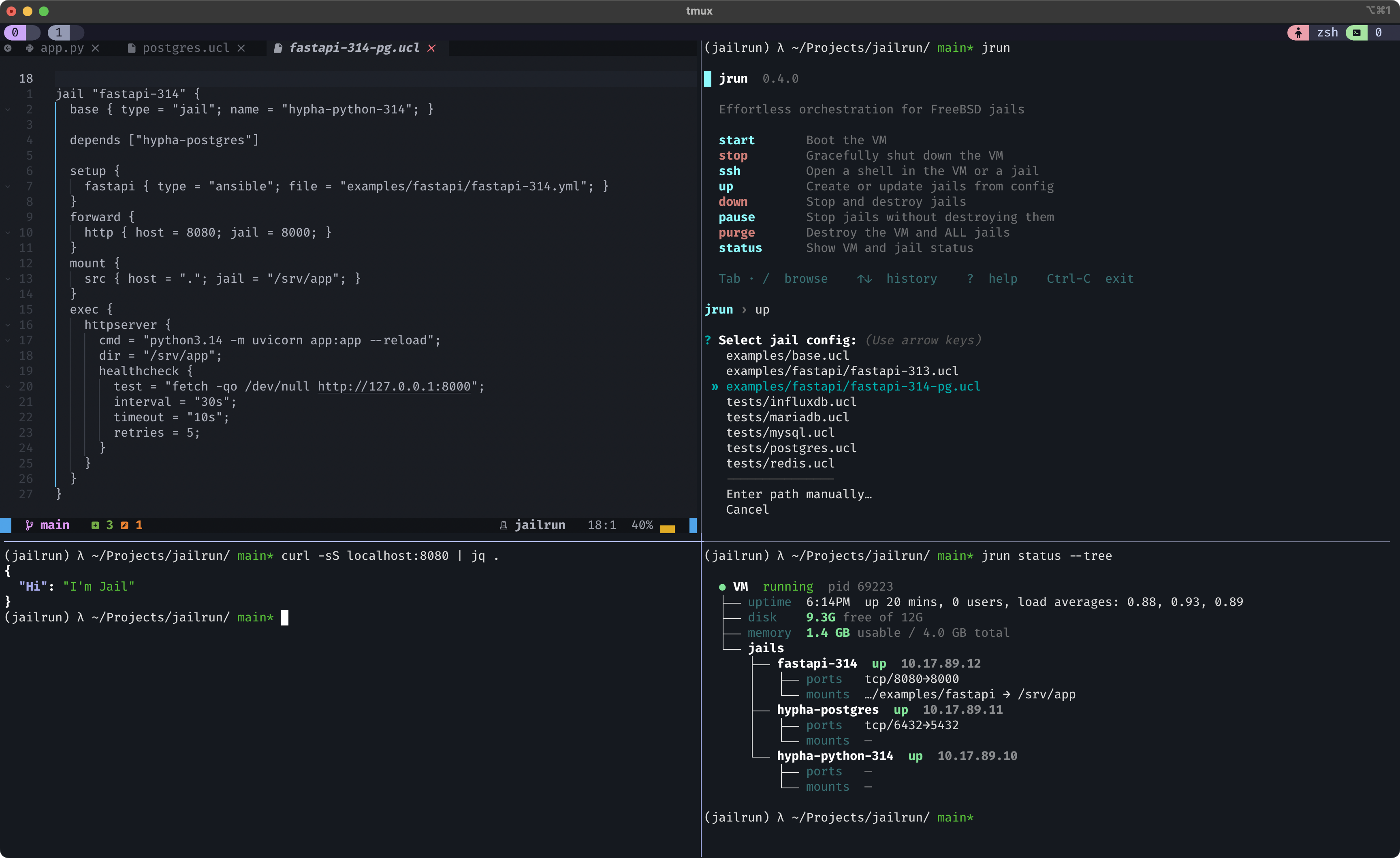
Jailrun lets you describe your services in a declarative config file and brings the system to the desired state. Under the hood, it boots a FreeBSD virtual machine on your host using QEMU with hardware acceleration to provision each service in its own jail, and exposes a set of powerful tools to wire and manage them.
What is a jail?
A jail is a self-contained environment running inside FreeBSD. Each jail is isolated from the host and from other jails, with its own filesystem, network, and processes.
Jails are a native FreeBSD feature. They are fast to create, cheap to run, and easy to destroy and recreate from scratch. FreeBSD jails are one of the most proven isolation technologies in computing, and Jailrun makes them accessible from macOS, Linux, and FreeBSD itself.
Install
macOS (Homebrew):
brew tap hyphatech/jailrun
brew install jailrun
This installs jrun and all its dependencies — Python, QEMU, Ansible, and mkisofs.
Linux:
Install the system-level dependencies first:
# Debian/Ubuntu
sudo apt install qemu-system mkisofs ansible

# Fedora
sudo dnf install qemu-system-x86 genisoimage ansible

# Arch
sudo pacman -S qemu-full cdrtools ansible
Install Python 3.13+ using your operating system's package manager or preferred installation method.
Install uv using your distribution's package manager if available, or via the official installer:
curl -LsSf https://astral.sh/uv/install.sh | sh
Then jrun itself:
uv tool install jailrun
To install jrun directly from the latest source on main:
uv tool install "git+https://github.com/hyphatech/jailrun.git@main"
FreeBSD:
Install the host dependencies first:
sudo pkg install qemu edk2-qemu-x64 uv rust cdrtools python313
Some Python dependencies may not have prebuilt wheels on FreeBSD and may need to be compiled locally, so rust is required.
Install Ansible and jrun with Python 3.13:
uv tool install --python 3.13 --with-executables-from ansible-core ansible
uv tool install --python 3.13 jailrun
To install jrun directly from the latest source on main:
uv tool install --python 3.13 "git+https://github.com/hyphatech/jailrun.git@main"
If jrun is not found after installation, make sure uv's user bin directory is on your PATH:
export PATH="$HOME/.local/bin:$PATH"
Quick start
Bring FreeBSD to your system:
jrun start
On first run, jrun downloads the FreeBSD image and bootstraps the base system.
Prefer an interactive experience? Run jrun with no arguments to enter the shell — guided wizards, autocomplete, and command history all included.
jrun
Your first jail
Jails are defined in config files using UCL — a clean, human-friendly format similar to JSON.
Create a file called web.ucl in your project directory:
jail "http-server" {
  forward {
    http { host = 7777; jail = 8080; }
  }
  mount {
    src { host = "."; jail = "/srv/project"; }
  }
  exec {
    server {
      cmd = "python3.13 -m http.server 8080";
      dir = "/srv/project";
    }
  }
}
Bring it up:
jrun up web.ucl
Here's what's happening:
- A jail was created — a fully isolated environment with its own IP address and filesystem.
- Your project directory was mounted inside the jail at
/srv/project. Changes you make on your host show up instantly inside the jail, and vice versa. - Port 7777 on your host was forwarded to port 8080 inside the jail. Traffic flows through automatically.
- A Python HTTP server was started inside the jail, serving your project files. It's supervised — if it crashes, it gets restarted.
Test it:
curl -sS localhost:7777
One config file, one command, and you can safely interact with your app from the host.
A real-world stack
Here's something more realistic: a FastAPI application running on Python 3.14, backed by PostgreSQL. Three jails, each doing one thing, all wired together.
# stack.ucl

jail "python-314" {
  setup {
    python { type = "ansible"; file = "playbooks/python-314.yml"; }
  }
}

jail "postgres-16" {
  setup {
    postgres { type = "ansible"; file = "playbooks/postgres.yml"; }
  }
  forward {
    pg { host = 6432; jail = 5432; }
  }
}

jail "fastapi-314" {
  base { type = "jail"; name = "python-314"; }

  depends ["postgres-16"]

  setup {
    fastapi { type = "ansible"; file = "playbooks/fastapi-314.yml"; }
  }
  forward {
    http { host = 8080; jail = 8000; }
  }
  mount {
    src { host = "."; jail = "/srv/app"; }
  }
  exec {
    uvicorn {
      cmd = "python3.14 -m uvicorn app:app --reload";
      dir = "/srv/app";
      healthcheck {
        test = "fetch -qo /dev/null http://127.0.0.1:8000";
        interval = "30s";
        timeout = "10s";
        retries = 5;
      }
    }
  }
}
Bring all services up together:
jrun up stack.ucl
Here's what's happening:
-
Each
setupblock points to an Ansible playbook that runs when the jail is first created.python-314compiles Python 3.14 from source.postgres-16installs and configures PostgreSQL. -
Block
baseclones one jail from another. Compiling from source might be slow. You do it once inpython-314, thenfastapi-314is created as a ZFS clone — a fully independent copy ready in milliseconds, using no extra disk space until it diverges from the base. -
Block
dependscontrols deploy order. jrun resolves the dependency graph automatically. In this case:python-314first (it's the base), thenpostgres-16(it's a dependency), thenfastapi-314last. -
Jails discover each other by name. From inside
fastapi-314, you canping postgres-16.local.jrun— it just works. Use jail names directly in your app's database config. -
Port forwarding works from your host. PostgreSQL is reachable at
localhost:6432. Your FastAPI app is atlocalhost:8080. Healthchecks are built in — the process supervisor monitors it and restarts it if the check fails. -
Live reload works out of the box. Your project directory is shared into the jail. Uvicorn's
--reloadsees file changes instantly.
Check on everything:
$ jrun status

  ● VM  running  on 127.0.0.1:2222  (pid 98136)

  uptime     7:10PM  up 15 mins, 0 users, load averages: 1.04, 0.91, 0.85
  disk       9.9G free of 13G
  memory     2.0 GB usable / 4.0 GB total

  name           state    ports           mounts
  fastapi-314    up       tcp/8080→8000   …/examples/fastapi → /srv/app
  postgres-16    up       tcp/6432→5432   —
  python-314     up       —               —
Drop into any jail to debug or inspect:
jrun ssh postgres-16
Run a command inside a jail without opening a shell:
jrun cmd postgres-16 psql -U postgres -c 'SELECT version()'
Using shared playbooks
Not every playbook needs to be written from scratch. Jailrun Hub is a curated collection of ready-to-use playbooks for common services — Redis, Nginx, PostgreSQL, and more.
Point a setup step at a Hub playbook with url instead of file:
jail "nginx" {
  setup {
    nginx {
      type = "ansible";
      url  = "hub://nginx/rolling";
      vars { NGINX_LISTEN_PORT = "88"; }
    }
  }
  forward {
    http { host = 8888; jail = 88; }
  }
}
The shorthand is equivalent to a full URL:
jail "nginx" {
  setup {
    nginx {
      type = "ansible";
      url  = "https://github.com/hyphatech/jailrun-hub/blob/main/playbooks/nginx/rolling/playbook.yml";
      vars { NGINX_LISTEN_PORT = "88"; }
    }
  }
  forward {
    http { host = 8888; jail = 88; }
  }
}
Both forms support pinning to a tag for reproducible builds:
url = "hub://nginx/rolling@v1.0.0";
url = "https://github.com/hyphatech/jailrun-hub/blob/v1.0.0/playbooks/nginx/rolling/playbook.yml";
Use vars to pass variables into the playbook — each playbook documents what it accepts. Works the same way with local ones:
setup {
  core { type = "ansible"; file = "setup.yml"; vars { APP_ENV = "production"; } }
}
Updating and tearing down
To redeploy a single jail after changing its config:
jrun up stack.ucl fastapi-314
To tear down specific jails:
jrun down python-314
Other jails are left untouched. To interactively select jails to destroy:
jrun down
Documentation
Full documentation is available at jail.run.
Commands
| Command | Description |
|---|---|
jrun |
Interactive shell |
jrun start |
Boot the VM (downloads FreeBSD on first run) |
jrun start --base <config> |
Boot the VM with a base config applied |
jrun start --provision |
Re-run base provisioning on an already-booted VM |
jrun start --mode graphic |
Boot the VM with a graphical QEMU display |
jrun stop |
Shut down the VM gracefully |
jrun ssh |
SSH into the VM |
jrun ssh <n> |
SSH directly into a jail |
jrun cmd |
Run a command inside a jail |
jrun up |
Create or update all jails in a config |
jrun up <config> <name...> |
Deploy specific jails (dependencies included automatically) |
jrun down |
Interactively select existing jails to destroy |
jrun down <name...> |
Destroy specific jails |
jrun status |
Show VM and jail status |
jrun status --show <col> |
Add extra columns: ip, services, all |
jrun status --tree |
Render status as a tree |
jrun status <jail> |
Full detail view for a single jail |
jrun status <jail> --live |
Live service monitor with sparklines |
jrun snapshot create <jail> |
Create a snapshot with auto-generated name |
jrun snapshot create <jail> <name> |
Create a named snapshot |
jrun snapshot list <jail> |
List snapshots for a jail |
jrun snapshot rollback <jail> <name> |
Rollback a jail to a snapshot |
jrun snapshot delete <jail> <name> |
Delete a snapshot |
jrun pair |
Create a mesh pairing and get a code |
jrun pair <code> |
Join a pairing using a peer's code |
jrun pair --list |
List current pairings |
jrun pair --drop <code> |
Remove a pairing and revoke access |
jrun purge |
Stop and destroy the VM with all jails |
Config reference
Jail config
A jail config file defines one or more jails. Each jail can have mounts, port forwards, setup playbooks, and supervised processes.
jail "myapp" {
  # FreeBSD release (optional, defaults to the VM's version)
  release = "15.0-RELEASE";

  # Static IP address (optional, auto-assigned if omitted)
  ip = "10.17.89.50";

  # Clone from an existing jail instead of creating from scratch
  base { type = "jail"; name = "base-jail"; }

  # Other jails that must exist before this one is deployed
  depends ["postgres", "redis"]

  # Share directories from your host into the jail
  mount {
    src { host = "."; jail = "/srv/app"; }
    data { host = "./data"; jail = "/var/data"; }
  }

  # Forward ports from your host to the jail
  forward {
    http { host = 8080; jail = 8080; }
    debug { host = 9229; jail = 9229; }
  }

  # Supervised processes (monitored, auto-restarted on failure)
  exec {
    server {
      cmd = "gunicorn app:main -b 0.0.0.0:8080";
      dir = "/srv/app";
      env {
        DATABASE_URL = "postgresql://postgres-16.local.jrun:5432/mydb";
        APP_ENV = "production";
      }
      healthcheck {
        test = "fetch -qo /dev/null http://127.0.0.1:8080/health";
        interval = "30s";
        timeout = "10s";
        retries = 5;
      }
    }
    worker {
      cmd = "python3 worker.py";
      dir = "/srv/app";
    }
  }

  # Ansible playbooks for provisioning, run in order
  setup {
    core { type = "ansible"; file = "install-deps.yml"; }
    extras { type = "ansible"; file = "install-more-deps.yml"; vars { DEBUG = "true"; } }
    nginx {
      type = "ansible";
      url  = "hub://nginx/rolling";
      vars { NGINX_LISTEN_PORT = "80"; }
    }
  }
}
Base config
Optional VM-level config for customizing the base system. Passed to jrun start via the --base flag.
# base.ucl

base {
  setup {
    provision { type = "ansible"; file = "base-setup.yml"; }
  }
  mount {
    data { host = "./data"; target = "/home/admin/data"; }
  }
  forward {
    custom_ssh { proto = "tcp"; host = 2200; target = 22; }
  }
}
How Jailrun works
Jailrun wires together a set of proven, focused tools — each chosen for a reason.
| Layer | Tool | What it does |
|---|---|---|
| OS | FreeBSD | Provides the base system, jail isolation, ZFS, pf, and the userland Jailrun builds on |
| Virtual machine | QEMU | Runs FreeBSD with hardware acceleration (HVF on macOS, KVM on Linux) |
| Jail management | Bastille | Creates, destroys, and manages jail lifecycles |
| Provisioning | Ansible | Runs playbooks to install software inside jails and the VM |
| Configuration | UCL | Human-friendly config format, native to FreeBSD |
| Process supervision | monit | Monitors processes inside jails, restarts on failure, runs healthchecks |
| Filesystem | ZFS + 9p | Instant jail clones via ZFS snapshots; host directory sharing via 9p |
| Networking | pf + Yggdrasil | Packet filter for port forwarding and access control; encrypted mesh between instances |
Platform support
| Platform | Status |
|---|---|
| macOS Apple Silicon | Tested (HVF acceleration) |
| macOS Intel | Should work (HVF), untested |
| Linux x86_64 | Tested (KVM acceleration) |
| Linux aarch64 | Should work (KVM), untested |
| FreeBSD x86_64 | Tested (TCG emulation) |
| FreeBSD aarch64 | Should work (TCG emulation), untested |
Roadmap
- Mesh networking. Connect Jailrun instances in a private mesh network.
- Time machine. Snapshot any jail at any point and roll back instantly using ZFS.
- Remote targets. Deploy jails to remote infrastructure.
- Resource limits. Set per-jail CPU, memory, and I/O constraints.
Acknowledgments
The isolation, filesystem, and networking features Jailrun exposes are native FreeBSD primitives — jails, ZFS, and pf — with decades of engineering behind them.
Thanks to the FreeBSD Foundation for supporting the continued development of FreeBSD, and to the maintainers of Bastille, Ansible, QEMU, and monit for the tools Jailrun builds on.
License
BSD-3-Clause
Release history Release notifications | RSS feed


Download files
Download the file for your platform. If you're not sure which to choose, learn more about installing packages.
Source Distribution
Built Distribution
Filter files by name, interpreter, ABI, and platform.
If you're not sure about the file name format, learn more about wheel file names.
Copy a direct link to the current filters
File details
Details for the file jailrun-0.8.0.tar.gz.
File metadata
- Download URL: jailrun-0.8.0.tar.gz
- Upload date:
- Size: 65.4 kB
- Tags: Source
- Uploaded using Trusted Publishing? No
- Uploaded via: uv/0.8.19
File hashes
| Algorithm | Hash digest | |
|---|---|---|
| SHA256 |
29b02c2b0911f1d6ae4a0575970f03ec42a03a329fa7ef1ee4b1e52c975c4f13
|
|
| MD5 |
8fbe350a503814f2e327ec1f5ef840ab
|
|
| BLAKE2b-256 |
47e32744cc8e734f1c414c911cc741e818c3f53a224e99d360b38ddf2e7082e3
|
File details
Details for the file jailrun-0.8.0-py3-none-any.whl.
File metadata
- Download URL: jailrun-0.8.0-py3-none-any.whl
- Upload date:
- Size: 92.1 kB
- Tags: Python 3
- Uploaded using Trusted Publishing? No
- Uploaded via: uv/0.8.19
File hashes
| Algorithm | Hash digest | |
|---|---|---|
| SHA256 |
329f260d8b9ff6685ea2d47a0cf914e1a20cf047c1cd57476b13174a33281335
|
|
| MD5 |
16524ace100fa89085ee693d640cc734
|
|
| BLAKE2b-256 |
987041efb988a63f8f4737923156e39481f73a8ef142c34cbd537f13b9442700
|






