
jevbrief
Clean, traceable state briefings for TypeSafe's Jev, from any source.
Other tools show what Jev decided. jevbrief shows what Jev was told, what it wasn't told, and why.


Quick start · Adapters · Python · Viewer · How it works · Benchmarks · Contributing
Why jevbrief
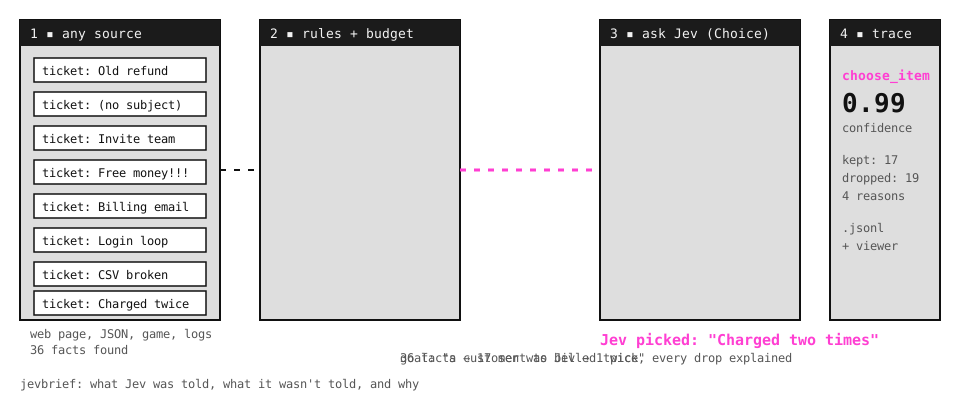
Jev turns state into typed decisions. It does its best work on small, relevant state, and it is weak at raw numbers, dates, and long lists of irrelevant detail. Real sources are the opposite: a web page has hundreds of elements, a failed build prints thousands of log lines, and an incident produces thousands more.
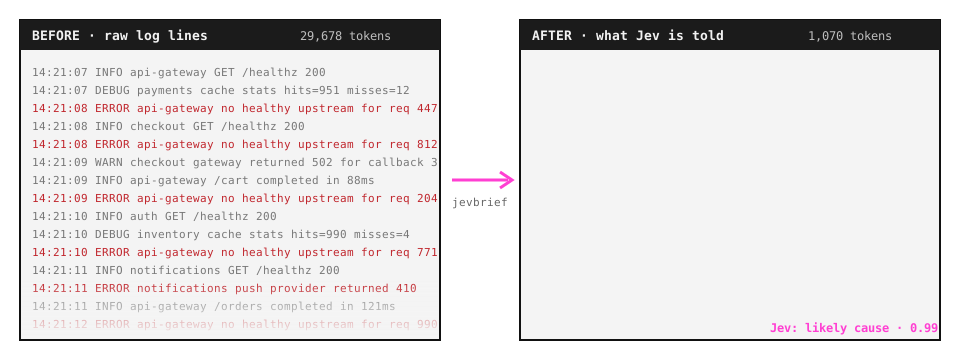
jevbrief sits between your source and Jev. It keeps what matters, drops the rest with a reason for every drop, asks Jev one clear question, and records the whole decision so you can replay it.
| Adapters | Read a source into facts, with numbers and dates already turned into plain words. |
| Rules with reasons | Fixed rules drop the noise. Every dropped fact gets a reason code, so a wrong answer is debuggable. |
| A token budget | 48% to 97% fewer input tokens on our benchmarks, with the same or better accuracy on the main question. |
| One clear question | Question packs ask Jev a narrow judgment and return a typed answer, a confidence, and every option's probability. |
| A trace and a replay | One JSON line per decision, and jevbrief view replays it step by step in one offline HTML file. |
Quick start
pip install jevbrief # json, otel, and ci; add [web] or [nes], or [all] for everything
Get an API key at console.typesafe.ai, and set TYPESAFE_API_KEY in your environment or in a .env file where you run the CLI.
Every adapter uses the same two commands. inspect shows what would be kept and dropped, with no API key and no cost. ask calls Jev, writes a trace, and --view opens the replay.
gh run view <run id> --log-failed > run.log
jevbrief inspect run.log --adapter ci --goal "CI is red on main"
jevbrief ask     run.log --adapter ci --goal "CI is red on main" --view
27 log lines -> 7 failures -> 3 sent to Jev
likely cause: Run pytest -q: E KeyError: 'currency_code'   (confidence 0.84)
looks flaky: no (0.07)
Run jevbrief adapters to list what is installed. Each adapter's page below has its own quick start.
Adapters
| Adapter | Reads | Jev answers | Install |
|---|---|---|---|
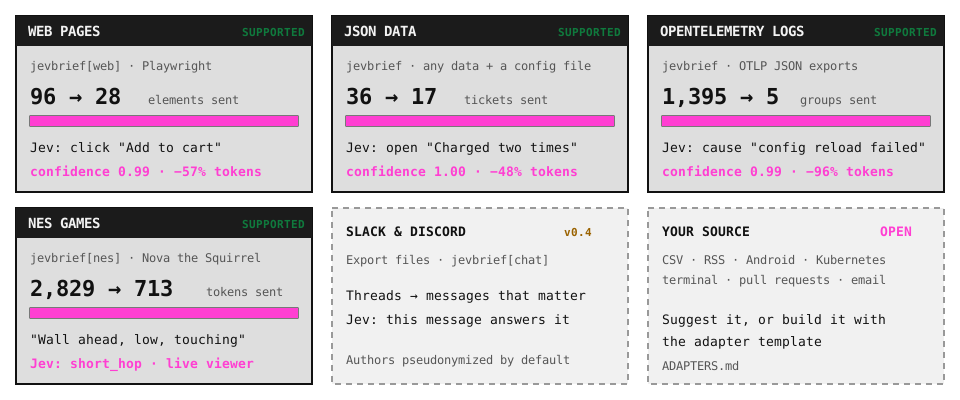
| ci | GitHub Actions logs and JUnit XML | Which error broke the build, and whether it looks flaky | jevbrief |
| otel | OpenTelemetry logs (OTLP JSON) | Which log group explains an incident | jevbrief |
| json | JSON and JSON Lines, with a config file | Which item fits, or which action to take | jevbrief |
| web | Web pages, through Playwright | Which element to click next | jevbrief[web] |
| nes | An NES game's memory (Nova the Squirrel) | Which move to make next | jevbrief[nes] |
| chat | Slack and Discord exports | Which message answers a question | Planned for v0.4 |
| Yours | Suggest it or build it |
Watch Jev play a game

Every frame is a real Jev decision. The nes adapter reads the game's memory, turns it into a few facts in words (Wall ahead, low (one block), touching), and asks Jev for one move. Play it yourself with python examples/nes_live.py --rom nova.nes --headed. The nes page covers getting the free game, the options, and adding another game.
Use it in Python
Every adapter works the same way: create a Briefing, extract, decide.
from jevbrief import Briefing
from jevbrief.adapters.ci import CiAdapter

brief = Briefing(CiAdapter(), goal="CI is red on main", trace="traces/ci.jsonl")
brief.extract(["logs.zip", "reports/junit.xml"])
decision = brief.decide()
if decision.fact:
    print("likely cause:", decision.fact.label, decision.fact.attrs)
Every decision comes back in the same shape:
decision.outcome |
Meaning | Your code should |
|---|---|---|
applied |
Jev answered at or above min_confidence (default 0.5) |
Act on decision.choice, and on decision.fact when the options are facts |
reused |
The facts did not change, so the last answer was reused with no API call | Act, but stop if nothing changes |
low_confidence |
Below min_confidence, or Jev chose "none" |
Take no action |
error |
The API call failed | Take no action |
Extra questions in the same call, such as ci's flaky, are in decision.answers.
Web shortcut for Playwright agents
from jevbrief import Brief

brief = Brief(goal="add this item to the cart", trace="traces/agent.jsonl")
await brief.from_page(page)                 # or brief.from_page_sync(page)
decision = brief.next_click()
if decision.fact:
    await page.locator(decision.fact.selector).click()
More in examples/: one script per adapter.
See every decision
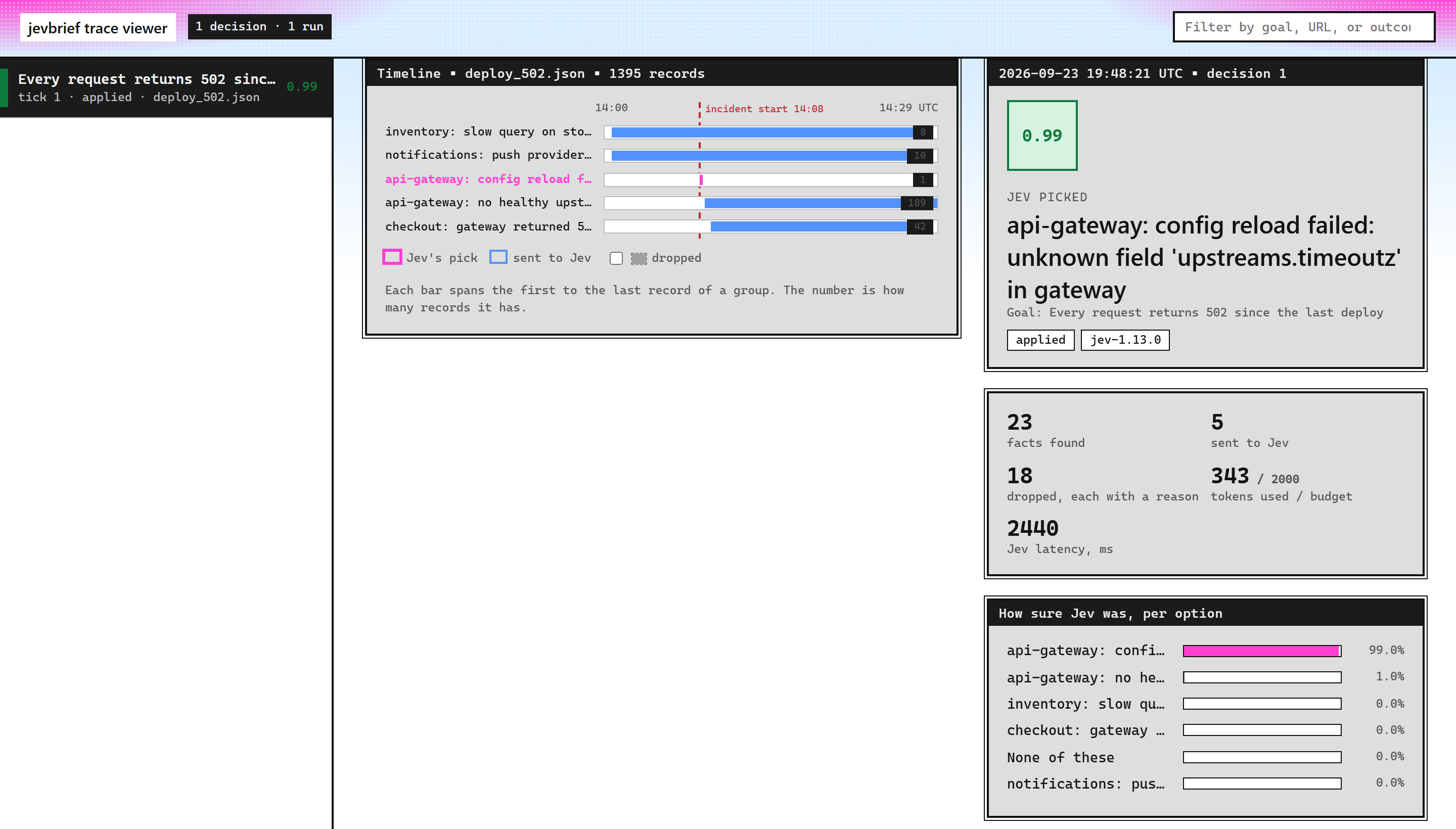
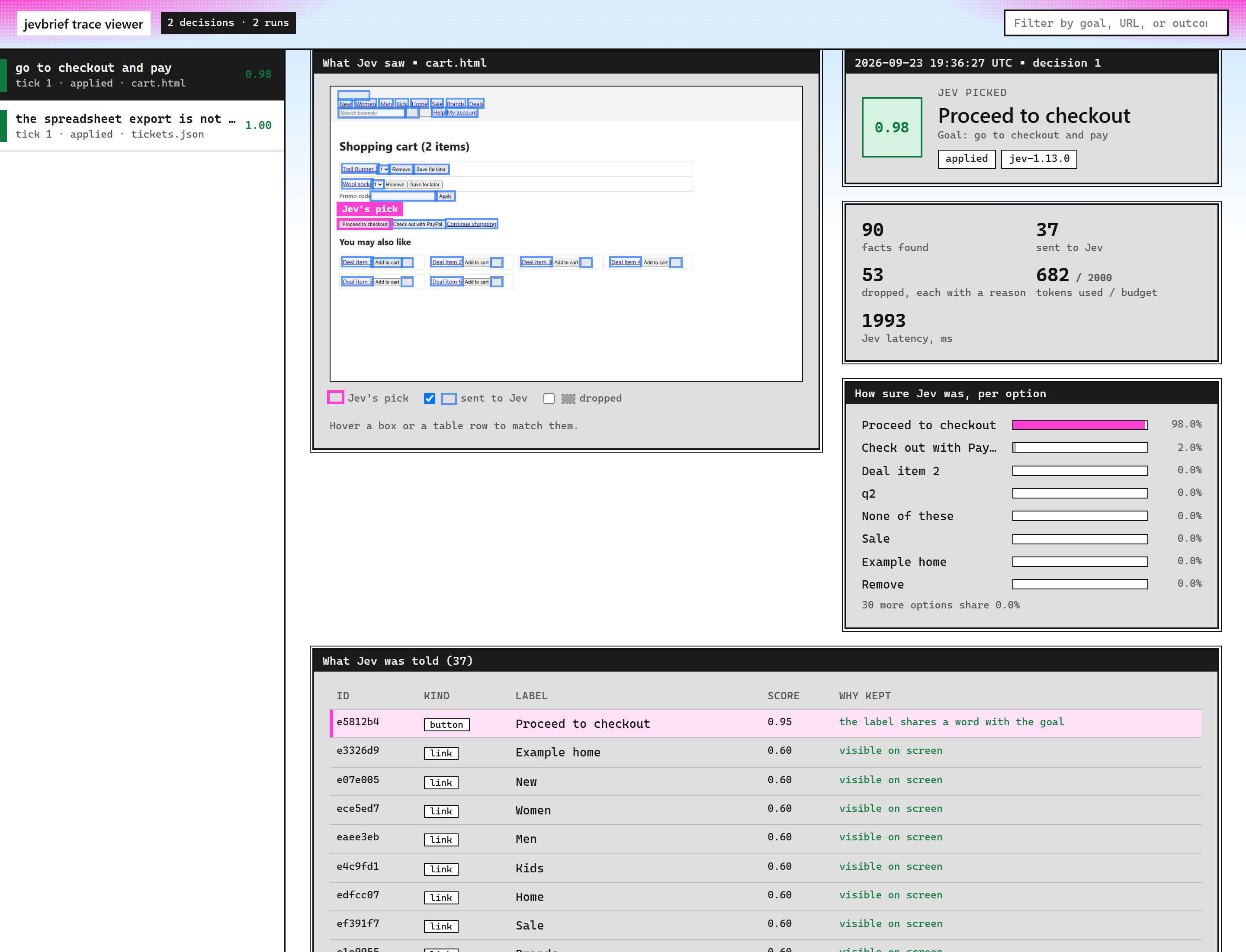
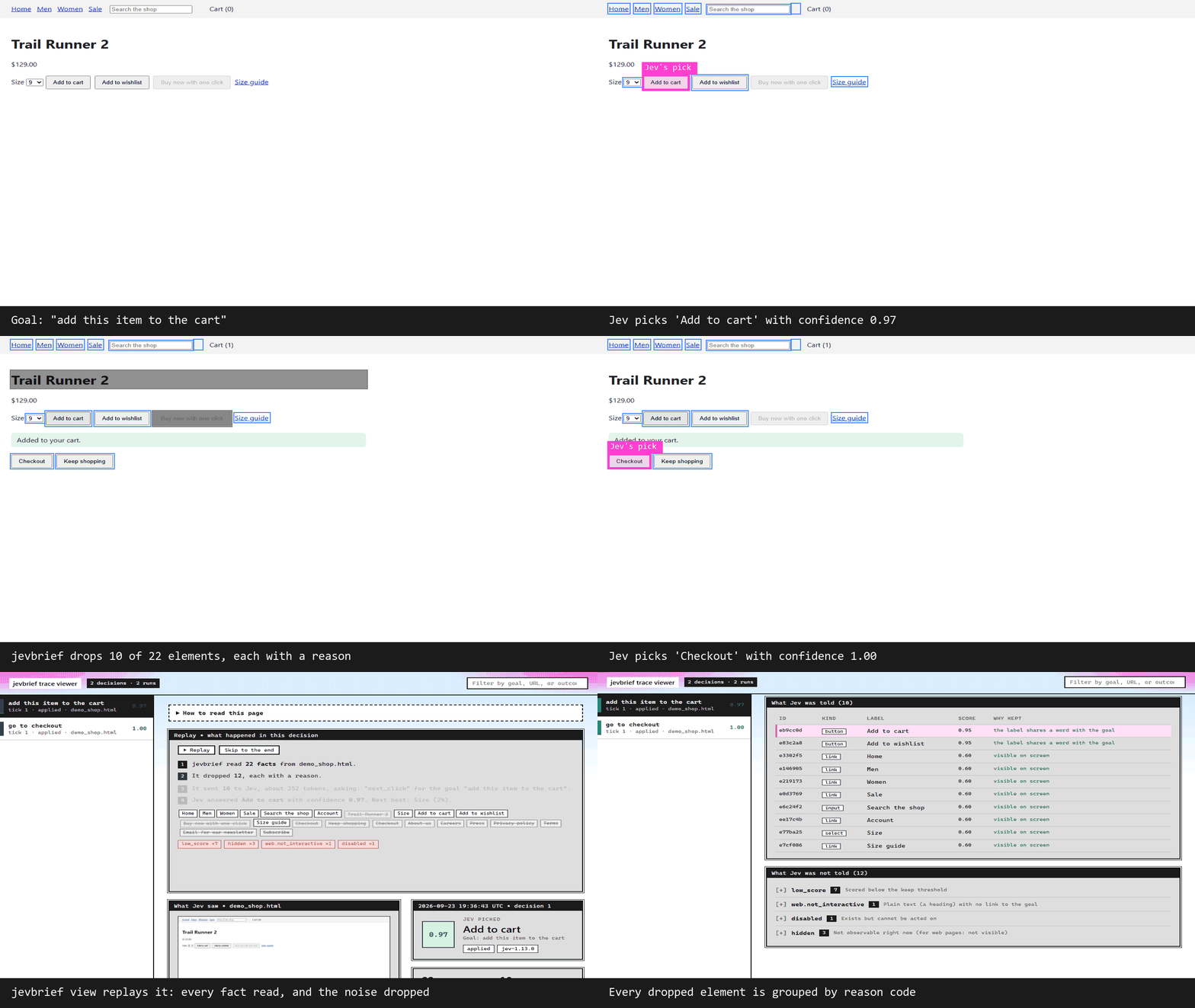
jevbrief ask ... --view opens the viewer after a run, and jevbrief view opens the newest trace. Each decision starts with an animated replay: every fact read, the dropped ones struck out with their reason, the ones sent to Jev, Jev's answer, and a plain-English summary of what it means.
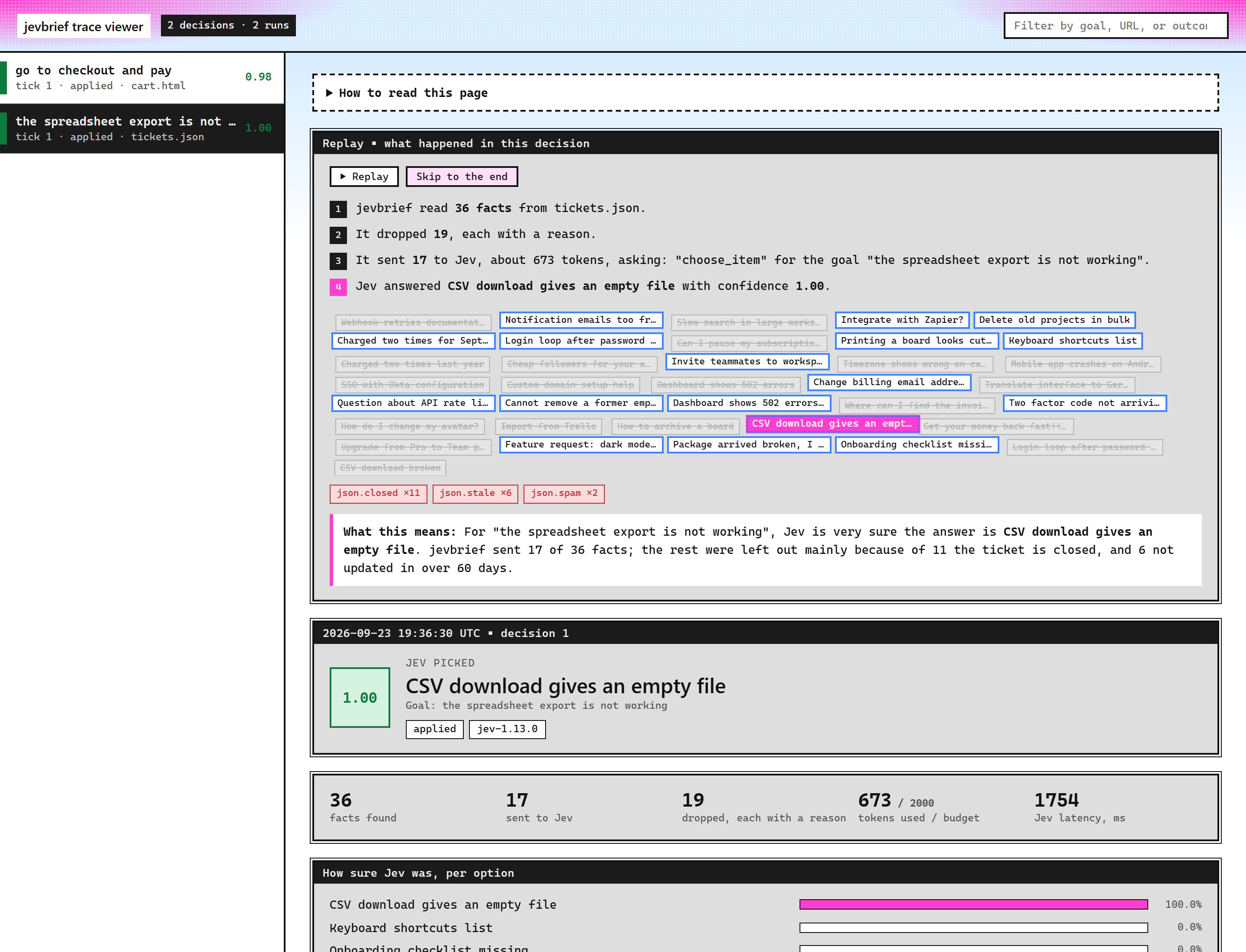
Each adapter picks the view that fits its source:
| View | Used by | Shows |
|---|---|---|
| Table | json, ci | Every fact with its score and reason |
| Timeline | otel | One bar per log group, with the incident start marked |
| Snapshot | web | The page with Jev's pick outlined |
| Live | nes | Decisions as they are written, next to the running game (jevbrief view --live) |
The viewer is a single HTML file with the trace and images embedded. It needs no server and no network, so it can be attached to a bug report.
Screenshots: timeline, snapshot, and a browser agent
How it works
| Step | What happens |
|---|---|
| 1. Extract | The adapter reads the source into facts. Each fact has a kind, a label, attrs sent to Jev, and meta kept private. Numbers, counts, and dates become words here. |
| 2. Rules | A RuleSet scores each fact and drops noise. Core rules are shared, adapters add their own, and you can remove, add, or reorder rules without forking. |
| 3. Budget | Kept facts are sorted by score and cut to a token budget (default 2,000) and an option cap (default 60). |
| 4. Fingerprint | If the kept facts have not changed, the previous answer is reused and Jev is not called. |
| 5. Ask Jev | A question pack builds one or more questions (Choice, Noul, or Score) in a single call. Options are either the facts or a fixed set of actions. |
| 6. Trace | One JSON line per decision, with a legend of every reason code used. Images are stored next to the trace. |
Reason codes
Core codes are shared by every adapter. Adapter codes are namespaced as <adapter>.<code>, such as ci.after_failure or otel.healthcheck, and listed on each adapter's page.
| Code | Meaning |
|---|---|
hidden |
Not observable right now |
disabled |
Exists but cannot be acted on |
unlabeled |
No usable label, so Jev could not tell what it is |
duplicate |
Same kind and label as a higher-scored fact |
low_score |
Scored below the keep threshold |
budget |
Would have been kept, cut only to fit the token or option budget |
Force-keep facts with pins=["<fact id>"]. Fact IDs are stable across decisions.
Benchmarks
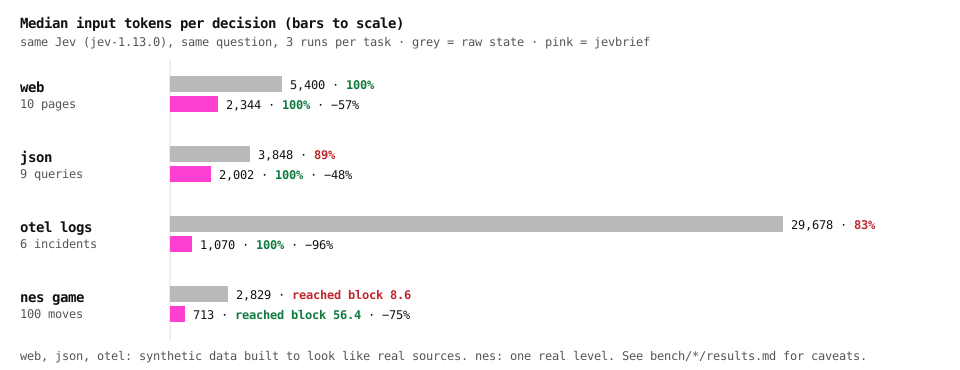
| Adapter | Data | Tasks | Raw accuracy | jevbrief accuracy | Raw tokens | jevbrief tokens |
|---|---|---|---|---|---|---|
| ci | Real | 16 failed GitHub Actions runs | 88% | 100% | 30,502 | 988 (−97%) |
| otel | Synthetic | 6 incidents | 83% | 100% | 29,678 | 1,070 (−96%) |
| json | Synthetic | 9 queries | 89% | 100% | 3,848 | 2,002 (−48%) |
| web | Synthetic | 10 pages | 100% | 100% | 5,400 | 2,344 (−57%) |
| nes | Real game | 100 moves on level 1-1 | block 8.6 | block 56.4 | 2,829 | 713 (−75%) |
- Same setup for both arms: the same Jev (
jev-1.13.0) and the same question, with three runs per task and median input tokens. The raw arm sends what a naive integration would send: every element, every record, or the most recent log lines. - ci's flaky question: here jevbrief scored lower, 67% against 93%. The raw arm answered "flaky" every time, and 13 of the 16 labels are flaky.
- Synthetic sets: some rules were designed while building them, so treat those numbers as illustrations.
Each adapter name links to its full results and caveats. Reproduce them with jevbrief bench.
Contributing
| To | Do this |
|---|---|
| Suggest a source | Open an adapter request. Upvote the ones you want; the most requested are built first. |
| Build an adapter | Copy contrib/adapter_template, follow ADAPTERS.md, and pass check_adapter(MyAdapter(), "sample.json", goal="..."). Ship it here in a pull request, or as your own package with a jevbrief.adapters entry point. |
| Report a wrong decision | Open a bug report and attach the trace. |
| Ask a question or share an idea | Start a discussion. |
An adapter is one class with extract, rules, packs, and optionally state. Adding one never changes the core, and removing one never breaks anything. Working with a coding agent? Copy skills/jevbrief/SKILL.md into its skills folder (for Claude Code, .claude/skills/jevbrief/SKILL.md).
git clone https://github.com/parthkomalwad/jevbrief && cd jevbrief
python -m venv .venv && . .venv/bin/activate    # Windows: .venv\Scripts\activate
pip install -e ".[dev]" && playwright install chromium
pytest -q
Privacy
- API key: read from the environment or
.env, and never printed, logged, or written to a trace. - What adapters send:
- The web adapter never sends form values.
- The json adapter sends only the configured fields and buckets.
- The otel and ci adapters send message templates, with IDs, emails, and addresses replaced.
- Traces: they contain labels, source names, and, for web pages, a screenshot. Treat them like logs, and use
--no-screenshotfor private pages.
License
MIT. Community project, not affiliated with TypeSafe AI.
1 maintainer

Release files for jevbrief 0.3.0
For a detailed explanation of source distributions (sdists) and built distributions (wheels), please see the package formats documentation.
Source distribution (sdist)
| File | Size | Uploaded | |
|---|---|---|---|
| jevbrief-0.3.0.tar.gz | 78.2 kB | Details |
Built distribution (wheel)
| File | Interpreter | ABI | Platform | Reset |
|---|---|---|---|---|
| jevbrief-0.3.0-py3-none-any.whl | Python 3 | none | any | Details |
Total release size: 147.4 kB
Release files / jevbrief-0.3.0.tar.gz
| Download URL | jevbrief-0.3.0.tar.gz |
|---|---|
| Size | 78.2 kB |
| Tags | Source |
|
SHA-256 checksum How to use checksums |
62ade578d08fbd9e0657632c6a49900162e258ea4c67bdcb604d41895bec4436
|
|
BLAKE2b-256 checksum How to use checksums |
84c3661578d341b3a3cc64b13e8b9a1b14968339b4c0536ea8f1ad158fc6437e
|
| Upload date | |
|
Uploaded using Trusted Publishing? What is trusted publishing? |
No |
| Uploaded via |
twine/7.0.0 CPython/3.14.7
|
Release files / jevbrief-0.3.0-py3-none-any.whl
| Download URL | jevbrief-0.3.0-py3-none-any.whl |
|---|---|
| Size | 69.1 kB |
| Tags | Python 3 |
|
SHA-256 checksum How to use checksums |
3efb8662d26ca9b39582d0d7c9f94b868bdea943c860bc279015b70fec6a05ae
|
|
BLAKE2b-256 checksum How to use checksums |
7dc7bbdb955db74c9cd2e3b812b883d3ea7203b04a827a0ee53f68b2c9bd3b4f
|
| Upload date | |
|
Uploaded using Trusted Publishing? What is trusted publishing? |
No |
| Uploaded via |
twine/7.0.0 CPython/3.14.7
|














