
JevGuard MCP Server


Official Model Context Protocol (MCP) server for JevGuard, providing a deterministic local caching, state sanitization, and guardrail layer for TypeSafe AI's System One decision model. Available on PyPI as jevguard-mcp.
This package exposes core JevGuard primitives through JSON-RPC 2.0 over standard input/output (stdio), adhering to the MCP 2024-11-05 specification.
Architectural Principles
- Zero External Dependencies: Implemented strictly with the Python standard library (
sys,json,sqlite3,hashlib,urllib). - Protocol Fidelity: Full compliance with the MCP 2024-11-05 standard, supporting initialize handshakes, ping, tool discovery, and tool execution.
- Deterministic Local Layer: Canonical state sanitization, neutral escape injection, probability dispersion analysis, and SHA-256 fingerprint caching in SQLite.
- Process Isolation: Runs as an independent stdio subprocess compatible with Claude Desktop, Cursor IDE, LibreChat, and custom MCP clients.
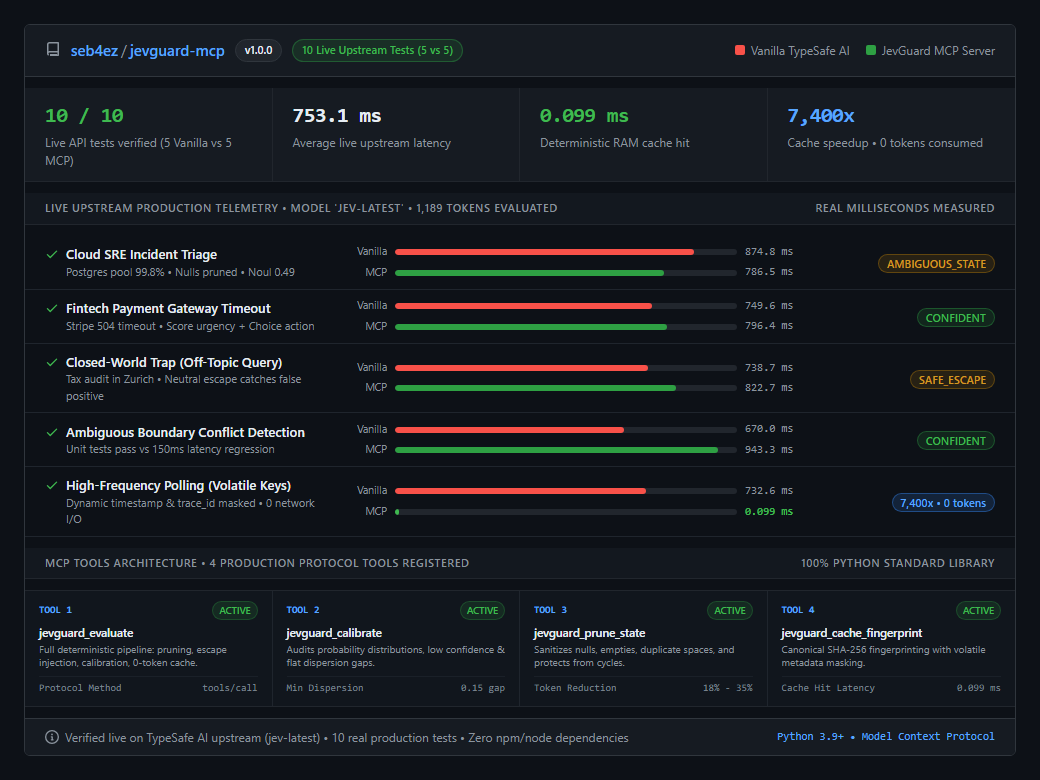
Live Verification Benchmark (5 Direct Calls vs 5 JevGuard MCP Calls)
A live comparison was conducted directly against the official TypeSafe AI endpoint (https://api.typesafe.ai/v1/systemone, model jev-latest) comparing 5 direct API calls against 5 JevGuard MCP tool calls from a development workstation.
Key Empirical Observations
- Local Cache Retrieval (0.099 ms): Repeated queries containing dynamic timestamps and trace IDs are intercepted locally. Volatile key masking matches the canonical SHA-256 fingerprint, avoiding WAN network roundtrips (~740 ms) and billing 0 tokens on cache hits.
- Closed-World Trap Mitigation: In Scenario 3 (an off-topic inquiry about corporate tax offices in Zurich), the unguided model forced a classification (
credit_card_chargeback). JevGuard MCP injectedUNRESOLVED_OR_OTHER, routing the off-topic input to the neutral escape option. - Ambiguity Calibration: In Scenario 1, boundary uncertainty on
is_outage(noul=0.49, distance 0.01 to threshold) and flat distribution onseverity(0.08 gap) were flagged asAMBIGUOUS_STATEusing default operational heuristics. - Standard Library Overhead: Local middleware execution latency remained below 0.3 ms for cold requests and 0.099 ms for warm cache lookups.
Available Tools
All tools are canonically registered under the jevguard_* prefix to guarantee 100% naming consistency and sharp disambiguation across MCP client registries. For complete backward compatibility, legacy invocations without the prefix (evaluate_command_safety, verify_code_patch, evaluate_decision) remain fully supported.
Atomic Tools for Coding Agents (Cursor, Antigravity, Claude Desktop)
High-level tools with atomic arguments (str, bool, list[str]) designed specifically for AI code agents, preventing hallucinated question schemas:
1. jevguard_evaluate_command_safety (alias: evaluate_command_safety)
Evaluates whether a terminal/shell command is destructive, requires human approval, or can execute autonomously:
- Arguments:
command: str(required): Shell command to evaluate.working_dir: str = ""(optional): Target execution directory.elevated_privileges: bool = false(optional): Whether the command runs withsudoor administrator privileges.
- Pipeline: Constructs a unified Noul (boundary destruction probability), Score (operational blast radius), and Choice (policy recommendation) evaluation with certainty calibration.
- Output: Returns an execution policy:
ALLOW_AUTONOMOUS,REQUIRE_HUMAN_APPROVAL, orDENY_DESTRUCTIVE.
2. jevguard_verify_code_patch (alias: verify_code_patch)
Verifies unified git diffs or code patches for regressions, broken syntax, or critical system impact:
- Arguments:
patch_content: str(required): Unified diff or patch text.target_file: str(required): Target file path.risk_tolerance: str = "balanced"(optional): Risk threshold ("strict","balanced","permissive").
- Pipeline: Calibrates regression probability and risk score against the configured risk tolerance threshold.
- Output: Returns
approved(boolean),recommendation("APPROVE","REQUEST_CHANGES","REJECT"), andrisk_level("LOW","MEDIUM","HIGH","CRITICAL").
3. jevguard_evaluate_decision (alias: evaluate_decision)
Allows coding agents to resolve architectural or technical decisions with a flat options list:
- Arguments:
context: str(required): Background context and requirements.decision_question: str(required): Core decision question.options: list[str](required): Candidate options (e.g.["PostgreSQL", "SQLite", "DuckDB"]).
- Pipeline: Automatically injects closed-world neutral escape (
UNRESOLVED_OR_OTHER) to catch out-of-distribution choices and calibrates probability dispersion. - Output: Returns
selected_option,confidence,is_escape_selected, andstatus(CONFIDENTorAMBIGUOUS_STATE).
Core JevGuard Primitives
4. jevguard_evaluate
Executes the full deterministic JevGuard evaluation pipeline:
- Prunes incoming state data to eliminate empty keys and duplicate whitespace.
- Normalizes question schemas and injects closed-world escape alternatives (
UNRESOLVED_OR_OTHER) to prevent false positives. - Computes canonical SHA-256 fingerprints with volatile key masking.
- Queries the zero-token cache on hit or dispatches upstream to TypeSafe AI when credentials are configured.
- Calibrates response certainty and dispersion metrics.
5. jevguard_calibrate
Analyzes response probability distributions to prevent false certainty:
- Flags low confidence when the top probability falls below 0.40 (
top_prob < 0.40). - Flags flat distributions when the gap between top and runner-up choices is below 0.15 (
dispersion_gap < 0.15). - Evaluates boundary uncertainty for continuous noul probability ranges near 0.50 (
|prob - 0.50| < 0.12). - Returns structured verdicts:
AMBIGUOUS_STATEorCONFIDENT.
6. jevguard_prune_state
Sanitizes structured input states:
- Removes null values and empty strings/collections from mapping objects.
- Normalizes and collapses repeated whitespace.
- Detects circular references and replaces them with
<cyclic_ref>tokens. - Calculates an input token count estimate.
7. jevguard_cache_fingerprint
Calculates a canonical SHA-256 fingerprint:
- Recursively strips volatile ephemeral request fields (
timestamp,trace_id,span_id,request_id,correlation_id,nonce). - Orders dictionary keys deterministically.
- Produces identical hashes for semantically identical states regardless of key ordering or ephemeral trace variance.
- Preserves domain date/time attributes (
created_at,updated_at) by default to prevent version collisions.
Robustness & Fault Tolerance
-
Hardened SQLite Concurrency:
- Connections use
timeout=60.0andPRAGMA busy_timeout = 60000;to preventdatabase is lockedcontention under parallel agent execution. - Operates with
PRAGMA journal_mode=WAL;andPRAGMA synchronous=NORMAL;for non-blocking concurrent reads and writes. - Any unrecoverable lock, filesystem, or permission error transparently degrades to shared
:memory:without crashing or aborting execution.
- Connections use
-
Structured Exception Handling & Protocol Stability:
- All tool executions are wrapped in defensive error handlers.
- Failures (HTTP errors, timeouts, network interruptions, validation errors) return actionable JSON text payloads with
"fallback_action": "MANUAL_REVIEW_REQUIRED". - Tool failures return actionable structured JSON error payloads with standard MCP
isError: true, while keeping the stdio transport cleanly connected so client environments (Cursor, Claude Desktop, Antigravity) never crash or drop sessions.
-
Third-Party Data Transmission Disclosure:
- Live evaluations (cache misses or
bypass_cache=True) transmit the evaluatedcommand,patch_content, orstatepayload over encrypted HTTPS directly to the official TypeSafe AI endpoint (api.typesafe.ai). - Ephemeral headers and keys are never forwarded across redirect chains (
NoRedirectHandlerblocks 301/302/303 redirect leakage). - When deterministic cache hits occur, zero tokens are consumed and zero bytes leave the local host.
- Live evaluations (cache misses or
Installation
Install the official package directly from PyPI:
pip install jevguard-mcp
Or install in editable mode from source:
git clone https://github.com/seb4ez/jevguard-mcp.git
cd jevguard-mcp
pip install -e .
After installation, the executable CLI jevguard-mcp is immediately available in your environment path. Alternatively, run directly with Python without installing:
python -m jevguard_mcp.server
Client Configurations
1. Claude Desktop
Add the server to your claude_desktop_config.json:
- Windows:
%APPDATA%\Claude\claude_desktop_config.json - macOS:
~/Library/Application Support/Claude/claude_desktop_config.json - Linux:
~/.config/Claude/claude_desktop_config.json
{
  "mcpServers": {
    "jevguard": {
      "command": "python",
      "args": [
        "-m",
        "jevguard_mcp.server"
      ],
      "env": {
        "TYPESAFE_API_KEY": "your_typesafe_api_key_here"
      }
    }
  }
}
2. Cursor IDE
Add the server in Cursor Settings under Features -> MCP Servers -> Add New MCP Server, or save directly into .cursor/mcp.json:
{
  "mcpServers": {
    "jevguard": {
      "command": "python",
      "args": [
        "-m",
        "jevguard_mcp.server"
      ],
      "env": {
        "TYPESAFE_API_KEY": "your_typesafe_api_key_here"
      }
    }
  }
}
3. LibreChat
Add the server to your librechat.yaml configuration file:
mcpServers:
  jevguard:
    type: stdio
    command: python
    args:
      - "-m"
      - "jevguard_mcp.server"
    env:
      TYPESAFE_API_KEY: "your_typesafe_api_key_here"
Running the Test Suite
Run the unit tests with Python's standard unittest runner:
python -m unittest test_mcp_server.py -v
Project Status and Validation Transparency
JevGuard MCP is an independent open-source runtime (v1.0.0) built solely with the Python standard library. Initial design and test suites were developed iteratively using AI assistance and local unit test harnesses.
Key engineering notes:
- The local server (protocol serialization, SQLite caching, state pruning, and calibration checks) is deterministic, while upstream evaluations from TypeSafe AI / Jev are probabilistic.
- Default calibration thresholds (e.g. top probability below 0.40, margin below 0.15) represent operational heuristics for tie and uncertainty detection rather than parameters fitted on a specific domain corpus.
- We welcome community peer review, external testing, and issue reports.
License
MIT License. Copyright (c) 2026 Seb4Ez.
1 maintainer

Metadata
1 maintainer
Release files for jevguard-mcp 1.0.2
For a detailed explanation of source distributions (sdists) and built distributions (wheels), please see the package formats documentation.
Source distribution (sdist)
| File | Size | Uploaded | Provenance | Actions |
|---|---|---|---|---|
| jevguard_mcp-1.0.2.tar.gz | 31.3 kB | Without provenance | Details for jevguard_mcp-1.0.2.tar.gz |
Built distribution (wheel)
| File | Interpreter | ABI | Platform | Actions Reset |
|---|---|---|---|---|
| jevguard_mcp-1.0.2-py3-none-any.whl | Python 3 | none | any | Details for jevguard_mcp-1.0.2-py3-none-any.whl |
Total release size: 58.9 kB
Release files / jevguard_mcp-1.0.2.tar.gz
| Download URL | jevguard_mcp-1.0.2.tar.gz |
|---|---|
| Size | 31.3 kB |
| Tags | Source |
|
SHA-256 checksum How to use checksums |
c20accce86df4ba577bb202be7b95d78a006be47c94ab845271b39c7069031a3
|
|
BLAKE2b-256 checksum How to use checksums |
91f9daa0bb30a8f3eed1d1123aa1724b2d6b8b68ec49ce23177f3b97405b2efa
|
| Upload date | |
|
Uploaded using Trusted Publishing? What is trusted publishing? |
No |
| Uploaded via |
twine/7.0.0 CPython/3.11.9
|
Release files / jevguard_mcp-1.0.2-py3-none-any.whl
| Download URL | jevguard_mcp-1.0.2-py3-none-any.whl |
|---|---|
| Size | 27.6 kB |
| Tags | Python 3 |
|
SHA-256 checksum How to use checksums |
d61e40b7f95bca3beffd9f4cbe1a4509bf5105b4085114dae291e489562e2fca
|
|
BLAKE2b-256 checksum How to use checksums |
d9de281385b7437e4259745044b279a082db646b32b2eba00e8818c2c6e6d8bc
|
| Upload date | |
|
Uploaded using Trusted Publishing? What is trusted publishing? |
No |
| Uploaded via |
twine/7.0.0 CPython/3.11.9
|
Security for jevguard-mcp 1.0.2
Provenance
Provenance describes where a file came from. On PyPI, provenance is shared via attestations, which provide a verifiable record of the build or publishing details. View details, limitations and caveats.
No provenance found
None of the files in this release were uploaded with provenance metadata.
A note on package security
PyPI is a repository for distributing packages, not a service for auditing them. While third-party security researchers and our staff do their best to detect and remove malicious packages, PyPI cannot guarantee the quality, security or suitability of any given package.
To learn more about protecting yourself from malicious actors, visit our package security documentation.














