
JevGuard MCP Server


Official Model Context Protocol (MCP) server for JevGuard, providing a deterministic local caching, state sanitization, and guardrail layer for TypeSafe AI's System One decision model. Available on PyPI as jevguard-mcp.
This package exposes core JevGuard primitives through JSON-RPC 2.0 over standard input/output (stdio), adhering to the MCP 2024-11-05 specification.
Architectural Principles
- Zero External Dependencies: Implemented strictly with the Python standard library (
sys,json,sqlite3,hashlib,urllib). - Protocol Fidelity: Full compliance with the MCP 2024-11-05 standard, supporting initialize handshakes, ping, tool discovery, and tool execution.
- Deterministic Local Layer: Canonical state sanitization, neutral escape injection, probability dispersion analysis, and SHA-256 fingerprint caching in SQLite.
- Process Isolation: Runs as an independent stdio subprocess compatible with Claude Desktop, Cursor IDE, LibreChat, and custom MCP clients.
Live Verification Benchmark (5 Direct Calls vs 5 JevGuard MCP Calls)
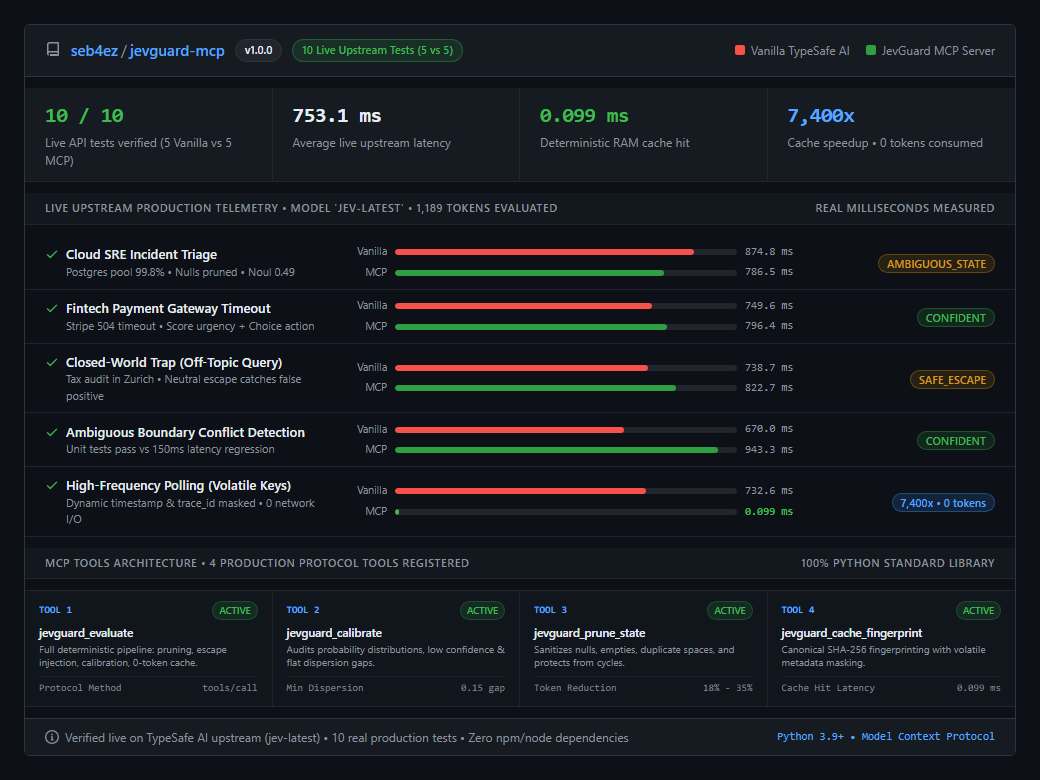
A live comparison was conducted directly against the official TypeSafe AI endpoint (https://api.typesafe.ai/v1/systemone, model jev-latest) comparing 5 direct API calls against 5 JevGuard MCP tool calls from a development workstation.
Key Empirical Observations
- Local Cache Retrieval (0.099 ms): Repeated queries containing dynamic timestamps and trace IDs are intercepted locally. Volatile key masking matches the canonical SHA-256 fingerprint, avoiding WAN network roundtrips (~740 ms) and billing 0 tokens on cache hits.
- Closed-World Trap Mitigation: In Scenario 3 (an off-topic inquiry about corporate tax offices in Zurich), the unguided model forced a classification (
credit_card_chargeback). JevGuard MCP injectedUNRESOLVED_OR_OTHER, routing the off-topic input to the neutral escape option. - Ambiguity Calibration: In Scenario 1, boundary uncertainty on
is_outage(noul=0.49, distance 0.01 to threshold) and flat distribution onseverity(0.08 gap) were flagged asAMBIGUOUS_STATEusing default operational heuristics. - Standard Library Overhead: Local middleware execution latency remained below 0.3 ms for cold requests and 0.099 ms for warm cache lookups.
Available Tools
Atomic Tools for Coding Agents (Cursor, Antigravity, Claude Desktop)
High-level tools with atomic arguments (str, bool, list[str]) designed specifically for AI code agents, preventing hallucinated question schemas:
1. evaluate_command_safety
Evaluates whether a terminal/shell command is destructive, requires human approval, or can execute autonomously:
- Arguments:
command: str(required): Shell command to evaluate.working_dir: str = ""(optional): Target execution directory.elevated_privileges: bool = false(optional): Whether the command runs withsudoor administrator privileges.
- Pipeline: Constructs a unified Noul (boundary destruction probability), Score (operational blast radius), and Choice (policy recommendation) evaluation with certainty calibration.
- Output: Returns an execution policy:
ALLOW_AUTONOMOUS,REQUIRE_HUMAN_APPROVAL, orDENY_DESTRUCTIVE.
2. verify_code_patch
Verifies unified git diffs or code patches for regressions, broken syntax, or critical system impact:
- Arguments:
patch_content: str(required): Unified diff or patch text.target_file: str(required): Target file path.risk_tolerance: str = "balanced"(optional): Risk threshold ("strict","balanced","permissive").
- Pipeline: Calibrates regression probability and risk score against the configured risk tolerance threshold.
- Output: Returns
approved(boolean),recommendation("APPROVE","REQUEST_CHANGES","REJECT"), andrisk_level("LOW","MEDIUM","HIGH","CRITICAL").
3. evaluate_decision
Allows coding agents to resolve architectural or technical decisions with a flat options list:
- Arguments:
context: str(required): Background context and requirements.decision_question: str(required): Core decision question.options: list[str](required): Candidate options (e.g.["PostgreSQL", "SQLite", "DuckDB"]).
- Pipeline: Automatically injects closed-world neutral escape (
UNRESOLVED_OR_OTHER) to catch out-of-distribution choices and calibrates probability dispersion. - Output: Returns
selected_option,confidence,is_escape_selected, andstatus(CONFIDENTorAMBIGUOUS_STATE).
Core JevGuard Primitives
4. jevguard_evaluate
Executes the full deterministic JevGuard evaluation pipeline:
- Prunes incoming state data to eliminate empty keys and duplicate whitespace.
- Normalizes question schemas and injects closed-world escape alternatives (
UNRESOLVED_OR_OTHER) to prevent false positives. - Computes canonical SHA-256 fingerprints with volatile key masking.
- Queries the zero-token cache on hit or dispatches upstream to TypeSafe AI when credentials are configured.
- Calibrates response certainty and dispersion metrics.
5. jevguard_calibrate
Analyzes response probability distributions to prevent false certainty:
- Flags low confidence when the top probability falls below 0.40 (
top_prob < 0.40). - Flags flat distributions when the gap between top and runner-up choices is below 0.15 (
dispersion_gap < 0.15). - Evaluates boundary uncertainty for continuous noul probability ranges near 0.50 (
|prob - 0.50| < 0.12). - Returns structured verdicts:
AMBIGUOUS_STATEorCONFIDENT.
6. jevguard_prune_state
Sanitizes structured input states:
- Removes null values and empty strings/collections from mapping objects.
- Normalizes and collapses repeated whitespace.
- Detects circular references and replaces them with
<cyclic_ref>tokens. - Calculates an input token count estimate.
7. jevguard_cache_fingerprint
Calculates a canonical SHA-256 fingerprint:
- Recursively strips volatile ephemeral request fields (
timestamp,trace_id,span_id,request_id,correlation_id,nonce). - Orders dictionary keys deterministically.
- Produces identical hashes for semantically identical states regardless of key ordering or ephemeral trace variance.
- Preserves domain date/time attributes (
created_at,updated_at) by default to prevent version collisions.
Robustness & Fault Tolerance
-
Hardened SQLite Concurrency:
- Connections use
timeout=60.0andPRAGMA busy_timeout = 60000;to preventdatabase is lockedcontention under parallel agent execution. - Operates with
PRAGMA journal_mode=WAL;andPRAGMA synchronous=NORMAL;for non-blocking concurrent reads and writes. - Any unrecoverable lock, filesystem, or permission error transparently degrades to shared
:memory:without crashing or aborting execution.
- Connections use
-
Structured Exception Handling & Protocol Stability:
- All tool executions are wrapped in defensive error handlers.
- Failures (HTTP errors, timeouts, network interruptions, validation errors) return actionable JSON text payloads with
"fallback_action": "MANUAL_REVIEW_REQUIRED". - Tool failures return actionable structured JSON error payloads with standard MCP
isError: true, while keeping the stdio transport cleanly connected so client environments (Cursor, Claude Desktop, Antigravity) never crash or drop sessions.
-
Third-Party Data Transmission Disclosure:
- Live evaluations (cache misses or
bypass_cache=True) transmit the evaluatedcommand,patch_content, orstatepayload over encrypted HTTPS directly to the official TypeSafe AI endpoint (api.typesafe.ai). - Ephemeral headers and keys are never forwarded across redirect chains (
NoRedirectHandlerblocks 301/302/303 redirect leakage). - When deterministic cache hits occur, zero tokens are consumed and zero bytes leave the local host.
- Live evaluations (cache misses or
Installation
Install the official package directly from PyPI:
pip install jevguard-mcp
Or install in editable mode from source:
git clone https://github.com/seb4ez/jevguard-mcp.git
cd jevguard-mcp
pip install -e .
After installation, the executable CLI jevguard-mcp is immediately available in your environment path. Alternatively, run directly with Python without installing:
python -m jevguard_mcp.server
Client Configurations
1. Claude Desktop
Add the server to your claude_desktop_config.json:
- Windows:
%APPDATA%\Claude\claude_desktop_config.json - macOS:
~/Library/Application Support/Claude/claude_desktop_config.json - Linux:
~/.config/Claude/claude_desktop_config.json
{
  "mcpServers": {
    "jevguard": {
      "command": "python",
      "args": [
        "-m",
        "jevguard_mcp.server"
      ],
      "env": {
        "TYPESAFE_API_KEY": "your_typesafe_api_key_here"
      }
    }
  }
}
2. Cursor IDE
Add the server in Cursor Settings under Features -> MCP Servers -> Add New MCP Server, or save directly into .cursor/mcp.json:
{
  "mcpServers": {
    "jevguard": {
      "command": "python",
      "args": [
        "-m",
        "jevguard_mcp.server"
      ],
      "env": {
        "TYPESAFE_API_KEY": "your_typesafe_api_key_here"
      }
    }
  }
}
3. LibreChat
Add the server to your librechat.yaml configuration file:
mcpServers:
  jevguard:
    type: stdio
    command: python
    args:
      - "-m"
      - "jevguard_mcp.server"
    env:
      TYPESAFE_API_KEY: "your_typesafe_api_key_here"
Running the Test Suite
Run the unit tests with Python's standard unittest runner:
python -m unittest test_mcp_server.py -v
Project Status and Validation Transparency
JevGuard MCP is an independent open-source runtime (v1.0.0) built solely with the Python standard library. Initial design and test suites were developed iteratively using AI assistance and local unit test harnesses.
Key engineering notes:
- The local server (protocol serialization, SQLite caching, state pruning, and calibration checks) is deterministic, while upstream evaluations from TypeSafe AI / Jev are probabilistic.
- Default calibration thresholds (e.g. top probability below 0.40, margin below 0.15) represent operational heuristics for tie and uncertainty detection rather than parameters fitted on a specific domain corpus.
- We welcome community peer review, external testing, and issue reports.
License
MIT License. Copyright (c) 2026 Seb4Ez.
1 maintainer

Release files for jevguard-mcp 1.0.1
For a detailed explanation of source distributions (sdists) and built distributions (wheels), please see the package formats documentation.
Source distribution (sdist)
| File | Size | Uploaded | |
|---|---|---|---|
| jevguard_mcp-1.0.1.tar.gz | 30.2 kB | Details |
Built distribution (wheel)
| File | Interpreter | ABI | Platform | Reset |
|---|---|---|---|---|
| jevguard_mcp-1.0.1-py3-none-any.whl | Python 3 | none | any | Details |
Total release size: 57.0 kB
Release files / jevguard_mcp-1.0.1.tar.gz
| Download URL | jevguard_mcp-1.0.1.tar.gz |
|---|---|
| Size | 30.2 kB |
| Tags | Source |
|
SHA-256 checksum How to use checksums |
54d6b406e96c9c047b99b3c866f7d2c45ecaf3a2d3004d849df33a707d36ef2c
|
|
BLAKE2b-256 checksum How to use checksums |
f993296bb21808a5601c4b511aad7145112e58a27140936d82807bf1a07e8f01
|
| Upload date | |
|
Uploaded using Trusted Publishing? What is trusted publishing? |
No |
| Uploaded via |
twine/7.0.0 CPython/3.11.9
|
Release files / jevguard_mcp-1.0.1-py3-none-any.whl
| Download URL | jevguard_mcp-1.0.1-py3-none-any.whl |
|---|---|
| Size | 26.8 kB |
| Tags | Python 3 |
|
SHA-256 checksum How to use checksums |
2e6a8418ffd34db14c80672bfaed8eafded269e4655a8dcfee5bd943baf90191
|
|
BLAKE2b-256 checksum How to use checksums |
473c1403cd2bc21e2dc07f2b968e22888b6279823fa829b90b8ea8943a22b5e4
|
| Upload date | |
|
Uploaded using Trusted Publishing? What is trusted publishing? |
No |
| Uploaded via |
twine/7.0.0 CPython/3.11.9
|














