
JupyDeep: Your AI partner in Jupyter

JupyDeep is an AI-native extension for JupyterLab, your always-on intelligent partner powered by Pydantic AI/Agents and beyond.

JupyDeep bridges the gap between large language models and complex, high-performance data analysis workflows. By integrating an intelligent agent engine directly into the Jupyter ecosystem, it transforms your standard workspace into a reactive, collaborative, and AI-assisted environment. Crucially, instead of piping your Jupyter context to external third-party services, JupyDeep is designed to embed AI agents as native citizens within your local Jupyter environment. With it, you can configure diverse agents by simply binding them to specific MCP tools, custom skills, and a wide array of underlying features.
⚠️ Note: JupyDeep is an active proof of concept under rapid development. Because its underlying foundation—including Pydantic AI/Agents—is also evolving quickly, unexpected issues may arise. We appreciate your patience as we lay the groundwork for a mature future.
🔥 News & Highlights
-
[2026-10-08] v0.1.11 Release:
- 🔑 Support authentication tokens for MCP configuration.
- 🏗️ Replace old backends with
pydantic-aiworkspace architecture.
-
[2026-09-28] v0.1.10 Release:
- 🔧 Pin
mcpto< 2and improve chat error handling. - 📝 New doc: How to Customize Agents .
- 🔧 Pin
-
[2026-08-12] v0.1.9 Release:
- 🧠 Introduced flexible Context Window management with live token updates.
- ⚡ Optimized Agent startup performance and responsiveness.
-
[2026-08-07] v0.1.8 Release:
- ⏱️ Introduced CountDownTimer to provide real-time visual feedback during agent startup.
🗺️ Roadmap / Upcoming Features
- Conversation Persistence & Checkpoint Rewind (State management)
- Multimodal Capabilities (Voice, images, and visual reasoning)
- Collaborative AI Workspaces (Multi-user shared sessions)
- Cross-Domain Data Analysis Demos (Bioinformatics, network algorithm, etc.)
- And much more...
Please visit our Documentation for installation, guides, examples, and more.
🚀 Getting Started
Please install it via pip or uv first (here we use uv as an example)
  uv init
  uv add jupyterlab jupydeep "jupyter-mcp-server @ git+https://github.com/yezhenqing/jupyter-mcp-server.git"
Then simply launch JupyterLab as below
uv run jupyter lab --ip=0.0.0.0
After installing JupyDeep for the first time, you'll need to configure a few settings to get the engine running:
- Locate Settings: Open the JupyterLab Settings Editor and search for options prefixed with
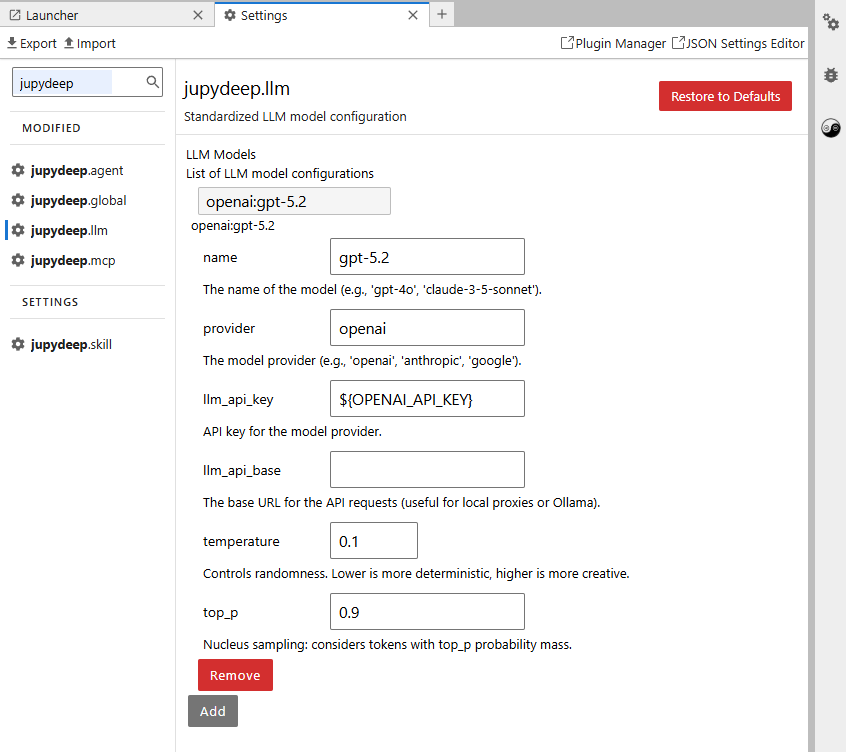
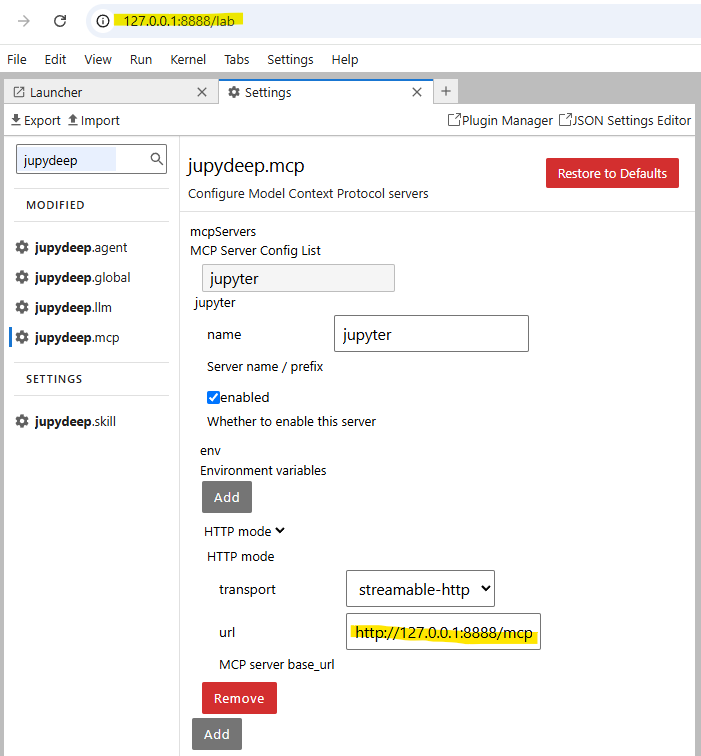
jupydeep. - Configure Your LLM (Required) and MCP (Recommended): The agent engine requires an LLM backend to function. Set up your model provider (e.g., OpenAI) and the Jupyter MCP by following the configurations below:
 |
 |
- Meet Your Built-in Agents: Once your LLM is connected, two default agents will instantly populate your
jupydeep.agentpanel:- 🐵 Wu Kong: Built for heavy-lifting code execution and technical problem-solving.
- 🐴 Monk Tang: Built for high-level tactical planning and orchestration.
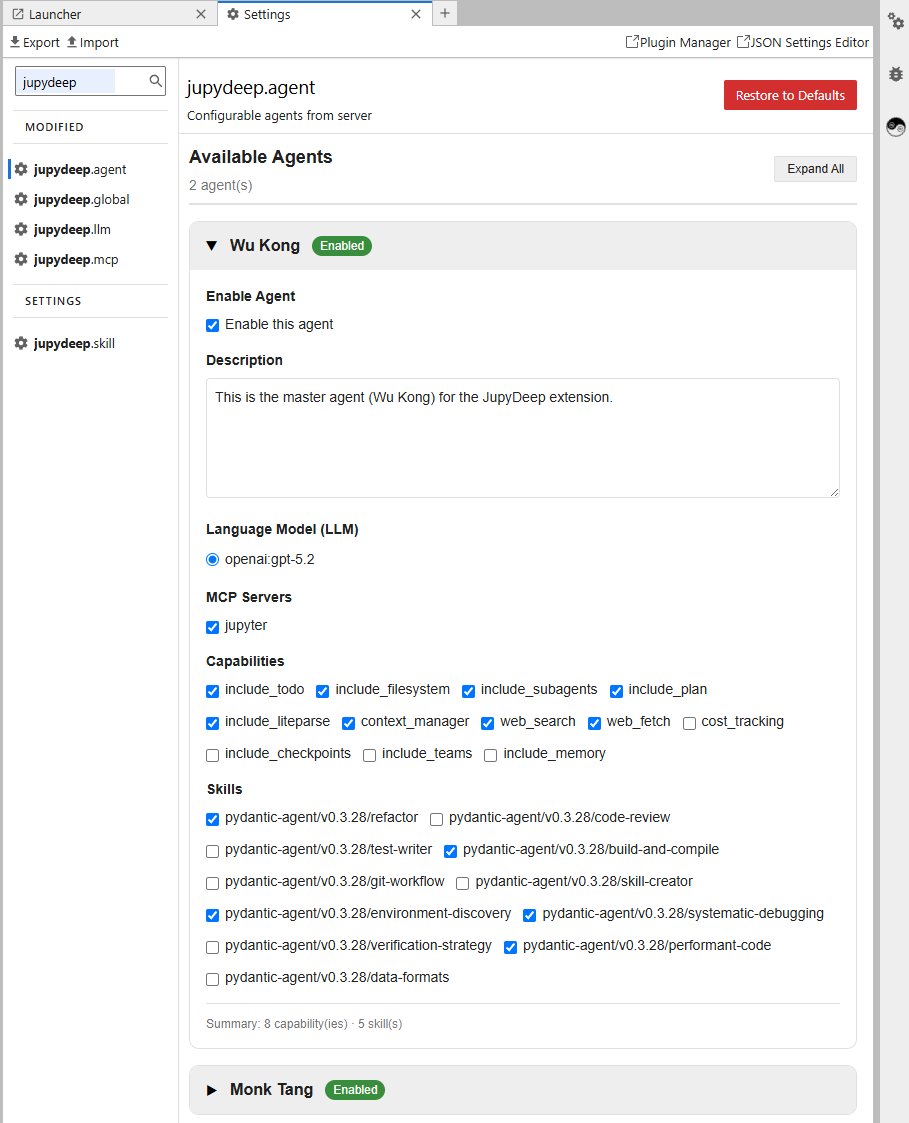
💡 Go Beyond the Defaults: You can easily tweak their skillsets or register your own custom agents in the workspace. Head over to our Documentation for the full customization guide. If the agents aren't visible, try refreshing the page; that might help.
🤝 Contributing
We welcome all forms of contributions—whether it's fixing bugs, improving documentation, or proposing new functionality.
Local Development Setup
JupyDeep consists of a Python backend (hatch / uv) and a TypeScript-based JupyterLab frontend extension (yarn / jlpm). Follow the steps below to set up your local development environment:
Clone the repository:
git clone https://github.com/yezhenqing/jupydeep.git
cd jupydeep
Install dependencies and create a virtual environment:
We highly recommend using uv for fast and robust package and environment management:
uv sync
uv pip install -e .
Since JupyDeep adheres to standard JupyterLab architecture, please refer to the official JupyterLab Extension Examples for detailed frontend compilation (jlpm build, jlpm watch) and source extension link workflows.
✨ Acknowledgments
Open-Source Credits
JupyDeep is built upon exceptional open-source projects, including the Jupyter ecosystem, Pydantic AI/Agents, and jupyter-mcp-server/tools from Datalayer, among others. We extend our deepest gratitude to all the creators and contributors who made this work possible.
AI Disclosure / Development Statement
AI was used primarily as a conversational sounding board for debugging; all core architecture and code logic remain purely human-authored.
1 maintainer

Metadata
1 maintainer
Release files for jupydeep 0.1.11
For a detailed explanation of source distributions (sdists) and built distributions (wheels), please see the package formats documentation.
Source distribution (sdist)
| File | Size | Uploaded | |
|---|---|---|---|
| jupydeep-0.1.11.tar.gz | 6.6 MB | Details |
Built distribution (wheel)
| File | Interpreter | ABI | Platform | Reset |
|---|---|---|---|---|
| jupydeep-0.1.11-py3-none-any.whl | Python 3 | none | any | Details |
Total release size: 12.4 MB
Release files / jupydeep-0.1.11.tar.gz
| Download URL | jupydeep-0.1.11.tar.gz |
|---|---|
| Size | 6.6 MB |
| Tags | Source |
|
SHA-256 checksum How to use checksums |
653e90189250cd6ac212104c104b3d0c8975994116725f56b237d186d20ea8b2
|
|
BLAKE2b-256 checksum How to use checksums |
cb448c0dcad128ae1caac45803c6632b1a92dfd7d2409bea8e5313d1c5ec81fd
|
| Upload date | |
|
Uploaded using Trusted Publishing? What is trusted publishing? |
Yes |
| Uploaded via |
twine/7.0.0 CPython/3.12.15
|
Release files / jupydeep-0.1.11-py3-none-any.whl
| Download URL | jupydeep-0.1.11-py3-none-any.whl |
|---|---|
| Size | 5.8 MB |
| Tags | Python 3 |
|
SHA-256 checksum How to use checksums |
5af497f33faa62d92748084b5254f97dee3bb26c1439d18d99000a69c4e7e46f
|
|
BLAKE2b-256 checksum How to use checksums |
bb5045fda059fbd61e51595c03edc31298e6c2a5f13dbc201a8fcaad04bdce13
|
| Upload date | |
|
Uploaded using Trusted Publishing? What is trusted publishing? |
Yes |
| Uploaded via |
twine/7.0.0 CPython/3.12.15
|














