
AI code completions and chat for JupyterLite
Verified details
These details have been verified by PyPIProject links
Owner
GitHub Statistics
Maintainers

Project description
jupyterlite-ai


AI code completions and chat for JupyterLab, Notebook 7 and JupyterLite ✨
a screencast showing the Jupyterlite AI extension in JupyterLite
Requirements
[!NOTE] This extension is meant to be used in JupyterLite to enable AI code completions and chat in the browser, with a specific provider. To enable more AI providers in JupyterLab and Jupyter Notebook, we recommend using the Jupyter AI extension directly. At the moment Jupyter AI is not compatible with JupyterLite, but might be to some extent in the future.
- JupyterLab >= 4.4.0 or Notebook >= 7.4.0
✨ Try it in your browser ✨
You can try the extension in your browser using JupyterLite:
See the Usage section below for more information on how to provide your API key.
Install
To install the extension, execute:
pip install jupyterlite-ai
To install requirements (jupyterlab, jupyterlite and notebook), there is an optional dependencies argument:
pip install jupyterlite-ai[jupyter]
Usage
AI providers typically require using an API key to access their models.
The process is different for each provider, so you may refer to their documentation to learn how to generate new API keys, if they are not covered in the sections below.
Using MistralAI
[!WARNING] This extension is still very much experimental. It is not an official MistralAI extension.
- Go to https://console.mistral.ai/api-keys/ and create an API key.

- Open the JupyterLab settings and go to the Ai providers section to select the
MistralAIprovider and the API key (required).

- Open the chat, or use the inline completer

Using ChromeAI
[!WARNING] Support for ChromeAI is still experimental and only available in Google Chrome.
You can test ChromeAI is enabled in your browser by going to the following URL: https://chromeai.org/
Enable the proper flags in Google Chrome.
- chrome://flags/#prompt-api-for-gemini-nano
- Select:
Enabled
- Select:
- chrome://flags/#optimization-guide-on-device-model
- Select:
Enabled BypassPrefRequirement
- Select:
- chrome://components
- Click
Check for Updateon Optimization Guide On Device Model to download the model
- Click
- [Optional] chrome://flags/#text-safety-classifier
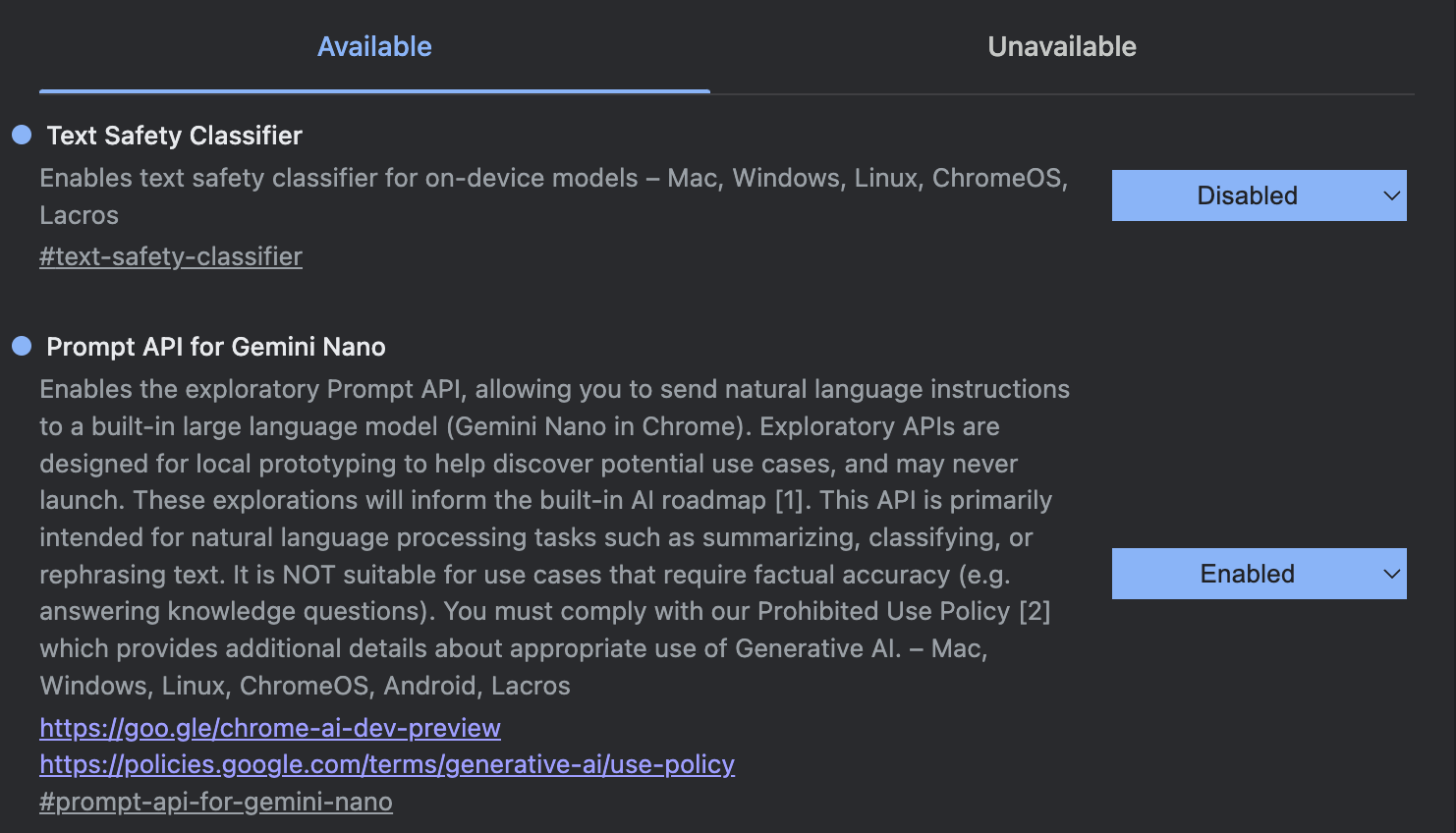
Then restart Chrome for these changes to take effect.
[!WARNING] On first use, Chrome will download the on-device model, which can be as large as 22GB (according to their docs and at the time of writing). During the download, ChromeAI may not be available via the extension.
[!NOTE] For more information about Chrome Built-in AI: https://developer.chrome.com/docs/ai/get-started
Uninstall
To remove the extension, execute:
pip uninstall jupyterlite-ai
Contributing
Development install
Note: You will need NodeJS to build the extension package.
The jlpm command is JupyterLab's pinned version of
yarn that is installed with JupyterLab. You may use
yarn or npm in lieu of jlpm below.
# Clone the repo to your local environment
# Change directory to the jupyterlite_ai directory
# Install package in development mode
pip install -e "."
# Link your development version of the extension with JupyterLab
jupyter labextension develop . --overwrite
# Rebuild extension Typescript source after making changes
jlpm build
You can watch the source directory and run JupyterLab at the same time in different terminals to watch for changes in the extension's source and automatically rebuild the extension.
# Watch the source directory in one terminal, automatically rebuilding when needed
jlpm watch
# Run JupyterLab in another terminal
jupyter lab
With the watch command running, every saved change will immediately be built locally and available in your running JupyterLab. Refresh JupyterLab to load the change in your browser (you may need to wait several seconds for the extension to be rebuilt).
By default, the jlpm build command generates the source maps for this extension to make it easier to debug using the browser dev tools. To also generate source maps for the JupyterLab core extensions, you can run the following command:
jupyter lab build --minimize=False
Development uninstall
pip uninstall jupyterlite-ai
In development mode, you will also need to remove the symlink created by jupyter labextension develop
command. To find its location, you can run jupyter labextension list to figure out where the labextensions
folder is located. Then you can remove the symlink named @jupyterlite/ai within that folder.
Packaging the extension
See RELEASE
Project details
Verified details
These details have been verified by PyPIProject links
Owner
GitHub Statistics
Maintainers
Release history Release notifications | RSS feed


Download files
Download the file for your platform. If you're not sure which to choose, learn more about installing packages.
Source Distribution
Built Distribution
Filter files by name, interpreter, ABI, and platform.
If you're not sure about the file name format, learn more about wheel file names.
Copy a direct link to the current filters
File details
Details for the file jupyterlite_ai-0.9.0a1.tar.gz.
File metadata
- Download URL: jupyterlite_ai-0.9.0a1.tar.gz
- Upload date:
- Size: 1.1 MB
- Tags: Source
- Uploaded using Trusted Publishing? Yes
- Uploaded via: twine/6.2.0 CPython/3.12.11
File hashes
| Algorithm | Hash digest | |
|---|---|---|
| SHA256 |
5f107b5238b4a8d88fab54482fb9cac63e94e6e341098b5be2d20c8d7202a4ad
|
|
| MD5 |
b38e90951ab806f474d60a686236c823
|
|
| BLAKE2b-256 |
a92ed7f675307376718e875ffd23b29ebe1b1840c99fe63c0a1cda3d14eeacd5
|
File details
Details for the file jupyterlite_ai-0.9.0a1-py3-none-any.whl.
File metadata
- Download URL: jupyterlite_ai-0.9.0a1-py3-none-any.whl
- Upload date:
- Size: 521.0 kB
- Tags: Python 3
- Uploaded using Trusted Publishing? Yes
- Uploaded via: twine/6.2.0 CPython/3.12.11
File hashes
| Algorithm | Hash digest | |
|---|---|---|
| SHA256 |
3f54fc16e0be7a1ce2bb16e18c9a7570780e21af0bdf41e2af684a742f04a43a
|
|
| MD5 |
afa9bedd3be2154b217fa604c65be49f
|
|
| BLAKE2b-256 |
55bb7a43d546aa9cd30689bc1e80d1ab20f320b902da6adf1855242518c35b13
|






