

Video you can diff.
Motion graphics and video edits written as JSON, checked by agents, rendered on the GPU.
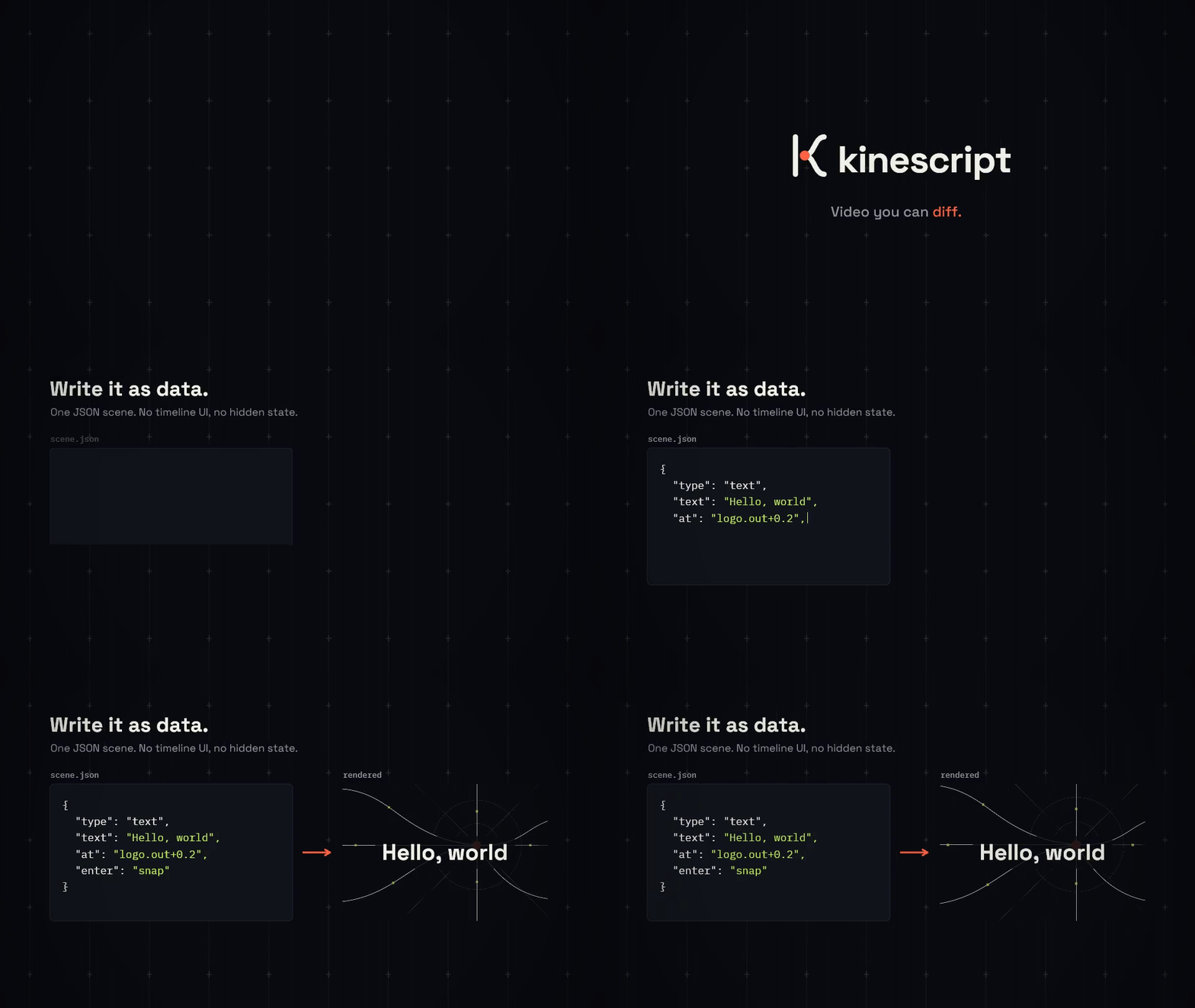
Kinescript turns a JSON scene into video. Every layer, keyframe and cut is a line of data, so a scene can be generated, reviewed in a pull request, and changed by a script or an agent. The renderer is a pure function of the frame number: any frame renders on its own, which makes previews instant and lets a render split across processes.
The launch video in docs/promo.mp4 is a Kinescript scene (marketing/promo.json). It is 35 seconds of 1080p
and renders, with audio, in about 3.5 seconds on the development machine.
What it does
- Cue timing. Start and end times can name other layers:
"at": "title.out+0.2". Lengthen one layer and everything cued after it moves. Cycles and missing references are reported with the ids involved. - Animate anything. Numbers and colours take constants, keyframes (
[[0, 0], [0.6, 1, "outBack"]], with negative times counted from the layer's end), a tween object, or an expression such as"=540 + sin(t*3)*40". Colours interpolate in OKLab. - Text that moves per letter.
"split": "chars"with a staggered enter motion, typewriter reveal with a caret,**emphasis**markup, per-unit expressions ("unitY": "=sin(T*4 + i)*12"for a wave). - Footage. Video layers with trim, speed, loop, cover/contain fit, punch-in
zoomaround afocuspoint, and rounded picture-in-picture. Asequenceturns a cut list into clips with fade, wipe, slide, zoom or blur transitions. Clip audio and music beds are mixed automatically. - Captions from
.srt/.vttor inline cues, with karaoke and pop modes. - Depth. Any layer takes
z,rotateXandrotateY; a scenecamerapans, dollies and orbits with real perspective;flip,flip-up,tumbleandpushmotions; two-sided cards with"backface": "hidden". - 3D models. Lit cubes, spheres, cylinders, cones, tori and planes, or several merged as
parts, with shine, metal, rim light and toon bands; light presets;explodeand abuildmotion. 3D text and extruded SVG paths (filled or stroked) with an optional bevel. Models from.glb,.gltfand.objfiles, and a softgroundshadow under any model. - Shaders. SkSL layers with
mesh,aurora,gridandscorepresets, or your own source. - Finishing. Per-layer blur, shadow, blend modes and colour adjustments; a scene grade with vignette and film grain; optional motion blur.
- Components.
lowerThird,titleCard,callout,focus(dim everything but a region),progress,kinetic, plus your own with{{param}}placeholders. - Outputs. H.264
.mp4, ProRes 4444.movand VP9.webmwith alpha for compositing,.gif, PNG sequences.
Built for agents
An agent cannot watch a video, so Kinescript gives it things it can read:
| Command | What the agent gets |
|---|---|
kine docs |
the full scene reference, short enough to keep in context |
kine check scene.json |
JSON issues with layer ids and time ranges: unknown keys (with the intended name first), bad values, missing media and out-of-range trims, text off canvas or in the safe margin, overlapping text, contrast under 3:1 against what is actually behind it, tiny text, too little reading time. Every problem is listed at once. Common names from other tools (color, fontSize, duration, position) are read and reported as info notes. |
kine look scene.json --boxes |
one PNG of many labelled frames, with every layer outlined and named |
kine probe scene.json --at 3.2 |
resolved in/out of every layer and each visible layer's screen box |
kine still / kine render |
a frame, a range (--from/--to), a draft (-q draft --scale 0.5) or the final file |
The same tools are available over MCP (kine mcp), and kine_look / kine_still return images inline.
{
  "mcpServers": {
    "kinescript": {"command": "kine", "args": ["mcp"]}
  }
}
Install
Requires Python 3.10+ and ffmpeg on PATH.
pip install kinescript
kine doctor        # ffmpeg path, GPU availability, default font
From a checkout: pip install -e .
Dependencies are skia-python, numpy and glfw. Space Grotesk and IBM Plex Mono (both SIL Open Font License)
ship with the package, so default text looks the same on every machine.
Quick start
kine new scene.json
kine check scene.json
kine look scene.json --boxes
kine render scene.json -o scene.mp4
{
  "canvas": {"w": 1920, "h": 1080, "fps": 30, "bg": "#0a0c10"},
  "grade": {"vignette": 0.35, "grain": 0.04},
  "layers": [
    {"id": "dot", "type": "circle", "x": "50%", "y": "50%", "r": 26, "fill": "$accent", "dur": 1.1,
     "enter": {"name": "pop", "dur": 0.4}, "exit": "fade"},
    {"id": "title", "type": "text", "text": "Motion, **written.**", "x": "50%", "y": "46%", "size": 140,
     "weight": 700, "split": "chars", "at": "dot.out-0.1", "dur": 3.2,
     "enter": {"name": "snap", "stagger": 0.03}, "exit": "fade"},
    {"id": "sub", "type": "text", "text": "scenes as data", "x": "50%", "y": "62%", "size": 40,
     "fill": "$muted", "at": "title.in+0.6", "until": "title.out", "enter": "rise"}
  ]
}
More in examples/: hello.json (title animation) and edit.json (a cut list with a punch-in, crossfade,
lower third, callout, karaoke captions and a music bed). Run python examples/make_media.py first to generate the
sample footage.
Performance
Measured on the development machine (Intel Core Ultra 7 265, 20 threads, NVIDIA RTX 5060 Ti, Windows 11), 2026-10-30:
| Workload | Result |
|---|---|
| Drawing one 1080p frame of the launch video on the GPU, converted to I420 and read back as a render does | median 2.7 ms, p95 3.3 ms (all 1038 frames) |
Launch video, 34.6 s at 1080p30, -q high, with audio |
3.5 s wall, about 300 frames/s (median of 5 runs) |
examples/edit.json, 10.4 s with two decoded video clips |
2.05 s wall, 152 frames/s (median of 5 runs) |
python bench/stages.py splits the time per frame into drawing, conversion and readback, and writing to
ffmpeg for several workloads, and times whole renders.
Rendering uses Skia on the GPU through a hidden OpenGL context, one per worker process. Frames are split into chunks, encoded in parallel and joined without re-encoding, while another ffmpeg process mixes the audio. Within one process, such as the MCP server, the workers stay warm for two minutes between renders.
Limits
- Without a usable GPU, Kinescript falls back to Skia's CPU rasteriser. With the Windows
skia-pythonwheel this is very slow (about 0.65 s per 1080p frame for the launch video); use--scale 0.5for previews on such machines.KINE_BACKEND=cpuforces this path. - 3D is drawn by Skia with a depth sort, not a GL pipeline: models have no image textures, skeletal animation or
shadows cast on each other, and separate model layers do not hide each other per pixel (merge touching
objects as
partsof one model). - Audio is mixing (trim, gain, fades, speed), not editing or effects.
- Video is decoded and resampled by ffmpeg to the scene frame rate. Jumping backwards or far ahead reopens the decoder, which is slower than sequential playback.
- Text layout is single-script left-to-right with greedy wrapping. No shaping for complex scripts or bidi.
- Expressions are limited to arithmetic and the listed helpers; attribute access and other names are rejected.
Project layout
kinescript/   engine: timing, props, presets, render, output, verify (check/look/probe), mcp, cli
examples/     scenes and the generator for sample media
marketing/    the launch video, as a scene and its builder script
brand/        logo files, generated art and the brand guide
content/      launch post and social copy
site/         landing page
tests/        pytest suite
License
MIT, see LICENSE. The bundled fonts are under the SIL Open Font License 1.1; their notices are in
kinescript/fonts/.
1 maintainer

Metadata
1 maintainer
Release files for kinescript 1.1.0
For a detailed explanation of source distributions (sdists) and built distributions (wheels), please see the package formats documentation.
Source distribution (sdist)
| File | Size | Uploaded | Provenance | Actions |
|---|---|---|---|---|
| kinescript-1.1.0.tar.gz | 540.3 kB | With provenance | Details for kinescript-1.1.0.tar.gz |
Built distribution (wheel)
| File | Interpreter | ABI | Platform | Actions Reset |
|---|---|---|---|---|
| kinescript-1.1.0-py3-none-any.whl | Python 3 | none | any | Details for kinescript-1.1.0-py3-none-any.whl |
Total release size: 1.1 MB
Release files / kinescript-1.1.0.tar.gz
| Download URL | kinescript-1.1.0.tar.gz |
|---|---|
| Size | 540.3 kB |
| Tags | Source |
|
SHA-256 checksum How to use checksums |
74c0520b8708b0e41edd89d1e8c06bc1688848c8b1fc715019e8366db7f455a2
|
|
BLAKE2b-256 checksum How to use checksums |
28a0337f0bfe9262e4e484c0837276da5d5c4ec2ae798ab26312d8cb7c6aa40e
|
| Upload date | |
|
Uploaded using Trusted Publishing? What is trusted publishing? |
Yes |
| Uploaded via |
twine/7.0.0 CPython/3.13.16
|
Provenance
Provenance describes where a file came from. On PyPI, provenance is shared via attestations, which provide a verifiable record of the build or publishing details. View details, limitations and caveats.


PyPI Publish Attestation
PyPI verified that this artifact, at this checksum, originated from the publisher listed below.
Signed by GitHub Actions, verified by PyPI on Oct 30, 2026.
Transparency logRelease files / kinescript-1.1.0-py3-none-any.whl
| Download URL | kinescript-1.1.0-py3-none-any.whl |
|---|---|
| Size | 531.1 kB |
| Tags | Python 3 |
|
SHA-256 checksum How to use checksums |
491a5b38c12d0be9b74aa8397764b3c67189725cc8841a3f32949ecd69252d18
|
|
BLAKE2b-256 checksum How to use checksums |
59a96487cdc3a79aaa9b3e2841de07b6ffe17abd229396462668b25f74f4d619
|
| Upload date | |
|
Uploaded using Trusted Publishing? What is trusted publishing? |
Yes |
| Uploaded via |
twine/7.0.0 CPython/3.13.16
|
Provenance
Provenance describes where a file came from. On PyPI, provenance is shared via attestations, which provide a verifiable record of the build or publishing details. View details, limitations and caveats.
PyPI Publish Attestation
PyPI verified that this artifact, at this checksum, originated from the publisher listed below.
Signed by GitHub Actions, verified by PyPI on Oct 30, 2026.
Transparency logSecurity for kinescript 1.1.0
Provenance
Provenance describes where a file came from. On PyPI, provenance is shared via attestations, which provide a verifiable record of the build or publishing details. View details, limitations and caveats.
Full provenance
All 2 files in this release have been uploaded with provenance metadata.
Attestation for kinescript-1.1.0.tar.gz
PyPI Publish Attestation
PyPI verified that this artifact, at this checksum, originated from the publisher listed below.
Signed by GitHub Actions, verified by PyPI on Oct 30, 2026.
Transparency logA note on package security
PyPI is a repository for distributing packages, not a service for auditing them. While third-party security researchers and our staff do their best to detect and remove malicious packages, PyPI cannot guarantee the quality, security or suitability of any given package.
To learn more about protecting yourself from malicious actors, visit our package security documentation.














