
LanCalc



LanCalc is a desktop application built with PyQt5, designed to calculate network configurations for Windows, macOS, and Linux systems.
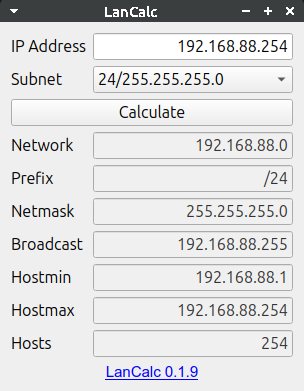
It provides a user-friendly interface to compute essential network parameters such as network address, broadcast address, the minimum and maximum host addresses, and the number of hosts within a given subnet.
Support IPv4 address formats, subnet masks and prefixes. This tool is particularly useful for network administrators and IT professionals who require quick calculations of network parameters.
Quick Start
Installation
Python 3.9+ is required.
- Default (with GUI):
pip3 install lancalc
- CLI-only / headless (avoid installing PyQt5):
# Install package without dependencies, then only required CLI deps
pip3 install --no-deps lancalc
pip3 install -r requirements.txt
- Install without GUI dependencies:
# Install with nogui extras (excludes PyQt5)
pip3 install 'lancalc[nogui]'
- Install from GitHub:
# With GUI (default)
pip3 install 'git+https://github.com/wachawo/lancalc.git'

# CLI-only / headless
pip3 install --no-deps 'git+https://github.com/wachawo/lancalc.git'
pip3 install -r requirements.txt

# Without GUI dependencies
pip3 install 'git+https://github.com/wachawo/lancalc.git#egg=lancalc[nogui]'
If pip is missing:
curl https://bootstrap.pypa.io/get-pip.py -o /tmp/get-pip.py
python3 /tmp/get-pip.py
If the lancalc command is not found after installation, add the local packages path to PATH:
export PATH="$HOME/.local/bin:$PATH"
To permanently add to PATH, add this line to your ~/.bashrc or ~/.zshrc:
echo 'export PATH="$HOME/.local/bin:$PATH"' >> ~/.bashrc
source ~/.bashrc
Notes:
- On Linux, PyQt5 may require system Qt libraries (xcb plugin). If GUI fails to start, ensure a desktop environment is available and try installing system packages (e.g. Debian/Ubuntu:
sudo apt install python3-pyqt5), or use the CLI-only steps above. - In CI/headless environments, prefer the CLI-only steps above to skip GUI dependencies.
Running the Application
GUI Mode
After installation (default with GUI), launch the application with the command:
lancalc
LanCalc auto-detects the environment. If GUI dependencies are unavailable or you are in a headless session, the launcher falls back to CLI help. In such cases, use the CLI examples below.
CLI Mode
LanCalc also supports command-line interface for automation and scripting:
# Basic usage
lancalc 192.168.1.1/24

# JSON output for parsing
lancalc 192.168.1.1/24 --json

# Examples
lancalc 10.0.0.1/8
lancalc 172.16.0.1/16
lancalc 192.168.1.100/31  # Point-to-point network
lancalc 192.168.1.1/32    # Single host
You can also run via module:
python3 -m lancalc 192.168.1.1/24 --json
Output Format
Text mode (default):
Network: 192.168.1.0
Prefix: /24
Netmask: 255.255.255.0
Broadcast: 192.168.1.255
Hostmin: 192.168.1.1
Hostmax: 192.168.1.254
Hosts: 254
JSON mode (--json):
{
  "network": "192.168.1.0",
  "prefix": "/24",
  "netmask": "255.255.255.0",
  "broadcast": "192.168.1.255",
  "hostmin": "192.168.1.1",
  "hostmax": "192.168.1.254",
  "hosts": "254",
  "comment": ""
}
Uninstall
pip3 uninstall -y lancalc
That's it! The application will start and automatically detect your current network settings.
For Developers
Prerequisites
Python 3.9+ is required. GUI development requires PyQt5 (installed by default).
- Production (CLI only):
pip3 install -r requirements.txt
- Editable install with GUI (default):
pip3 install -e .
- Editable install without GUI:
pip3 install --no-deps -e .
pip3 install -r requirements.txt
- Full dev setup (with GUI):
pip3 install -e '.[dev]'
- Dev without GUI:
pip3 install --no-deps -e .
pip3 install -r requirements.txt
pip3 install pytest pytest-qt pre-commit flake8
- Reinstall
pip3 install -e . --force-reinstall
Installation for Development
Clone the repository and install in development mode:
git clone https://github.com/wachawo/lancalc.git
Running from Source
# GUI (requires PyQt5)
python3 lancalc/main.py

# CLI
python3 -m lancalc 192.168.1.1/24
Development Tools
pip3 install pre-commit flake8 pytest pytest-qt
pre-commit install
pre-commit run --all-files
pre-commit autoupdate
Running Tests
pytest -v
Test Build
pip3 install -e .
~/.local/bin/lancalc
Test Build Linux
pip3 install git+file://$(pwd)
export PATH="$HOME/.local/bin:$PATH"
lancalc
Test Build Windows
pip3 install "git+file://$(Get-Location)"
lancalc
License
Distributed under the MIT License. See LICENSE for more information.
Contact
Notes
A /31 mask allows the use of 2 addresses. The first will be the network address, the last the broadcast address, and for connecting hosts we use these same addresses. Limitations when using a /31 prefix: Protocols that use L3 broadcast stop working. In fact, at present there are almost no protocols left that rely on L3 broadcast in their operation. The main currently relevant protocols, such as OSPF, IS-IS, EIGRP, and BGP, use multicast or unicast addresses instead. This limitation can even be seen as an advantage, because it increases resistance to DoS attacks based on broadcast traffic distribution. But not all devices support /31 prefixes. On Juniper and Cisco devices, you can safely use a /31 mask, although Cisco will issue a warning (% Warning: use /31 mask on non point-to-point interface cautiously). ZyXEL, however, does not allow you to select a /31 mask at all. As a result, there are additional limitations in network operation — from using equipment of different manufacturers to even using equipment from the same vendor but with different firmware versions. If you are not concerned by the above limitations, you can confidently save addresses by using the /31 prefix.
The use of the /31 prefix is described in detail in RFC 3021 — Using 31-Bit Prefixes on IPv4 Point-to-Point Links.
Special IPv4 Ranges and Cases
Special Network Types
- /31 networks: Show
2*in Hosts field - both addresses are usable (RFC 3021) - /32 networks: Show
1*in Hosts field - single host network - The asterisk (*) indicates special network types where all addresses are usable
Special IPv4 Address Ranges
LanCalc automatically detects and handles special IPv4 address ranges according to RFC specifications. For these ranges, host-related fields show "*" and a message field indicates the range type with RFC reference.
Supported Special Ranges
| Range | Type | RFC | Description |
|---|---|---|---|
| 127.0.0.0/8 | Loopback | RFC 3330 | Loopback addresses - not routable on the Internet |
| 169.254.0.0/16 | Link-local | RFC 3927 | Link-local addresses - not routable |
| 224.0.0.0/4 | Multicast | RFC 5771 | Multicast addresses - not for host addressing |
| 0.0.0.0/8 | Unspecified | RFC 1122 | Unspecified addresses - not for host addressing |
| 255.255.255.255/32 | Broadcast | RFC 919 | Limited broadcast address - not for host addressing |
Special Range Behavior
When you enter an address from a special range:
CLI Text Mode:
lancalc 127.0.0.1/8
Network: 127.0.0.0
Prefix: /8
Netmask: 255.0.0.0
Broadcast: *
Hostmin: 127.0.0.1
Hostmax: 127.255.255.254
Hosts: 16777214
Comment: RFC 3330 Loopback (https://github.com/wachawo/lancalc/blob/main/docs/RFC.md#rfc-3330---loopback-addresses)
CLI JSON Mode:
lancalc 224.0.0.1/4 --json
{
  "network": "224.0.0.0",
  "prefix": "/4",
  "netmask": "240.0.0.0",
  "broadcast": "*",
  "hostmin": "*",
  "hostmax": "*",
  "hosts": "*",
  "comment": "RFC 5771 Multicast (https://github.com/wachawo/lancalc/blob/main/docs/RFC.md#rfc-5771---multicast-addresses)"
}
GUI Mode:
- Host fields (Hostmin, Hostmax, Broadcast, Hosts) show "*"
- Status bar displays the special range message instead of version
- No special styling or warnings needed
JSON Fields
The JSON output includes the following fields:
comment: Description and RFC reference for special ranges (empty for normal unicast addresses)hosts: Number of available host addresses in the specified subnet
These fields are always present, making the JSON output format consistent regardless of address type.
Usage
Command Line Interface
# Basic subnet calculation
lancalc 192.168.1.1/24

# JSON output
lancalc 192.168.1.1/24 --json

# Show internal/private IP address
lancalc --internal
lancalc -i

# Show external/public IP address
lancalc --external
lancalc -e

# Use multiple info flags simultaneously
lancalc -i -e
lancalc -i -e --json

# Show version
lancalc --version
Examples
Basic calculation:
$ lancalc 192.168.1.1/24
Network: 192.168.1.0
Prefix: /24
Netmask: 255.255.255.0
Broadcast: 192.168.1.255
Hostmin: 192.168.1.1
Hostmax: 192.168.1.254
Hosts: 254
JSON output:
$ lancalc 192.168.1.1/24 --json
{
  "network": "192.168.1.0",
  "prefix": "/24",
  "netmask": "255.255.255.0",
  "broadcast": "192.168.1.255",
  "hostmin": "192.168.1.1",
  "hostmax": "192.168.1.254",
  "hosts": "254"
}
Interface information:
$ lancalc -i
Address: 10.16.69.146
Prefix: /24

$ lancalc -i --json
{"address": "10.16.69.146", "prefix": "/24"}
External IP detection:
$ lancalc -e
External IP: 216.66.18.3

$ lancalc -e --json
{"external_ip": "216.66.18.3"}
Multiple info flags:
$ lancalc -i -e
Address: 10.16.69.146
Prefix: /24

External IP: 216.66.18.3

$ lancalc -i -e --json
{"address": "10.16.69.146", "prefix": "/24"}

{"external_ip": "216.66.18.3"}
1 maintainer

Metadata
1 maintainer
Release files for lancalc 0.1.11
For a detailed explanation of source distributions (sdists) and built distributions (wheels), please see the package formats documentation.
Source distribution (sdist)
| File | Size | Uploaded | |
|---|---|---|---|
| lancalc-0.1.11.tar.gz | 29.5 kB | Details |
Built distribution (wheel)
| File | Interpreter | ABI | Platform | Reset |
|---|---|---|---|---|
| lancalc-0.1.11-py3-none-any.whl | Python 3 | none | any | Details |
Total release size: 50.8 kB
Release files / lancalc-0.1.11.tar.gz
| Download URL | lancalc-0.1.11.tar.gz |
|---|---|
| Size | 29.5 kB |
| Tags | Source |
|
SHA-256 checksum How to use checksums |
a6212cec6c92fc82a86f355455bf5bfc6463e7199268fb1dee410b36fb864c70
|
|
BLAKE2b-256 checksum How to use checksums |
8d566fe3cf65841dfd0cfd4716f214616c3ec3e7c2814f7c1a854a5130ff3622
|
| Upload date | |
|
Uploaded using Trusted Publishing? What is trusted publishing? |
Yes |
| Uploaded via |
twine/6.1.0 CPython/3.13.7
|
Provenance
Provenance describes where a file came from. On PyPI, provenance is shared via attestations, which provide a verifiable record of the build or publishing details. View details, limitations and caveats.


PyPI Publish Attestation
PyPI verified that this artifact, at this checksum, originated from the publisher listed below.
Signed by GitHub Actions, verified by PyPI on Oct 19, 2025.
Transparency logRelease files / lancalc-0.1.11-py3-none-any.whl
| Download URL | lancalc-0.1.11-py3-none-any.whl |
|---|---|
| Size | 21.3 kB |
| Tags | Python 3 |
|
SHA-256 checksum How to use checksums |
872b57bf623b81903572758a5ed6fad88d7cfaa527a40536110e2bff29aafd2f
|
|
BLAKE2b-256 checksum How to use checksums |
04c4994b2205792eabc42cf376a1aa31bc12a02ab82110dcc3c55c94b10a180d
|
| Upload date | |
|
Uploaded using Trusted Publishing? What is trusted publishing? |
Yes |
| Uploaded via |
twine/6.1.0 CPython/3.13.7
|
Provenance
Provenance describes where a file came from. On PyPI, provenance is shared via attestations, which provide a verifiable record of the build or publishing details. View details, limitations and caveats.
PyPI Publish Attestation
PyPI verified that this artifact, at this checksum, originated from the publisher listed below.
Signed by GitHub Actions, verified by PyPI on Oct 19, 2025.
Transparency log













