
LATED
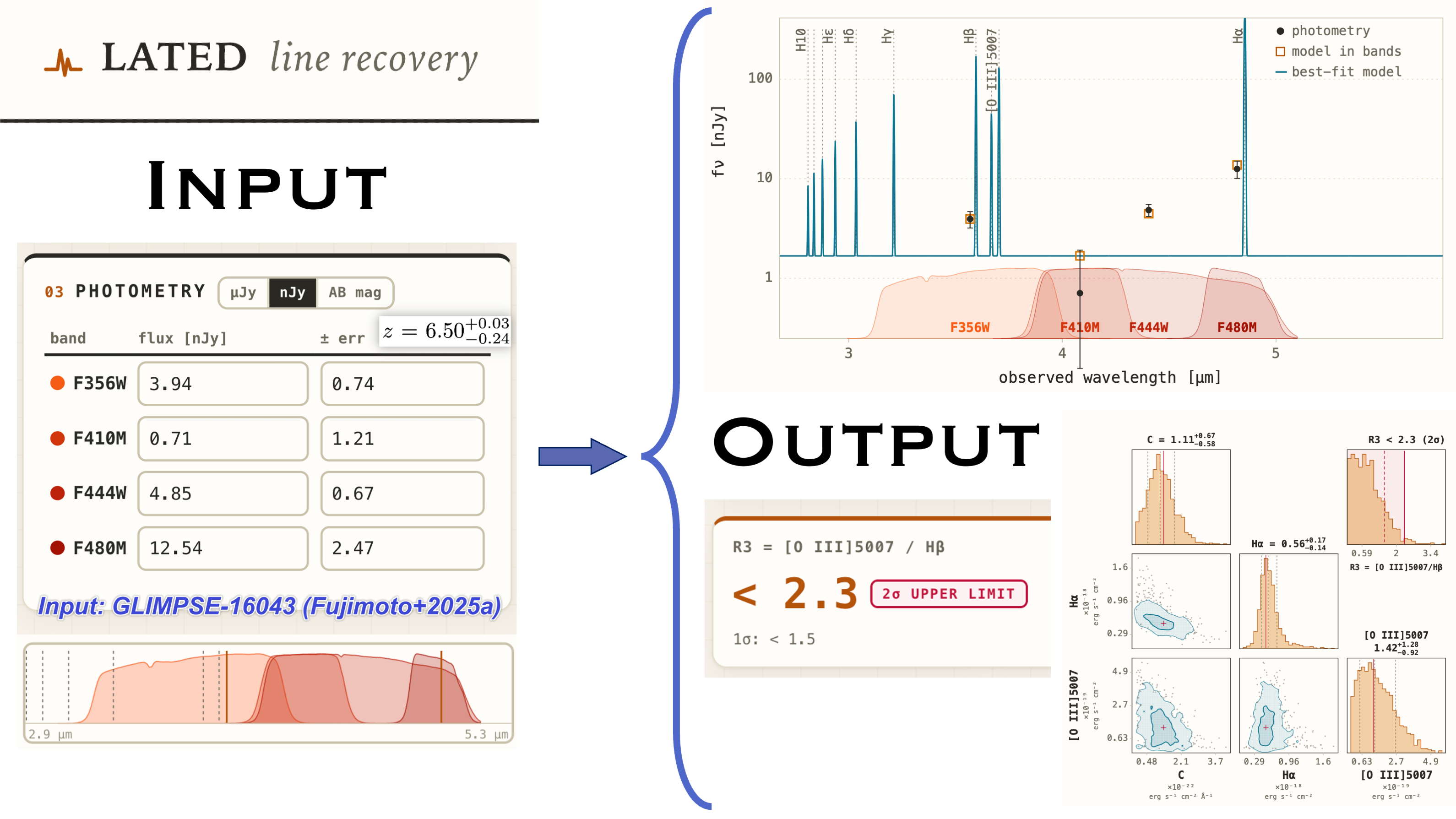
Measure emission lines you can't spectroscopically resolve, straight from photometry.


You have JWST (or Roman) photometry of a galaxy, and one of the bands looks
too bright: an emission line is boosting it. lated turns that excess into a
number. It fits a simple continuum + emission-line model through the real
filter curves and reports the line fluxes, rest-frame equivalent widths and
line ratios (for example [O III] 5007 / Hβ) that the photometry implies.
When a line is genuinely there, you get a measurement with uncertainties. When it isn't, you get an honest upper limit, not a fabricated value. That distinction is the whole point of the tool.
Use it two ways: a point-and-click web app (no coding), or a small Python API for scripting and batch work.
Install
pip install lated
That is everything: the Python library, the command line, and the web app. Python 3.9+ (depends only on NumPy, SciPy, pydantic and FastAPI).
The web app
lated serve # open http://127.0.0.1:8321
Pick a redshift, tick the bands you have, paste your fluxes, and press run. You get a verdict card (measurement or limit), an SED figure and a corner plot, all exportable to PDF. Start from one of the built-in literature examples to see the whole workflow in a single click. Everything on the board is editable: the line list, which lines are free / tied / off, the nebular conditions that set the Balmer ratios (Osterbrock & Ferland 2006 Case A/B by temperature and density), the continuum slope, dust, and the error budget.
From Python
from lated import FitConfig, fit

photometry = {"F200W": (0.0136, 0.0019),   # {band: (flux, error)} in microJansky
              "F277W": (0.0249, 0.0016),
              "F356W": (0.0040, 0.0014)}

res = fit(photometry, FitConfig.fixed_slope(z=3.193))
print(res.ratios[0].status)                # 'upper_limit', 'measured', ...
That is the whole idea. The example notebook walks through reading the results, plotting the SED and corner, editing line roles, choosing nebular conditions, and the posterior error budget.
What you get back
Every line ratio carries a status, so a number is never mistaken for a measurement it isn't:
| status | meaning | quote |
|---|---|---|
measured |
both lines detected | the value with 16/50/84 percentiles |
upper_limit |
numerator consistent with zero | < p97.5 (2σ) |
lower_limit |
denominator consistent with zero | > p2.5 |
unconstrained |
no band covers the line | nothing usable |
Each line also reports the faintest flux your photometry could have detected, so every non-detection comes with its depth.
How it works
Per band, the predicted flux is the photon-weighted mean of
f_λ(λ) = C (λ/λ0)^β + Σ_l F_l · δ(λ − λ_l (1+z))
integrated through the real transmission curve and compared to your photometry with a Gaussian likelihood; amplitudes are solved by error-weighted non-negative least squares over a grid of slopes. Every parameter has an explicit role (free, fixed, or tied) that you can change, and invalid setups (unknown bands, tie cycles, non-positive errors, under-constrained fits) are raised as errors rather than silently ignored.
Command line
lated serve                 # run the web app
lated fit input.json        # fit from a JSON file
lated bands                 # list the bundled filter curves
lated lines                 # show the default line registry
The web app also exposes a small REST API (/api/meta,
/api/filters/{name}, /api/fit) with interactive docs at /docs.
Citing
If lated contributes to your research, please cite Li et al. (2026, LATED
Paper I).
Development
git clone https://github.com/lmytime/lated
cd lated
pip install -e ".[test]"
PYTEST_DISABLE_PLUGIN_AUTOLOAD=1 pytest tests/ -q
Issues and contributions are welcome at github.com/lmytime/lated. Released under the MIT License.
1 maintainer

Metadata
1 maintainer
Release files for lated 0.3.2
For a detailed explanation of source distributions (sdists) and built distributions (wheels), please see the package formats documentation.
Source distribution (sdist)
| File | Size | Uploaded | Provenance | Actions |
|---|---|---|---|---|
| lated-0.3.2.tar.gz | 279.1 kB | With provenance | Details for lated-0.3.2.tar.gz |
Built distribution (wheel)
| File | Interpreter | ABI | Platform | Actions Reset |
|---|---|---|---|---|
| lated-0.3.2-py3-none-any.whl | Python 3 | none | any | Details for lated-0.3.2-py3-none-any.whl |
Total release size: 479.3 kB
Release files / lated-0.3.2.tar.gz
| Download URL | lated-0.3.2.tar.gz |
|---|---|
| Size | 279.1 kB |
| Tags | Source |
|
SHA-256 checksum How to use checksums |
9d8e440bbacbd3b92dbaf8a4c229412104e444c7742a31cc2862bd9d079693c8
|
|
BLAKE2b-256 checksum How to use checksums |
bbcffddba7b16b1847842120efe9570250ecd54e7a6b7e114007ff21d1aea706
|
| Upload date | |
|
Uploaded using Trusted Publishing? What is trusted publishing? |
Yes |
| Uploaded via |
twine/7.0.0 CPython/3.13.14
|
Provenance
Provenance describes where a file came from. On PyPI, provenance is shared via attestations, which provide a verifiable record of the build or publishing details. View details, limitations and caveats.


PyPI Publish Attestation
PyPI verified that this artifact, at this checksum, originated from the publisher listed below.
Signed by GitHub Actions, verified by PyPI on Sep 21, 2026.
Transparency logRelease files / lated-0.3.2-py3-none-any.whl
| Download URL | lated-0.3.2-py3-none-any.whl |
|---|---|
| Size | 200.2 kB |
| Tags | Python 3 |
|
SHA-256 checksum How to use checksums |
bd27827c58de9dd462ae0228a8a4bd1d93d0590c76f4b5df8b4011e78a5cd692
|
|
BLAKE2b-256 checksum How to use checksums |
0ec4572a586691cbb439879297608aebfbb04b7632a85d0528fca2529e128b9f
|
| Upload date | |
|
Uploaded using Trusted Publishing? What is trusted publishing? |
Yes |
| Uploaded via |
twine/7.0.0 CPython/3.13.14
|
Provenance
Provenance describes where a file came from. On PyPI, provenance is shared via attestations, which provide a verifiable record of the build or publishing details. View details, limitations and caveats.
PyPI Publish Attestation
PyPI verified that this artifact, at this checksum, originated from the publisher listed below.
Signed by GitHub Actions, verified by PyPI on Sep 21, 2026.
Transparency logSecurity for lated 0.3.2
Provenance
Provenance describes where a file came from. On PyPI, provenance is shared via attestations, which provide a verifiable record of the build or publishing details. View details, limitations and caveats.
Full provenance
All 2 files in this release have been uploaded with provenance metadata.
Attestation for lated-0.3.2.tar.gz
PyPI Publish Attestation
PyPI verified that this artifact, at this checksum, originated from the publisher listed below.
Signed by GitHub Actions, verified by PyPI on Sep 21, 2026.
Transparency logA note on package security
PyPI is a repository for distributing packages, not a service for auditing them. While third-party security researchers and our staff do their best to detect and remove malicious packages, PyPI cannot guarantee the quality, security or suitability of any given package.
To learn more about protecting yourself from malicious actors, visit our package security documentation.














