

Laufband: Embarrassingly parallel, embarrassingly simple!

Laufband enables parallel iteration over a dataset from multiple processes, utilizing file-based locking and communication to ensure each item is processed exactly once.
Installation
Install Laufband using pip:
pip install laufband
Usage
Using Laufband is similar to the familiar tqdm progress bar for sequential iteration.
from laufband import Laufband

data = list(range(100))
for item in Laufband(data):
    # Process each item in the dataset
    pass
The true power of Laufband emerges when you run your script in parallel. Multiple processes will coordinate using file-based locking to ensure that each item in the dataset is processed by only one process.
Here's a typical example demonstrating parallel processing with Laufband and file-based locking for shared resource access:
import json
import time
from pathlib import Path
from laufband import Laufband

output_file = Path("data.json")
output_file.write_text(json.dumps({"processed_data": []}))
data = list(range(100))

worker = Laufband(data, tqdm_kwargs={"desc": "using Laufband"})

for item in worker:
    # Simulate some computationally intensive task
    time.sleep(0.1)
    with worker.lock:
        # Access and modify a shared resource (e.g., a file) safely using the lock
        file_content = json.loads(output_file.read_text())
        file_content["processed_data"].append(item)
        output_file.write_text(json.dumps(file_content))
To execute this script (main.py) in parallel, you can use a command like the following in your terminal (this example launches 10 background processes):
for i in {1..10} ; do python main.py & done
Failure Policy
In Laufband, a job will be automatically marked as failed if the iteration is interrupted by:
- an unhandled Exception
- or an explicit break.
from laufband import Laufband

data = list(range(100))

# Example 1: break
for item in Laufband(data):
    if item == 50:
        break  # Job 50 will be marked as failed

# Example 2: Exception
for item in Laufband(data):
    if item == 70:
        raise ValueError("Something went wrong")  # Job 70 will be marked as failed
If you want to exit early but still mark the job as successfully completed,
you should use Laufband.close() instead of break:
from laufband import Laufband

data = list(range(100))

worker = Laufband(data)

for item in worker:
    if item == 50:
        worker.close()  # Job 50 will be marked as completed, and iteration will stop cleanly
Context Manager Protocol
Laufband supports context manager usage for better worker lifecycle management.
This is recommended, if you want to iterate over the Laufband or Graphband instance multiple times.
from laufband import Laufband

data = list(range(100))

# Using context manager for multiple iterations (recommended)
with Laufband(data) as worker:
    while True:
        for item in worker:
            # do something
            pass
# Worker automatically goes offline when exiting context
Context Manager Benefits:
- Proper cleanup: Workers are automatically set to
OFFLINEstatus when exiting the context
Worker Status Lifecycle:
- Without context manager: Worker goes from
IDLE→BUSY→OFFLINE(after completing all tasks) - With context manager: Worker goes from
IDLE→BUSY→IDLE(during processing) →OFFLINE(on context exit)
Examples
ASE Calculator
For atomistic data, the ASE package is widely used to calculate energies and forces of atomic configurations using either ab initio methods or machine-learned interatomic potentials (MLIPs).
You can use Laufband to parallelize these calculations easily without duplication or manual bookkeeping and automatic checkpointing.
The following example uses a MACE foundation model to compute energies and forces on the ASE S22 dataset.
import ase.io
from ase.collections import s22
from laufband import Laufband
from mace.calculators import mace_mp

# Initialize calculator
calc = mace_mp(model="medium", dispersion=False, default_dtype="float32")

worker = Laufband(list(s22))

for atoms in worker:
    atoms.calc = calc
    energy = atoms.get_potential_energy()
    worker.iterator.set_description(f"{energy = }")
    with worker.lock:
        ase.io.write("frames.xyz", atoms, append=True)
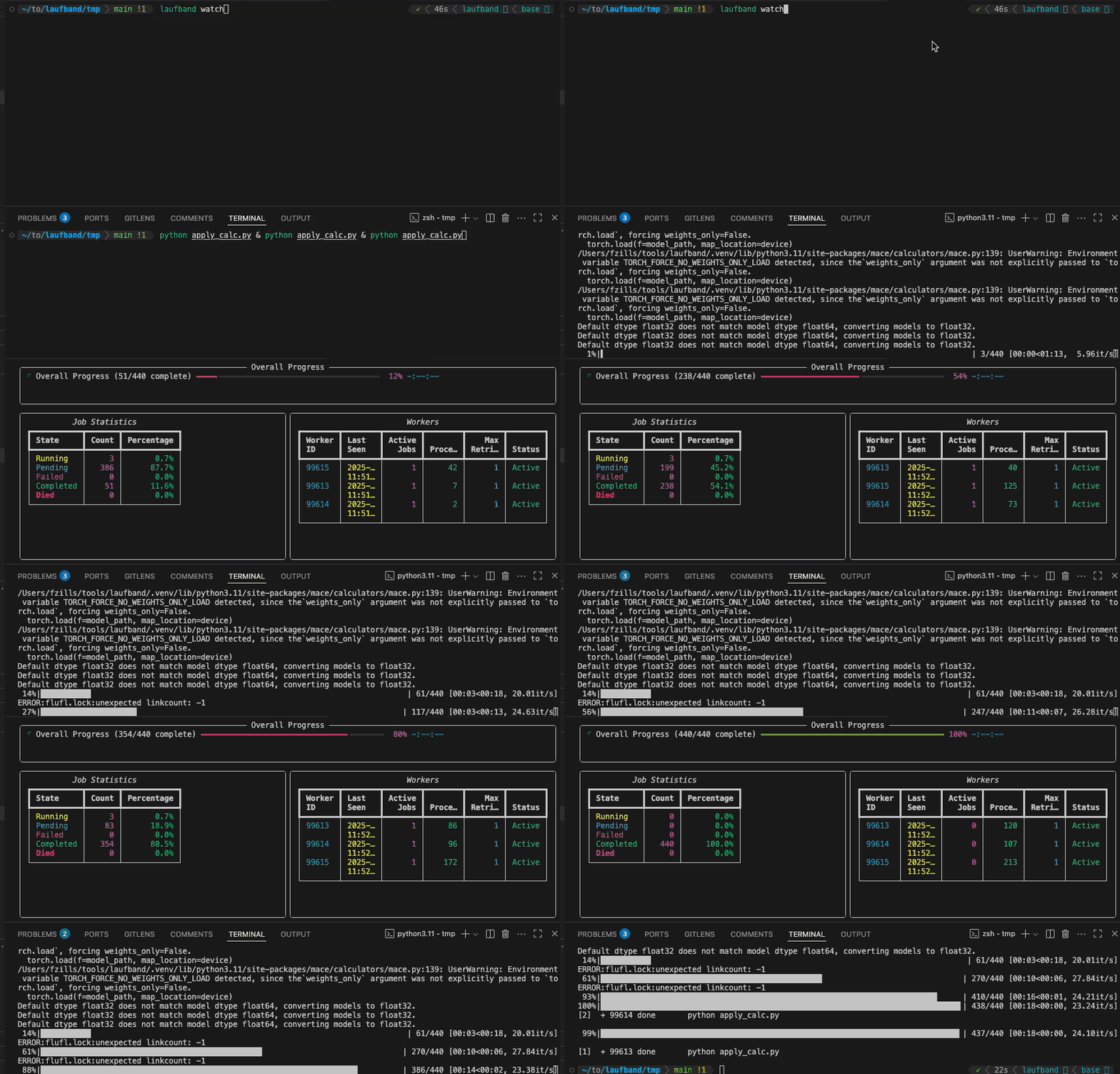
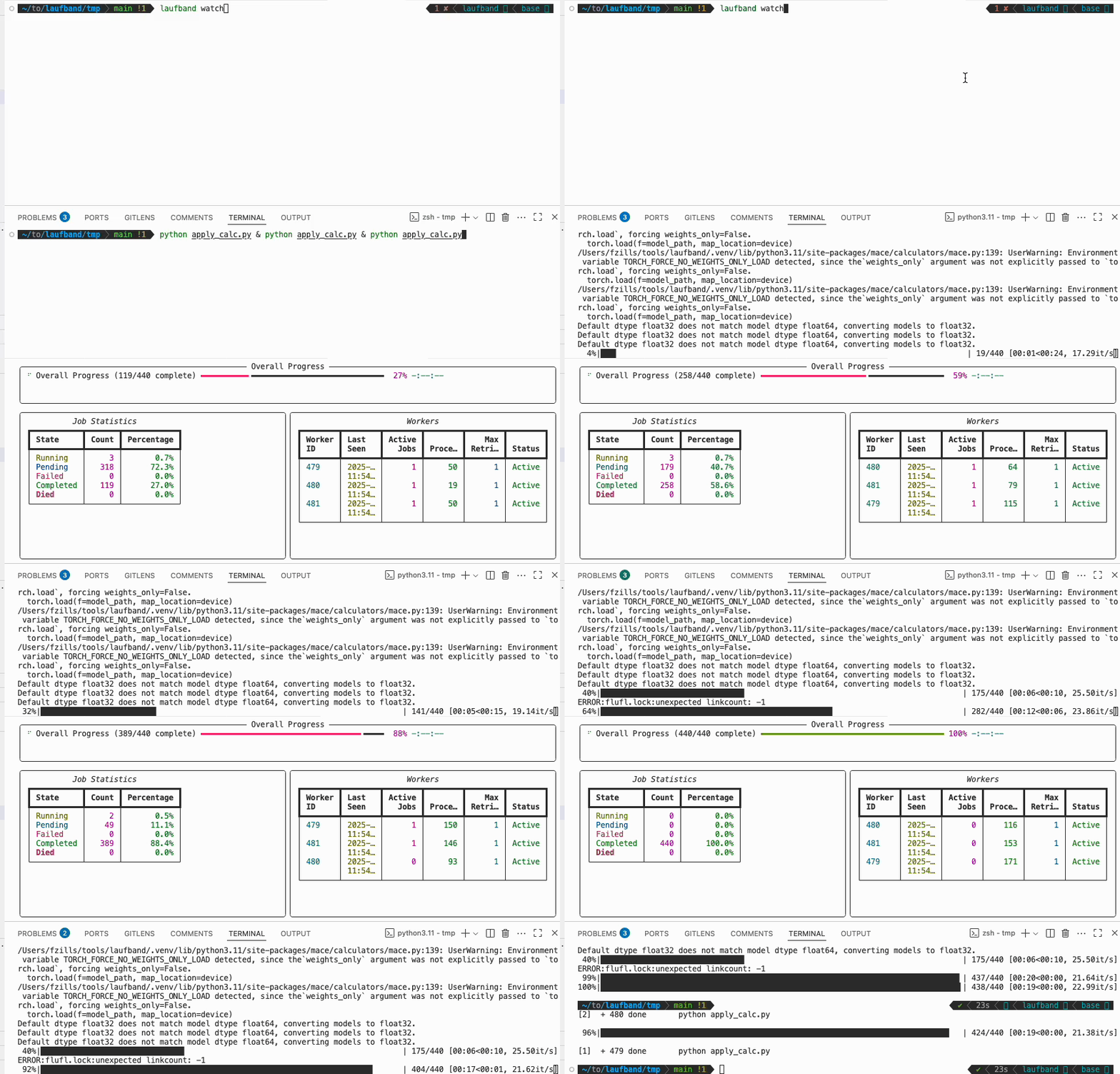
You can use the laufband watch to follow the progress across all active workers.
Graphband
Laufband supports dependency-aware tasks through laufband.Graphband.
To use this, provide an iterator that yields tasks in a valid execution order.
import networkx as nx
from laufband import Task

def graph_tasks():
    digraph = nx.DiGraph()
    edges = [
        ("a", "b"),
        ("a", "c"),
        ("b", "d"),
        ("b", "e"),
        ("c", "f"),
        ("c", "g"),
    ]
    digraph.add_edges_from(edges)
    for node in nx.topological_sort(digraph):
        yield Task(
            id=node,  # unique string representation of the task
            data=node, # optional data associated with the task
            dependencies=set(digraph.predecessors(node)), # dependencies of the task
        )
Given this generator, you can iterate the graph in parallel using laufband.Graphband.
from laufband import Graphband

worker = Graphband(graph_tasks())

for task in worker:
    print(task.id, task.data)
Labels, Requirements, and Multiple Workers per Task
You can assign requirements to your tasks and labels to workers to control their execution.
from laufband import Task, Graphband

def iterator():
    yield Task(id="task1")
    yield Task(id="task2", requirements={"gpu"})

w1 = Graphband(iterator(), identifier="w1")
w2 = Graphband(iterator(), identifier="w2", labels={"gpu"})

print([x.id for x in w1])
# ["task1"]
print([x.id for x in w2])
# ["task2"]
Sometimes a task supports internal parallel execution (e.g., nested use of laufband). In such a case, you can assign multiple workers to one task.
from laufband import Task, Graphband

def iterator():
    yield Task(id="task1", max_parallel_workers=2)
    # At most 2 workers will be assigned to this job until both successfully finish.

worker = Graphband(iterator())

for item in worker:
    # Code that can be executed multiple times, e.g., via laufband itself.
    ...
Metadata
Release files for laufband 0.2.1
For a detailed explanation of source distributions (sdists) and built distributions (wheels), please see the package formats documentation.
Source distribution (sdist)
| File | Size | Uploaded | Provenance | |
|---|---|---|---|---|
| laufband-0.2.1.tar.gz | 198.1 kB | Without provenance | Details |
Built distribution (wheel)
| File | Interpreter | ABI | Platform | Reset |
|---|---|---|---|---|
| laufband-0.2.1-py3-none-any.whl | Python 3 | none | any | Details |
Total release size: 217.9 kB
Release files / laufband-0.2.1.tar.gz
| Download URL | laufband-0.2.1.tar.gz |
|---|---|
| Size | 198.1 kB |
| Tags | Source |
|
SHA-256 checksum How to use checksums |
550083fe4bce1a95db99f4b61d9ec523121c9e37d8cbf352d02325fb2b4da06a
|
|
BLAKE2b-256 checksum How to use checksums |
9ca854a04b70936d162395c556c859047810da1a2829e5d9e077228f0132b8c9
|
| Upload date | |
|
Uploaded using Trusted Publishing? What is trusted publishing? |
No |
| Uploaded via |
uv/0.8.18
|
Release files / laufband-0.2.1-py3-none-any.whl
| Download URL | laufband-0.2.1-py3-none-any.whl |
|---|---|
| Size | 19.9 kB |
| Tags | Python 3 |
|
SHA-256 checksum How to use checksums |
d9adcae469029bf06a0ac3a9741daceb7f754b10d0661cd8b0184eb45589f019
|
|
BLAKE2b-256 checksum How to use checksums |
caccae496d34403f0e27a845d8ebb63dc32c8ce0418c4df34a97ddef188c6fbd
|
| Upload date | |
|
Uploaded using Trusted Publishing? What is trusted publishing? |
No |
| Uploaded via |
uv/0.8.18
|
Security for laufband 0.2.1
Provenance
Provenance describes where a file came from. On PyPI, provenance is shared via attestations, which provide a verifiable record of the build or publishing details. View details, limitations and caveats.
No provenance found
None of the files in this release were uploaded with provenance metadata.
A note on package security
PyPI is a repository for distributing packages, not a service for auditing them. While third-party security researchers and our staff do their best to detect and remove malicious packages, PyPI cannot guarantee the quality, security or suitability of any given package.
To learn more about protecting yourself from malicious actors, visit our package security documentation.














