

LayaEval
Ultra-Fast Neural Evaluation Framework for Agent and RAG Systems
42 production-ready metrics • Sub-50ms latency • Zero external LLM judge costs • Calibrated confidence





Highlights • Why LayaEval • Installation • Quickstart • Notebooks • How It Works • Metric Catalog • CLI Reference • Acknowledgements • License
LayaEval is an ultra-fast, developer-first Python evaluation SDK for Agentic workflows and RAG pipelines, powered by the Laya MCP Server.
LayaEval brings 42 production-grade evaluation metrics (20 RAG metrics + 22 Agent metrics) directly into your CI/CD and production verification loops—executed as calibrated, non-autoregressive neural decisions with zero external LLM API cost and sub-50ms latency.
Key Highlights
- ⚡ Sub-50ms Latency: Non-autoregressive neural verification replaces slow, multi-second LLM-as-a-judge roundtrips.
- 💰 Zero External Token Cost: No OpenAI or Anthropic API bills for running quality guardrails and regression suites.
- 🎯 42 Production-Ready Metrics: Comprehensive coverage spanning retrieval quality, groundedness, hallucination risk, multi-step agent traces, tool accuracy, policy compliance, and prompt injections.
- 🚀 Single Forward Pass Batching: Evaluates multiple metrics for an interaction in a unified forward pass for optimal throughput.
- 📊 Calibrated Confidence: Outputs statistical probabilities ($P(\text{true})$), standard confidence intervals, and configurable pass/fail thresholds.
- 🔌 Native MCP Integration: Direct connection via stdio JSON-RPC or embedded runtime to the Laya MCP ecosystem.
- 🪶 Ultra Lightweight: Zero heavy dependencies required at install time (
numpyonly).
Why LayaEval?
| Feature | Traditional LLM-as-a-Judge | LayaEval |
|---|---|---|
| Latency per Metric | 1,500ms – 5,000ms | < 50ms |
| API Cost | ~$0.01 – $0.05 per eval call | $0.00 (Zero external API fees) |
| Determinism & Calibration | Brittle prompt parsing & hallucinations | Calibrated neural probabilities & confidence |
| Multi-Metric Evaluation | Sequential calls or bloated judge prompts | Single forward-pass batching |
| CI/CD Regression Suitability | Slow, flaky, expensive | Fast, offline-capable, cost-free |
| Dependencies | Bulky orchestration frameworks | Ultra-lightweight (numpy only) |
Installation
Install via uv (recommended) or pip:
# Core package (ultra-lightweight, connects to existing laya-mcp-server)
uv add layaeval

# Or with full local Laya runtime included:
uv add "layaeval[laya]"
Using standard pip:
pip install layaeval
# Or with local Laya runtime & MCP server:
pip install "layaeval[laya]"
Google Colab / Jupyter Notebooks:
!pip install "layaeval[laya]"
Quickstart
1. Instant Multi-Metric RAG Evaluation
Evaluate multiple metrics in a single neural forward pass with zero boilerplate:
import layaeval

results = layaeval.evaluate(
    ["groundedness", "hallucination", "response_relevance"],
    query="What is the capital and population of France?",
    retrieved_context="Paris is the capital and most populous city of France, with 2.1M residents.",
    response="Paris is the capital of France, home to about 2.1 million people.",
)

for r in results:
    print(
        f"[{r.metric_name:<20}] Passed: {r.passed:<5} | Value: {r.value:.2f} | Confidence: {r.confidence:.2f}"
    )
2. Autonomous Agent Execution & Trace Evaluation
Audit multi-step tool calls, goal achievement, and task completion using metric classes or identifiers:
import layaeval
from layaeval import TaskCompletion, ToolCallAccuracy

task = "Find user #104 and check subscription status."
trace = "Step 1: db.query(user_id=104) -> Plan: Pro\nStep 2: stripe.check(sub_id=sub_104) -> Active"
result = "User #104 has an active Pro subscription."

res = layaeval.evaluate(
    TaskCompletion(threshold=0.75),
    task=task,
    agent_trace=trace,
    final_result=result,
)

print(f"Task Completed: {res.passed} (P(true) = {res.noul:.2f}, confidence = {res.confidence:.2f})")
3. Direct Callable Metric Objects
Metric objects can be instantiated with custom thresholds and called directly like standard functions:
from layaeval import Groundedness

groundedness = Groundedness(threshold=3.0)

res = groundedness(
    retrieved_context="Paris is the capital of France.",
    response="Paris is the capital.",
)

print(f"Passed: {res.passed} (Score: {res.score}/4.0 | Reason: {res.reasoning})")
4. Managed Evaluator Context
For dedicated server processes, custom models, or high-throughput batch sessions:
from layaeval import Evaluator, Groundedness, HallucinationRisk

with Evaluator(model="auto") as ev:
    results = ev.evaluate(
        [Groundedness(threshold=3.0), HallucinationRisk(threshold=0.2)],
        retrieved_context="Revenue grew by 24% year-over-year.",
        response="The company posted 24% YoY revenue growth.",
    )
    for r in results:
        print(f"{r.metric_name}: {r.passed} (Score/Risk: {r.value:.2f})")
5. Dataset Evaluation & Reporting
Run evaluations against entire benchmark datasets and generate structured summary reports:
from layaeval import EvalDataset, evaluate

dataset = EvalDataset.from_jsonl("eval_benchmark.jsonl")

report = evaluate(
    dataset,
    metrics=["groundedness", "hallucination", "response_relevance"],
    name="v1.2-rag-baseline",
)

print(f"Pass Rate: {report.pass_rate * 100:.1f}%")
print(f"Total Evaluations: {report.total_evaluations}")
report.save("eval_report.json")
Interactive Notebooks
Hands-on Jupyter notebooks with end-to-end code, real-world examples, and step-by-step walkthroughs are available in the examples/notebook/ folder:
| Evaluation Domain | Notebook File Path | Workflows & Metrics Covered | Run Command |
|---|---|---|---|
| 🔍 RAG Evaluation | examples/notebook/rag_metrics_evaluation.ipynb |
End-to-end evaluation of retrieval relevance, document relevance, context sufficiency & coverage, groundedness, hallucination detection, citation correctness, and contradiction detection. | uv run --with jupyter jupyter notebook examples/notebook/rag_metrics_evaluation.ipynb |
| 🤖 Autonomous Agents | examples/notebook/agent_metrics_evaluation.ipynb |
Multi-step agent trace auditing, task completion, tool call & parameter validation, workflow navigation efficiency, agent groundedness, policy compliance, and prompt injection detection. | uv run --with jupyter jupyter notebook examples/notebook/agent_metrics_evaluation.ipynb |
To launch the notebooks with all dependencies:
# Launch Jupyter Lab directly via uv
uv run --with jupyter jupyter lab examples/notebook/
How It Works
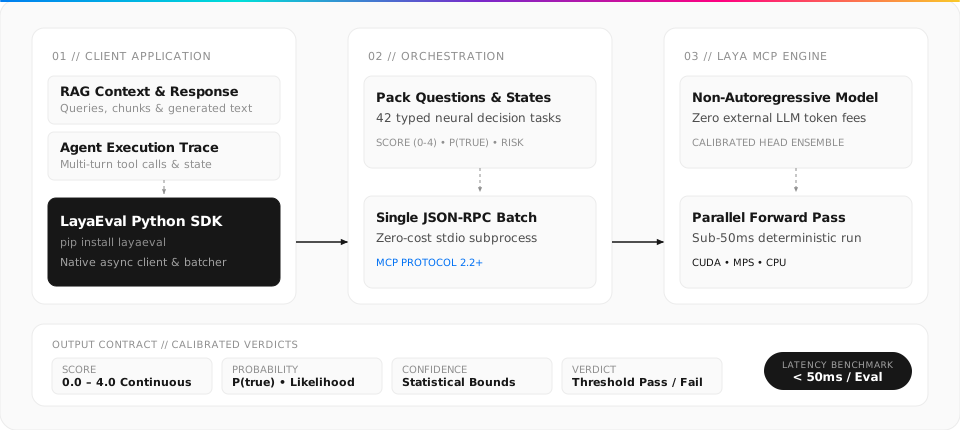
View Mermaid Source
flowchart LR
    subgraph Client["Your Application / Pipeline"]
        A["RAG Context & Response"] --> C["LayaEval SDK"]
        B["Agent Execution Trace"] --> C
    end

    subgraph Batcher["LayaEval Orchestrator"]
        C --> D["Pack Questions & States"]
        D --> E["Single JSON-RPC / MCP Request"]
    end

    subgraph MCP["Laya MCP Server"]
        E --> F["Non-Autoregressive Neural Model"]
        F --> G["Multi-Question Forward Pass"]
    end

    G --> H["Calibrated Verdicts\nScore (0-4) • P(true) • Confidence"]
    H --> C
- State Aggregation: You supply standard state keys (
query,retrieved_context,response,agent_trace, etc.). - Batch Construction: LayaEval compiles the requested metrics into typed neural decision prompts.
- Sub-50ms Inference: The Laya MCP Server runs a non-autoregressive forward pass, returning calibrated probabilities rather than generating arbitrary text tokens.
- Normalized Results: Every output is mapped to a typed
EvalResultwith normalized scores, confidence intervals, and pass/fail statuses against your specified thresholds.
Supported Metrics Catalog
LayaEval uses three calibrated output types:
- Score (0.0 – 4.0): Graded rubric (0: poor, 1: weak, 2: partial, 3: mostly good, 4: perfect). Default pass threshold is $\ge 3.0$.
- Probability $P(\text{true})$ (0.0 – 1.0): Calibrated likelihood for positive qualities. Default pass threshold is $\ge 0.50$ (or $\ge 0.70$).
- Risk Probability $P(\text{true}) \le \text{threshold}$: Calibrated likelihood of negative events (hallucination, contradiction, security injection). Safe pass threshold is $\le 0.20$ or $\le 0.30$.
1. RAG Metrics Guide (20 Metrics)
📓 Interactive Notebook: Open
examples/notebook/rag_metrics_evaluation.ipynbfor runnable code examples of each RAG metric.
| Metric & ID | Definition | Type / Scale | Good Score (Pass) | Bad Score (Fail) | Required Inputs |
|---|---|---|---|---|---|
RetrievalRelevanceRAG-001 • retrieval_relevance |
Measures how relevant the retrieved context chunks are to the user's question. | Score (0–4) | $\ge 3.0$ Context directly addresses question |
$< 2.0$ Context is noisy or off-topic |
query, retrieved_context |
DocumentRelevanceRAG-002 • document_relevance |
Evaluates whether a single specific document chunk contains pertinent information. | Score (0–4) | $\ge 3.0$ Document is strongly relevant |
$< 2.0$ Document contains useless data |
query, document |
ContextSufficiencyRAG-003 • context_sufficient |
Checks if the retrieved context has all needed facts to answer without guessing. | $P(\text{true})$ (0–1) | $P \ge 0.50$ Sufficient facts to answer |
$P < 0.50$ Critical information missing |
query, retrieved_context |
ContextCoverageRAG-004 • context_coverage |
Quantifies what fraction of the required information is present in the context. | Score (0–4) | $\ge 3.0$ Covers almost all required details |
$< 2.0$ Major knowledge gaps |
query, retrieved_context |
RetrievalCompletenessRAG-005 • retrieval_completeness |
Evaluates whether retrieved evidence is complete or missing major pieces. | Score (0–4) | $\ge 3.0$ Complete evidence package |
$< 2.0$ Fragmented / incomplete evidence |
query, retrieved_context |
GroundednessRAG-006 • groundedness |
Measures how well the response statements are supported by facts in the context. | Score (0–4) | $\ge 3.0$ Claims solidly backed by context |
$< 2.0$ Unverified claims made |
retrieved_context, response |
StrictGroundednessRAG-007 • strictly_grounded |
Strict binary verification that every material claim in the response is proven. | $P(\text{true})$ (0–1) | $P \ge 0.50$ 100% of claims verified |
$P < 0.50$ Contains unverified claim(s) |
retrieved_context, response |
HallucinationRiskRAG-008 • hallucination |
Detects whether the response fabricates facts unsupported by the retrieved context. | Risk $P \le \text{max}$ | $P \le 0.30$ Zero/minimal hallucination risk |
$P > 0.30$ Fabricated facts detected |
retrieved_context, response |
ResponseRelevanceRAG-009 • response_relevance |
Evaluates how directly and appropriately the response answers the user's query. | Score (0–4) | $\ge 3.0$ Directly answers user question |
$< 2.0$ Rambling, evasive, or off-topic |
query, response |
ResponseCompletenessRAG-010 • response_completeness |
Checks whether the response answers all sub-questions and key parts of the query. | Score (0–4) | $\ge 3.0$ All questions addressed |
$< 2.0$ Key questions left unanswered |
query, response |
FactualCorrectnessRAG-011 • factual_correctness |
Compares the generated response against a reference ground-truth answer. | Score (0–4) | $\ge 3.0$ Accurately matches ground truth |
$< 2.0$ Factually conflicts with ground truth |
query, response, ground_truth |
AnswerabilityRAG-012 • answerable |
Checks if the question can realistically be answered given the retrieved context. | $P(\text{true})$ (0–1) | $P \ge 0.50$ Question is answerable |
$P < 0.50$ Context cannot answer question |
query, retrieved_context |
AbstentionCorrectnessRAG-013 • abstention_correct |
Verifies if the model appropriately refused to answer when context was missing. | $P(\text{true})$ (0–1) | $P \ge 0.50$ Correct decision to answer/abstain |
$P < 0.50$ Answered blindly without facts |
query, retrieved_context, response |
ContextUtilizationRAG-014 • context_utilization |
Checks how effectively the response incorporated available facts from context. | Score (0–4) | $\ge 3.0$ Appropriately uses provided facts |
$< 2.0$ Ignores relevant facts in context |
retrieved_context, response |
CitationCorrectnessRAG-015 • citation_correctness |
Verifies whether inline citations accurately support the claim they are attached to. | Score (0–4) | $\ge 3.0$ Citations accurately back claim |
$< 2.0$ Citations point to wrong text |
query, response, citations, cited_source_text |
CitationCompletenessRAG-016 • citation_completeness |
Measures whether all important factual claims include appropriate citations. | Score (0–4) | $\ge 3.0$ All major claims properly cited |
$< 2.0$ Claims made without citations |
response, citations |
CitationRelevanceRAG-017 • citation_relevance |
Evaluates if the cited source document is directly relevant to the specific claim. | Score (0–4) | $\ge 3.0$ Source is pertinent to claim |
$< 2.0$ Cited source is irrelevant |
claim, citation, source_text |
ClaimSupportRAG-018 • claim_supported |
Tests whether a single isolated claim is directly corroborated by given evidence. | $P(\text{true})$ (0–1) | $P \ge 0.50$ Claim is directly supported |
$P < 0.50$ Evidence does not back claim |
claim, evidence |
ContradictionDetectionRAG-019 • contradiction |
Detects if the response directly contradicts or refutes facts stated in the context. | Risk $P \le \text{max}$ | $P \le 0.20$ No contradictions found |
$P > 0.20$ Contradicts retrieved context |
context, response |
ContextConflictDetectionRAG-020 • context_conflict |
Flags when two or more retrieved source documents provide conflicting information. | Risk $P \le \text{max}$ | $P \le 0.30$ Sources are in agreement |
$P > 0.30$ Sources present conflicting facts |
query, retrieved_context |
2. Agent Metrics Guide (22 Metrics)
📓 Interactive Notebook: Open
examples/notebook/agent_metrics_evaluation.ipynbfor runnable code examples of each Agent metric.
| Metric & ID | Definition | Type / Scale | Good Score (Pass) | Bad Score (Fail) | Required Inputs |
|---|---|---|---|---|---|
IntentResolutionAG-001 • intent |
Classifies the user's primary intent (information, action, troubleshooting, etc.). | Choice (Category) | Confidence $\ge 0.70$ Correct intent identified |
Low confidence Misclassified or ambiguous intent |
query |
TaskCompletionAG-002 • task_completed |
Verifies whether the agent fully finished the task and produced the expected result. | $P(\text{true})$ (0–1) | $P \ge 0.50$ Task completed successfully |
$P < 0.50$ Task aborted or left incomplete |
task, agent_trace, final_result |
TaskAdherenceAG-003 • task_adherence |
Measures how strictly the agent adhered to instructions, constraints, and guidelines. | Score (0–4) | $\ge 3.0$ Followed instructions fully |
$< 2.0$ Ignored or broke constraints |
instructions, query, agent_trace, response |
GoalAchievementAG-004 • goal_achieved |
Checks whether the agent's actions achieved the true underlying objective. | $P(\text{true})$ (0–1) | $P \ge 0.50$ End goal accomplished |
$P < 0.50$ Underlying goal not achieved |
goal, agent_trace, final_result |
ToolSelectionAG-005 • tool_selection |
Identifies which tool is the optimal choice for the current step in the workflow. | Choice (Category) | Confidence $\ge 0.70$ Optimal tool selected |
Low confidence Wrong tool selected |
task, available_tools, selected_tool |
ToolSelectionCorrectnessAG-006 • tool_selection_correct |
Verifies whether the tool chosen by the agent was appropriate for the task step. | $P(\text{true})$ (0–1) | $P \ge 0.50$ Correct tool selected |
$P < 0.50$ Inappropriate tool chosen |
task, tool_definition, selected_tool |
ToolCallAccuracyAG-007 • tool_call_accuracy |
Evaluates whether the generated tool call was structured and executed correctly. | Score (0–4) | $\ge 3.0$ Accurate, valid tool invocation |
$< 2.0$ Malformed or invalid tool call |
task, tool_definition, tool_call |
ToolInputAccuracyAG-008 • tool_input_accuracy |
Checks whether tool input arguments are correct, schema-compliant, and accurate. | Score (0–4) | $\ge 3.0$ Valid and correct arguments |
$< 2.0$ Invalid, missing, or fake params |
task, tool_schema, tool_input |
ToolOutputUtilizationAG-009 • tool_output_utilization |
Measures how well the agent leveraged tool return values in next steps or answers. | Score (0–4) | $\ge 3.0$ Correctly used tool output |
$< 2.0$ Ignored or misinterpreted output |
task, tool_output, subsequent_actions, final_response |
ToolNecessityAG-010 • tool_needed |
Evaluates whether invoking this tool was truly necessary or could be avoided. | $P(\text{true})$ (0–1) | $P \ge 0.50$ Tool was genuinely necessary |
$P < 0.50$ Unnecessary or extraneous call |
task, available_context, tool_call |
ToolRedundancyAG-011 • tool_call_redundant |
Flags whether the agent repeated a call for data it already had in prior turns. | Risk $P \le \text{max}$ | $P \le 0.30$ Non-redundant, clean execution |
$P > 0.30$ Wasted, redundant tool call |
task, prior_tool_calls, current_tool_call |
ToolSequenceCorrectnessAG-012 • tool_sequence |
Evaluates whether the multi-step ordering of tool calls was logical and optimal. | Score (0–4) | $\ge 3.0$ Optimal, logical sequence |
$< 2.0$ Disordered or illogical steps |
task, executed_sequence, expected_sequence |
NavigationEfficiencyAG-013 • navigation_efficiency |
Evaluates how directly the agent reached the solution without useless steps or loops. | Score (0–4) | $\ge 3.0$ Direct path with few extra steps |
$< 2.0$ Inefficient path with retry loops |
task, agent_trace, expected_workflow |
AgentGroundednessAG-014 • agent_groundedness |
Measures if the agent's final answer is supported by observed tool outputs. | Score (0–4) | $\ge 3.0$ Backed by tool observations |
$< 2.0$ Claims unsupported by tool data |
tool_outputs, context, response |
AgentHallucinationRiskAG-015 • agent_hallucination |
Detects if the agent fabricated action outcomes not present in execution evidence. | Risk $P \le \text{max}$ | $P \le 0.30$ No fabricated results |
$P > 0.30$ Fictitious action results claimed |
tool_outputs, context, response |
AgentResponseRelevanceAG-016 • agent_response_relevance |
Evaluates how directly the agent's final message responds to the user's prompt. | Score (0–4) | $\ge 3.0$ Directly answers user request |
$< 2.0$ Off-topic or misses the request |
query, response |
AgentAnswerCompletenessAG-017 • agent_answer_completeness |
Checks whether the agent's final response covers all parts of the assigned task. | Score (0–4) | $\ge 3.0$ Thorough, complete resolution |
$< 2.0$ Incomplete, leaves items pending |
task, response |
AgentCorrectnessAG-018 • agent_correct |
Compares the agent's final outcome against expected ground-truth answers. | Score (0–4) | $\ge 3.0$ Matches ground-truth outcome |
$< 2.0$ Incorrect or conflicting outcome |
task, final_result, ground_truth |
AgentAbstentionAG-019 • should_abstain |
Verifies whether the agent properly abstains from unauthorized or impossible actions. | $P(\text{true})$ (0–1) | $P \ge 0.50$ Safely refuses out-of-scope tasks |
$P < 0.50$ Recklessly executes unsafe action |
task, context, response, available_tools |
PolicyComplianceAG-020 • policy_compliant |
Checks whether the agent's actions and responses adhered to policies & guardrails. | $P(\text{true})$ (0–1) | $P \ge 0.50$ Fully compliant with policy |
$P < 0.50$ Policy violation detected |
policy, task, agent_trace, response |
PromptInjectionDetectionAG-021 • prompt_injection |
Detects direct user jailbreak attempts or instruction overrides in user prompts. | Risk $P \le \text{max}$ | $P \le 0.20$ Safe, benign prompt |
$P > 0.20$ Direct injection attack detected |
user_input, system_instructions |
IndirectPromptInjectionDetectionAG-022 • indirect_prompt_injection |
Detects hidden adversarial commands inside retrieved third-party text or tool data. | Risk $P \le \text{max}$ | $P \le 0.20$ Safe third-party content |
$P > 0.20$ Indirect injection payload found |
retrieved_or_tool_content, system_instructions |
CLI Usage
LayaEval includes a command-line interface for testing, batch benchmarking, and regression comparison:
# List all 42 available metrics with descriptions
layaeval list-metrics

# Evaluate a JSONL dataset with selected metrics
layaeval run dataset.jsonl --metrics groundedness hallucination task_completed --output report.json

# Compare candidate run against a baseline to check for regressions
layaeval compare baseline_report.json candidate_report.json
Development & Testing
Run unit tests and lint checks using uv:
# Install dev dependencies
uv sync --all-extras

# Run test suite
uv run pytest

# Check code formatting and linting
uv run ruff check .
Acknowledgements & Special Thanks
Special thanks and gratitude to the Laya open-source contributors and community. LayaEval is powered by the foundational non-autoregressive neural architectures, latency breakthroughs, and high-performance Model Context Protocol (MCP) server engineered by the Laya project.
- Laya GitHub Repository: github.com/NandhaKishorM/laya
- Laya MCP Ecosystem & Docs: github.com/NandhaKishorM/laya/blob/main/docs
License
This project is licensed under the Apache License 2.0. See the LICENSE file for details.
1 maintainer

Metadata
1 maintainer
Release files for layaeval 0.1.3
For a detailed explanation of source distributions (sdists) and built distributions (wheels), please see the package formats documentation.
Source distribution (sdist)
| File | Size | Uploaded | |
|---|---|---|---|
| layaeval-0.1.3.tar.gz | 34.2 kB | Details |
Built distribution (wheel)
| File | Interpreter | ABI | Platform | Reset |
|---|---|---|---|---|
| layaeval-0.1.3-py3-none-any.whl | Python 3 | none | any | Details |
Total release size: 67.4 kB
Release files / layaeval-0.1.3.tar.gz
| Download URL | layaeval-0.1.3.tar.gz |
|---|---|
| Size | 34.2 kB |
| Tags | Source |
|
SHA-256 checksum How to use checksums |
7823da4c4221cca338ee301ca67d5fbc790ad069cd31cd7eecf9eed79ec9f973
|
|
BLAKE2b-256 checksum How to use checksums |
8684a3bfe57194add9ba495fb3c9c446fa8e4eb67d0df62111aa0beefa3eff52
|
| Upload date | |
|
Uploaded using Trusted Publishing? What is trusted publishing? |
No |
| Uploaded via |
uv/0.12.23 {"installer":{"name":"uv","version":"0.12.23","subcommand":["publish"]},"python":null,"implementation":{"name":null,"version":null},"distro":{"name":"macOS","version":null,"id":null,"libc":null},"system":{"name":null,"release":null},"cpu":null,"openssl_version":null,"setuptools_version":null,"rustc_version":null,"ci":null}
|
Release files / layaeval-0.1.3-py3-none-any.whl
| Download URL | layaeval-0.1.3-py3-none-any.whl |
|---|---|
| Size | 33.2 kB |
| Tags | Python 3 |
|
SHA-256 checksum How to use checksums |
cc86f074dcca949428a3600bb2f189a4ad0c5da9904534752cbd31d0341fb7ff
|
|
BLAKE2b-256 checksum How to use checksums |
922cac2b93b4dd3f6c43de34770bf59d7bfbe51302b789e7204d409939d6d7dc
|
| Upload date | |
|
Uploaded using Trusted Publishing? What is trusted publishing? |
No |
| Uploaded via |
uv/0.12.23 {"installer":{"name":"uv","version":"0.12.23","subcommand":["publish"]},"python":null,"implementation":{"name":null,"version":null},"distro":{"name":"macOS","version":null,"id":null,"libc":null},"system":{"name":null,"release":null},"cpu":null,"openssl_version":null,"setuptools_version":null,"rustc_version":null,"ci":null}
|














