


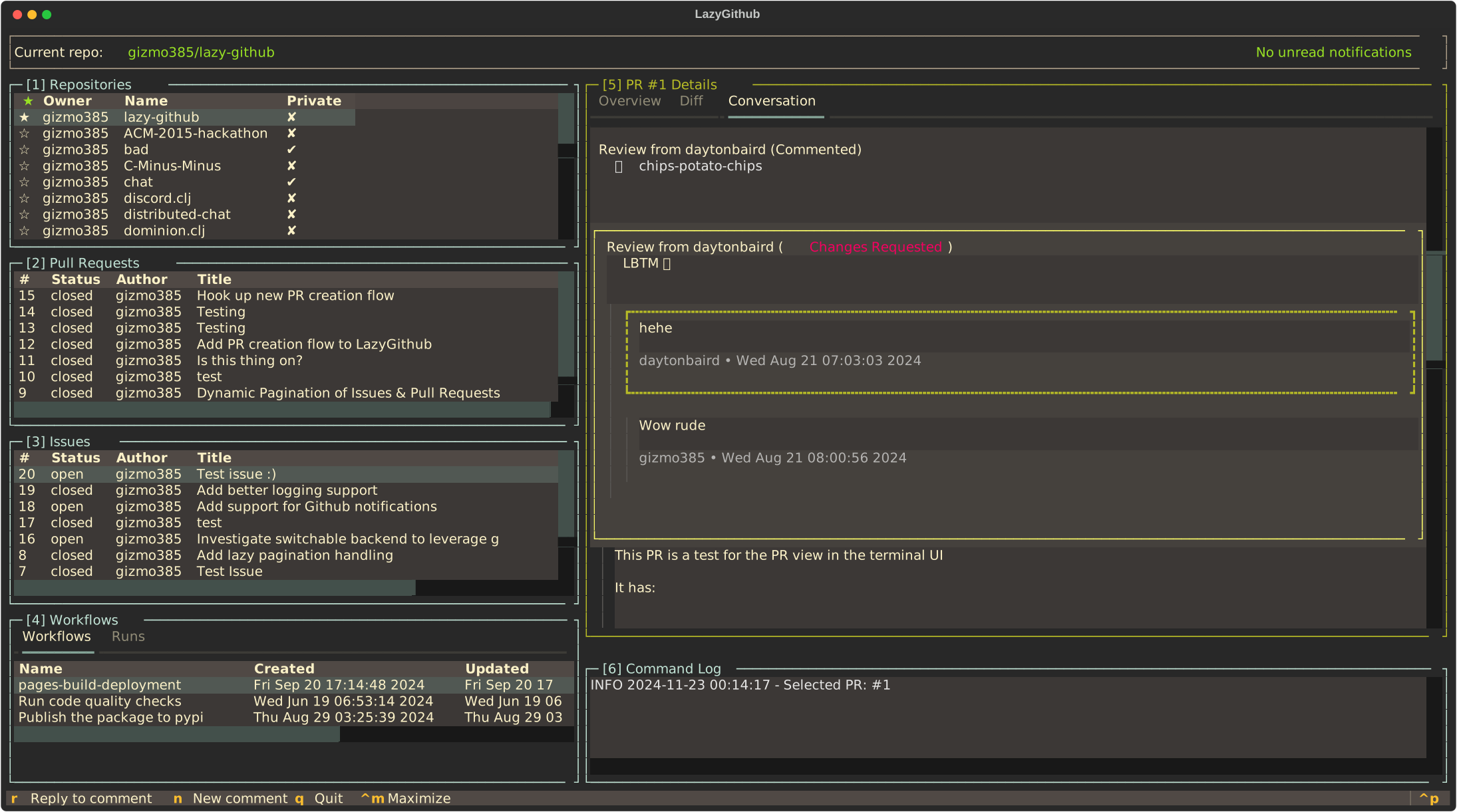
LazyGithub is a terminal UI client for interacting with GitHub. It draws heavy inspiration from the lazygit project and uses Textual to drive the terminal UI interactions.
How to Use It
Installing with the Github CLI
If you have the Github CLI installed, you can install LazyGithub as an extension with gh extension install gizmo385/gh-lazy and then running gh lazy to run it.
Installing from PyPi
You can run the most recently built version by installing it from PyPI. If you have uv installed, you can do that easily with uvx lazy-github.
When you first start LazyGithub, you will be prompted with a device login code and a link to GitHub where you will be able to authenticate the app against your account. This allows the app to act on your behalf and is necessary for LazyGithub to function.
Currently, it supports the following:
- Listing the repositories associated with your account
- Listing the issues, pull requests, and actions on your repositories
- Listing the details, diff, and reviews on any of those pull requests
- Detailed issue and pull request views, including conversation participation
Reporting Bugs
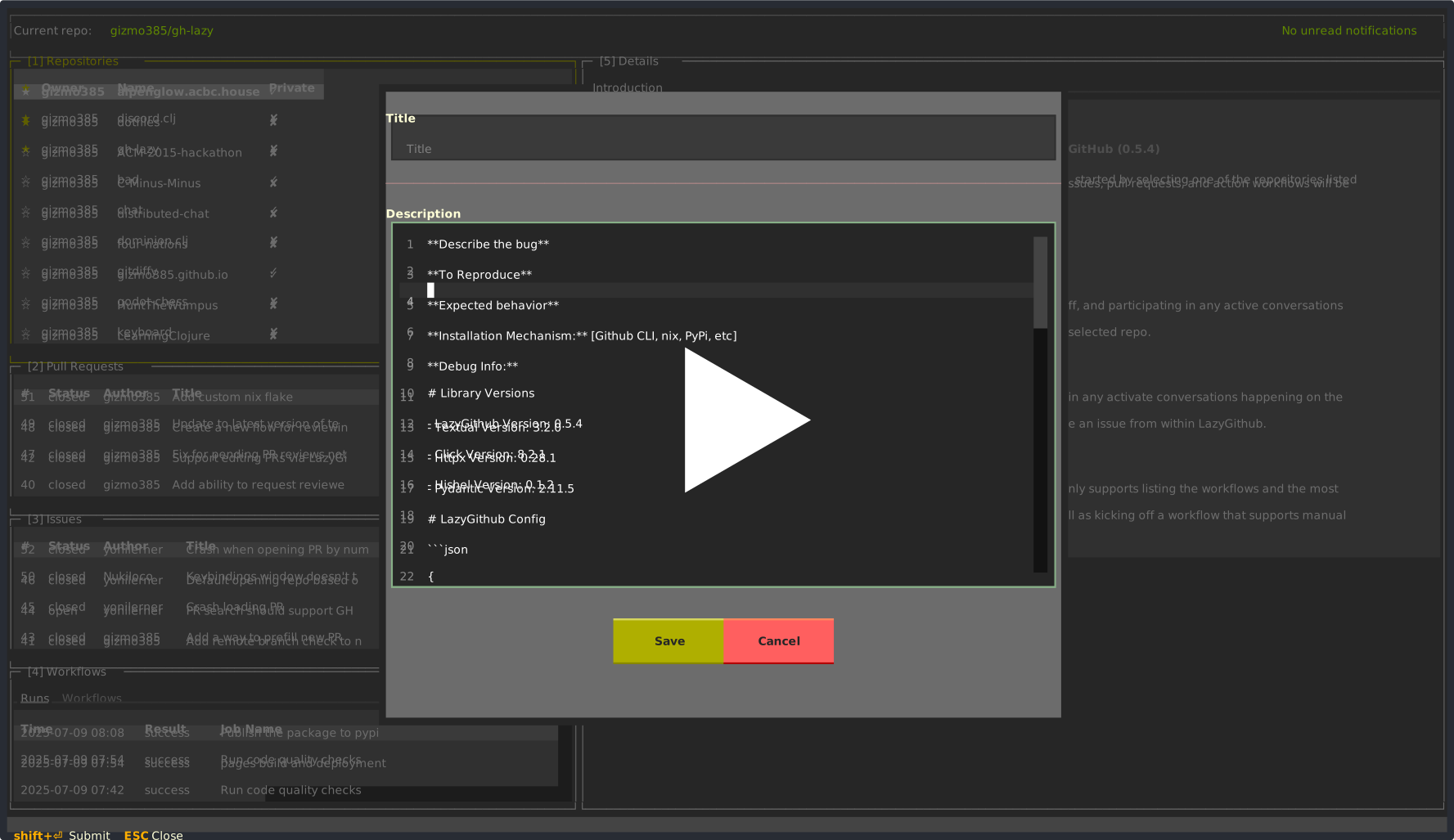
If you run into any bugs while using LazyGithub, please let me know! You can do this by creating a
new bug report or search
for Open Bug Report in the command pallete from inside LazyGithub.
Running Locally
If you wish to run it from a local clone of the repository, you can do so by running the ./start.sh located in the root of the repo.
Customization
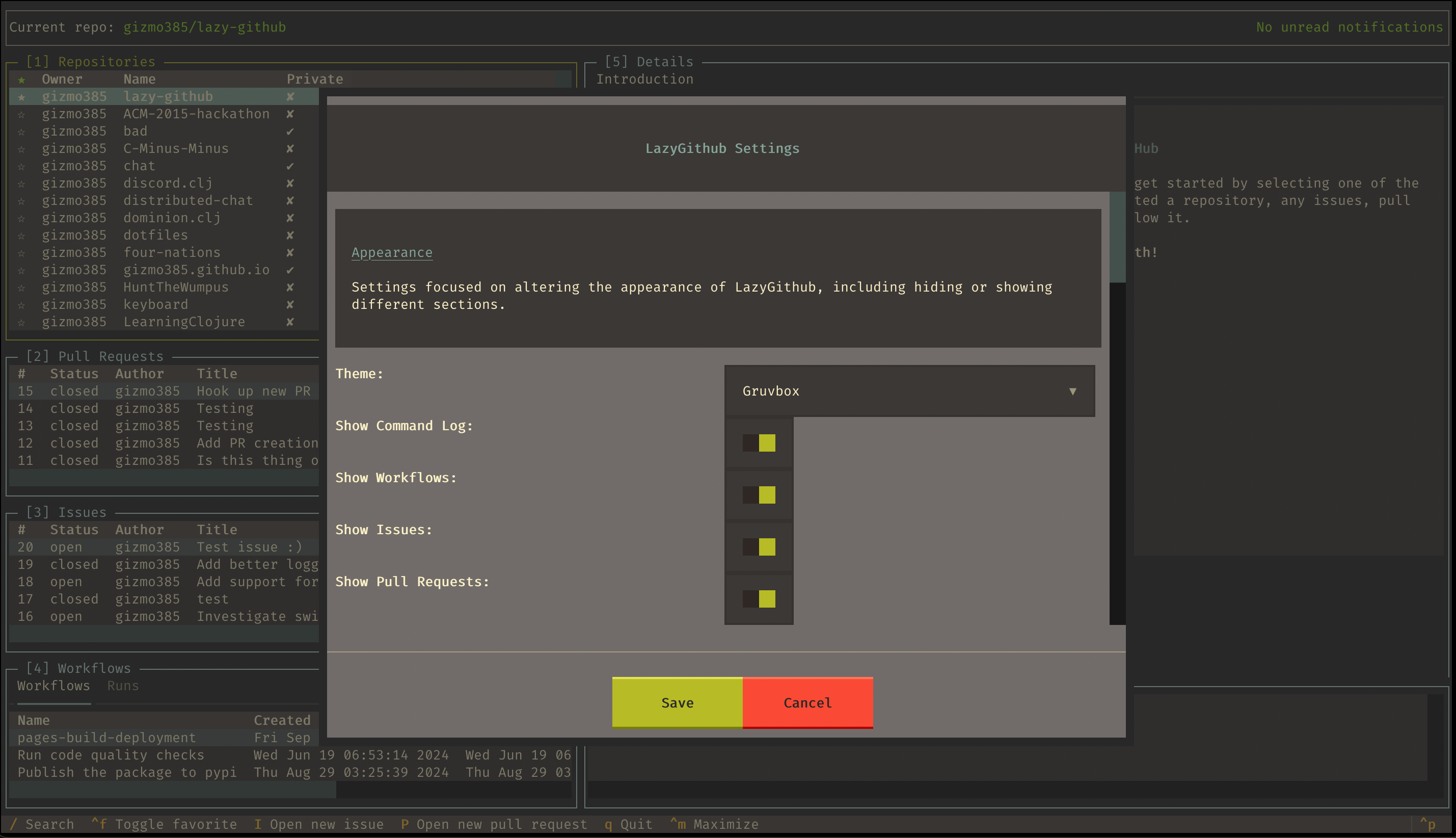
LazyGithub supports a number of customization options, all of which are stored in $HOME/.config/lazy-github/config.json.
These can be edited manually via changing the config or by opening the settings management UI within LazyGithub. That UI
can be accessed via the command pallete (CMD+p) and then searching for settings.
1 maintainer

Release files for lazy-github 0.6.6
For a detailed explanation of source distributions (sdists) and built distributions (wheels), please see the package formats documentation.
Source distribution (sdist)
| File | Size | Uploaded | |
|---|---|---|---|
| lazy_github-0.6.6.tar.gz | 1.3 MB | Details |
Built distribution (wheel)
| File | Interpreter | ABI | Platform | Reset |
|---|---|---|---|---|
| lazy_github-0.6.6-py3-none-any.whl | Python 3 | none | any | Details |
Total release size: 1.4 MB
Release files / lazy_github-0.6.6.tar.gz
| Download URL | lazy_github-0.6.6.tar.gz |
|---|---|
| Size | 1.3 MB |
| Tags | Source |
|
SHA-256 checksum How to use checksums |
4cd9ea9ddcf0f32a3c79d8fd2c7e633c12edc6c2511a9ce144e6694db8c4ab50
|
|
BLAKE2b-256 checksum How to use checksums |
0603c58494bc7daaac172955c9145aad66826eb9da155a8d24e89c8f7dc4b108
|
| Upload date | |
|
Uploaded using Trusted Publishing? What is trusted publishing? |
Yes |
| Uploaded via |
twine/6.1.0 CPython/3.13.12
|
Provenance
Provenance describes where a file came from. On PyPI, provenance is shared via attestations, which provide a verifiable record of the build or publishing details. View details, limitations and caveats.


PyPI Publish Attestation
PyPI verified that this artifact, at this checksum, originated from the publisher listed below.
Signed by GitHub Actions, verified by PyPI on May 3, 2026.
Transparency logRelease files / lazy_github-0.6.6-py3-none-any.whl
| Download URL | lazy_github-0.6.6-py3-none-any.whl |
|---|---|
| Size | 115.9 kB |
| Tags | Python 3 |
|
SHA-256 checksum How to use checksums |
e5bd8fb466fc0a434bbb7cd84448553af961810f160a2a823371474a9a68d532
|
|
BLAKE2b-256 checksum How to use checksums |
7f09975f5a9529daffa19b42f3f0a404622c2f89f8dd9805827ae3bd486a5c56
|
| Upload date | |
|
Uploaded using Trusted Publishing? What is trusted publishing? |
Yes |
| Uploaded via |
twine/6.1.0 CPython/3.13.12
|
Provenance
Provenance describes where a file came from. On PyPI, provenance is shared via attestations, which provide a verifiable record of the build or publishing details. View details, limitations and caveats.
PyPI Publish Attestation
PyPI verified that this artifact, at this checksum, originated from the publisher listed below.
Signed by GitHub Actions, verified by PyPI on May 3, 2026.
Transparency log













