
lexindex







Compact, immutable string ↔ id indexes for huge catalogs, with a Rust core, Python bindings and a C ABI.
Build once over a set of strings — entity names, document keys, vocabulary terms, cluster labels —
persist a flat blob, and query it many times, memory-mapped where the structure allows. Pairs with
betula-cluster (string ids ↔ cluster ids, both ways)
but stands on its own.
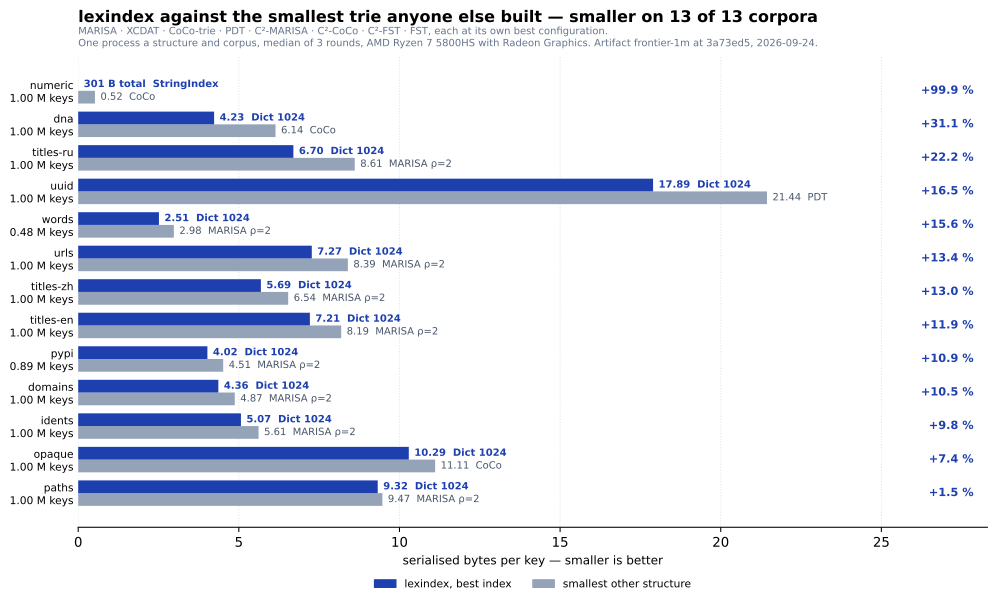
Thirteen corpora at a million keys against MARISA, XCDAT, CoCo-trie, PDT and the C² benchmark's
structures, each at its own best configuration — the protocol, the ten-million-key table and every
other structure are in the benchmarks.
The figure is the size axis, which DictIndex wins; its search is 1.2× to 5.1× slower than XCDAT's
at a million keys and 1.1× to 1.8× past ten million on five corpora of six. HashedDictIndex
(4.1) wins the latency axis as well: the same dictionary with its id answered by a perfect hash
is 3.9× to 8.9× faster than XCDAT 15 and 1.4× to 3.2× smaller, on all thirteen corpora at a million
keys and all six at ten million — and 3.1× to 7.6× faster and 1.2× to 2.8× smaller with an 8-bit
fingerprint that turns away all but one stranger in 256. An exact answer for a stranger is still
the dictionary's search, and there XCDAT keeps its lead. Every column is in
the benchmarks, and
none is quoted here without the others.
Six indexes
StringIndex |
DictIndex |
HashedDictIndex |
CompactHashIndex |
ClosedHashIndex |
PerfectHashIndex |
|
|---|---|---|---|---|---|---|
string → id |
✅ | ✅ | ✅ | ✅ | ✅ | ✅ |
id → string |
✅ | ✅ | ✅ | — | — | ✅ |
ordered ids, ranges, lower_bound |
✅ | ✅ | ✅ | — | — | — |
| prefix | ✅ | ✅ | ✅ | — | — | — |
| common prefix · longest prefix | ✅ | ✅ | ✅ | — | — | — |
| fuzzy · subsequence | ✅ | — | — | — | — | — |
| membership | exact | exact | 2^-bits false positives ² |
2^-bits false positives |
none: closed vocabulary | exact |
Overlay edits |
✅ | — | — | ✅ | — | ✅ |
zero-copy load_mmap |
✅ | ✅ ¹ | ✅ ¹ | ✅ | — | ✅ |
| bytes/key, 480 k English words | 5.95 | 2.64 | 5.25 · 6.25 at 8 bits | 1.24 · 0.74 at 4 bits | 0.24 | 10.88 |
id, 1 M word bigrams |
319 ns | 445 ns | 82 ns · id_unchecked 65 |
62 ns | the bare perfect hash | 113 ns · id_unchecked 51 |
| Cargo feature | — | — | mph |
mph (default) |
mph |
mph |
¹ DictIndex maps every section but the per-block samples — eight bytes a block, one byte per
thirty-two keys at the default block — which two binary searches read on every lookup and which are
therefore read into memory rather than borrowed. HashedDictIndex maps its dictionary the same way
and its rank table whole. ² At zero fingerprint bits id is the dictionary's own search, exact and
at its cost, and the hash is id_unchecked, which answers a stranger with some rank below n.
StringIndex— an ordered index that is the finite-state transducer (fst) alone: exactstring ↔ id, prefix, common prefix (the keys a query starts with, in one walk), range, predecessor / successor, fuzzy (bounded Levenshtein distance), subsequence and lazy in-order iteration, all automata over the FST with no key list to scan. Autocomplete, fuzzy search, ordered browse.DictIndex— an ordered dictionary with the key stored for every id:string ↔ rankboth ways,lower_bound,prefix,common_prefix,range, in-order iteration — no automata, so no fuzzy. The sorted keys front-coded in blocks of 256, each cut into microblocks of 16, the suffixes coded per shard under a symbol table or a packed alphabet — whichever that shard's own bytes prefer — over a phrase dictionary mined from the whole blob where repeated spans pay for it: 2.64 bytes/key, 56 % belowStringIndex,id333–335 ns against its 256–270,key_into194–196 against itskeyat 441–448. A prefix is a range here, not an automaton walk, soprefix_countis two order lookups — 483 ns wheremarisa-triemust enumerate every match to count it (119 840). Every block from 32 to 1024 comes in under everymarisa-triesetting measured on this corpus — 2.85 down to 2.51 against its 2.96–3.07. Over the eleven-corpus sweep at a million keys it is the smaller of the two on ten, against marisa's best setting on each and not its default: 1.6 % ontitles-zhup to 78 % ondna, withpathsthe one it loses, by 5.3 %. At those same settings it answers faster on all butnumerictoo, 1.5–5.7×. Exact queries, every id back to its key, small.HashedDictIndex— aDictIndexwhoseidis a hash: the dictionary kept whole, and beside it a minimal perfect hash and a table holding each key's rank at its slot, soidis a hash and a read where the dictionary searches, whilekey(id), prefix, range and iteration are the dictionary's own, on the same ids. Against XCDAT, the fastest trie measured, over thirteen corpora at a million keys and six at ten million: 3.9–8.9× faster and 1.4–3.2× smaller throughid_unchecked, for 2.62 bytes a key over the dictionary on real words, and 3.1–7.6× faster and 1.2–2.8× smaller throughidwith an 8-bit fingerprint — a byte a key more — that turns away all but one stranger in 256. The dictionary's queries, and a hash'sid.CompactHashIndex— the smalleststring → dense idmap that can reject a non-member: an in-crate minimal perfect hash plus a fingerprint per key, no keys stored. 1.24 bytes/key on real words — 2.4× belowmarisa-trie— and 0.74 at a 4-bit fingerprint (6.25 % false positives), for probabilistic membership (about2^-bits) and no reverse lookup. Footprint first, a rare false positive acceptable.ClosedHashIndex— the perfect hash and nothing else:id(key) -> u32, noOption— a member's id, and some id in[0, n)for anything else. 0.24 bytes/key, a fifth ofCompactHashIndex, and a lookup atid_unchecked's cost (19.8 ns on the dictionary, against 24.7 for the fingerprint-checkedid). A token → id map where every query is a member by construction.PerfectHashIndex— the perfect hash with the keys stored: verified membership andid → key, no ordering.id_uncheckedskips the compare and runs 4.8× as fast asstd::HashMap;fingerprints=Trueadds one byte per key so an absent key stops after one cache miss instead of two (166 → 74 ns on the dictionary) — a stop list, a block list. A fixed-vocabulary token ↔ id map on a hot path.
All six assign dense ids in [0, n), build deterministically and serialise to a flat blob:
save / load everywhere, zero-copy load_mmap where there is more than the perfect hash to map —
DictIndex mapping everything but its per-block samples, eight bytes a block.
They are immutable; Overlay adds and removes keys on StringIndex, CompactHashIndex and
PerfectHashIndex without a rebuild, keeps every id stable, and folds the edits into a fresh base
with compact(). The other three are absent by design rather than omission: an overlay issues a
new key the next id after the base, which is exactly what DictIndex and HashedDictIndex cannot
accept — their ids are the lexicographic rank, and a key added in the middle of the order would
not get one — and ClosedHashIndex has no membership to ask, so there is no "already in the base"
for an overlay to test against. Every configuration builds on 32-bit targets, wasm32-unknown-unknown included
(leave mmap off there — nothing to map).
Install
pip install lexindex # one abi3 wheel for CPython 3.11+, no runtime dependencies
[dependencies]
lexindex = "4.2"
# fst-only (drop the memory-mapping and perfect-hash code):
# lexindex = { version = "4.2", default-features = false }
Python
from lexindex import ClosedHashIndex, CompactHashIndex, DictIndex, HashedDictIndex, PerfectHashIndex, StringIndex

idx = StringIndex(["apple", "apricot", "banana", "cherry"])
idx.id("banana")             # 2  (sorted rank)
idx.key(0)                   # "apple"  — reconstructed from the FST, no stored reverse map
idx.prefix("ap")             # [("apple", 0), ("apricot", 1)]
idx.fuzzy("aple", 1)         # [("apple", 0)]  — typo-tolerant
idx.successor("ba")          # ("banana", 2)   — nearest key >= query
idx.ids_of(["apple", "x"])   # [0, None]  — batched: one FFI call, not one per key
idx.save("catalog.bix")      # StringIndex.load("catalog.bix") reloads it; load_mmap borrows it zero-copy

c = CompactHashIndex(["GET", "POST", "PUT", "DELETE"])  # 1.24 B/key at scale; fingerprint_bits=4 → 0.74
c.id("POST")                 # dense id in [0, n); probabilistic membership, no id → key
c.id_unchecked("POST")       # fastest lookup for a known-closed vocabulary

z = ClosedHashIndex(["GET", "POST", "PUT", "DELETE"])   # the perfect hash alone, ~0.24 B/key
z.id("POST")                 # a member's id; any other string gets *some* id in [0, n)

w = DictIndex(["GET", "POST", "PUT", "DELETE"])         # ordered, keys stored, ~2.64 B/key
w.id("POST")                 # 2  (sorted rank); w.key(2) == "POST"; w.lower_bound("P") == 2

h = HashedDictIndex.from_dict(w, fingerprint_bits=8)    # w's ranks from a hash, not a search
h.id("POST")                 # 2; h.dict is w, for key, prefix and range

d = PerfectHashIndex(["GET", "POST", "PUT", "DELETE"])  # verified membership and id → key
d.key(d.id("POST"))          # "POST"; d.id("PATCH") is None
examples/quickstart.py runs
all six end to end; the usage guide covers every
interface, including batched lookups into NumPy and Arrow buffers and free-threaded CPython.
With betula-cluster: the lexindex dense id is the embedding-matrix row, so string id → cluster and cluster → string ids are both one lookup
(runnable):
idx = PerfectHashIndex(doc_ids)                  # string id <-> dense [0, n) id
matrix[idx.id(doc_id)] = embedding[doc_id]       # row index == lexindex id
labels = betula_cluster.fit_predict(matrix, n_clusters=k)
cluster = labels[idx.id("doc-00042")]            # string id -> cluster
members = [idx.key(int(r)) for r in (labels == cluster).nonzero()[0]]  # cluster -> string ids
With Polars: lexindex-polars is an expression plugin, so the lookup runs in the engine's own
threads, inside a lazy plan and under the streaming engine, without the GIL
(the plugin):
import lexindex_polars  # noqa: F401  -- the import registers the namespace

df.with_columns(pl.col("track").lexindex.id("tracks.bdx"))   # and .contains, .key, .id_unchecked
Rust
use lexindex::StringIndex;

let idx = StringIndex::build(["apple", "apricot", "banana", "cherry"])?;
assert_eq!(idx.id("banana"), Some(2));                  // string → id (sorted rank)
assert_eq!(idx.key(0).as_deref(), Some("apple"));       // id → string, a rank-walk over the FST

// prefix / range / fuzzy / subsequence, all lexicographically ordered
let fruit: Vec<_> = idx.prefix("ap").into_iter().map(|(k, _)| k).collect();
assert_eq!(fruit, ["apple", "apricot"]);
let near: Vec<_> = idx.fuzzy("aple", 1)?.into_iter().map(|(k, _)| k).collect();
assert_eq!(near, ["apple"]);                            // Levenshtein distance ≤ 1
let sub: Vec<_> = idx.subsequence("ap").into_iter().map(|(k, _)| k).collect();
assert_eq!(sub, ["apple", "apricot"]);

// a flat blob: reload it, or borrow it zero-copy from the file
idx.save("catalog.bix")?;
// SAFETY: nothing may modify the file while a mapped index borrows it (see `load_mmap`).
let idx = unsafe { StringIndex::load_mmap("catalog.bix") }?; // no read into RAM; pages shared
assert_eq!(idx.id("cherry"), Some(3));                  // the same answers, off the mapped file
# drop(idx);
# std::fs::remove_file("catalog.bix").ok();
# Ok::<(), lexindex::IndexError>(())
use lexindex::{ClosedHashIndex, CompactHashIndex, DictIndex, HashedDictIndex, PerfectHashIndex};

let verbs = ["GET", "POST", "PUT", "DELETE"];

// The smallest string → id map that rejects strangers: an 8-bit fingerprint per key, 1.24 B/key,
// ~0.4 % false positives.
let compact = CompactHashIndex::build(verbs, 1)?;
let id = compact.id("POST").unwrap();                  // Some(slot); a stranger may rarely read as present
assert_eq!(compact.id_unchecked("POST"), id);          // no fingerprint check, for a closed vocabulary

// The perfect hash alone, ~0.24 B/key: a member's id, and *some* id in [0, n) for anything else.
let closed = ClosedHashIndex::build(verbs)?;
assert!((closed.id("POST") as usize) < closed.len());

// Verified membership and id → key, the keys stored; ids survive save / load on every index.
let exact = PerfectHashIndex::build(verbs)?;
let id = exact.id("POST").unwrap();
assert_eq!(exact.key(id), Some("POST"));
assert_eq!(exact.id("PATCH"), None);
exact.save("verbs.bmp")?;
assert_eq!(PerfectHashIndex::load("verbs.bmp")?.id("POST"), Some(id));

// Ordered, the key stored for every id, ~2.64 B/key; prefix and range, no fuzzy.
let dict = DictIndex::build(verbs)?;
assert_eq!(dict.id("POST"), Some(2));                  // the sorted rank
assert_eq!(dict.key(2).as_deref(), Some("POST"));
assert_eq!(dict.lower_bound("P"), 2);                  // the "P…" keys are ids 2..lower_bound("Q")

// The same dictionary with a hash sidecar: its ranks from one hash and two reads, not a search.
let hashed = HashedDictIndex::from_dict(dict, 8)?;
assert_eq!(hashed.id("POST"), Some(2));
assert_eq!(hashed.dict().key(2).as_deref(), Some("POST"));
# std::fs::remove_file("verbs.bmp").ok();
# Ok::<(), lexindex::IndexError>(())
C
Under the capi feature the six indexes are one opaque handle behind fourteen lexindex_*
functions, declared in include/lexindex.h:
#include "lexindex.h"

const char *keys[] = {"cherry", "apple", "banana", "apricot"};
size_t lens[] = {6, 5, 6, 7};
LexindexIndex *index = NULL;
lexindex_index_build(LEXINDEX_KIND_DICT, keys, lens, 4, &index);

uint64_t id;
lexindex_index_id(index, "banana", 6, &id);            /* 2 — the sorted rank */
char key[16]; size_t len;
lexindex_index_key(index, 0, key, sizeof key, &len);   /* "apple" */
lexindex_index_free(index);
Every fallible call returns a LexindexStatus, zero on success, with the message behind a failure
in lexindex_last_error(). cargo build --release --features capi builds the shared library with
the symbols; examples/capi.c walks the whole surface and usage has the rules.
Design notes
One line each; the sections are in the design notes.
StringIndexis the FST alone.id → keyis a rank-walk over the automaton, so the blob is[magic "BIX4"][fst]and there is no reverse map to store or keep in sync.DictIndexis front coding under a symbol table. Blocks of 256 sorted keys, the first whole, cut into microblocks of 16 to 32 whose first keys are coded against each other and the rest against their predecessors as (shared-prefix length, suffix) — one byte a header, the headers of a run before its suffixes — the suffixes under a 255-symbol FSST-style table (its own format) trained on the index's own suffixes; a lookup walks the microblock heads to one microblock, rules most of its entries out by the header alone and compares the rest against the probe without decoding them.HashedDictIndexstores the rank at the perfect hash's slot. One bit-packed value a key,⌈log2 n⌉ + fingerprint_bitswide, beside the dictionary's ownBDX3blob embedded byte for byte:idnever reads the dictionary, and nothing ordered reads the hash.CompactHashIndexstores no keys. A minimal perfect hash plus onefingerprint_bits-wide fingerprint per slot from a second, uncorrelated hash — a design rate of about2^-bits, not a defence against chosen queries. Its build streams 16 bytes per key, never the strings: 302 MB peak at 100 M keys against 8.8 GB for a list, 0.94 GB at 10⁹.ClosedHashIndexis that perfect hash alone — the same slotCompactHashIndex::id_uncheckedgives, with a signature that says nothing can tell a member from a stranger.PerfectHashIndexverifies every hit against the stored key. The pair in a billion that collides in the 64-bit hash is served, still exactly, from a side table the hot path never reads.- Keys are bytes. No Unicode normalisation, case folding or collation: normalise (NFC/NFKC, casefold) before building and before querying if the application needs it.
- Every build is deterministic. The same keys give the same blob, byte for byte, on any machine and thread count — within one version; ids are arbitrary and change whenever the key set does, so persist the blob rather than re-derive it.
- Loading is safe; mapping is
unsafe.from_bytesandloadtake arbitrary bytes on every index — the reason the perfect hash is in-crate — and a crafted blob answers wrong ids, never out-of-range ones.load_mmapand its_verified/_untrustedforms borrow the mapped pages, so the file must not change while the index is alive. - Blobs move forward, not backward. 2.0 replaced the key hash (the previous one had a two-word
collision family on ordinary text) and 4.0 replaced it again (branch-free over the key's
length, half the time on real words), so every hash blob written before 4.0 (
BMP5–BMP7,BCH6,BCH7,BCL1) is refused by name and rebuilt from the keys, as is every dictionary blob beforeBDX3(BDX1,BDX2), which 4.0 rewrote a third smaller;BIX4crosses the versions unchanged, and anOVL2does when its base is one — an overlay embeds its base, so one over an older hash blob is refused with it. --no-default-featuresisfstonly (StringIndex,DictIndex,Overlay);mphadds no dependency, so the whole tree isfstplusmemmap2, andcargo auditreports nothing on either.
Benchmarks
Serialised size on real English words
python bench/compare.py on /usr/share/dict/words (479 823 words, 9.3 B/key raw). Keys are a
real vocabulary, never a synthetic entity-{i} sequence — sequential keys collapse the FST to a
near-regular automaton and report a misleading ~0 B/key, so the benchmark refuses them. Smaller is
better; the capability columns are why you would still pick a larger one.
| library | prefix | range | fuzzy | reverse id→str | exact membership | zero-copy mmap | bytes/key | ns/lookup |
|---|---|---|---|---|---|---|---|---|
lexindex ClosedHashIndex |
— | — | — | — | none (closed vocabulary) | — | 0.24 | 92 |
lexindex CompactHashIndex (fp=4 bits) |
— | — | — | — | probabilistic | ✅ | 0.74 | 89 |
lexindex CompactHashIndex (fp=1) |
— | — | — | — | probabilistic | ✅ | 1.24 | 82 |
lexindex CompactHashIndex (fp=2) |
— | — | — | — | probabilistic | ✅ | 2.24 | 89 |
lexindex DictIndex (512 per block) |
✅ | ✅ | — | ✅ | ✅ | ✅ | 2.52 | 401 |
lexindex DictIndex (256 per block, default) |
✅ | ✅ | — | ✅ | ✅ | ✅ | 2.64 | 373 |
marisa-trie (4 tries, tiny cache — its smallest here) |
✅ | — | — | ✅ | ✅ | ✅ | 2.96 | 484 |
marisa-trie (default) |
✅ | — | — | ✅ | ✅ | ✅ | 2.98 | 467 |
marisa-trie (huge cache) |
✅ | — | — | ✅ | ✅ | ✅ | 3.07 | 440 |
lexindex StringIndex |
✅ | ✅ | ✅ | ✅ | ✅ | ✅ | 5.95 | 304 |
lexindex HashedDictIndex (fp=8) |
✅ | ✅ | — | ✅ | probabilistic | ✅ | 6.25 | 103 |
lexindex PerfectHashIndex |
— | — | — | ✅ | ✅ | ✅ | 10.88 | 170 |
DAWG (dawg2) |
✅ | — | — | — | ✅ | — | 23.96 | 229 |
datrie |
✅ | — | — | — | ✅ | — | 30.91 | 571 |
builtin dict |
— | — | — | — | ✅ | — | — (in RAM only) | 245 |
Generated by bench/compare.py — raw numbers and the machine that produced them:
bench/results/compare-2026-09-22-arz-8e04b0b.json
— every cell's build and lookup samples, the false-positive measurement, the CPU, kernel, rustc,
Python and the load average at both ends of the run. ns/lookup is one exact lookup through
Python over 100 000 probes, half of them plausible near-misses, shuffled — the counterweight to the
size column, since bytes alone read as though the smallest structure were the best one. Every row
pays a 48 ns call boundary, which is what the empty loop and call cost in this run, as in the
run this table carried until now, against 46 in the one before that and 51 before it;
bench/reproduce.sh prints them side by side because that floor has measured 100 in another
session, and a column from such a run is only comparable within itself. The builtin dict is in the table because it is the thing being
replaced. The four smallest rows are also the fastest, and for the same
reason: they store no keys, so a miss is only probably detected and there is no id → key on offer.
Fifth is HashedDictIndex, which does keep its keys — its dictionary — and answers id beside them
in 103 ns, ahead of every other row that can give a key back and of the builtin dict, for 6.25
bytes a key. The two DictIndex rows are one type at two block sizes; it builds in 153–155 ms
against marisa-trie's 234, and the larger block trades reverse-lookup latency for the bytes.
marisa-trie appears three times for the same reason it has tuning parameters: its
own documentation says the right setting depends on the data, so the table carries its compact end,
its default and its fast end rather than one point somebody could fairly call untuned.
The benchmark notes table the
whole block-size curve, the prefix queries, and the same nine structures over a pinned set of
thirteen corpora at three scales — where the ranking between DictIndex and marisa-trie reverses
with how much the keys share, which one word list cannot show.
Two claims, scoped to libraries a Python or Rust project can install. The research-grade C++
frontier has no binding, so it is measured in a harness of its own, on the C² paper's protocol:
lexindex is on the size–latency front on all thirteen corpora at a million keys and all six at ten
million, DictIndex is the smallest structure on twelve and five of them and builds faster than
every compressed trie there, HashedDictIndex answers id faster than every structure there on
all nineteen while smaller than XCDAT, the fastest of them, on every one, and the one corpus that
keeps a trie smaller than DictIndex is numeric, where StringIndex is smaller still
(measured in the benchmark notes;
papers, code and licences cited).
CompactHashIndex is the smallest string → dense id map here that can reject a non-member,
2.4× below marisa-trie at the
default 8-bit fingerprint and 3.9× at 4 bits, when a bounded false-positive rate is acceptable:
about 2^-fingerprint_bits by design, measured 6.2530 % at 4 bits and 1.5553 % at 6 over
2 M non-member probes (z = +0.18 / −0.83 against theory), ≈0.4 % at 8, ≈0.0015 % at 16. Both hashes
are deterministic and unseeded, so an adversary who chooses the queries can find false positives at
will — it is not a security primitive. StringIndex is the only structure here that answers
fuzzy and subsequence queries, at 4× below a plain DAWG; ordered range queries DictIndex
answers too, and more cheaply. On this corpus DictIndex at its default block is smaller than
marisa-trie while answering everything marisa does and key(id), lower_bound and range
besides — but a trie's size swings 3× across corpora and marisa has tuning parameters of its
own, so that is a result about these words at these settings rather than a general ranking
(how it was measured).
Which one to pick
Every size above is one corpus at one n, and the ranking is stable across neither: a trie's size
depends on how much the keys share, a fingerprint index's does not
(three corpora, and 10 M).
plan does this on your keys. lexindex.plan(keys, prefix=True) in Python,
lexindex::plan(&keys, Needs::default().prefix()) in Rust, and lexindex plan keys.txt --prefix
from a shell after either install: it prices every index that answers what you asked for — the
dictionary at each of its three block sizes, though not yet HashedDictIndex —
ranks them cheapest first, and
says when two are too close to call or when the corpus is one its model cannot carry. Past 100 000
keys it models from two draws of that size and lands within 1.0 % of the built DictIndex blob at
the median and 7.2 % at worst, over 23 corpora at three blocks each;
below it, it builds the candidates and reports what they weigh. plan_file does the same for a
keys file without ever holding it: 0.27 GB of resident memory against 1.30 on a 925 MB path
list, and the same ladder to the byte. By hand, in decision order:
- Do the keys need to come back out, or be scanned in order? Then the fingerprint indexes are
out:
StringIndexfor prefix / range / fuzzy,DictIndexfor exactstring ↔ rankat 52 % less — andHashedDictIndexover it whereidis the hot path, 5.7× to 20× the dictionary's own search for 2.6 to 3.2 bytes a key more —PerfectHashIndexforid → keywithout ordering; each pays for the keys it stores. - Is a bounded false-positive rate acceptable? Then
CompactHashIndex: 2.4× undermarisa-trieon single words, 4.9× on random pairs, 3.3× at 10 M — and exactly one byte per key above the bareClosedHashIndex(1.24 against 0.24), which is the fingerprint that buys the membership check. - Do the keys share a lot of structure (a path namespace, a versioned catalogue, a cross product)? Measure before choosing: that is where an FST can beat a keyless hash outright.
- A
dict/HashMapis not in the table because it has no serialised form: 71–95 bytes per key above the key list across these corpora (58–60 at 10 M), rebuilt from the keys on every process start, where every structure here is mapped from a file.
Point-lookup latency vs the standard library
cargo run --release --example bench — 1 M real dictionary-word bigrams (word_i.word_j, mean
key 10.9 bytes; never a synthetic entity-000…N sequence, which arrives pre-sorted and
hash-degenerate). Measured 2026-09-22 at 8e04b0b, 55 minutes after a reboot, six runs back to
back, each lookup cell the minimum of five passes after a warm-up; the table quotes the minimum over
the six. The first five agree within 2 % on every hash row and on the HashMap control, while
StringIndex climbs 313 → 355 ns across the run and PerfectHashIndex and BTreeMap spread 7 %;
the sixth, with the load average up from 0.33 to 0.89, is the slowest of the six on every row
(latency-rs-2026-09-22-arz-8e04b0b.txt).
Absolute numbers are one machine on one day — the std::HashMap control reads 234 ns here against
241 on the 4.0 table, 285 on 3.0.0, 295 on 2.1.0, 289 on 2.0.0 and 245 on 1.1.0, and StringIndex,
unchanged since 0.5.1, is 1.34× of it against 1.32×, 1.47×, 1.32×, 1.47× and 1.30× there — so read
the ratios within a column, and a shift under ~15 % between tables as the session.
| structure | build | lookup | note |
|---|---|---|---|
lexindex PerfectHashIndex::id_unchecked |
~243 ms | ~50 ns | closed vocabulary, no membership check |
lexindex CompactHashIndex::id (fp=1) |
~37 ms | ~60 ns | fingerprint-verified, 2^-8 false-positive rate |
lexindex HashedDictIndex::id_unchecked |
~262 ms | ~62 ns | closed vocabulary; the id is the key's rank, so key(id), prefix and range stay on the same index |
lexindex HashedDictIndex::id (8 bits) |
~268 ms | ~79 ns | fingerprint-checked, 2^-8; builds are the dictionary's and the sidecar's together |
lexindex PerfectHashIndex::id (verified) |
~229 ms | ~110 ns | one extra cache line + full key compare |
std::HashMap<String, u32> |
~179 ms | ~234 ns | in-RAM, not serialisable |
lexindex StringIndex (FST) |
~248 ms | ~313 ns | and prefix / range / fuzzy |
lexindex DictIndex (256 per block) |
~206 ms | ~442 ns | ordered, exact reverse; its worst case — a word.word cross product is what a transducer factors out (0.68 B/key against 1.93 here; on the dictionary 2.64 against 5.95, 333–335 ns against 256–270) |
std::BTreeMap<String, u32> |
~203 ms | ~715 ns | in-RAM |
Reading it: for a fixed / closed vocabulary, PerfectHashIndex::id_unchecked is the fastest
structure in the table — 4.7× as quick as the SipHash HashMap and 2.8× an FxHash one — and
compact and serialisable. CompactHashIndex::id keeps a probabilistic membership check and still
beats the HashMap 3.9× on lookup, and builds in a fifth of its time. HashedDictIndex answers
with ranks — the ids its DictIndex gives, which the others cannot — 5.6× as fast as that
dictionary's own id at 8 bits and 7.1× closed. Verified id pays one
extra cache line and a key compare and is still twice as quick as the HashMap; StringIndex
trades latency for the queries a hash map cannot answer at all. The other Rust string indexes, the three-corpus table, the Python-level table against dict
and marisa-trie, the 1 M / 10 M scale table and the protocol behind every number are in
the benchmarks.
Security
Every loader is a safe fn on arbitrary bytes since 1.0: a crafted blob answers wrong ids, never
out-of-range ones. The load_mmap family is what is unsafe, and its obligation is about the file,
not the bytes. The checksums are integrity and not authentication, and the hashes are unseeded, so
this is not a HashDoS defence — the threat model and the supported versions are in
SECURITY.md.
Sponsoring
If lexindex saves memory or latency in a system you run, consider sponsoring its development. Using it in production? Corporate sponsorship funds what keeps a library like this dependable — compatibility across Rust and Python releases, the benchmark suite behind every number above, security hardening of the loaders, and performance work at hundreds of millions of keys — and tells the maintainer which workloads to measure next.
Commercial support and integration work — a tuning pass on your key distribution, an integration into your stack, or a support retainer: ilia.gradina@gmail.com.
Used by
Nothing yet that I know of. If lexindex is in something you ship, say so in a Discussion and it goes here — knowing which workloads are real is what decides what gets measured next.
Prior art
The minimal perfect hash under the three hash indexes is in-crate and follows PHast's map-or-bump construction, the successor of PTHash: keys grouped into buckets by a first hash, a one-byte seed per bucket that slides the bucket's keys along a short slice of the table until every one lands on a free value, the buckets no seed places bumped to a smaller table under a fresh hash, and a remap that pulls every bumped key into a hole the first table left. Nothing is ever displaced, which is what makes the build one streaming pass over sorted hashes.
- Giulio Ermanno Pibiri and Roberto Trani, PTHash: Revisiting FCH Minimal Perfect Hashing, SIGIR 2021 — arXiv:2104.10402.
- Piotr Beling and Peter Sanders, PHast — Perfect Hashing with fast evaluation, 2025 — arXiv:2504.17918.
- Ragnar Groot Koerkamp, PtrHash: Minimal Perfect Hashing at RAM Throughput, 2025 —
arXiv:2502.15539,
ptr_hash.
Until 1.0 the perfect hash was ptr_hash. Its pilot table was serialised behind private fields,
so a blob holding one could not be validated from outside the crate that owned it, and from_bytes
and load_mmap had to be unsafe fn on both hash indexes; an MPH whose every array length is
written and checked here makes those loaders safe, and that is the whole of the trade. The
MPH3 table builds 10 M keys in 38 ns/key on one thread (11 ns/key on eight) at
1.92 bits/key, against 280 ns/key and 2.39 bits for 1.0's, and answers a lookup in 2.6 ns,
2.5 in a batch; the same-process comparison with ptr_hash and the PHast authors'
ph crate is in the benchmarks.
License
MIT © Ilia Gradina
1 maintainer

Release files for lexindex 4.2.0
For a detailed explanation of source distributions (sdists) and built distributions (wheels), please see the package formats documentation.
Source distribution (sdist)
| File | Size | Uploaded | |
|---|---|---|---|
| lexindex-4.2.0.tar.gz | 774.4 kB | Details |
Built distributions (wheels)
Total release size: 17.2 MB
Release files / lexindex-4.2.0.tar.gz
| Download URL | lexindex-4.2.0.tar.gz |
|---|---|
| Size | 774.4 kB |
| Tags | Source |
|
SHA-256 checksum How to use checksums |
1c26ba43dd81f4ef9b80af43cca0f4da8767db8dc1ad3157268843e14450b6cf
|
|
BLAKE2b-256 checksum How to use checksums |
e72ecf0ce0eaa87934b71c6c5a48ff131e083b0d4a986449b2b3ab68c913fb93
|
| Upload date | |
|
Uploaded using Trusted Publishing? What is trusted publishing? |
Yes |
| Uploaded via |
twine/7.0.0 CPython/3.13.14
|
Provenance
Provenance describes where a file came from. On PyPI, provenance is shared via attestations, which provide a verifiable record of the build or publishing details. View details, limitations and caveats.


PyPI Publish Attestation
PyPI verified that this artifact, at this checksum, originated from the publisher listed below.
Signed by GitHub Actions, verified by PyPI on Sep 23, 2026.
Transparency logRelease files / lexindex-4.2.0-cp314-cp314t-win_amd64.whl
| Download URL | lexindex-4.2.0-cp314-cp314t-win_amd64.whl |
|---|---|
| Size | 1.2 MB |
| Tags | CPython 3.14 CPython 3.14 free-threading Windows x86-64 |
|
SHA-256 checksum How to use checksums |
cf447859ddf3e3842a61965094351b6effbb986a473a83a0b0e20936ef920222
|
|
BLAKE2b-256 checksum How to use checksums |
eb527c05a4e1a20e299aa22fe4759dd62ad25af922040150e8d2008d3dc7c4ac
|
| Upload date | |
|
Uploaded using Trusted Publishing? What is trusted publishing? |
Yes |
| Uploaded via |
twine/7.0.0 CPython/3.13.14
|
Provenance
Provenance describes where a file came from. On PyPI, provenance is shared via attestations, which provide a verifiable record of the build or publishing details. View details, limitations and caveats.
PyPI Publish Attestation
PyPI verified that this artifact, at this checksum, originated from the publisher listed below.
Signed by GitHub Actions, verified by PyPI on Sep 23, 2026.
Transparency logRelease files / lexindex-4.2.0-cp314-cp314t-musllinux_1_2_x86_64.whl
| Download URL | lexindex-4.2.0-cp314-cp314t-musllinux_1_2_x86_64.whl |
|---|---|
| Size | 1.5 MB |
| Tags | CPython 3.14 CPython 3.14 free-threading Linux musl 1.2+ x86-64 |
|
SHA-256 checksum How to use checksums |
824bfd6996efa1f60d65f1d9e6449dba3fe7d467627c50b95c25de55437a3c22
|
|
BLAKE2b-256 checksum How to use checksums |
211aa7cf4f25dc256a1097362ee1f7fc6604bb914076f722f4101f2efdc3adb5
|
| Upload date | |
|
Uploaded using Trusted Publishing? What is trusted publishing? |
Yes |
| Uploaded via |
twine/7.0.0 CPython/3.13.14
|
Provenance
Provenance describes where a file came from. On PyPI, provenance is shared via attestations, which provide a verifiable record of the build or publishing details. View details, limitations and caveats.
PyPI Publish Attestation
PyPI verified that this artifact, at this checksum, originated from the publisher listed below.
Signed by GitHub Actions, verified by PyPI on Sep 23, 2026.
Transparency logRelease files / lexindex-4.2.0-cp314-cp314t-musllinux_1_2_aarch64.whl
| Download URL | lexindex-4.2.0-cp314-cp314t-musllinux_1_2_aarch64.whl |
|---|---|
| Size | 1.4 MB |
| Tags | CPython 3.14 CPython 3.14 free-threading Linux musl 1.2+ ARM64 |
|
SHA-256 checksum How to use checksums |
703140af2b626df51e47c466fd5cfc1fdfd070b27a48d90c59dbf3ca6f182745
|
|
BLAKE2b-256 checksum How to use checksums |
d1a77090c9404693c51a0ff7f504796f63c4270a1b475b351ce620b293bfa56c
|
| Upload date | |
|
Uploaded using Trusted Publishing? What is trusted publishing? |
Yes |
| Uploaded via |
twine/7.0.0 CPython/3.13.14
|
Provenance
Provenance describes where a file came from. On PyPI, provenance is shared via attestations, which provide a verifiable record of the build or publishing details. View details, limitations and caveats.
PyPI Publish Attestation
PyPI verified that this artifact, at this checksum, originated from the publisher listed below.
Signed by GitHub Actions, verified by PyPI on Sep 23, 2026.
Transparency logRelease files / lexindex-4.2.0-cp314-cp314t-manylinux_2_17_x86_64.manylinux2014_x86_64.whl
| Download URL | lexindex-4.2.0-cp314-cp314t-manylinux_2_17_x86_64.manylinux2014_x86_64.whl |
|---|---|
| Size | 1.2 MB |
| Tags | CPython 3.14 CPython 3.14 free-threading Linux glibc 2.17+ x86-64 |
|
SHA-256 checksum How to use checksums |
285c464d56de2a07187b4630dece8606e3d0e98f93d8529b1e21176dd0a6c2b1
|
|
BLAKE2b-256 checksum How to use checksums |
225183b0b6819a52864ef9531d2522dc5376bf56ede7a09be8b9264290d1c087
|
| Upload date | |
|
Uploaded using Trusted Publishing? What is trusted publishing? |
Yes |
| Uploaded via |
twine/7.0.0 CPython/3.13.14
|
Provenance
Provenance describes where a file came from. On PyPI, provenance is shared via attestations, which provide a verifiable record of the build or publishing details. View details, limitations and caveats.
PyPI Publish Attestation
PyPI verified that this artifact, at this checksum, originated from the publisher listed below.
Signed by GitHub Actions, verified by PyPI on Sep 23, 2026.
Transparency logRelease files / lexindex-4.2.0-cp314-cp314t-manylinux_2_17_aarch64.manylinux2014_aarch64.whl
| Download URL | lexindex-4.2.0-cp314-cp314t-manylinux_2_17_aarch64.manylinux2014_aarch64.whl |
|---|---|
| Size | 1.2 MB |
| Tags | CPython 3.14 CPython 3.14 free-threading Linux glibc 2.17+ ARM64 |
|
SHA-256 checksum How to use checksums |
ee1452d8ec77a976e52a8627d3cbb213ad8a5f32189c64b2ac519b2e16dda82a
|
|
BLAKE2b-256 checksum How to use checksums |
e8bff5b6f212dd9d771182a8dca37daec4f311cdf73aae327a7b2e020c034f48
|
| Upload date | |
|
Uploaded using Trusted Publishing? What is trusted publishing? |
Yes |
| Uploaded via |
twine/7.0.0 CPython/3.13.14
|
Provenance
Provenance describes where a file came from. On PyPI, provenance is shared via attestations, which provide a verifiable record of the build or publishing details. View details, limitations and caveats.
PyPI Publish Attestation
PyPI verified that this artifact, at this checksum, originated from the publisher listed below.
Signed by GitHub Actions, verified by PyPI on Sep 23, 2026.
Transparency logRelease files / lexindex-4.2.0-cp314-cp314t-macosx_11_0_arm64.whl
| Download URL | lexindex-4.2.0-cp314-cp314t-macosx_11_0_arm64.whl |
|---|---|
| Size | 1.1 MB |
| Tags | CPython 3.14 CPython 3.14 free-threading macOS 11.0+ ARM64 |
|
SHA-256 checksum How to use checksums |
232eebba034f1f96526aac8ddb6ed9eeb06af8a048e7c04f34ab3f9b9a3634d2
|
|
BLAKE2b-256 checksum How to use checksums |
2c2025973de95965e80f5298232da748c27f5055997035bf8177cdb5de3c0368
|
| Upload date | |
|
Uploaded using Trusted Publishing? What is trusted publishing? |
Yes |
| Uploaded via |
twine/7.0.0 CPython/3.13.14
|
Provenance
Provenance describes where a file came from. On PyPI, provenance is shared via attestations, which provide a verifiable record of the build or publishing details. View details, limitations and caveats.
PyPI Publish Attestation
PyPI verified that this artifact, at this checksum, originated from the publisher listed below.
Signed by GitHub Actions, verified by PyPI on Sep 23, 2026.
Transparency logRelease files / lexindex-4.2.0-cp311-abi3-win_amd64.whl
| Download URL | lexindex-4.2.0-cp311-abi3-win_amd64.whl |
|---|---|
| Size | 1.2 MB |
| Tags | CPython 3.11 Windows x86-64 abi3 |
|
SHA-256 checksum How to use checksums |
31011eae606a1c218fc180bcba21523215a0f83aa88cf6930f5a98c793cdd4c2
|
|
BLAKE2b-256 checksum How to use checksums |
3102ff0df753a804c47bc92d373b84bc0dd1bba64b7d3d790c5668dcf49c3af1
|
| Upload date | |
|
Uploaded using Trusted Publishing? What is trusted publishing? |
Yes |
| Uploaded via |
twine/7.0.0 CPython/3.13.14
|
Provenance
Provenance describes where a file came from. On PyPI, provenance is shared via attestations, which provide a verifiable record of the build or publishing details. View details, limitations and caveats.
PyPI Publish Attestation
PyPI verified that this artifact, at this checksum, originated from the publisher listed below.
Signed by GitHub Actions, verified by PyPI on Sep 23, 2026.
Transparency logRelease files / lexindex-4.2.0-cp311-abi3-musllinux_1_2_x86_64.whl
| Download URL | lexindex-4.2.0-cp311-abi3-musllinux_1_2_x86_64.whl |
|---|---|
| Size | 1.5 MB |
| Tags | CPython 3.11 Linux musl 1.2+ x86-64 abi3 |
|
SHA-256 checksum How to use checksums |
dd36ccef52daa88c9fa815e4fcb79c989796ce6337bf68b304a5ff27bc4545d8
|
|
BLAKE2b-256 checksum How to use checksums |
9ad0b9d7b2a6d5855bc86b23f0f48a4919ed154a016be259d8556eb1bd9866c1
|
| Upload date | |
|
Uploaded using Trusted Publishing? What is trusted publishing? |
Yes |
| Uploaded via |
twine/7.0.0 CPython/3.13.14
|
Provenance
Provenance describes where a file came from. On PyPI, provenance is shared via attestations, which provide a verifiable record of the build or publishing details. View details, limitations and caveats.
PyPI Publish Attestation
PyPI verified that this artifact, at this checksum, originated from the publisher listed below.
Signed by GitHub Actions, verified by PyPI on Sep 23, 2026.
Transparency logRelease files / lexindex-4.2.0-cp311-abi3-musllinux_1_2_aarch64.whl
| Download URL | lexindex-4.2.0-cp311-abi3-musllinux_1_2_aarch64.whl |
|---|---|
| Size | 1.4 MB |
| Tags | CPython 3.11 Linux musl 1.2+ ARM64 abi3 |
|
SHA-256 checksum How to use checksums |
8ffb3b0d934f79d7d57ee96d2cbb7ced0ff27cdebdeb7509781f43e87faea783
|
|
BLAKE2b-256 checksum How to use checksums |
d5fe18b4cc293f970eb20b6e3c0947dd6a4312fa1add7356aebddc3cf82d9dd0
|
| Upload date | |
|
Uploaded using Trusted Publishing? What is trusted publishing? |
Yes |
| Uploaded via |
twine/7.0.0 CPython/3.13.14
|
Provenance
Provenance describes where a file came from. On PyPI, provenance is shared via attestations, which provide a verifiable record of the build or publishing details. View details, limitations and caveats.
PyPI Publish Attestation
PyPI verified that this artifact, at this checksum, originated from the publisher listed below.
Signed by GitHub Actions, verified by PyPI on Sep 23, 2026.
Transparency logRelease files / lexindex-4.2.0-cp311-abi3-manylinux_2_17_x86_64.manylinux2014_x86_64.whl
| Download URL | lexindex-4.2.0-cp311-abi3-manylinux_2_17_x86_64.manylinux2014_x86_64.whl |
|---|---|
| Size | 1.3 MB |
| Tags | CPython 3.11 Linux glibc 2.17+ x86-64 abi3 |
|
SHA-256 checksum How to use checksums |
dfec44d2d0bf8444a9e31e216999f6309895dd07b25af369da7dc665d1afb130
|
|
BLAKE2b-256 checksum How to use checksums |
dadcbc46460c71dbf7a086451bd1b115b4447f6cd694f7d838d9d86c87b044da
|
| Upload date | |
|
Uploaded using Trusted Publishing? What is trusted publishing? |
Yes |
| Uploaded via |
twine/7.0.0 CPython/3.13.14
|
Provenance
Provenance describes where a file came from. On PyPI, provenance is shared via attestations, which provide a verifiable record of the build or publishing details. View details, limitations and caveats.
PyPI Publish Attestation
PyPI verified that this artifact, at this checksum, originated from the publisher listed below.
Signed by GitHub Actions, verified by PyPI on Sep 23, 2026.
Transparency logRelease files / lexindex-4.2.0-cp311-abi3-manylinux_2_17_aarch64.manylinux2014_aarch64.whl
| Download URL | lexindex-4.2.0-cp311-abi3-manylinux_2_17_aarch64.manylinux2014_aarch64.whl |
|---|---|
| Size | 1.2 MB |
| Tags | CPython 3.11 Linux glibc 2.17+ ARM64 abi3 |
|
SHA-256 checksum How to use checksums |
3fe7059650ab792e462400533baa5d513dca75d5eeee93ab8cd52ff001caf35e
|
|
BLAKE2b-256 checksum How to use checksums |
0e9c064ad01a66e6730f72ab42b14fee43d1574276805b4308b1bae59dd53ab3
|
| Upload date | |
|
Uploaded using Trusted Publishing? What is trusted publishing? |
Yes |
| Uploaded via |
twine/7.0.0 CPython/3.13.14
|
Provenance
Provenance describes where a file came from. On PyPI, provenance is shared via attestations, which provide a verifiable record of the build or publishing details. View details, limitations and caveats.
PyPI Publish Attestation
PyPI verified that this artifact, at this checksum, originated from the publisher listed below.
Signed by GitHub Actions, verified by PyPI on Sep 23, 2026.
Transparency logRelease files / lexindex-4.2.0-cp311-abi3-macosx_11_0_arm64.whl
| Download URL | lexindex-4.2.0-cp311-abi3-macosx_11_0_arm64.whl |
|---|---|
| Size | 1.2 MB |
| Tags | CPython 3.11 abi3 macOS 11.0+ ARM64 |
|
SHA-256 checksum How to use checksums |
10d0591e65789941cbfc75723dd1c02f600df64e6b925f3cb40220176691eff3
|
|
BLAKE2b-256 checksum How to use checksums |
980fecbf443daa1ce511ac5b54bcbd40450ebc98ff39329c0dc0052edaca494f
|
| Upload date | |
|
Uploaded using Trusted Publishing? What is trusted publishing? |
Yes |
| Uploaded via |
twine/7.0.0 CPython/3.13.14
|
Provenance
Provenance describes where a file came from. On PyPI, provenance is shared via attestations, which provide a verifiable record of the build or publishing details. View details, limitations and caveats.
PyPI Publish Attestation
PyPI verified that this artifact, at this checksum, originated from the publisher listed below.
Signed by GitHub Actions, verified by PyPI on Sep 23, 2026.
Transparency logRelease files / lexindex-4.2.0-cp311-abi3-macosx_10_12_x86_64.whl
| Download URL | lexindex-4.2.0-cp311-abi3-macosx_10_12_x86_64.whl |
|---|---|
| Size | 1.2 MB |
| Tags | CPython 3.11 abi3 macOS 10.12+ x86-64 |
|
SHA-256 checksum How to use checksums |
1fb82c91a4f27de5093a6c74a09b46fb9311534a00e40a6adb9cdac1f18f11f8
|
|
BLAKE2b-256 checksum How to use checksums |
f15bfd4aff5a77b87cf4a6f5a58293ff97816f1eb9db189f978a8e6b7d5be46e
|
| Upload date | |
|
Uploaded using Trusted Publishing? What is trusted publishing? |
Yes |
| Uploaded via |
twine/7.0.0 CPython/3.13.14
|
Provenance
Provenance describes where a file came from. On PyPI, provenance is shared via attestations, which provide a verifiable record of the build or publishing details. View details, limitations and caveats.
PyPI Publish Attestation
PyPI verified that this artifact, at this checksum, originated from the publisher listed below.
Signed by GitHub Actions, verified by PyPI on Sep 23, 2026.
Transparency log













