
CLI-based LFCS Practice Environment with Docker containers

Project description
LFCS Practice Tool
========================================================================

   ██╗     ███████╗ ██████╗███████╗
   ██║     ██╔════╝██╔════╝██╔════╝
   ██║     █████╗  ██║     ███████╗
   ██║     ██╔══╝  ██║     ╚════██║
   ███████╗██║     ╚██████╗███████║
   ╚══════╝╚═╝      ╚═════╝╚══════╝

        Linux System Administration Practice Tool

========================================================================
Interactive Linux System Administration Practice Environment with Docker Containers
A comprehensive CLI-based training tool designed to help you prepare for the Linux Foundation Certified System Administrator (LFCS) exam. Practice real-world Linux administration tasks in isolated Docker containers with automatic validation, progress tracking, and interactive learning modules.
Demo
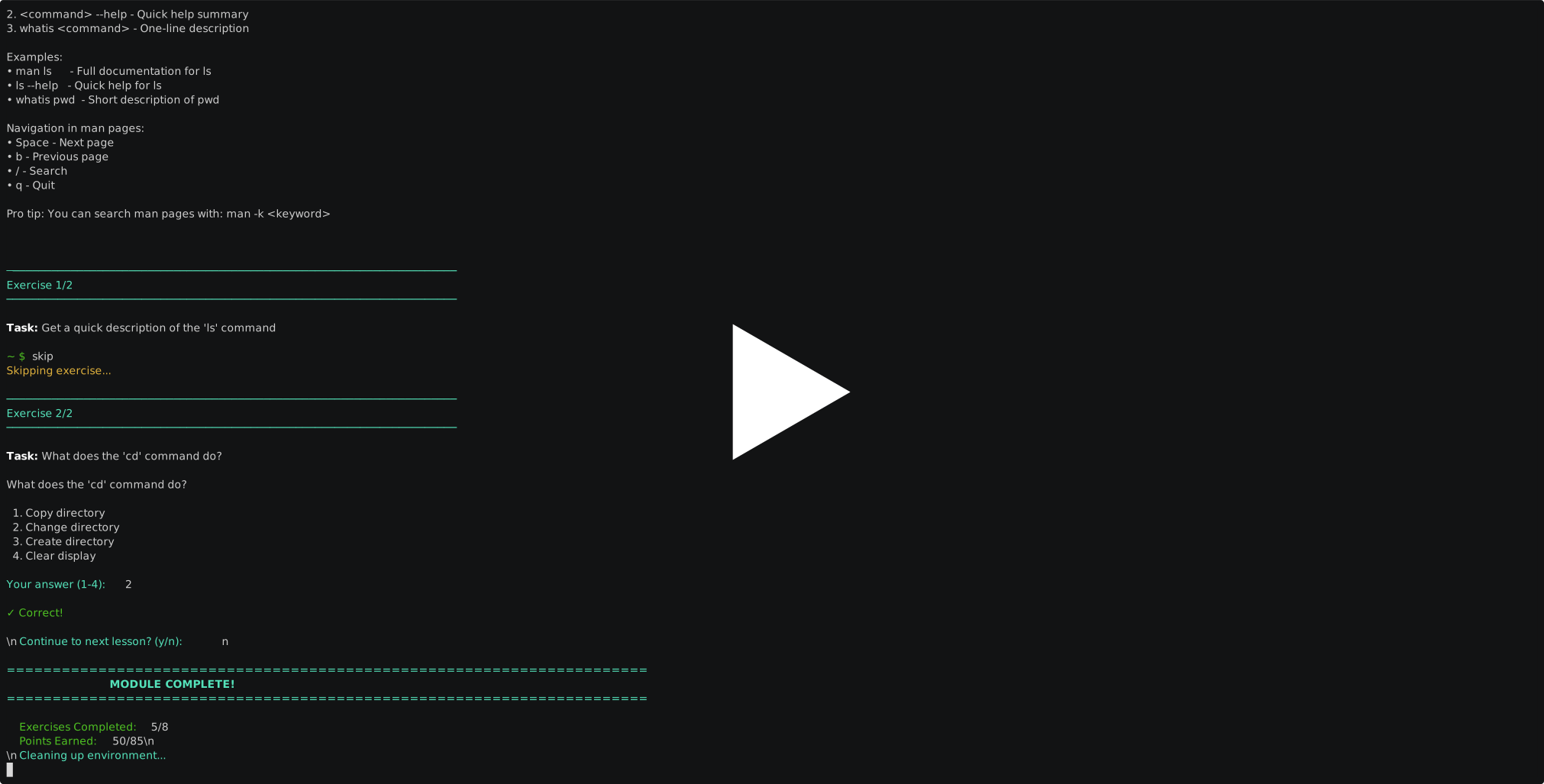
Watch the tool in action - see how to start a practice session, complete tasks, and get instant validation feedback.
Table of Contents
- Features
- Quick Start
- Installation
- Usage
- Learning Modes
- Documentation
- Requirements
- Contributing
- License
Features
Core Features
- 83+ Practice Scenarios across 5 LFCS exam categories
- Isolated Docker Environments for safe, repeatable practice
- Automatic Validation with detailed feedback on task completion
- Progress Tracking with statistics, streaks, and mastery percentages
- Multi-Distribution Support (Ubuntu, CentOS, Rocky Linux)
- Interactive Learning Mode with 14 structured learning modules
- Live Validation - check your work without exiting the container
- Difficulty Progression from easy to hard scenarios
- Smart Recommendations based on your performance
Advanced Features
- Context Generation - scenarios with randomized values for variety
- Property-Based Testing - comprehensive test coverage
- Error Recovery - intelligent error handling with recovery suggestions
- Comprehensive Logging - detailed logs for debugging
- Configuration Management - flexible YAML and environment variable configuration
- Achievement System - track milestones and accomplishments
Quick Start
Choose your installation method based on your needs:
Method 1: Simple Installation (Recommended for Users)
# 1. Install from PyPI
pip install lfcs

# 2. Start practicing (Docker images build automatically on first use)
lfcs start
Note: Docker images are built automatically when you first use the tool. The first run will take 5-20 minutes to build images, but subsequent runs will be instant.
Method 2: Full Repository Installation (For Contributors)
# 1. Clone repository
git clone https://github.com/loyality7/lfcs-practice-tool.git
cd lfcs-practice-tool

# 2. Install in editable mode
pip install -e ".[dev,ai]"

# 3. Build Docker images (optional - will auto-build if skipped)
cd docker/base_images
./build_all.sh
cd ../..

# 4. Start practicing
lfcs start
Installation
Prerequisites
Before installing, ensure you have:
- Python 3.9+ - Check with
python3 --version - Docker 20.10+ - Check with
docker --version - 4GB RAM minimum (8GB recommended)
- 10GB disk space for Docker images
- Internet connection for downloading packages and images
Installation Method 1: Simple Pip Install (Recommended)
Best for: Users who just want to practice LFCS scenarios
What you get: Full LFCS practice tool with all 83+ scenarios, 14 learning modules, and automatic Docker image building
Steps:
-
Install the package:
pip install lfcs
-
Start practicing:
lfcs start
That's it! Docker images will be built automatically on first use.
Important Notes:
- ✅ Automatic setup - Docker images build automatically when first needed
- ⏱️ First run takes 5-20 minutes - Building images (one-time setup)
- 🚀 Subsequent runs are instant - Images are reused
- 📦 Everything included - Scenarios, learning modules, and Dockerfiles in pip package
Installation Method 2: Repository Install (For Contributors)
Best for: Developers who want to contribute or modify the code
What you get: Full source code with editable installation
Steps:
-
Clone repository:
git clone https://github.com/loyality7/lfcs-practice-tool.git
cd lfcs-practice-tool
-
Install in editable mode:
# Install with development dependencies
pip install -e ".[dev,ai]"
-
Build Docker images:
cd docker/base_images
./build_all.sh
cd ../..
-
Verify installation:
lfcs --version
lfcs start
Optional: Enable AI Features
To use AI-powered hints and validation:
# Set your API key (choose one)
export ANTHROPIC_API_KEY="your-api-key-here"
# OR
export OPENAI_API_KEY="your-api-key-here"

# Start with AI mode
lfcs start --ai
Usage
Basic Commands
# Start interactive practice session
lfcs start

# Start with filters
lfcs start --category networking --difficulty easy

# List available scenarios
lfcs list

# View your statistics
lfcs stats

# Interactive learning mode
lfcs learn

# Reset progress
lfcs reset --confirm
Practice Workflow
- Select Scenario: Choose category, difficulty, and specific scenario
- Read Task: Review the task description and hints
- Work in Container: Complete the task in the Docker shell
- Validate: Type
exitto validate your work - Review Results: See detailed feedback and score
- Track Progress: View statistics and recommendations
Interactive Learning Mode
# Start learning mode
lfcs learn

# List all modules
lfcs learn --list

# Start specific module
lfcs learn --module 01_beginner/01_linux_basics

# Continue from last lesson
lfcs learn --continue
Learning Modes
1. Practice Mode (Scenario-Based)
Practice specific LFCS exam tasks with automatic validation:
- Essential Commands: Text processing, pipes, archives
- Operations & Deployment: Services, packages, systemd
- Networking: Interface configuration, routing, firewall
- Storage: Filesystems, LVM, mounting, permissions
- Users & Groups: User management, permissions, sudo
2. Interactive Learning Mode
Structured learning path from basics to LFCS level:
- Beginner: Linux basics, file navigation, basic commands
- Intermediate: Text processing, process management, packages
- Advanced: Networking, storage management, user administration
- Expert: Security hardening, automation, troubleshooting
3. Local Practice Mode
Practice on your local system without Docker (use with caution):
lfcs start --local
WARNING: Local mode modifies your actual system. Use only if you understand the risks.
Documentation
- User Guide - Comprehensive usage guide
- Developer Guide - Adding scenarios and contributing
- Architecture - System design and components
- Troubleshooting - Common issues and solutions
- Contributing - Contribution guidelines
Requirements
System Requirements
- OS: Linux, macOS, or Windows with WSL2
- CPU: 2+ cores recommended
- RAM: 4GB minimum, 8GB recommended
- Disk: 10GB free space for Docker images
- Network: Internet connection for Docker image downloads
Software Requirements
- Python 3.9 or higher
- Docker 20.10 or higher
- Git (for cloning repository)
Optional Requirements
- Anthropic or OpenAI API key (for AI features)
- 16GB RAM (for running multiple containers)
Project Structure
lfcs-practice-tool/
├── src/                    # Source code
│   ├── cli/               # Command-line interface
│   ├── core/              # Core engine and scenario loader
│   ├── docker_manager/    # Docker container management
│   ├── validation/        # Validation strategies
│   ├── learn/             # Interactive learning system
│   ├── utils/             # Utilities and helpers
│   └── main.py            # Main entry point
├── scenarios/             # Practice scenarios (83+ YAML files)
│   ├── essential_commands/
│   ├── networking/
│   ├── operations_deployment/
│   ├── storage/
│   └── users_groups/
├── learn_modules/         # Learning modules (14 YAML files)
│   ├── 01_beginner/
│   ├── 02_intermediate/
│   ├── 03_advanced/
│   └── 04_expert/
├── docker/                # Docker configuration
│   ├── base_images/       # Dockerfiles for Ubuntu, CentOS, Rocky
│   └── validation_scripts/ # Custom validation scripts
├── database/              # SQLite database for progress
├── config/                # Configuration files
├── tests/                 # Test suite
└── docs/                  # Documentation
Configuration
Configuration Files
config/config.yaml- Main configurationconfig/ai_config.yaml- AI provider settings.env- Environment variables (create from.env.example)
Environment Variables
# Docker configuration
export DEFAULT_IMAGE="ubuntu"
export CONTAINER_NETWORK="bridge"
export DOCKER_PRIVILEGED="true"

# Database and logs
export DB_PATH="database/progress.db"
export LOGS_PATH="logs"
export LOG_LEVEL="INFO"

# AI configuration (optional)
export AI_ENABLED="true"
export ANTHROPIC_API_KEY="your-key"

# Local mode (practice without Docker)
export LOCAL_MODE="false"
Statistics and Progress
The tool tracks comprehensive statistics:
- Overall Performance: Total attempts, pass rate, average score
- Category Breakdown: Performance by category and difficulty
- Mastery Levels: Percentage mastery for each difficulty level
- Streaks: Current and best passing streaks
- Achievements: Unlocked milestones
- Recommendations: Personalized suggestions for improvement
View your stats anytime:
lfcs stats                    # Overall statistics
lfcs stats --category storage # Category-specific stats
Troubleshooting
Docker Issues
# Docker not running
sudo systemctl start docker

# Permission denied
sudo usermod -aG docker $USER
newgrp docker

# Image not found
cd docker/base_images && ./build_all.sh
Common Issues
- Container fails to start: Check Docker daemon status and available resources
- Validation fails unexpectedly: Check container logs with
docker logs <container-id> - Database locked: Close other instances of the tool
- Permission errors: Ensure write permissions for database and logs directories
See TROUBLESHOOTING.md for detailed solutions.
Contributing
We welcome contributions! See CONTRIBUTING.md for guidelines.
Quick Contribution Guide
- Fork the repository
- Create a feature branch
- Add scenarios or fix bugs
- Write tests
- Submit a pull request
Adding Scenarios
# Create a new scenario YAML file
cp scenarios/storage/easy/create_directory_01.yaml \
   scenarios/storage/easy/my_scenario_01.yaml

# Edit the scenario
# Test it
lfcs start --category storage --difficulty easy

# Submit PR
Testing
# Run all tests
pytest

# Run with coverage
pytest --cov=src --cov-report=html

# Run specific test
pytest tests/unit/test_scenario_loader.py

# Run property-based tests
pytest tests/unit/ -k "property"
License
MIT License - see LICENSE file for details.
Acknowledgments
- Linux Foundation for the LFCS certification program
- Docker for containerization technology
- All contributors and scenario authors
Support
- Issues: GitHub Issues
- Discussions: GitHub Discussions
- Email: sarathbabuc@duck.com
Roadmap
- Web-based UI
- Multi-user support
- Cloud deployment scenarios
- Kubernetes practice scenarios
- Video tutorials integration
- Mobile app for progress tracking
Made with ❤️ for the Linux community
Version: 1.0.6 | Author: C Sarath Babu | License: MIT
Release history Release notifications | RSS feed


Download files
Download the file for your platform. If you're not sure which to choose, learn more about installing packages.
Source Distribution
Built Distribution
Filter files by name, interpreter, ABI, and platform.
If you're not sure about the file name format, learn more about wheel file names.
Copy a direct link to the current filters
File details
Details for the file lfcs-1.1.0.tar.gz.
File metadata
- Download URL: lfcs-1.1.0.tar.gz
- Upload date:
- Size: 153.7 kB
- Tags: Source
- Uploaded using Trusted Publishing? No
- Uploaded via: twine/6.2.0 CPython/3.12.3
File hashes
| Algorithm | Hash digest | |
|---|---|---|
| SHA256 |
0a578cfb486df36b9132522b646ac40b040a9a7c19d11a6f5671b6c1efcf8c4c
|
|
| MD5 |
8b3e481c51adf877cc73e1daa33c9d94
|
|
| BLAKE2b-256 |
d44c05e3b11574a31b1a62efaf00eb54cf54bc36d3ae1387c066e85dbd0bf405
|
File details
Details for the file lfcs-1.1.0-py3-none-any.whl.
File metadata
- Download URL: lfcs-1.1.0-py3-none-any.whl
- Upload date:
- Size: 175.9 kB
- Tags: Python 3
- Uploaded using Trusted Publishing? No
- Uploaded via: twine/6.2.0 CPython/3.12.3
File hashes
| Algorithm | Hash digest | |
|---|---|---|
| SHA256 |
dfefab5abd466a40a089d78bfe1f8ecb6fd5b7b09fb85311de12291f551e2274
|
|
| MD5 |
a3f933c7a62b64dc86ffb7e25827f416
|
|
| BLAKE2b-256 |
53f178cb8ff9b2d8f717ecb1e5ce204efd2d6c7cb8e821b73520bae792376b4a
|






