
Lixity






Read before you revise.
Lixity is a local manuscript analysis tool for authors, editors and researchers. Read continuous chapters, inspect changes in sentence rhythm, vocabulary, dialogue and tense, and keep research beside the text. Measurements help you choose passages to review; they do not grade literary quality or rewrite prose. The browser app, CLI and Python API share one analysis pipeline.
Explore the demo · Website and guides · v0.7.2 release notes
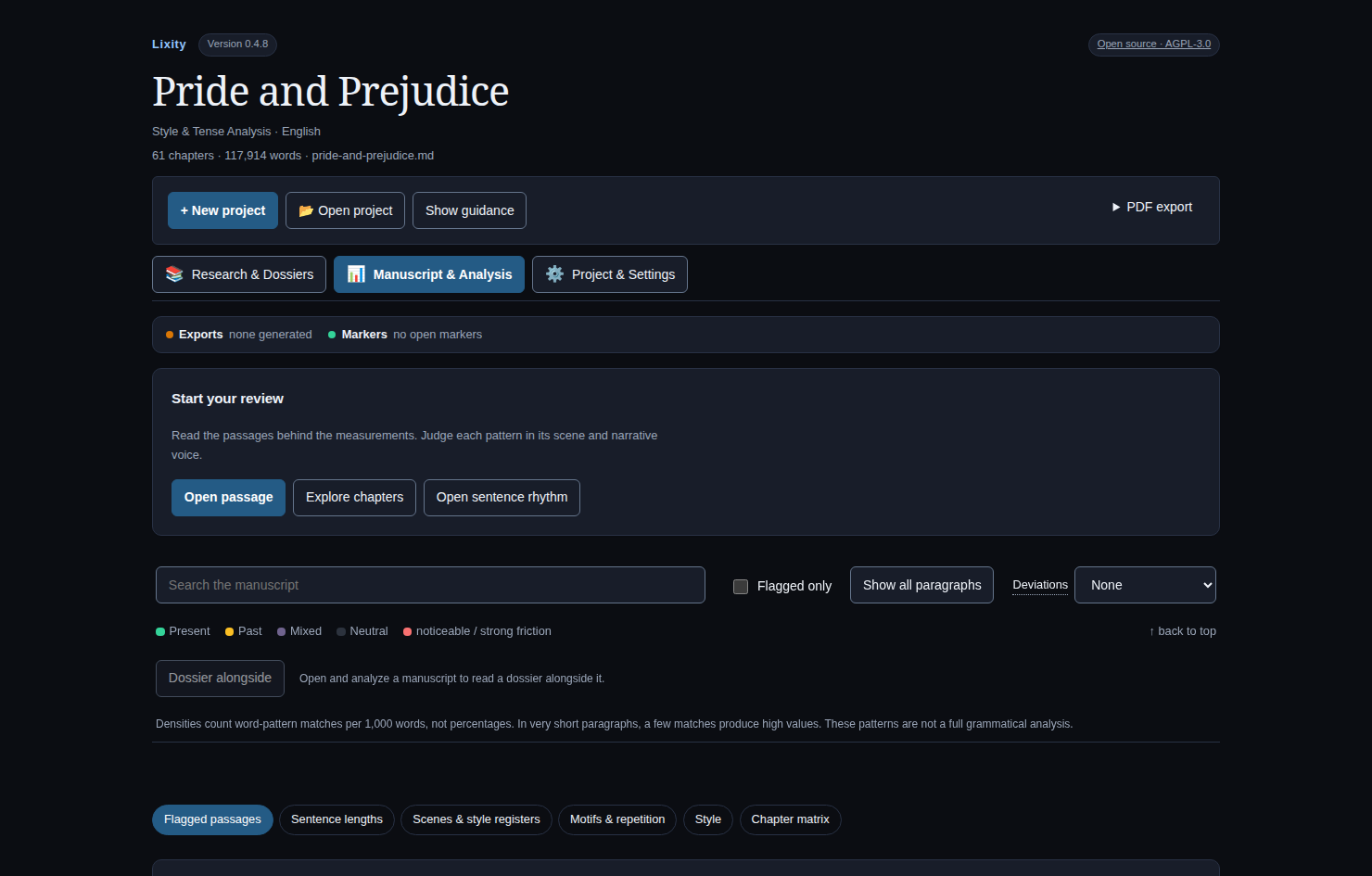
The demo opens The Crate at Warehouse 4: six invented English chapters and a research archive with credited historical images. Explore the three native workspace views without an account or upload. It is read-only: local actions cannot import, edit or save. Follow the three-minute walkthrough or browse more views and image credits.
Install and start
Install uv, then run on Windows, macOS or Linux:
uv tool install --python 3.12 --managed-python lixity
uv tool update-shell
Open a new terminal:
lixity --version
lixity service start --open
Choose Open Project or Analyze a manuscript, then confirm the language. English is the default; automatic detection is explicit. Built-in analysis runs on your computer. Optional integrations have separate data boundaries.
Your first project explains the
workflow. Installation and updates
covers launchers, pinned wheels, service management and removal. After upgrading,
run lixity service restart --open and reload the browser; installing a package
does not update an already running service.
What you can do
- Read and review. Adjust the reading view, turn Analysis on or off, and open passage Values or work markers when needed. Compare chapters against your manuscript’s own patterns, then return to the text.
- Connect research. Keep a dossier alongside a passage. The experimental research workspace connects retained sources, authored claims and decisions to exact manuscript quotations. Zotero remains your collection tool; retaining evidence is an explicit action. An integrity check is not a fact check.
- Export and automate. Create editorial, reading, submission or analysis
PDFs; use terminal reports and versioned JSON in your own workflows.
lixity --helpandlixity about --jsondescribe the installed commands and capabilities.
English and German have the broadest analysis resources. French, Spanish, Italian, Portuguese and Dutch offer localized interfaces with narrower heuristic coverage. Language support and interpretation explain coverage, short-sample limits and unavailable measurements.
Documentation map
| Looking for | Start here |
|---|---|
| Daily checks, project defaults and CLI | Usage and CLI reference · Practical guides |
| Research and Zotero | Research workflows and compatibility · Data model |
| Measurements and limits | Methods · Validation |
| Integrations | Python, CLI and HTTP contracts · Architecture · Agent index |
| Contributing | Contributor setup and checks · Security |
In the repository, src/lixity/
contains the shared engine, CLI and UI;
tests/ verifies behavior;
docs/ holds maintained product
documentation; and samples/
contains synthetic or public-domain examples. Book-specific adapters belong in
their own projects.
Release, citation and license
The current release is v0.7.2, in the pre-1.0 development line. Historical v3.0.1 and earlier tags remain available. Product and schema versions are independent; Release notes cover archive compatibility and upgrades. See the changelog for subsequent work.
Cite Lixity on Zenodo, with metadata in
CITATION.cff.
The software paper draft
describes its research context.
AGPL-3.0-or-later. Use Lixity for private or commercial writing, research and teaching, including self-publishing your book. A separate written commercial license is available for integrations that cannot meet the AGPL. Licensing guide · Full terms · Legal notice and contact.
1 maintainer

Metadata
1 maintainer
Release files for lixity 0.7.2
For a detailed explanation of source distributions (sdists) and built distributions (wheels), please see the package formats documentation.
Source distribution (sdist)
| File | Size | Uploaded | Provenance | |
|---|---|---|---|---|
| lixity-0.7.2.tar.gz | 1.9 MB | With provenance | Details |
Built distribution (wheel)
| File | Interpreter | ABI | Platform | Reset |
|---|---|---|---|---|
| lixity-0.7.2-py3-none-any.whl | Python 3 | none | any | Details |
Total release size: 3.5 MB
Release files / lixity-0.7.2.tar.gz
| Download URL | lixity-0.7.2.tar.gz |
|---|---|
| Size | 1.9 MB |
| Tags | Source |
|
SHA-256 checksum How to use checksums |
9ba0dec29b8592f5365b4703432cfc372c264f0dc43a27cdc6e1f2b1d0000c1d
|
|
BLAKE2b-256 checksum How to use checksums |
2fd779bcb77b418259099bb05538d808f1a81000f03bb467abea2f23c098ced3
|
| Upload date | |
|
Uploaded using Trusted Publishing? What is trusted publishing? |
Yes |
| Uploaded via |
twine/7.0.0 CPython/3.13.16
|
Provenance
Provenance describes where a file came from. On PyPI, provenance is shared via attestations, which provide a verifiable record of the build or publishing details. View details, limitations and caveats.


PyPI Publish Attestation
PyPI verified that this artifact, at this checksum, originated from the publisher listed below.
Signed by GitHub Actions, verified by PyPI on Oct 20, 2026.
Transparency logRelease files / lixity-0.7.2-py3-none-any.whl
| Download URL | lixity-0.7.2-py3-none-any.whl |
|---|---|
| Size | 1.6 MB |
| Tags | Python 3 |
|
SHA-256 checksum How to use checksums |
cdf844667861b8e1299edfa3000867459a6c09213b809e1710b6ee8c01268224
|
|
BLAKE2b-256 checksum How to use checksums |
344cfab957dc22e3777bef37c52d388fc512b93a1cece14d6e7b80705a9ffb2c
|
| Upload date | |
|
Uploaded using Trusted Publishing? What is trusted publishing? |
Yes |
| Uploaded via |
twine/7.0.0 CPython/3.13.16
|
Provenance
Provenance describes where a file came from. On PyPI, provenance is shared via attestations, which provide a verifiable record of the build or publishing details. View details, limitations and caveats.
PyPI Publish Attestation
PyPI verified that this artifact, at this checksum, originated from the publisher listed below.
Signed by GitHub Actions, verified by PyPI on Oct 20, 2026.
Transparency logSecurity for lixity 0.7.2
Provenance
Provenance describes where a file came from. On PyPI, provenance is shared via attestations, which provide a verifiable record of the build or publishing details. View details, limitations and caveats.
Full provenance
All 2 files in this release have been uploaded with provenance metadata.
Attestation for lixity-0.7.2.tar.gz
PyPI Publish Attestation
PyPI verified that this artifact, at this checksum, originated from the publisher listed below.
Signed by GitHub Actions, verified by PyPI on Oct 20, 2026.
Transparency logA note on package security
PyPI is a repository for distributing packages, not a service for auditing them. While third-party security researchers and our staff do their best to detect and remove malicious packages, PyPI cannot guarantee the quality, security or suitability of any given package.














