
A simple CI/CD utility for running LLM tasks with Semantic Kernel

Project description
AI-First Toolkit: LLM-Powered Automation




🚀 The Future of DevOps is AI-First
This toolkit represents a step toward AI-First DevOps - where intelligent automation handles the entire development lifecycle. Built for teams ready to embrace the exponential productivity gains of AI-powered development. Please read the blog post for more details on the motivation.
TLDR: What This Tool Does
Purpose: Zero-friction LLM integration for pipelines with 100% guaranteed schema compliance. This is your foundation for AI-first integration practices.
Perfect For:
- 🤖 AI-Generated Code Reviews: Automated PR analysis with structured findings
- 📝 Intelligent Documentation: Generate changelogs, release notes, and docs automatically
- 🔍 Security Analysis: AI-powered vulnerability detection with structured reports
- 🎯 Quality Gates: Enforce standards through AI-driven validation
- 🚀 Autonomous Development: Enable AI agents to make decisions in your pipelines
- 🎯 JIRA Ticket Updates: Update JIRA tickets based on LLM output
- 🔗 Unlimited Integration Possibilities: Chain it multiple times and use as glue code in your tool stack
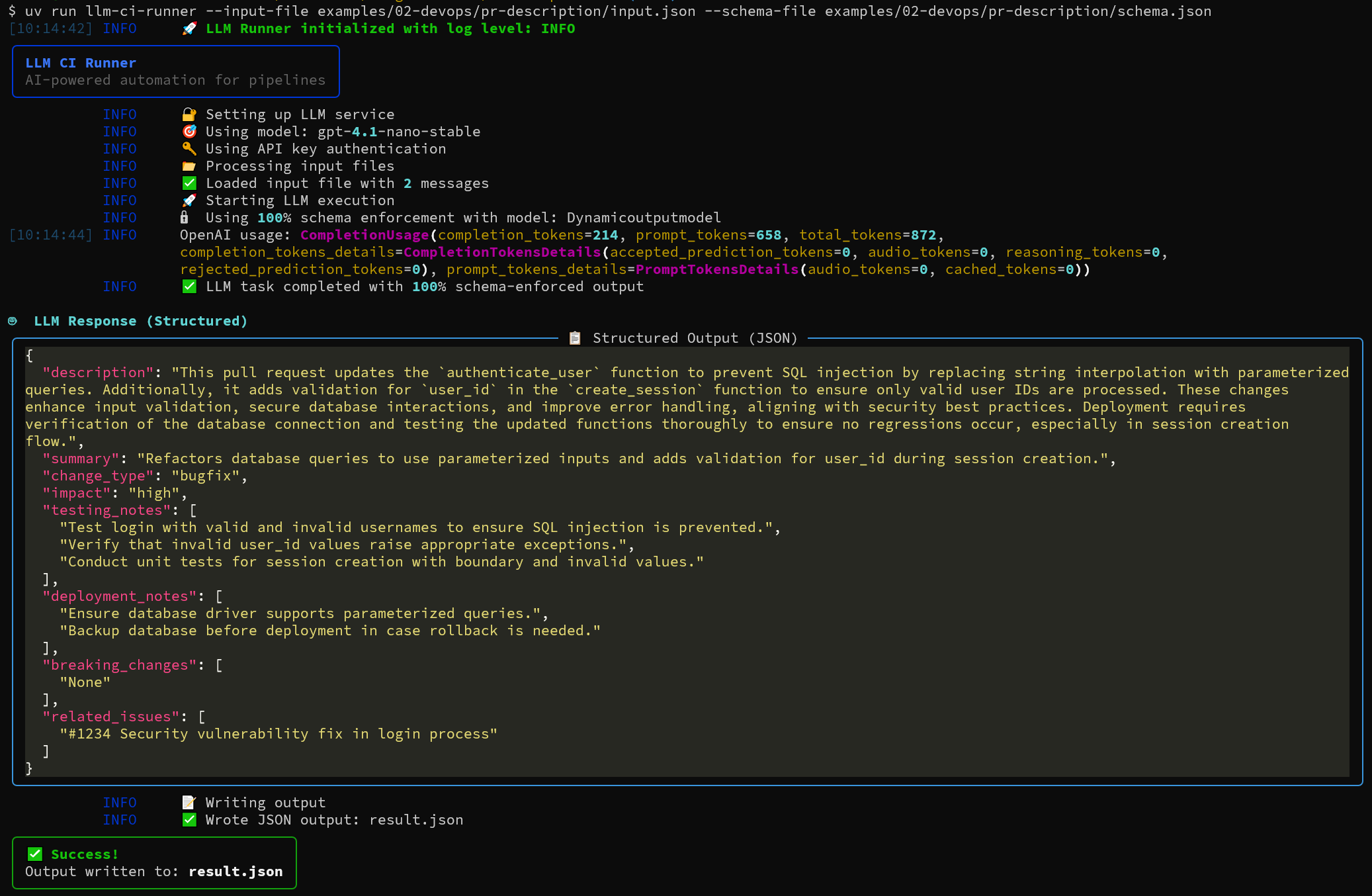
Simple structured output example
# Install and use immediately
pip install llm-ci-runner
llm-ci-runner --input-file examples/02-devops/pr-description/input.json --schema-file examples/02-devops/pr-description/schema.json
The AI-First Development Revolution
This toolkit embodies the principles outlined in Building AI-First DevOps:
| Traditional DevOps | AI-First DevOps (This Tool) |
|---|---|
| Manual code reviews | 🤖 AI-powered reviews with structured findings |
| Human-written documentation | 📝 AI-generated docs with guaranteed consistency |
| Reactive security scanning | 🔍 Proactive AI security analysis |
| Manual quality gates | 🎯 AI-driven validation with schema enforcement |
| Linear productivity | 📈 Exponential gains through intelligent automation |
Features
- 🎯 100% Schema Enforcement: Your pipeline never gets invalid data. Token-level schema enforcement with guaranteed compliance
- 🔄 Resilient execution: Retries with exponential back-off and jitter plus a clear exception hierarchy keep transient cloud faults from breaking your CI.
- 🚀 Zero-Friction CLI: Single script, minimal configuration for pipeline integration and automation
- 🔐 Enterprise Security: Azure RBAC via DefaultAzureCredential with fallback to API Key
- 📦 CI-friendly CLI: Stateless command that reads JSON/YAML, writes JSON/YAML, and exits with proper codes
- 🎨 Beautiful Logging: Rich console output with timestamps and colors
- 📁 File-based I/O: CI/CD friendly with JSON/YAML input/output
- 📋 Template-Driven Workflows: Handlebars and Jinja2 templates with YAML variables for dynamic prompt generation
- 📄 YAML Support: Use YAML for schemas, input files, and output files - more readable than JSON
- 🔧 Simple & Extensible: Easy to understand and modify for your specific needs
- 🤖 Semantic Kernel foundation: async, service-oriented design ready for skills, memories, orchestration, and future model upgrades
- 📚 Documentation: Comprehensive documentation for all features and usage examples. Use your semantic kernel skills to extend the functionality.
- 🧑⚖️ Acceptance Tests: pytest framework with the LLM-as-Judge pattern for quality gates. Test your scripts before you run them in production.
- 💰 Coming soon: token usage and cost estimation appended to each result for budgeting and optimisation
Installation
pip install llm-ci-runner
That's it! No complex setup, no dependency management - just install and use. Perfect for CI/CD pipelines and local development.
Quick Start
1. Install from PyPI
pip install llm-ci-runner
2. Set Environment Variables
export AZURE_OPENAI_ENDPOINT="https://your-resource.openai.azure.com/"
export AZURE_OPENAI_MODEL="gpt-4.1-nano"  # or any other GPT deployment name
export AZURE_OPENAI_API_VERSION="2024-12-01-preview"  # Optional
Authentication Options:
- RBAC (Recommended): Uses
DefaultAzureCredentialfor Azure RBAC authentication - no API key needed! See Microsoft Docs for setup. - API Key: Set
AZURE_OPENAI_API_KEYenvironment variable if not using RBAC.
3a. Basic Usage
# Simple chat example
llm-ci-runner --input-file examples/01-basic/simple-chat/input.json

# With structured output schema
llm-ci-runner \
  --input-file examples/01-basic/sentiment-analysis/input.json \
  --schema-file examples/01-basic/sentiment-analysis/schema.json

# Custom output file
llm-ci-runner \
  --input-file examples/02-devops/pr-description/input.json \
  --schema-file examples/02-devops/pr-description/schema.json \
  --output-file pr-analysis.json

# YAML input files (alternative to JSON)
llm-ci-runner \
  --input-file config.yaml \
  --schema-file schema.yaml \
  --output-file result.yaml
3b. Template-Based Workflows
Dynamic prompt generation with YAML, Handlebars or Jinja2 templates:
# Handlebars template example
llm-ci-runner \
  --template-file examples/05-templates/handlebars-template/template.hbs \
  --template-vars examples/05-templates/handlebars-template/template-vars.yaml \
  --schema-file examples/05-templates/handlebars-template/schema.yaml \
  --output-file handlebars-result.yaml

# Or using Jinja2 templates
llm-ci-runner \
  --template-file examples/05-templates/jinja2-template/template.j2 \
  --template-vars examples/05-templates/jinja2-template/template-vars.yaml \
  --schema-file examples/05-templates/jinja2-template/schema.yaml \
  --output-file jinja2-result.yaml
For more examples see the examples directory.
Benefits of Template Approach:
- 🎯 Reusable Templates: Create once, use across multiple scenarios
- 📝 YAML Configuration: More readable than JSON for complex setups
- 🔄 Dynamic Content: Variables and conditional rendering
- 🚀 CI/CD Ready: Perfect for parameterized pipeline workflows
4. Development Setup (Optional)
For contributors or advanced users who want to modify the source:
# Install UV if you haven't already
curl -LsSf https://astral.sh/uv/install.sh | sh

# Clone and install for development
git clone https://github.com/Nantero1/ai-first-devops-toolkit.git
cd ai-first-devops-toolkit
uv sync

# Run from source
uv run llm-ci-runner --input-file examples/01-basic/simple-chat/input.json
Real-World Examples
You can explore the examples directory for a complete collection of self-contained examples organized by category.
For comprehensive real-world CI/CD scenarios, see examples/uv-usage-example.md which includes:
- 🔄 Automated PR Description Updates: Generate comprehensive PR descriptions from commit messages and code changes
- 🔒 Security Analysis with LLM-as-Judge: Analyze code changes for vulnerabilities with guaranteed schema compliance
- 📋 Automated Changelog Generation: Create structured changelogs from commit history
- 🤖 Code Review Automation: Automated reviews with structured findings and quality gates
- 🔗 Multi-Stage AI Pipelines: Chain multiple AI operations for complex workflows
Input Formats
Traditional JSON Input
{
  "messages": [
    {
      "role": "system",
      "content": "You are a helpful assistant."
    },
    {
      "role": "user",
      "content": "Your task description here"
    }
  ],
  "context": {
    "session_id": "optional-session-id",
    "metadata": {
      "any": "additional context"
    }
  }
}
YAML Input
messages:
  - role: system
    content: "You are a helpful assistant."
  - role: user
    content: "Your task description here"
context:
  session_id: "optional-session-id"
  metadata:
    any: "additional context"
Template-Based Input
Handlebars Template (template.hbs):
<message role="system">
You are an expert {{expertise.domain}} engineer.
Focus on {{expertise.focus_areas}}.
</message>

<message role="user">
Analyze this {{task.type}}:

{{#each task.items}}
- {{this}}
{{/each}}

Requirements: {{task.requirements}}
</message>
Jinja2 Template (template.j2):
<message role="system">
You are an expert {{expertise.domain}} engineer.
Focus on {{expertise.focus_areas}}.
</message>

<message role="user">
Analyze this {{task.type}}:

{% for item in task.items %}
- {{item}}
{% endfor %}

Requirements: {{task.requirements}}
</message>
Template Variables (vars.yaml):
expertise:
  domain: "DevOps"
  focus_areas: "security, performance, maintainability"
task:
  type: "pull request"
  items:
    - "Changed authentication logic"
    - "Updated database queries"
    - "Added input validation"
  requirements: "Focus on security vulnerabilities"
Structured Outputs with 100% Schema Enforcement
When you provide a --schema-file, the runner guarantees perfect schema compliance:
llm-ci-runner \
  --input-file examples/01-basic/sentiment-analysis/input.json \
  --schema-file examples/01-basic/sentiment-analysis/schema.json
Note: Output defaults to result.json. Use --output-file custom-name.json for custom output files.
Supported Schema Features:
✅ String constraints (enum, minLength, maxLength, pattern)
✅ Numeric constraints (minimum, maximum, multipleOf)
✅ Array constraints (minItems, maxItems, items type)
✅ Required fields enforced at generation time
✅ Type validation (string, number, integer, boolean, array)
CI/CD Integration
GitHub Actions Example
- name: Setup Python
  uses: actions/setup-python@v5
  with:
    python-version: '3.12'

- name: Install LLM CI Runner
  run: pip install llm-ci-runner

- name: Generate PR Review with Templates
  run: |
    llm-ci-runner \
      --template-file .github/templates/pr-review.j2 \
      --template-vars pr-context.yaml \
      --schema-file .github/schemas/pr-review.yaml \
      --output-file pr-analysis.yaml
  env:
    AZURE_OPENAI_ENDPOINT: ${{ secrets.AZURE_OPENAI_ENDPOINT }}
    AZURE_OPENAI_MODEL: ${{ secrets.AZURE_OPENAI_MODEL }}
For complete CI/CD examples, see examples/uv-usage-example.md.
Authentication
Uses Azure's DefaultAzureCredential supporting:
- Environment variables (local development)
- Managed Identity (recommended for Azure CI/CD)
- Azure CLI (local development)
- Service Principal (non-Azure CI/CD)
Testing
We maintain comprehensive test coverage with 100% success rate:
# For package users - install test dependencies
pip install llm-ci-runner[dev]

# For development - install from source with test dependencies
uv sync --group dev

# Run specific test categories
pytest tests/unit/ -v          # 70 unit tests
pytest tests/integration/ -v   # End-to-end examples
pytest acceptance/ -v          # LLM-as-judge evaluation

# Or with uv for development
uv run pytest tests/unit/ -v
uv run pytest tests/integration/ -v
uv run pytest acceptance/ -v
Architecture
Built on Microsoft Semantic Kernel for:
- Enterprise-ready Azure OpenAI integration
- Future-proof model compatibility
- 100% Schema Enforcement: KernelBaseModel integration with token-level constraints
- Dynamic Model Creation: Runtime JSON schema → Pydantic model conversion
- RBAC: Azure RBAC via DefaultAzureCredential
The AI-First Development Journey
This toolkit is your first step toward AI-First DevOps. As you integrate AI into your development workflows, you'll experience:
- 🚀 Exponential Productivity: AI handles routine tasks while you focus on architecture
- 🎯 Guaranteed Quality: Schema enforcement eliminates validation errors
- 🤖 Autonomous Operations: AI agents make decisions in your pipelines
- 📈 Continuous Improvement: Every interaction improves your AI system
The future belongs to teams that master AI-first principles. This toolkit gives you the foundation to start that journey today.
License
MIT License - See LICENSE file for details. Copyright (c) 2025, Benjamin Linnik.
Support
🐛 Found a bug? 💡 Have a question? 📚 Need help?
GitHub is your primary destination for all support:
- 📋 Issues & Bug Reports: Create an issue
- 📖 Documentation: Browse examples
- 🔧 Source Code: View source
Before opening an issue, please:
- ✅ Check the examples directory for solutions
- ✅ Review the error logs (beautiful output with Rich!)
- ✅ Validate your Azure authentication and permissions
- ✅ Ensure your input JSON follows the required format
- ✅ Search existing issues for similar problems
Quick Links:
Ready to embrace the AI-First future? Start with this toolkit and build your path to exponential productivity. Learn more about the AI-First DevOps revolution in Building AI-First DevOps.
Release history Release notifications | RSS feed


Download files
Download the file for your platform. If you're not sure which to choose, learn more about installing packages.
Source Distribution
Built Distribution
Filter files by name, interpreter, ABI, and platform.
If you're not sure about the file name format, learn more about wheel file names.
Copy a direct link to the current filters
File details
Details for the file llm_ci_runner-1.2.2.tar.gz.
File metadata
- Download URL: llm_ci_runner-1.2.2.tar.gz
- Upload date:
- Size: 795.4 kB
- Tags: Source
- Uploaded using Trusted Publishing? No
- Uploaded via: twine/6.1.0 CPython/3.12.11
File hashes
| Algorithm | Hash digest | |
|---|---|---|
| SHA256 |
82053e1157b6869c3c16c6a8d801826261456733a96d070b0153bc082f7503f7
|
|
| MD5 |
6be1575e0ac0ac16adb966b509d999b2
|
|
| BLAKE2b-256 |
17dd6b22368667f7707b6b045324e40afaed8c07840e06cf17634da2f8d9ada4
|
File details
Details for the file llm_ci_runner-1.2.2-py3-none-any.whl.
File metadata
- Download URL: llm_ci_runner-1.2.2-py3-none-any.whl
- Upload date:
- Size: 25.2 kB
- Tags: Python 3
- Uploaded using Trusted Publishing? No
- Uploaded via: twine/6.1.0 CPython/3.12.11
File hashes
| Algorithm | Hash digest | |
|---|---|---|
| SHA256 |
a93a2a1480e46b50f355b4566b158ac5a3fc75e0c7f36e8458aa7584ab6f6f44
|
|
| MD5 |
4fc890b84572bc7f51310b16daac377f
|
|
| BLAKE2b-256 |
d03eb07290f2d77c51a0de5ee4ec97c03508d975feeba5b4f46d3a68cd0e2668
|






