
LLMRig
Know what your rig can run.
The open compatibility and performance intelligence layer for local AI.


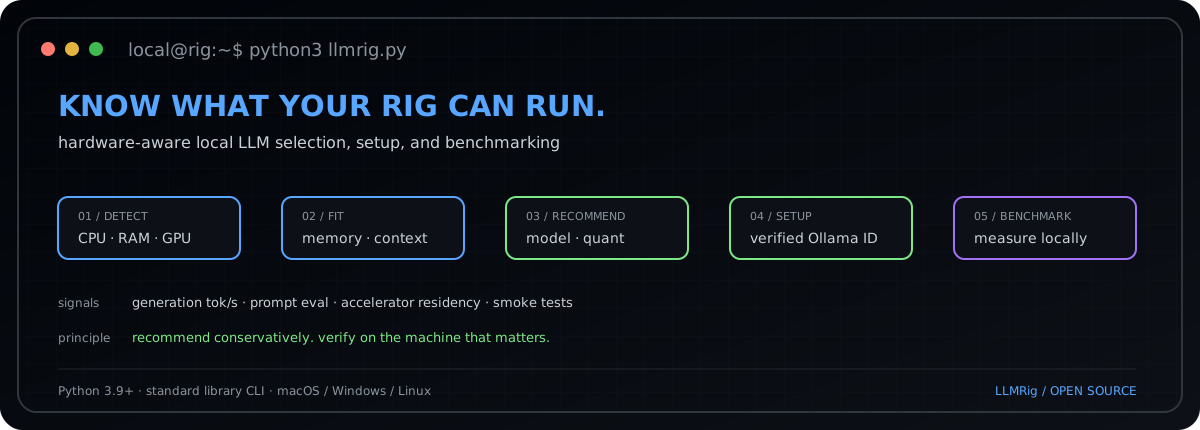
LLMRig helps answer one practical question:
Which local LLM can this machine actually run well?
It inspects hardware, resolves logical models and runnable artifacts, identifies runtime paths, estimates compatibility, measures local execution, compares configurations, and preserves reproducible benchmark evidence. Curated setup and measured execution currently use Ollama.
Install
LLMRig is a CLI application, so the recommended installation method is
pipx, which installs it in an isolated environment:
pipx install llmrig
Upgrade an existing installation:
pipx upgrade llmrig
Verify the installed CLI:
llmrig --version
Some system-managed Python installations, including common Homebrew Python setups,
prevent global pip installs under PEP 668. If pipx is not available, use a
virtual environment instead of modifying the system Python:
python3 -m venv .venv
source .venv/bin/activate  # macOS/Linux
python -m pip install llmrig
On Windows, activate the environment before installing with:
.venv\Scripts\Activate.ps1
python -m pip install llmrig
Then use LLMRig from anywhere:
llmrig doctor
llmrig can qwen3.8:27b-mlx
llmrig recommend
llmrig models --fit
Or run directly from source without installing:
python3 llmrig.py
LLMRig has no third-party Python runtime dependencies. The CLI uses only the Python standard library.
detect hardware
→ resolve model + artifact
→ identify runtime paths
→ estimate compatibility
→ execute locally
→ measure
→ compare
→ preserve evidence
LLMRig is currently Qwen-first. The architecture is intended to expand to additional model families, runtimes, GPUs, and platforms without changing the core workflow.
What LLMRig does
- Detects privacy-safe hardware facts across macOS, Windows, and Linux.
- Separates logical models from GGUF, MLX, Safetensors, and curated Ollama artifacts, with generic read-only Hugging Face resolution.
- Analyzes compatibility with explicit confidence, evidence provenance, practical context, and unknown handling.
- Detects Ollama, llama.cpp, and MLX-LM runtime capabilities without implying an execution adapter exists.
- Recommends and sets up only curated, verified model identifiers through Ollama.
- Measures local generation, prompt evaluation, latency, residency, and lightweight correctness through the Ollama benchmark adapter.
- Races at least two unique executable configurations with metric-specific, non-composite results.
- Exports privacy-safe benchmark passports containing raw per-run evidence and deterministic identities.
- Verifies passport structure, integrity, aggregates, and privacy entirely offline without inference.
Current scope
LLMRig remains Qwen-first. Its curated catalog supports practical recommendations and setup, while generic Hugging Face resolution inspects repository metadata without downloading model weights. Automatic installation remains limited to manually verified curated identifiers.
Ollama is currently LLMRig's implemented setup, execution, and benchmark backend. LLMRig can detect and reason about llama.cpp and MLX-LM capabilities, but execution adapters for those runtimes are not yet implemented.
The project name is intentionally broader than Qwen because the long-term direction is to support additional model families and runtimes without changing the user experience:
hardware → model + artifact → runtime paths → compatibility → measurement → evidence
If you want to add support for another model family, runtime, GPU vendor, or operating system, see CONTRIBUTING.md.
Requirements
- Python 3.9+
- macOS, Windows, or Linux
- Ollama for automatic model setup and benchmarking
- Internet access for live discovery and model downloads
- No third-party Python runtime dependencies
Quick start
Run the interactive wizard:
llmrig
The wizard inspects the machine, recommends a supported model, pulls it if necessary, benchmarks it, and prints the local chat/API details.
Commands
Inspect the machine
llmrig doctor
Machine-readable output:
llmrig doctor --json
Check whether a curated model can run
llmrig can qwen3.8:27b-mlx
Machine-readable compatibility, confidence, configuration, and evidence:
llmrig can qwen3.8:27b-mlx --json
Curated identifiers receive the existing practical compatibility analysis. An
owner/repository Hugging Face ID is resolved through read-only metadata and file
listings, without downloading weights. LLMRig recognizes evidenced GGUF, MLX, and
Safetensors artifacts. For generic GGUF and MLX artifacts it reports matching
llama.cpp or MLX-LM capability candidates and whether those runtimes are locally
available; Safetensors alone does not imply a runnable path. Runtime installation,
current availability, format support, and total machine compatibility remain separate.
Even a detected candidate is not a claim that inference was tested. Memory results
are conservative planning estimates, and unmeasured runtime overhead, practical
context, and performance remain explicitly unknown.
llmrig can also behaves as a three-state Unix predicate in both human and JSON
modes: exit 0 means the model can run, exit 1 means it cannot run, and exit
2 means compatibility is unknown or the identifier cannot be analyzed.
Race locally executable configurations
llmrig race qwen3.8:27b-mlx
llmrig race qwen3.8:27b-mlx --json
race measures only configurations that are already local, currently available,
and backed by an LLMRig execution/benchmark adapter. It never installs runtimes or
downloads artifacts. At least two executable configurations are required; otherwise
the command reports the eligible and blocked alternatives without running a benchmark.
Runtime race execution currently supports Ollama. llama.cpp and MLX-LM are detected
as capability providers but do not yet have LLMRig execution adapters.
Exit 0 means at least two competitors were measured successfully. Exit 1 means
an attempted execution failed and invalidated the comparison. Exit 2 means the race
is unavailable or the model could not be resolved. Winners are reported separately
for measured generation throughput, prompt-evaluation throughput, and latency; there
is no composite score or model-quality claim. Results within 5% are treated as
inconclusive, and at least two timed runs per competitor are required for a winner.
List models
Show curated local-ready models plus the newest live Qwen LLM/multimodal candidates:
llmrig models --fit
Force live refresh:
llmrig models --refresh --fit
Show the full Qwen Hugging Face organization catalog, including non-LLM artifacts:
llmrig models --all --fit
Use only the built-in curated snapshot:
llmrig models --offline --fit
Get a recommendation
llmrig recommend
Official models only:
llmrig recommend --category official
Community reduced-refusal models only:
llmrig recommend --category unrestricted
Prioritize quality:
llmrig recommend \
  --category official \
  --preference quality
For CLI convenience, unrestricted, uncensored, and reduced-refusal map to the community reduced-refusal category. restricted is accepted as an alias for the official category. LLMRig uses official and reduced-refusal in its output because those labels are more precise.
Set up a model
llmrig setup --category official
Or choose an exact curated model:
llmrig setup \
  --model qwen3.8:27b-mlx \
  --context 32768
If a known alias of the selected curated build is already installed, LLMRig reuses it when possible.
Benchmark installed models
One model:
llmrig bench \
  --model qwen3.8:27b-mlx \
  --context 32768 \
  --runs 2 \
  --passport benchmark.passport.json
All installed supported Qwen models:
llmrig bench \
  --all-installed \
  --context 32768 \
  --runs 2
LLMRig deduplicates installed aliases that resolve to the same Ollama model ID.
Benchmark passports
A benchmark passport is a versioned, privacy-safe JSON record of one measured
execution configuration. It records the exact model/build, runtime, safe hardware
summary, applied workload, individual timed samples, reproducible aggregates, and
evidence provenance. Use bench --passport FILE for a single model, or
race --passport-dir DIR to export each successfully measured race competitor.
Validate a passport locally without network access or inference:
llmrig passport verify benchmark.passport.json
Verification checks the schema, SHA-256 identity and configuration fingerprints, raw-sample aggregates, impossible states, and privacy constraints. It establishes only that the document is internally consistent according to LLMRig's schema. The hashes are identifiers and integrity checks, not signatures, independent proof, or benchmark certification.
passport_id is the SHA-256 hash of canonical passport content with passport_id
itself excluded. It identifies the exact record, including its timestamp and
measurements. configuration_fingerprint hashes the logical model, exact
artifact/build, artifact digest, format, quantization, runtime and version, execution
adapter, privacy-safe hardware facts, exact workload and generation settings, and
benchmark method version. It excludes the passport ID, timestamp, measurements,
aggregates, run-only warnings, and output path. The LLMRig tool version is record
metadata; the benchmark method version is the compatibility boundary and must change
when the procedure changes.
Two passports are exact when their configuration fingerprints match, even though
their passport IDs and measured results may differ. comparable_with_warnings means
the logical model and workload match but artifact, format, quantization, runtime,
runtime version, or hardware differs. not_comparable means the logical model or
workload—including context—differs. These classifications do not rank results.
Race passports are exported only when the overall race completes successfully. If
any intended competitor fails, the race remains failed and --passport-dir writes
no standalone competitor passports that could hide the incomplete comparison.
Passport aggregates are derived only from the recorded timed-run samples. Throughput
means are rounded to two decimal places, wall-latency means to four decimal places,
using Python's deterministic round behavior; generated tokens are the sum of the
runtime-reported per-run counts. Warmups are recorded as policy metadata and never
enter samples or aggregates.
Run project checks
Offline:
llmrig check
Include live Hugging Face discovery:
llmrig check --online
Model discovery and safety
LLMRig deliberately separates discovery from automatic installation.
The curated catalog contains local model identifiers that LLMRig may pull automatically. Live discovery queries the official Qwen organization on Hugging Face so new releases can appear without requiring an immediate LLMRig release.
A newly discovered repository is discovery only. LLMRig does not infer package size, hardware fit, or Ollama compatibility from a repository name. A model becomes eligible for one-command setup only after its identifier, package size, context capability, backend support, and provenance are verified and added to the curated catalog.
Community reduced-refusal discovery is best-effort and is not an authoritative registry. Third-party models should be reviewed before use.
Official vs reduced-refusal models
Official entries are upstream Qwen models distributed through the selected local backend.
Community reduced-refusal entries are third-party derivatives that modify model behavior to reduce refusals. Their authors may use terms such as uncensored, unrestricted, or abliterated.
Reduced refusal behavior does not imply better reasoning, accuracy, safety, or reliability. Review model provenance, licensing, and benchmark results before relying on a derivative for important work.
Hardware fit and context
LLMRig deliberately leaves headroom for the operating system, inference runtime, KV cache, other applications, and GPU/runtime buffers.
For Apple Silicon, CPU and GPU share unified memory. For discrete GPUs, LLMRig favors configurations likely to stay mostly or fully on the accelerator when VRAM can be detected.
The model's advertised maximum context is not automatically used as the default. Longer context allocations consume more memory, so LLMRig starts conservatively and increases context only when there is comfortable headroom.
Hardware-fit results are estimates. The benchmark on the user's actual machine is the final check.
Benchmarking
LLMRig unloads currently resident Ollama models before a benchmark and unloads the target model afterward. This reduces cross-model memory contamination and makes comparisons more reproducible.
Each benchmark records:
- generation tokens/second
- prompt-evaluation tokens/second
- load and total duration
- Ollama-reported context length
- accelerator residency when available
- RAM/swap snapshots when available
- three lightweight deterministic correctness smoke tests
Reports are written under benchmarks/ as JSON and Markdown. That directory is ignored by Git by default so local benchmark data is not published accidentally. Review any benchmark before sharing it.
These are local performance/configuration checks, not academic model-quality benchmarks. Memory values are snapshots rather than peak-memory measurements.
Contributing
LLMRig is open source and contributions are welcome.
Good first contribution areas include:
- additional model families
- new Ollama/local-backend model mappings
- AMD, Intel, and NVIDIA GPU detection improvements
- Windows and Linux hardware testing
- reproducible benchmark improvements
- new hardware profiles and recommendation rules
- documentation and usability improvements
- tests for new operating systems and model variants
Please read CONTRIBUTING.md before opening a pull request. Bug reports, feature ideas, model-support requests, and benchmark improvements are all welcome through GitHub issues.
Development
Run the full local validation set before opening a pull request:
python3 -m py_compile llmrig.py
python3 -m unittest discover -s tests -v
python3 llmrig.py check
python3 llmrig.py models --offline --fit
With internet access:
python3 llmrig.py check --online
GitHub Actions also runs compile, unit-test, and sanity-check jobs on Linux, macOS, and Windows.
Repository layout
llmrig/
├── .github/
│   ├── ISSUE_TEMPLATE/
│   ├── workflows/
│   │   ├── ci.yml
│   │   ├── publish-to-pypi.yml
│   │   └── refresh-profile-on-release.yml
│   └── PULL_REQUEST_TEMPLATE.md
├── assets/
│   └── llmrig-terminal.svg
├── tests/
│   ├── __init__.py
│   └── test_llmrig.py
├── .gitignore
├── CHANGELOG.md
├── CODE_OF_CONDUCT.md
├── CONTRIBUTING.md
├── LICENSE
├── pyproject.toml
├── README.md
├── SECURITY.md
└── llmrig.py
Roadmap
The roadmap is intentionally community-driven. Credible next directions include additional model families; llama.cpp, MLX-LM, and other execution adapters; richer GPU and runtime support; explainable comparison and decision intelligence; Pareto-style configuration optimization; and standardized privacy-safe benchmark sharing.
The rule for new functionality is simple: be useful, be reproducible, and do not turn unverified discovery metadata into an automatic install decision.
License
LLMRig is released under the MIT License.
Primary references
- Qwen official Hugging Face organization:
https://huggingface.co/Qwen - Qwen3.8 official repository:
https://github.com/QwenLM/Qwen3.8 - Hugging Face Hub API:
https://huggingface.co/docs/huggingface_hub/package_reference/hf_api - Ollama documentation:
https://docs.ollama.com/ - Ollama generate API:
https://docs.ollama.com/api/generate - Ollama running-model API:
https://docs.ollama.com/api/ps - Qwen3.8 Ollama tags:
https://ollama.com/library/qwen3.8/tags
1 maintainer

Download files
Download the file for your platform. If you're not sure which to choose, learn more about installing packages.
Source Distribution
Built Distribution
Filter files by name, interpreter, ABI, and platform.
If you're not sure about the file name format, learn more about wheel file names.
Copy a direct link to the current filters
File details
Details for the file llmrig-0.5.1.tar.gz.
File metadata
- Download URL: llmrig-0.5.1.tar.gz
- Upload date:
- Size: 64.5 kB
- Tags: Source
- Uploaded using Trusted Publishing? Yes
- Uploaded via:
twine/7.0.0 CPython/3.13.14
File hashes
| Algorithm | Hash digest | |
|---|---|---|
| SHA256 |
ae01f7059fbbfb0d3c7106242962c5453b0e55d68dc79b88f770c6ff758a87a0
|
|
| MD5 |
87a2c8d7b09722d6dddb5b247ebdaded
|
|
| BLAKE2b-256 |
2788888f5c30e16628c4274930f5e70b9eb91dcb0e4ac9eba660c10938e0044f
|
Provenance
The following attestation bundles were made for llmrig-0.5.1.tar.gz:
Publisher:
publish-to-pypi.yml on sunilteja93/llmrig
-
Statement:
-
Statement type:
https://in-toto.io/Statement/v1 -
Predicate type:
https://docs.pypi.org/attestations/publish/v1 -
Subject name:
llmrig-0.5.1.tar.gz -
Subject digest:
ae01f7059fbbfb0d3c7106242962c5453b0e55d68dc79b88f770c6ff758a87a0 - Sigstore transparency entry: 2621053173
- Sigstore integration time:
-
Permalink:
sunilteja93/llmrig@f75469d7e185789892e2dd9e33a148d5ce6614fe -
Branch / Tag:
refs/tags/v0.5.1 - Owner: https://github.com/sunilteja93
-
Access:
public
-
Token Issuer:
https://token.actions.githubusercontent.com -
Runner Environment:
github-hosted -
Publication workflow:
publish-to-pypi.yml@f75469d7e185789892e2dd9e33a148d5ce6614fe -
Trigger Event:
release
-
Statement type:
File details
Details for the file llmrig-0.5.1-py3-none-any.whl.
File metadata
- Download URL: llmrig-0.5.1-py3-none-any.whl
- Upload date:
- Size: 51.1 kB
- Tags: Python 3
- Uploaded using Trusted Publishing? Yes
- Uploaded via:
twine/7.0.0 CPython/3.13.14
File hashes
| Algorithm | Hash digest | |
|---|---|---|
| SHA256 |
7ccc8f03b4f641d79f4ab080eb92b94c94e3ebb6f01855b5ff927503c92993a9
|
|
| MD5 |
9985de5cdf18db867f851587a5210648
|
|
| BLAKE2b-256 |
1dcd4a719a8856fa417a6affebcc9b98b8ed950ff2507f57a212b4a8c578a3ff
|
Provenance
The following attestation bundles were made for llmrig-0.5.1-py3-none-any.whl:
Publisher:
publish-to-pypi.yml on sunilteja93/llmrig
-
Statement:
-
Statement type:
https://in-toto.io/Statement/v1 -
Predicate type:
https://docs.pypi.org/attestations/publish/v1 -
Subject name:
llmrig-0.5.1-py3-none-any.whl -
Subject digest:
7ccc8f03b4f641d79f4ab080eb92b94c94e3ebb6f01855b5ff927503c92993a9 - Sigstore transparency entry: 2621053191
- Sigstore integration time:
-
Permalink:
sunilteja93/llmrig@f75469d7e185789892e2dd9e33a148d5ce6614fe -
Branch / Tag:
refs/tags/v0.5.1 - Owner: https://github.com/sunilteja93
-
Access:
public
-
Token Issuer:
https://token.actions.githubusercontent.com -
Runner Environment:
github-hosted -
Publication workflow:
publish-to-pypi.yml@f75469d7e185789892e2dd9e33a148d5ce6614fe -
Trigger Event:
release
-
Statement type:














