
Easy-to-use LLM fine-tuning framework

Project description











👋 Join our WeChat.
[ English | 中文 ]
LLaMA Board: A One-stop Web UI for Getting Started with LLaMA Factory
Preview LLaMA Board at 🤗 Spaces and ModelScope, or launch it locally with CUDA_VISIBLE_DEVICES=0 python src/train_web.py.
Here is an example of altering the self-cognition of an instruction-tuned language model within 10 minutes on a single GPU.
https://github.com/hiyouga/LLaMA-Factory/assets/16256802/6ba60acc-e2e2-4bec-b846-2d88920d5ba1
Table of Contents
- Features
- Benchmark
- Changelog
- Supported Models
- Supported Training Approaches
- Provided Datasets
- Requirement
- Getting Started
- Projects using LLaMA Factory
- License
- Citation
- Acknowledgement
Features
- Various models: LLaMA, Mistral, Mixtral-MoE, Qwen, Yi, Gemma, Baichuan, ChatGLM, Phi, etc.
- Integrated methods: (Continuous) pre-training, supervised fine-tuning, reward modeling, PPO and DPO.
- Scalable resources: 32-bit full-tuning, 16-bit freeze-tuning, 16-bit LoRA, 2/4/8-bit QLoRA via AQLM/AWQ/GPTQ/LLM.int8.
- Advanced algorithms: DoRA, LongLoRA, LLaMA Pro, LoftQ, agent tuning.
- Practical tricks: FlashAttention-2, Unsloth, RoPE scaling, NEFTune, rsLoRA.
- Experiment monitors: LlamaBoard, TensorBoard, Wandb, MLflow, etc.
Benchmark
Compared to ChatGLM's P-Tuning, LLaMA-Factory's LoRA tuning offers up to 3.7 times faster training speed with a better Rouge score on the advertising text generation task. By leveraging 4-bit quantization technique, LLaMA-Factory's QLoRA further improves the efficiency regarding the GPU memory.

Definitions
- Training Speed: the number of training samples processed per second during the training. (bs=4, cutoff_len=1024)
- Rouge Score: Rouge-2 score on the development set of the advertising text generation task. (bs=4, cutoff_len=1024)
- GPU Memory: Peak GPU memory usage in 4-bit quantized training. (bs=1, cutoff_len=1024)
- We adopt
pre_seq_len=128for ChatGLM's P-Tuning andlora_rank=32for LLaMA-Factory's LoRA tuning.
Changelog
[24/02/28] We supported weight-decomposed LoRA (DoRA). Try --use_dora to activate DoRA training.
[24/02/15] We supported block expansion proposed by LLaMA Pro. See tests/llama_pro.py for usage.
[24/02/05] Qwen1.5 (Qwen2 beta version) series models are supported in LLaMA-Factory. Check this blog post for details.
Full Changelog
[24/01/18] We supported agent tuning for most models, equipping model with tool using abilities by fine-tuning with --dataset glaive_toolcall.
[23/12/23] We supported unsloth's implementation to boost LoRA tuning for the LLaMA, Mistral and Yi models. Try --use_unsloth argument to activate unsloth patch. It achieves 1.7x speed in our benchmark, check this page for details.
[23/12/12] We supported fine-tuning the latest MoE model Mixtral 8x7B in our framework. See hardware requirement here.
[23/12/01] We supported downloading pre-trained models and datasets from the ModelScope Hub for Chinese mainland users. See this tutorial for usage.
[23/10/21] We supported NEFTune trick for fine-tuning. Try --neftune_noise_alpha argument to activate NEFTune, e.g., --neftune_noise_alpha 5.
[23/09/27] We supported $S^2$-Attn proposed by LongLoRA for the LLaMA models. Try --shift_attn argument to enable shift short attention.
[23/09/23] We integrated MMLU, C-Eval and CMMLU benchmarks in this repo. See this example to evaluate your models.
[23/09/10] We supported FlashAttention-2. Try --flash_attn argument to enable FlashAttention-2 if you are using RTX4090, A100 or H100 GPUs.
[23/08/12] We supported RoPE scaling to extend the context length of the LLaMA models. Try --rope_scaling linear argument in training and --rope_scaling dynamic argument at inference to extrapolate the position embeddings.
[23/08/11] We supported DPO training for instruction-tuned models. See this example to train your models.
[23/07/31] We supported dataset streaming. Try --streaming and --max_steps 10000 arguments to load your dataset in streaming mode.
[23/07/29] We released two instruction-tuned 13B models at Hugging Face. See these Hugging Face Repos (LLaMA-2 / Baichuan) for details.
[23/07/18] We developed an all-in-one Web UI for training, evaluation and inference. Try train_web.py to fine-tune models in your Web browser. Thank @KanadeSiina and @codemayq for their efforts in the development.
[23/07/09] We released FastEdit ⚡🩹, an easy-to-use package for editing the factual knowledge of large language models efficiently. Please follow FastEdit if you are interested.
[23/06/29] We provided a reproducible example of training a chat model using instruction-following datasets, see Baichuan-7B-sft for details.
[23/06/22] We aligned the demo API with the OpenAI's format where you can insert the fine-tuned model in arbitrary ChatGPT-based applications.
[23/06/03] We supported quantized training and inference (aka QLoRA). Try --quantization_bit 4/8 argument to work with quantized models.
Supported Models
| Model | Model size | Default module | Template |
|---|---|---|---|
| Baichuan2 | 7B/13B | W_pack | baichuan2 |
| BLOOM | 560M/1.1B/1.7B/3B/7.1B/176B | query_key_value | - |
| BLOOMZ | 560M/1.1B/1.7B/3B/7.1B/176B | query_key_value | - |
| ChatGLM3 | 6B | query_key_value | chatglm3 |
| DeepSeek (MoE) | 7B/16B/67B | q_proj,v_proj | deepseek |
| Falcon | 7B/40B/180B | query_key_value | falcon |
| Gemma | 2B/7B | q_proj,v_proj | gemma |
| InternLM2 | 7B/20B | wqkv | intern2 |
| LLaMA | 7B/13B/33B/65B | q_proj,v_proj | - |
| LLaMA-2 | 7B/13B/70B | q_proj,v_proj | llama2 |
| Mistral | 7B | q_proj,v_proj | mistral |
| Mixtral | 8x7B | q_proj,v_proj | mistral |
| Phi-1.5/2 | 1.3B/2.7B | q_proj,v_proj | - |
| Qwen | 1.8B/7B/14B/72B | c_attn | qwen |
| Qwen1.5 | 0.5B/1.8B/4B/7B/14B/72B | q_proj,v_proj | qwen |
| XVERSE | 7B/13B/65B | q_proj,v_proj | xverse |
| Yi | 6B/34B | q_proj,v_proj | yi |
| Yuan | 2B/51B/102B | q_proj,v_proj | yuan |
[!NOTE] Default module is used for the
--lora_targetargument, you can use--lora_target allto specify all the available modules.For the "base" models, the
--templateargument can be chosen fromdefault,alpaca,vicunaetc. But make sure to use the corresponding template for the "chat" models.
Please refer to constants.py for a full list of models we supported.
Supported Training Approaches
| Approach | Full-tuning | Freeze-tuning | LoRA | QLoRA |
|---|---|---|---|---|
| Pre-Training | :white_check_mark: | :white_check_mark: | :white_check_mark: | :white_check_mark: |
| Supervised Fine-Tuning | :white_check_mark: | :white_check_mark: | :white_check_mark: | :white_check_mark: |
| Reward Modeling | :white_check_mark: | :white_check_mark: | :white_check_mark: | :white_check_mark: |
| PPO Training | :white_check_mark: | :white_check_mark: | :white_check_mark: | :white_check_mark: |
| DPO Training | :white_check_mark: | :white_check_mark: | :white_check_mark: | :white_check_mark: |
[!NOTE] Use
--quantization_bit 4argument to enable QLoRA.
Provided Datasets
Pre-training datasets
Supervised fine-tuning datasets
- Stanford Alpaca (en)
- Stanford Alpaca (zh)
- Alpaca GPT4 (en&zh)
- Self Cognition (zh)
- Open Assistant (multilingual)
- ShareGPT (zh)
- Guanaco Dataset (multilingual)
- BELLE 2M (zh)
- BELLE 1M (zh)
- BELLE 0.5M (zh)
- BELLE Dialogue 0.4M (zh)
- BELLE School Math 0.25M (zh)
- BELLE Multiturn Chat 0.8M (zh)
- UltraChat (en)
- LIMA (en)
- OpenPlatypus (en)
- CodeAlpaca 20k (en)
- Alpaca CoT (multilingual)
- OpenOrca (en)
- SlimOrca (en)
- MathInstruct (en)
- Firefly 1.1M (zh)
- Wiki QA (en)
- Web QA (zh)
- WebNovel (zh)
- Nectar (en)
- deepctrl (en&zh)
- Ad Gen (zh)
- ShareGPT Hyperfiltered (en)
- ShareGPT4 (en&zh)
- UltraChat 200k (en)
- AgentInstruct (en)
- LMSYS Chat 1M (en)
- Evol Instruct V2 (en)
- Glaive Function Calling V2 (en)
- Open Assistant (de)
- Dolly 15k (de)
- Alpaca GPT4 (de)
- OpenSchnabeltier (de)
- Evol Instruct (de)
- Dolphin (de)
- Booksum (de)
- Airoboros (de)
- Ultrachat (de)
Preference datasets
Please refer to data/README.md for details.
Some datasets require confirmation before using them, so we recommend logging in with your Hugging Face account using these commands.
pip install --upgrade huggingface_hub
huggingface-cli login
Requirement
| Mandatory | Minimum | Recommend |
|---|---|---|
| python | 3.8 | 3.10 |
| torch | 1.13.1 | 2.2.1 |
| transformers | 4.37.2 | 4.38.1 |
| datasets | 2.14.3 | 2.17.1 |
| accelerate | 0.27.2 | 0.27.2 |
| peft | 0.9.0 | 0.9.0 |
| trl | 0.7.11 | 0.7.11 |
| Optional | Minimum | Recommend |
|---|---|---|
| CUDA | 11.6 | 12.2 |
| deepspeed | 0.10.0 | 0.13.4 |
| bitsandbytes | 0.39.0 | 0.41.3 |
| flash-attn | 2.3.0 | 2.5.5 |
Hardware Requirement
* estimated
| Method | Bits | 7B | 13B | 30B | 65B | 8x7B |
|---|---|---|---|---|---|---|
| Full | 16 | 160GB | 320GB | 600GB | 1200GB | 900GB |
| Freeze | 16 | 20GB | 40GB | 120GB | 240GB | 200GB |
| LoRA | 16 | 16GB | 32GB | 80GB | 160GB | 120GB |
| QLoRA | 8 | 10GB | 16GB | 40GB | 80GB | 80GB |
| QLoRA | 4 | 6GB | 12GB | 24GB | 48GB | 32GB |
Getting Started
Data Preparation (optional)
Please refer to data/README.md for checking the details about the format of dataset files. You can either use a single .json file or a dataset loading script with multiple files to create a custom dataset.
[!NOTE] Please update
data/dataset_info.jsonto use your custom dataset. About the format of this file, please refer todata/README.md.
Dependence Installation (optional)
git clone https://github.com/hiyouga/LLaMA-Factory.git
conda create -n llama_factory python=3.10
conda activate llama_factory
cd LLaMA-Factory
pip install -r requirements.txt
If you want to enable the quantized LoRA (QLoRA) on the Windows platform, you will be required to install a pre-built version of bitsandbytes library, which supports CUDA 11.1 to 12.2.
pip install https://github.com/jllllll/bitsandbytes-windows-webui/releases/download/wheels/bitsandbytes-0.40.0-py3-none-win_amd64.whl
To enable FlashAttention-2 on the Windows platform, you need to install the precompiled flash-attn library, which supports CUDA 12.1 to 12.2. Please download the corresponding version from flash-attention based on your requirements.
Use ModelScope Hub (optional)
If you have trouble with downloading models and datasets from Hugging Face, you can use LLaMA-Factory together with ModelScope in the following manner.
export USE_MODELSCOPE_HUB=1 # `set USE_MODELSCOPE_HUB=1` for Windows
Then you can train the corresponding model by specifying a model ID of the ModelScope Hub. (find a full list of model IDs at ModelScope Hub)
CUDA_VISIBLE_DEVICES=0 python src/train_bash.py \
    --model_name_or_path modelscope/Llama-2-7b-ms \
    ... # arguments (same as above)
LLaMA Board also supports using the models and datasets on the ModelScope Hub.
CUDA_VISIBLE_DEVICES=0 USE_MODELSCOPE_HUB=1 python src/train_web.py
Train on a single GPU
[!IMPORTANT] If you want to train models on multiple GPUs, please refer to Distributed Training.
Pre-Training
CUDA_VISIBLE_DEVICES=0 python src/train_bash.py \
    --stage pt \
    --do_train \
    --model_name_or_path path_to_llama_model \
    --dataset wiki_demo \
    --finetuning_type lora \
    --lora_target q_proj,v_proj \
    --output_dir path_to_pt_checkpoint \
    --overwrite_cache \
    --per_device_train_batch_size 4 \
    --gradient_accumulation_steps 4 \
    --lr_scheduler_type cosine \
    --logging_steps 10 \
    --save_steps 1000 \
    --learning_rate 5e-5 \
    --num_train_epochs 3.0 \
    --plot_loss \
    --fp16
Supervised Fine-Tuning
CUDA_VISIBLE_DEVICES=0 python src/train_bash.py \
    --stage sft \
    --do_train \
    --model_name_or_path path_to_llama_model \
    --dataset alpaca_gpt4_en \
    --template default \
    --finetuning_type lora \
    --lora_target q_proj,v_proj \
    --output_dir path_to_sft_checkpoint \
    --overwrite_cache \
    --per_device_train_batch_size 4 \
    --gradient_accumulation_steps 4 \
    --lr_scheduler_type cosine \
    --logging_steps 10 \
    --save_steps 1000 \
    --learning_rate 5e-5 \
    --num_train_epochs 3.0 \
    --plot_loss \
    --fp16
Reward Modeling
CUDA_VISIBLE_DEVICES=0 python src/train_bash.py \
    --stage rm \
    --do_train \
    --model_name_or_path path_to_llama_model \
    --adapter_name_or_path path_to_sft_checkpoint \
    --create_new_adapter \
    --dataset comparison_gpt4_en \
    --template default \
    --finetuning_type lora \
    --lora_target q_proj,v_proj \
    --output_dir path_to_rm_checkpoint \
    --per_device_train_batch_size 2 \
    --gradient_accumulation_steps 4 \
    --lr_scheduler_type cosine \
    --logging_steps 10 \
    --save_steps 1000 \
    --learning_rate 1e-6 \
    --num_train_epochs 1.0 \
    --plot_loss \
    --fp16
PPO Training
CUDA_VISIBLE_DEVICES=0 python src/train_bash.py \
    --stage ppo \
    --do_train \
    --model_name_or_path path_to_llama_model \
    --adapter_name_or_path path_to_sft_checkpoint \
    --create_new_adapter \
    --dataset alpaca_gpt4_en \
    --template default \
    --finetuning_type lora \
    --lora_target q_proj,v_proj \
    --reward_model path_to_rm_checkpoint \
    --output_dir path_to_ppo_checkpoint \
    --per_device_train_batch_size 2 \
    --gradient_accumulation_steps 4 \
    --lr_scheduler_type cosine \
    --top_k 0 \
    --top_p 0.9 \
    --logging_steps 10 \
    --save_steps 1000 \
    --learning_rate 1e-5 \
    --num_train_epochs 1.0 \
    --plot_loss \
    --fp16
[!TIP] Use
--adapter_name_or_path path_to_sft_checkpoint,path_to_ppo_checkpointto infer the fine-tuned model.
[!WARNING] Use
--per_device_train_batch_size=1for LLaMA-2 models in fp16 PPO training.
DPO Training
CUDA_VISIBLE_DEVICES=0 python src/train_bash.py \
    --stage dpo \
    --do_train \
    --model_name_or_path path_to_llama_model \
    --adapter_name_or_path path_to_sft_checkpoint \
    --create_new_adapter \
    --dataset comparison_gpt4_en \
    --template default \
    --finetuning_type lora \
    --lora_target q_proj,v_proj \
    --output_dir path_to_dpo_checkpoint \
    --per_device_train_batch_size 2 \
    --gradient_accumulation_steps 4 \
    --lr_scheduler_type cosine \
    --logging_steps 10 \
    --save_steps 1000 \
    --learning_rate 1e-5 \
    --num_train_epochs 1.0 \
    --plot_loss \
    --fp16
[!TIP] Use
--adapter_name_or_path path_to_sft_checkpoint,path_to_dpo_checkpointto infer the fine-tuned model.
Distributed Training
Use Huggingface Accelerate
accelerate config # configure the environment
accelerate launch src/train_bash.py # arguments (same as above)
Example config for LoRA training
compute_environment: LOCAL_MACHINE
debug: false
distributed_type: MULTI_GPU
downcast_bf16: 'no'
gpu_ids: all
machine_rank: 0
main_training_function: main
mixed_precision: fp16
num_machines: 1
num_processes: 4
rdzv_backend: static
same_network: true
tpu_env: []
tpu_use_cluster: false
tpu_use_sudo: false
use_cpu: false
Use DeepSpeed
deepspeed --num_gpus 8 --master_port=9901 src/train_bash.py \
    --deepspeed ds_config.json \
    ... # arguments (same as above)
Example config for full-parameter training with DeepSpeed ZeRO-2
{
  "train_batch_size": "auto",
  "train_micro_batch_size_per_gpu": "auto",
  "gradient_accumulation_steps": "auto",
  "gradient_clipping": "auto",
  "zero_allow_untested_optimizer": true,
  "fp16": {
    "enabled": "auto",
    "loss_scale": 0,
    "initial_scale_power": 16,
    "loss_scale_window": 1000,
    "hysteresis": 2,
    "min_loss_scale": 1
  },
  "zero_optimization": {
    "stage": 2,
    "allgather_partitions": true,
    "allgather_bucket_size": 5e8,
    "reduce_scatter": true,
    "reduce_bucket_size": 5e8,
    "overlap_comm": false,
    "contiguous_gradients": true
  }
}
Merge LoRA weights and export model
python src/export_model.py \
    --model_name_or_path path_to_llama_model \
    --adapter_name_or_path path_to_checkpoint \
    --template default \
    --finetuning_type lora \
    --export_dir path_to_export \
    --export_size 2 \
    --export_legacy_format False
[!WARNING] Merging LoRA weights into a quantized model is not supported.
[!TIP] Use
--export_quantization_bit 4and--export_quantization_dataset data/c4_demo.jsonto quantize the model after merging the LoRA weights.
Inference with OpenAI-style API
python src/api_demo.py \
    --model_name_or_path path_to_llama_model \
    --adapter_name_or_path path_to_checkpoint \
    --template default \
    --finetuning_type lora
[!TIP] Visit
http://localhost:8000/docsfor API documentation.
Inference with command line
python src/cli_demo.py \
    --model_name_or_path path_to_llama_model \
    --adapter_name_or_path path_to_checkpoint \
    --template default \
    --finetuning_type lora
Inference with web browser
python src/web_demo.py \
    --model_name_or_path path_to_llama_model \
    --adapter_name_or_path path_to_checkpoint \
    --template default \
    --finetuning_type lora
Evaluation
CUDA_VISIBLE_DEVICES=0 python src/evaluate.py \
    --model_name_or_path path_to_llama_model \
    --adapter_name_or_path path_to_checkpoint \
    --template vanilla \
    --finetuning_type lora \
    --task mmlu \
    --split test \
    --lang en \
    --n_shot 5 \
    --batch_size 4
Predict
CUDA_VISIBLE_DEVICES=0 python src/train_bash.py \
    --stage sft \
    --do_predict \
    --model_name_or_path path_to_llama_model \
    --adapter_name_or_path path_to_checkpoint \
    --dataset alpaca_gpt4_en \
    --template default \
    --finetuning_type lora \
    --output_dir path_to_predict_result \
    --per_device_eval_batch_size 1 \
    --max_samples 100 \
    --predict_with_generate \
    --fp16
[!WARNING] Use
--per_device_train_batch_size=1for LLaMA-2 models in fp16 predict.
[!TIP] We recommend using
--per_device_eval_batch_size=1and--max_target_length 128at 4/8-bit predict.
Projects using LLaMA Factory
- Wang et al. ESRL: Efficient Sampling-based Reinforcement Learning for Sequence Generation. 2023. [arxiv]
- Yu et al. Open, Closed, or Small Language Models for Text Classification? 2023. [arxiv]
- Luceri et al. Leveraging Large Language Models to Detect Influence Campaigns in Social Media. 2023. [arxiv]
- Zhang et al. Alleviating Hallucinations of Large Language Models through Induced Hallucinations. 2023. [arxiv]
- Wang et al. Know Your Needs Better: Towards Structured Understanding of Marketer Demands with Analogical Reasoning Augmented LLMs. 2024. [arxiv]
- Wang et al. CANDLE: Iterative Conceptualization and Instantiation Distillation from Large Language Models for Commonsense Reasoning. 2024. [arxiv]
- Choi et al. FACT-GPT: Fact-Checking Augmentation via Claim Matching with LLMs. 2024. [arxiv]
- Zhang et al. AutoMathText: Autonomous Data Selection with Language Models for Mathematical Texts. 2024. [arxiv]
- Lyu et al. KnowTuning: Knowledge-aware Fine-tuning for Large Language Models. 2024. [arxiv]
- Yang et al. LaCo: Large Language Model Pruning via Layer Collaps. 2024. [arxiv]
- Bhardwaj et al. Language Models are Homer Simpson! Safety Re-Alignment of Fine-tuned Language Models through Task Arithmetic. 2024. [arxiv]
- Yang et al. Enhancing Empathetic Response Generation by Augmenting LLMs with Small-scale Empathetic Models. 2024. [arxiv]
- Yi et al. Generation Meets Verification: Accelerating Large Language Model Inference with Smart Parallel Auto-Correct Decoding. 2024. [arxiv]
- Cao et al. Head-wise Shareable Attention for Large Language Models. 2024. [arxiv]
- Zhang et al. Enhancing Multilingual Capabilities of Large Language Models through Self-Distillation from Resource-Rich Languages. 2024. [arxiv]
- Kim et al. Efficient and Effective Vocabulary Expansion Towards Multilingual Large Language Models. 2024. [arxiv]
- StarWhisper: A large language model for Astronomy, based on ChatGLM2-6B and Qwen-14B.
- DISC-LawLLM: A large language model specialized in Chinese legal domain, based on Baichuan-13B, is capable of retrieving and reasoning on legal knowledge.
- Sunsimiao: A large language model specialized in Chinese medical domain, based on Baichuan-7B and ChatGLM-6B.
- CareGPT: A series of large language models for Chinese medical domain, based on LLaMA2-7B and Baichuan-13B.
- MachineMindset: A series of MBTI Personality large language models, capable of giving any LLM 16 different personality types based on different datasets and training methods.
[!TIP] If you have a project that should be incorporated, please contact via email or create a pull request.
License
This repository is licensed under the Apache-2.0 License.
Please follow the model licenses to use the corresponding model weights: Baichuan2 / BLOOM / ChatGLM3 / DeepSeek / Falcon / Gemma / InternLM2 / LLaMA / LLaMA-2 / Mistral / Phi-1.5/2 / Qwen / XVERSE / Yi / Yuan
Citation
If this work is helpful, please kindly cite as:
@Misc{llama-factory,
  title = {LLaMA Factory},
  author = {hiyouga},
  howpublished = {\url{https://github.com/hiyouga/LLaMA-Factory}},
  year = {2023}
}
Acknowledgement
This repo benefits from PEFT, QLoRA and FastChat. Thanks for their wonderful works.
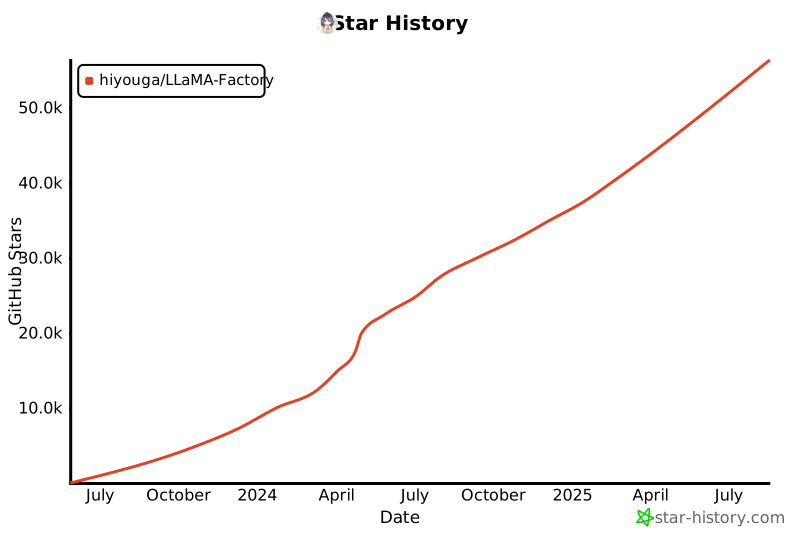
Star History
Release history Release notifications | RSS feed


Download files
Download the file for your platform. If you're not sure which to choose, learn more about installing packages.
Source Distribution
Built Distribution
Filter files by name, interpreter, ABI, and platform.
If you're not sure about the file name format, learn more about wheel file names.
Copy a direct link to the current filters
File details
Details for the file llmtuner-0.5.3.tar.gz.
File metadata
- Download URL: llmtuner-0.5.3.tar.gz
- Upload date:
- Size: 117.6 kB
- Tags: Source
- Uploaded using Trusted Publishing? No
- Uploaded via: twine/4.0.2 CPython/3.10.10
File hashes
| Algorithm | Hash digest | |
|---|---|---|
| SHA256 |
c6317dbbeb08aa94cbc6314a01d70ce6f24d8027e0778091b7adb696fcdcddc0
|
|
| MD5 |
84c0bd46fdaae281469b04aea1965917
|
|
| BLAKE2b-256 |
6f3596f0c366b4ea34050adfaebf2b6f9713befc1f1b47193b28f5ceec150dfe
|
File details
Details for the file llmtuner-0.5.3-py3-none-any.whl.
File metadata
- Download URL: llmtuner-0.5.3-py3-none-any.whl
- Upload date:
- Size: 125.9 kB
- Tags: Python 3
- Uploaded using Trusted Publishing? No
- Uploaded via: twine/4.0.2 CPython/3.10.10
File hashes
| Algorithm | Hash digest | |
|---|---|---|
| SHA256 |
968a0f91e1ca862a363e1bbd0732085bd4643e3b276ca60125cd37e71d574ab7
|
|
| MD5 |
f2837621c48dae3e5fd11179642de6d1
|
|
| BLAKE2b-256 |
138f50e56d8af322350931d5581e718bed5f1e4bcb167f16da689b65e804deb9
|







