
LLM-powered personal knowledge base — raw data goes in, an LLM compiles it into a structured, interlinked wiki

Project description
LLMBase
A personal knowledge base that an LLM compiles, not just stores.





Inspired by Karpathy's LLM Knowledge Base pattern — raw material in, an LLM compiles it into a structured, interlinked wiki, and you keep querying & refining it. No vector DB. No embeddings pipeline. Just markdown, an LLM, and one operations contract that serves your CLI, your browser, and your AI agent.
Live: 華藏閣 — autonomous trilingual Buddhist KB, continuously learning from CBETA · 斯文 — classical-Chinese (文言) KB of Confucian, Daoist & Buddhist classics
The Idea
Most "memory systems" store every word and hope semantic search finds it later. LLMBase does the opposite — an LLM reads and restructures your raw material into composed markdown articles, with [[wiki-links]], backlinks, and a taxonomy that emerges from the content itself. Storage is cheap; structure is the product.
Everything compounds. Every query, every lint pass, every ingest batch adds to the same graph: duplicate concepts merge (叠加进化), broken links auto-generate stubs, tone modes explain the same idea in several registers, citations resolve back to their sources. Humans and agents read the same wiki.
One registry — tools/operations.py — declares every KB operation exactly once. The MCP server dispatches every tool through it; the CLI and HTTP API share the same Operation definitions and are being migrated onto it. Register an op via operations.register(...) and it's reachable from an MCP-enabled agent immediately.
Pipeline
raw/ ──compile──>  wiki/concepts/  ──query/lint──>  wiki/ (enhanced)
                         │                               ↑
                         └─────── 叠加进化 ───────────────┘
1 · Ingest — URLs, PDFs, local files, or corpus plugins (CBETA canon, ctext.org, Wikisource) land in raw/ with provenance metadata.
2 · Compile — the LLM extracts concepts and writes trilingual articles (EN / 中文 / 日本語) with cross-references, aliases, and an emergent taxonomy. Existing concepts update in place.
3 · Query — a deep-research loop pulls context from compiled concepts, answers in the voice you choose (scholar 🎓 · 文言 📜 · ELI5 👶 · caveman 🦴), and optionally files the answer back. Agents that need verbatim material can call kb_search_raw directly for a second-layer recall over the original sources.
4 · Heal — the lint pipeline detects broken links, garbage stubs, dirty tags, duplicates, uncategorized drift — and repairs them. The background worker runs this on a schedule.
What Makes It Different
- Synthesis, not archiving. The wiki is the memory. No vector store, no giant transcript tape.
- Two-layer recall.
kb_searchscores compiled concepts with a TF-IDF tokenizer;kb_search_rawruns the same scoring over the originalraw/sources — verbatim fallback when the compile glossed over a detail. - Trilingual by default. Every article ships with English, 中文, and 日本語 sections. A multilingual alias map resolves
[[参禅]]→can-chan.md, with simplified/traditional conversion via opencc. - Emergent structure. Taxonomy is LLM-generated per-domain — nothing hardcoded to Buddhism or classics. Works for any field.
- One contract, three surfaces. The same
Operation(name=..., handler=..., params=...)powers CLI / HTTP / MCP simultaneously. - Self-healing. 7-step auto-fix: clean → metadata → broken-links → dedup → taxonomy. Merges
benevolence+ren+仁爱into one article rather than three. - Library, not framework. Downstream projects override module-level constants and register hooks. No forking. The customization contract is stable across versions.
Install
pip install llmwiki                                    # PyPI
# or
git clone https://github.com/Hosuke/llmbase.git
cd llmbase && pip install -e .
Quick Start
cd frontend && npm install && npx vite build && cd ..
cp .env.example .env                     # set API key / base URL / model
llmbase web                              # → http://localhost:5555
Any OpenAI-compatible endpoint works (self-hosted or aggregator). Configure a fallback chain and retry budget:
LLMBASE_API_KEY=...
LLMBASE_BASE_URL=...
LLMBASE_MODEL=...

LLMBASE_FALLBACK_MODELS=model-a,model-b   # optional; empty = no fallback
LLMBASE_PRIMARY_RETRIES=3                 # default 3
LLMBASE_FALLBACK_RETRIES=1                # default 1
.env is discovered in this order (first hit wins; shell export always
beats the file):
$LLMBASE_ENV_FILE— explicit path override$PWD/.env— only when$PWD/config.yamldeclares llmbase paths (paths.concepts/paths.wiki/paths.raw). This keeps a strayconfig.yamlfrom an unrelated project from qualifying CWD as a KB root and loading a hostile.envthat could redirect requests.~/.config/llmbase/.env— user-level default, works across projects<package_parent>/.env— legacy source-install path
Works identically for pip install llmwiki, pipx install llmwiki, and
pip install -e ..
Three Surfaces, One Contract
Every operation is declared once in tools/operations.py and exposed everywhere.
CLI
# ─── Ingest ─────────────────────────────────────
llmbase ingest url   https://example.com/article
llmbase ingest pdf   ./book.pdf --chunk-pages 20
llmbase ingest file  ./notes.md
llmbase ingest dir   ./research-papers/

llmbase ingest cbeta-learn      --batch 10         # Buddhist canon
llmbase ingest ctext-book 论语  /analects/zh       # Chinese classics
llmbase ingest wikisource-learn --batch 5

# ─── Compile & maintain ─────────────────────────
llmbase compile new             # incremental (3-layer dedup)
llmbase compile all             # full rebuild
llmbase compile index           # rebuild index + aliases

llmbase lint check              # 8 categories of structural checks
llmbase lint heal               # check → fix → re-check → report
llmbase lint deep               # LLM deep quality analysis

# ─── Query ──────────────────────────────────────
llmbase query "何为空性" --tone wenyan            # 📜 Classical Chinese
llmbase query "Explain X"  --tone scholar         # 🎓 Academic
llmbase query "What is Y"  --tone eli5            # 👶 Simple
llmbase query "Compare A and B" --file-back       # save to wiki

# ─── Serve ──────────────────────────────────────
llmbase web                     # Web UI     :5555
llmbase serve                   # Agent API  :5556
HTTP
| Method | Endpoint | Description |
|---|---|---|
| GET | /api/articles |
list articles |
| GET | /api/articles/<slug> |
article + backlinks + citations |
| GET | /api/search?q=... |
full-text search over concepts |
| POST | /api/ask |
deep-research Q&A |
| GET | /api/taxonomy?lang=zh |
hierarchical categories |
| GET | /api/xici?lang=zh |
guided reading (导读) |
| GET | /api/entities |
people / events / places |
| GET | /api/trails |
research exploration paths |
| POST | /api/lint/fix |
auto-fix pipeline |
Read endpoints (articles, search, taxonomy, xici, entities) stay open. Mutating endpoints (ingest, compile, delete, clean, lint/fix) auto-protect behind LLMBASE_API_SECRET in cloud deployments — auto-generated if unset; same-origin frontend cookies set automatically. kb_search_raw is reachable via CLI and MCP; a REST route can be added via the customization contract.
MCP (AI agents)
{
  "mcpServers": {
    "llmbase": {
      "command": "python",
      "args": ["-m", "tools.mcp_server", "--base-dir", "/path/to/kb"]
    }
  }
}
Tools: kb_search, kb_search_raw, kb_ask, kb_get, kb_list, kb_backlinks, kb_taxonomy, kb_xici, kb_stats, kb_ingest, kb_compile, kb_lint, kb_export* — plus anything you register.
Works with Claude Code, Cursor, Windsurf, ClawHub, and any MCP client. An agent mounted on this server can answer from compiled concepts, fall back to raw sources when the compile missed detail, ingest new material mid-session, and trigger healing. See docs/mcp-server.md.
Autonomous Worker
Deploy once; the server keeps learning.
# config.yaml
worker:
  enabled: true
  learn_source: cbeta              # or any registered learn source
  learn_interval_hours: 6
  learn_batch_size: 10
  compile_interval_hours: 1
  health_check_interval_hours: 24

health:
  auto_fix_broken_links: true
  max_stubs_per_run: 10
The worker starts automatically under the production WSGI entrypoint (wsgi.py → start_worker_thread) — single deployment, no separate queue or cron. Local dev with llmbase web does not start the worker; run gunicorn wsgi:app (or call tools.worker.start_worker_thread yourself) to exercise the autonomous loop locally.
Customization
Library, not framework. Override module-level constants at import time, or register callbacks on lifecycle events.
import tools.compile as c
import tools.query   as q
from tools.hooks     import register
from tools.worker    import register_learn_source
from tools.operations import register as register_op, Operation

# Single-language KB
c.SECTION_HEADERS = [("wenyan", "## 文言")]

# Custom tone mode
q.TONE_INSTRUCTIONS["formal_zh"] = "請以正式中文回答。"

# React to lifecycle events (10 emitted across compile/lint/xici/entities/…)
register("compiled", lambda source, title, **kw: sync.push(source, title))

# Custom learn source for the worker
register_learn_source("my_corpus", my_learn_handler)

# One op, three surfaces
register_op(Operation(
    name="kb_custom",
    description="My custom KB op",
    handler=my_handler,
    params={"type": "object", "properties": {"query": {"type": "string"}}},
))
Stable contract — see docs/customization.md for the full surface (compile, query, taxonomy, xici, entities, lint, web, worker, operations).
Live Deployments
Both run pure llmwiki as a dependency; all customization goes through hooks and overrides, no forks.
- 華藏閣 — autonomous Buddhist KB, continuously learning from CBETA canon, trilingual (EN / 中 / 日). Supabase sync wired via lifecycle hooks.
- 斯文 — classical-Chinese KB of Confucian, Daoist & Buddhist classics. Single-language 文言 frontend. CJK slugs enabled via the customization contract.
Design Principles
- Domain-agnostic — taxonomy emerges from content; nothing is hardcoded
- No vector DB — markdown + a thoughtful tokenizer + LLM context is enough at personal scale;
kb_search_rawcovers verbatim recall - Explorations add up — every query, lint, and ingest compounds the wiki
- LLM writes, you curate — the LLM maintains; you direct
- Incremental, not batch — 叠加进化: concepts merge, never overwrite
- Extensible without forking — stable customization contract
- Agent-native — humans and agents are equal users
- Self-healing — the system detects and fixes its own drift
Deploy
docker compose up -d                                                    # Docker
railway up                                                              # Railway
gunicorn --bind 0.0.0.0:5555 --workers 2 --timeout 300 wsgi:app         # any VPS
中文说明
这是什么
LLMBase(PyPI:llmwiki)是一个 由 LLM 合成、而非单纯存储的知识库。大多数"记忆系统"把每一个字塞进向量库、靠语义检索找回;LLMBase 恰恰相反——让 LLM 读懂并重写你的原始材料为结构化、互链的 markdown 文章,带 [[wiki 链接]]、反向链接、以及由内容涌现的分类体系。存储是廉价的,结构才是产品。
一切会累加。每次查询、每轮 lint、每批摄入都落进同一张图:重复概念合并(叠加进化)、断链自动补 stub、多种语气模式换不同方式讲同一件事、引用可溯源回原文。人和 agent 读的是同一套 wiki。
单一注册表 tools/operations.py 把每个操作声明一次:MCP server 全部工具走该注册表派发;CLI 和 HTTP API 共用同一套 Operation 定义,正在逐步迁移接入。通过 operations.register(...) 注册一个 op,MCP-enabled agent 即可调用。
灵感来自 Karpathy 的 LLM Knowledge Base 设计。
管道
raw/ ──compile──>  wiki/concepts/  ──query/lint──>  wiki/(增强)
                         │                                ↑
                         └───────  叠加进化  ──────────────┘
- 摄入 — URL、PDF、本地文件、语料插件(CBETA 大藏经、ctext、Wikisource)落地
raw/,带出处元数据 - 编译 — LLM 提取概念,生成三语文章(EN/中/日),建立交叉引用、别名图与涌现式分类
- 查询 — 深度研究式问答从编译后的概念层召回;agent 需要原文时可直接调用
kb_search_raw走原文兜底。支持学者 🎓、文言 📜、幼稚园 👶、原始人 🦴 等语气;答案可归档回 wiki - 自愈 — lint pipeline 检测断链、垃圾 stub、脏 tag、重复、未分类,并修复。Worker 按时自动执行
与其他方案的区别
- 合成 vs 存档——wiki 本身即记忆,不用向量库,不堆原文磁带
- 双层召回——
kb_search对编译后概念做 TF-IDF 打分;kb_search_raw用同一套打分器跑raw/原文,兜底取被 compile 抽象掉的细节 - 默认三语——每篇都有 English / 中文 / 日本語;alias 图跨脚本解析
[[参禅]]→can-chan.md,繁简互通 - 结构涌现——分类由 LLM 按域生成,零硬编码
- 一套契约,三个面——同一个
Operation(...)同时驱动 CLI / HTTP / MCP - 自愈——7 步 auto-fix:清理 → 元数据 → 断链 → 合并 → 分类
- 库而非框架——下游通过覆盖模块常数和注册 hook 定制,不 fork,契约跨版本稳定
安装
pip install llmwiki
# 或
git clone https://github.com/Hosuke/llmbase.git
cd llmbase && pip install -e .
快速开始
cd frontend && npm install && npx vite build && cd ..
cp .env.example .env                     # 配置 API key / base URL / 模型
llmbase web                              # → http://localhost:5555
兼容任何 OpenAI 协议端点(自部署或聚合器)。可配置备选模型链与重试预算:
LLMBASE_API_KEY=...
LLMBASE_BASE_URL=...
LLMBASE_MODEL=...

LLMBASE_FALLBACK_MODELS=model-a,model-b   # 可选;空 = 不降级
LLMBASE_PRIMARY_RETRIES=3                 # 默认 3
LLMBASE_FALLBACK_RETRIES=1                # 默认 1
三个面,一套契约
CLI
# 摄入
llmbase ingest url   https://...
llmbase ingest pdf   ./book.pdf --chunk-pages 20
llmbase ingest cbeta-learn      --batch 10
llmbase ingest ctext-book 论语  /analects/zh

# 编译与维护
llmbase compile new           # 增量编译
llmbase lint heal             # 检查 → 修复 → 复查 → 报告
llmbase lint deep             # LLM 深度质量分析

# 查询
llmbase query "何为空性" --tone wenyan
llmbase query "比较儒道佛"   --file-back

# 服务
llmbase web                   # Web UI    :5555
llmbase serve                 # Agent API :5556
HTTP
读接口(articles / search / taxonomy / xici / entities)常开;变更类接口(ingest / compile / delete / clean / lint/fix)由 LLMBASE_API_SECRET 保护(云端部署自动生成;同源前端自动种 cookie)。kb_search_raw 目前通过 CLI 与 MCP 暴露,如需 REST 路由可通过定制契约添加。
MCP
{
  "mcpServers": {
    "llmbase": {
      "command": "python",
      "args": ["-m", "tools.mcp_server", "--base-dir", "/path/to/kb"]
    }
  }
}
工具集:kb_search、kb_search_raw(原文兜底)、kb_ask、kb_get、kb_list、kb_backlinks、kb_taxonomy、kb_xici、kb_stats、kb_ingest、kb_compile、kb_lint、kb_export*,以及下游自注册的 op。
支持 Claude Code、Cursor、Windsurf、ClawHub 等所有 MCP 客户端。挂载后 agent 可从概念层答题、原文层兜底、会话中继续摄入、触发自愈。
自治 Worker
worker:
  enabled: true
  learn_source: cbeta
  learn_interval_hours: 6
  learn_batch_size: 10
  compile_interval_hours: 1
  health_check_interval_hours: 24

health:
  auto_fix_broken_links: true
  max_stubs_per_run: 10
Worker 在生产 WSGI 入口(wsgi.py → start_worker_thread)自动启动——单部署,无需额外队列或 cron。本地 llmbase web 开发时 worker 不会自启;要在本地跑自治循环,请用 gunicorn wsgi:app,或自行调用 tools.worker.start_worker_thread。
定制与扩展
"库而非框架"。import 时覆盖模块常数,或注册 hook:
import tools.compile as c
import tools.query   as q
from tools.hooks     import register
from tools.worker    import register_learn_source
from tools.operations import register as register_op, Operation

c.SECTION_HEADERS = [("wenyan", "## 文言")]                 # 单语 KB
q.TONE_INSTRUCTIONS["formal_zh"] = "請以正式中文回答。"       # 自定义语气
register("compiled", my_sync_handler)                        # 编译后回调
register_learn_source("my_corpus", my_handler)               # 自定义学习源
register_op(Operation(                                       # 一次注册,三面同暴露
    name="kb_custom", description="自定义 op",
    handler=my_handler,
    params={"type": "object", "properties": {"query": {"type": "string"}}},
))
完整契约见 docs/customization.md(涵盖 compile / query / taxonomy / xici / entities / lint / web / worker / operations)。
线上实例
两者均为纯 llmwiki 依赖,定制全走 hook + override,无 fork。
设计原则
- 域无关——分类由内容涌现,零硬编码
- 不依赖向量库——个人规模 markdown + 合理 tokenizer 足矣,
kb_search_raw补足原文召回 - 探索会累加——每次查询、lint、摄入都让知识库更强
- LLM 写,你审——LLM 维护,你指导方向
- 增量而非批处理——叠加进化,不覆盖重来
- 可扩展而不 fork——契约稳定
- Agent 原生——人与 agent 平权
- 自愈——系统自己发现并修复漂移
部署
docker compose up -d                                                    # Docker
railway up                                                              # Railway
gunicorn --bind 0.0.0.0:5555 --workers 2 --timeout 300 wsgi:app         # 任意 VPS
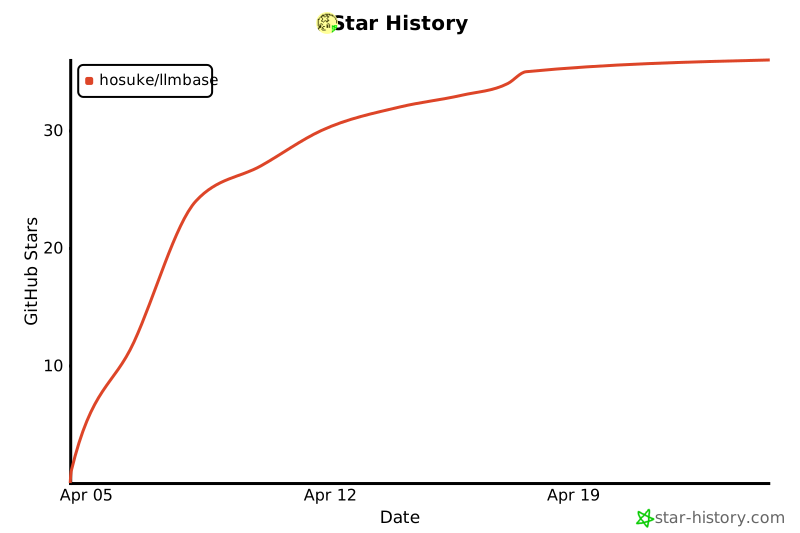
Star History
License
MIT
Release history Release notifications | RSS feed


Download files
Download the file for your platform. If you're not sure which to choose, learn more about installing packages.
Source Distribution
Built Distribution
Filter files by name, interpreter, ABI, and platform.
If you're not sure about the file name format, learn more about wheel file names.
Copy a direct link to the current filters
File details
Details for the file llmwiki-0.7.2.tar.gz.
File metadata
- Download URL: llmwiki-0.7.2.tar.gz
- Upload date:
- Size: 142.9 kB
- Tags: Source
- Uploaded using Trusted Publishing? No
- Uploaded via: twine/6.2.0 CPython/3.12.1
File hashes
| Algorithm | Hash digest | |
|---|---|---|
| SHA256 |
87556a32c9f56fc10b89db5334e201b12a1d421ba9490f1fd215500d1f4cf103
|
|
| MD5 |
a3a2119da72e8433071d32d774089876
|
|
| BLAKE2b-256 |
68abd12537fd023165f0d738093c8c9c1a85c2719ea91b30e25d2b4415cc5764
|
File details
Details for the file llmwiki-0.7.2-py3-none-any.whl.
File metadata
- Download URL: llmwiki-0.7.2-py3-none-any.whl
- Upload date:
- Size: 136.8 kB
- Tags: Python 3
- Uploaded using Trusted Publishing? No
- Uploaded via: twine/6.2.0 CPython/3.12.1
File hashes
| Algorithm | Hash digest | |
|---|---|---|
| SHA256 |
c93df510873e878bf70041230c2fe8ff068fa0d3e59ea5e1621883b8ec42df3e
|
|
| MD5 |
5cd39e6bc4a784f613a8ca1cf3fcb0bb
|
|
| BLAKE2b-256 |
99c212a3cdc2ef2e95b9426ccf4bb32e9491633a5eb810ce0c6d8358996084d1
|






