
localCIDER
version 0.1.21 - May 2023
Introduction
localCIDER is a Python package developed by the lab of Rohit Pappu at Washington University in St. Louis for calculating and plotting parameters associated with intrinsically disordered proteins (IDPs) and disodered regions (IDRs). localCIDER is the Python backend for CIDER, ( Classification of Intrinsically Disordered Ensemble Regions) - a webserver for the calculation of many of those same properties. Essentially, localCIDER lets you run CIDER’s calculations locally, allowing you to create custom analysis pipelines which do not rely on the webserver. It also allows you to take advantage of your own local computing hardware, rather than competing with everyone else for a common set of hardware provided by the Pappu lab.
This project was motivated by the need to rapidly and easily calculate the κ (kappa) parameter, as defined in the 2013 Das & Pappu PNAS paper [1], as well as provide a tool to easily plot a sequence on the diagram-of-states;
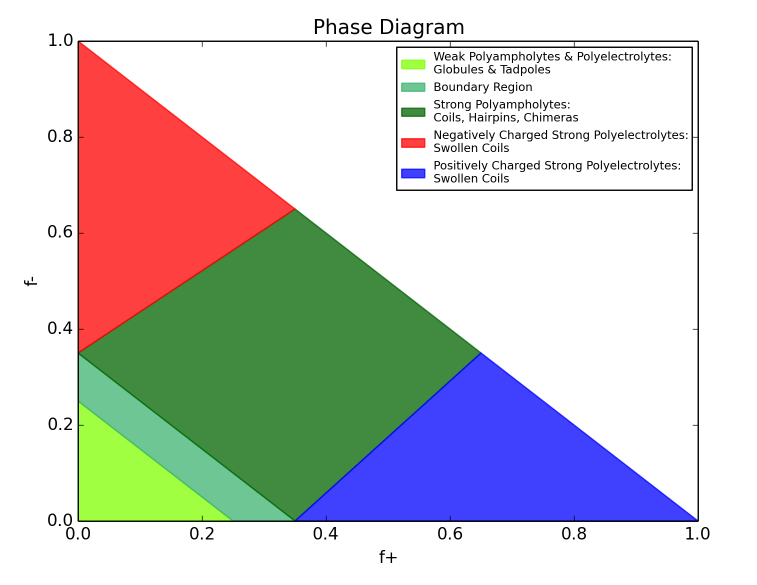
The original method for calculating κ involved an incredibly computationally expensive Monte Carlo step (used to determine the maximally segregated sequence), whereas localCIDER makes use of a newly developed algorithm that computes κ in O(1) time. More generally, localCIDER provides a wide range of sequence analysis routines for understanding, classifying, and designing disordered proteins. Beyond charge-based parameters, a wide range of additional parameters can also be calculated. localCIDER represents an ideal tool for the construction of a high-throughput sequence analysis pipelines, and we believe provides a direct route to explore the sequence-to-ensemble relationship of IDPs.
For more information please see the full documentation .
Installation
To install run
pip install localcider
We strongly recommend using a conda environment (or a virtualenv) to install localcider. Note that localcider requires numpy, scipy, and matplotlib to run.
Usage, bugs, and questions
Please see the see the full documentation for usage guidelines. Please address all questions and bug reports to Alex and he’ll do his best to get back to you!
About
localCIDER was written by Alex Holehouse and James Ahad in the Pappu Lab . Please cite localCIDER (and CIDER) as:
A.S. Holehouse, R.K. Das, J.N. Ahad, M.O.G. Richardson, R.V. Pappu (2017) CIDER: Resources to analyze sequence-ensemble relationships of intrinsically disordered proteins. Biophysical Journal, 112: 16-21
Also, make sure to cite the various studies used if you use analyses that make use of other datasets (e.g. PPII propensity, charge patterning, proline patterning, hydrophobicity etc.).
References
[1] Conformations of intrinsically disordered proteins are influenced by linear sequence distributions of oppositely charged residues R.K. Das & R.V. Pappu (2013) PNAS 110, 33, pp13392–13397.
1 maintainer

Metadata
1 maintainer
Release files for localcider 0.1.21
For a detailed explanation of source distributions (sdists) and built distributions (wheels), please see the package formats documentation.
Source distribution (sdist)
| File | Size | Uploaded | Provenance | Actions |
|---|---|---|---|---|
| localcider-0.1.21.tar.gz | 110.1 kB | Without provenance | Details for localcider-0.1.21.tar.gz |
Release files / localcider-0.1.21.tar.gz
| Download URL | localcider-0.1.21.tar.gz |
|---|---|
| Size | 110.1 kB |
| Tags | Source |
|
SHA-256 checksum How to use checksums |
58acf94264c08675c6fc2edc7e0e6e4e3b046594bbe25f238993483c75250393
|
|
BLAKE2b-256 checksum How to use checksums |
8e0030959378f2d557c6db98b6af6e9d87b5154ee90a2ea94184e9b9a1b27d66
|
| Upload date | |
|
Uploaded using Trusted Publishing? What is trusted publishing? |
No |
| Uploaded via |
twine/4.0.0 CPython/3.8.12
|
Security for localcider 0.1.21
Provenance
Provenance describes where a file came from. On PyPI, provenance is shared via attestations, which provide a verifiable record of the build or publishing details. View details, limitations and caveats.
No provenance found
None of the files in this release were uploaded with provenance metadata.
A note on package security
PyPI is a repository for distributing packages, not a service for auditing them. While third-party security researchers and our staff do their best to detect and remove malicious packages, PyPI cannot guarantee the quality, security or suitability of any given package.
To learn more about protecting yourself from malicious actors, visit our package security documentation.














