

In-flight circuit breaker & reasoning loop recovery for LangGraph & LangChain agents










⚡ Quick Start · 📖 Documentation · 👥 CrewAI · 🪄 @guarded · 💡 How It Works · 🔍 Loop Detectors · 🐍 Raw Clients · 📜 Changelog
Overview
"Why did my agent just burn $14 repeating the exact same search 20 times?" — now you have an in-flight circuit breaker that detects loops and recovers gracefully.
When autonomous LLM agents hit an unexpected hurdle, they often get trapped in repetitive reasoning loops: calling identical tools with the same parameters, oscillating between two conflicting thoughts, or drifting aimlessly while burning thousands of tokens.
LangGraph's built-in recursion_limit is a hard crash (GraphRecursionError). It drops state, discards user context, and provides zero opportunity for recovery.
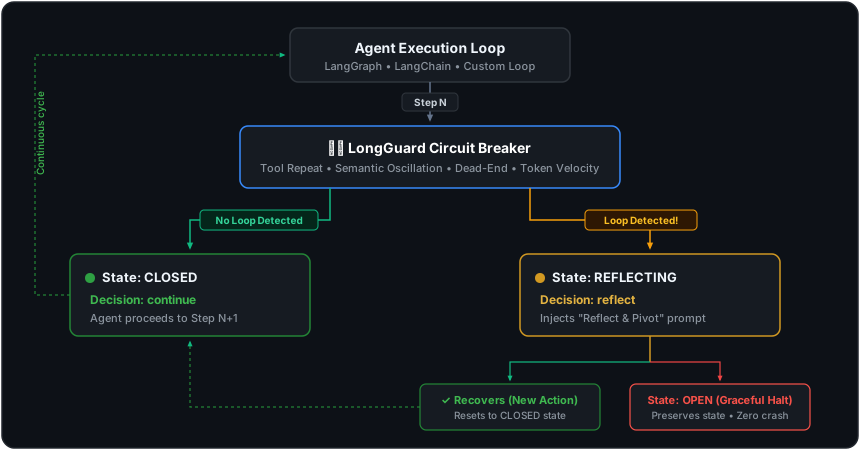
LongGuard is an intelligent circuit breaker middleware. It monitors your agent's chain-of-thought in real time, catches loops early, injects a "Reflect & Pivot" prompt to guide the agent back on track, and only halts (kill) gracefully if recovery fails—preserving complete state and token analytics.
🌐 Part of the Long Suite
LongGuard is part of the EnDevSols Long Suite of open-source production AI tools:
- LongParser — High-speed, privacy-first local document ingestion & chunking (PDF, DOCX, PPTX, XLSX)
- LongTrainer — Production multi-tenant RAG chatbot and agent framework
- LongTracer — Post-generation hallucination detection via hybrid STS + NLI claim verification
- LongProbe — Sub-second RAG retrieval regression testing with pytest
- LongGuard — In-flight runtime agent circuit breaker & reasoning loop recovery ← You are here
Together, the Long Suite covers the full AI lifecycle from data ingestion and retrieval CI regression to runtime agent safety and post-generation verification.
💡 Why LongGuard?
- ⚡ Sub-millisecond overhead: Evaluates in-flight agent steps without slowing down LLM inference.
- 🔄 4 loop detectors: Catches tool repetition, semantic oscillation, dead-end drift, and token velocity spikes.
- 🧭 Reflect & Pivot prompt injection: Guides stuck agents back on track before giving up.
- 🛡️ Zero unhandled crashes: Gracefully terminates and preserves conversation state if recovery fails.
- 🔌 1-line framework integrations: Drop-in wrapper for LangGraph 1.0+ (
add_guard_to_graph), LangChain (GuardedAgentExecutor), and CrewAI (add_guard_to_crew). - 🪄 Universal
@guardeddecorator: 1-line protection for arbitrary Python functions, generators, and async loops. - 🐍 Raw client support: Use LongGuard directly with
openaioranthropicSDK — no framework needed. - 💵 Dollar cost tracking: Built-in pricing for 40+ models. Set
max_cost_usdto hard-kill on budget overrun. - 📊 Full observability: Detailed
GuardReportwith per-step telemetry. Save to JSON/YAML. Load for offline analysis.
🏗️ Architecture
⚡ Quick Start
Installation
# Core package (standalone, zero heavy dependencies)
pip install longguard

# With LangGraph integration (LangGraph 1.0+)
pip install longguard[langgraph]

# With LangChain integration
pip install longguard[langchain]

# With CrewAI integration
pip install longguard[crewai]

# With high-quality sentence embeddings
pip install longguard[embeddings]

# Everything
pip install longguard[all]
1. LangGraph Integration (1 Line)
Compatible with LangGraph 1.0+ and modern multimodal models (Claude 3.7, Gemini 2.5, GPT-4o):
from langgraph.graph import StateGraph
from longguard.integrations.langgraph import add_guard_to_graph
from longguard import GuardConfig

# 1. Build your LangGraph workflow as usual
workflow = StateGraph(AgentState)
workflow.add_node("agent", agent_node)
workflow.add_node("tools", tool_node)
workflow.add_edge("agent", "tools")
workflow.add_conditional_edges("tools", should_continue)

# 2. Add LongGuard in one line!
workflow = add_guard_to_graph(workflow, GuardConfig())
app = workflow.compile()

# 3. Read execution telemetry after run
guard = workflow.__longguard__
print(guard.get_report().summary())
2. CrewAI Integration (1 Line)
Protect multi-agent crews from delegation loops and repetitive tool calls:
from crewai import Crew
from longguard import GuardConfig
from longguard.integrations.crewai import add_guard_to_crew

crew = Crew(agents=[researcher, writer], tasks=[task1, task2])
crew = add_guard_to_crew(crew, GuardConfig(model="gpt-4o", max_cost_usd=1.00))
result = crew.kickoff()

print(crew.__longguard__.summary())
3. Universal @guarded Decorator
Add circuit breaking to any custom agent function or LLM call:
from longguard import guarded

@guarded(max_cost_usd=0.50, tool_repeat_threshold=3)
def run_agent_step(thought: str, action: str, action_input: dict, observation: str):
    return execute_tool(action, action_input)

# Check execution report at any time:
print(run_agent_step.report.summary())
4. Raw OpenAI / Anthropic Client (No Framework Needed)
Call LongGuard directly from any while loop — works with plain openai or anthropic SDK:
import openai
from longguard import AgentStep, CircuitBreaker, GuardConfig

client = openai.OpenAI()
breaker = CircuitBreaker(GuardConfig(
    model="gpt-4o",        # enables dollar-cost tracking
    max_cost_usd=0.50,     # hard-kill if run exceeds $0.50
    max_steps=30,
))

observation = None
for i in range(1, 31):
    response = client.chat.completions.create(model="gpt-4o", messages=messages)

    # One-line conversion from SDK response → AgentStep
    step = AgentStep.from_openai_response(response, step_number=i, observation=observation)
    decision = breaker.check(step)

    if decision.action == "kill":
        print(f"⛔ Halted: {decision.reason}")
        break
    elif decision.action == "reflect":
        messages.append({"role": "system", "content": decision.inject_prompt})

    if step.action is None:
        break  # final answer
    observation = run_tool(step.action, step.action_input)

# Full run report including estimated cost
print(breaker.report.summary())
# → Estimated Cost: $0.0143 USD (gpt-4o)
For Anthropic: use
AgentStep.from_anthropic_response(response, step_number=i)— same API, zero dependencies.
5. Standalone / Custom Agent Loop
If you run a custom while loop or proprietary agent orchestrator:
from longguard import CircuitBreaker, GuardConfig, AgentStep

breaker = CircuitBreaker(GuardConfig(
    tool_repeat_threshold=3,    # 3 identical tool calls = trigger
    max_tokens_per_run=50_000,  # Hard token cap
))

for step in run_agent():
    decision = breaker.check(AgentStep(
        step_number=step.index,
        thought=step.thought,
        action=step.tool_name,
        action_input=step.arguments,
        observation=step.tool_output,
        tokens_used=step.tokens,
    ))

    if decision.action == "reflect":
        # Inject the recovery advice into your agent's context
        messages.append({"role": "user", "content": decision.inject_prompt})
    elif decision.action == "kill":
        print(f"Halted safely: {decision.reason}")
        break

# View summary report
print(breaker.report.summary())
🔍 The 4 Loop Detectors
| Detector | What It Catches | Real-World Example |
|---|---|---|
| 🔄 Tool Repeat | Calling the same tool with identical inputs $\ge N$ times | Agent calls search("revenue 2025") 4 times with zero parameter changes |
| 🌀 Semantic Oscillation | Cycling between the same concepts in reasoning | Agent reasons "Option A", then "No, B", then "Actually A", then "No, B" |
| 📉 Dead-End Drift | Zero new information or observations for 5+ steps | Queries return empty results or repetitive error strings |
| ⚡ Token Velocity | Sudden exponential token spikes per step | Agent injects giant raw HTML payloads into context, blowing budget |
📊 LongGuard vs. LangGraph recursion_limit
| Capability | LangGraph recursion_limit |
LongGuard 🛡️ |
|---|---|---|
| Detects Tool-Repeat Loops | ❌ No | ✅ Yes |
| Detects Semantic Reasoning Loops | ❌ No | ✅ Yes |
| Detects Sudden Cost / Token Spikes | ❌ No | ✅ Yes |
| Auto-Injects Recovery Prompts | ❌ No | ✅ Yes |
| Exit Behavior | 💥 Unhandled Exception (Crash) |
🛡️ Graceful State Preservation |
| Run Reporting & Telemetry | ❌ No | ✅ JSON & Summary Reports |
| Configurable Thresholds | ❌ Single integer | ✅ Granular GuardConfig |
⚙️ Configuration at a Glance
All behavior is customizable through GuardConfig:
from longguard import GuardConfig

config = GuardConfig(
    # Loop Detection Sensitivity
    tool_repeat_threshold=3,          # Repeated tool calls before reflection
    tool_repeat_window=6,             # History window to examine
    dead_end_threshold=5,             # Steps with no progress before triggering
    token_velocity_multiplier=3.0,    # Spike multiplier vs rolling baseline

    # Hard Safety Guardrails
    max_tokens_per_run=50_000,        # Hard stop if agent burns > 50k tokens
    max_steps=30,                     # Maximum steps permitted
    max_reflections=2,                # Maximum recovery attempts before kill

    # Dollar Cost Tracking (v0.1.3)
    model="gpt-4o",                   # Enables built-in cost estimation
    max_cost_usd=0.50,                # Hard-kill if run exceeds $0.50
    # cost_per_input_token=2.5e-6,    # Override for unlisted models (USD/token)
    # cost_per_output_token=10e-6,
)
👉 For detailed documentation on custom detectors, embedding backends, and LangSmith telemetry, see the Full Documentation.
🧪 CI/CD Ready
Run the test suite locally with uv or pytest:
# Run all 255 unit & integration tests
uv run pytest tests/ -v

# Run with coverage report
uv run pytest tests/ --cov=longguard --cov-report=term-missing

# Run code style & type checks
uv run ruff check src/ tests/
uv run mypy src/
Every push and pull request is automatically tested across Python 3.10, 3.11, and 3.12 on both Ubuntu and macOS via GitHub Actions.
🤝 Contributing
Contributions are welcome! Please see CONTRIBUTING.md for guidelines on code formatting, running tests, and opening pull requests.
🛡️ Security
For vulnerability disclosures, please review SECURITY.md or contact technology@endevsols.com.
📄 License
LongGuard is open-source software released under the MIT License.
1 maintainer

Metadata
1 maintainer
Release files for longguard 0.1.4
For a detailed explanation of source distributions (sdists) and built distributions (wheels), please see the package formats documentation.
Source distribution (sdist)
| File | Size | Uploaded | |
|---|---|---|---|
| longguard-0.1.4.tar.gz | 1.5 MB | Details |
Built distribution (wheel)
| File | Interpreter | ABI | Platform | Reset |
|---|---|---|---|---|
| longguard-0.1.4-py3-none-any.whl | Python 3 | none | any | Details |
Total release size: 1.6 MB
Release files / longguard-0.1.4.tar.gz
| Download URL | longguard-0.1.4.tar.gz |
|---|---|
| Size | 1.5 MB |
| Tags | Source |
|
SHA-256 checksum How to use checksums |
7c215505a4b91f94488d6f43549325ad1ad2085d6d2888d4263b4184e0cf6051
|
|
BLAKE2b-256 checksum How to use checksums |
826629dd2a0d190edb90a9d69f5b33519a970efb2ef4778f7b7c61169e831dec
|
| Upload date | |
|
Uploaded using Trusted Publishing? What is trusted publishing? |
No |
| Uploaded via |
uv/0.9.22 {"installer":{"name":"uv","version":"0.9.22","subcommand":["publish"]},"python":null,"implementation":{"name":null,"version":null},"distro":{"name":"macOS","version":null,"id":null,"libc":null},"system":{"name":null,"release":null},"cpu":null,"openssl_version":null,"setuptools_version":null,"rustc_version":null,"ci":null}
|
Release files / longguard-0.1.4-py3-none-any.whl
| Download URL | longguard-0.1.4-py3-none-any.whl |
|---|---|
| Size | 56.4 kB |
| Tags | Python 3 |
|
SHA-256 checksum How to use checksums |
09b87b73dbfb769faa78b8061bc7eb116e375f4e5905694663f6c2ea3b6b425b
|
|
BLAKE2b-256 checksum How to use checksums |
346720914dcf10432d35f52206d7c95c24666113c576592602fdb7d0b09b2748
|
| Upload date | |
|
Uploaded using Trusted Publishing? What is trusted publishing? |
No |
| Uploaded via |
uv/0.9.22 {"installer":{"name":"uv","version":"0.9.22","subcommand":["publish"]},"python":null,"implementation":{"name":null,"version":null},"distro":{"name":"macOS","version":null,"id":null,"libc":null},"system":{"name":null,"release":null},"cpu":null,"openssl_version":null,"setuptools_version":null,"rustc_version":null,"ci":null}
|














