



Loopcaptain is an open protocol for agent loops and a local dashboard to monitor and steer them: a human in the loop without a chat window. Alpha: protocol 1 only grows, so a loop written today keeps working; the board may change.
Get started
Paste one line into your coding agent, whichever you use.
Start a new loop
Use Loopcaptain to build an agent loop in this repository: follow https://github.com/faviens/loopcaptain/blob/v0.9.1/standard/AGENTS.md.
Connect a loop you have
Connect the agent loops on this machine to the Loopcaptain board: follow https://github.com/faviens/loopcaptain/blob/v0.9.1/AGENTS.md, section A.
The board
Every loop on your machine on one page: what waits for you, what needs a look, what runs, what it cost. One loop in detail: whether it converges, every round and what each reviewer found, and where you answer, steer, stop or start it.
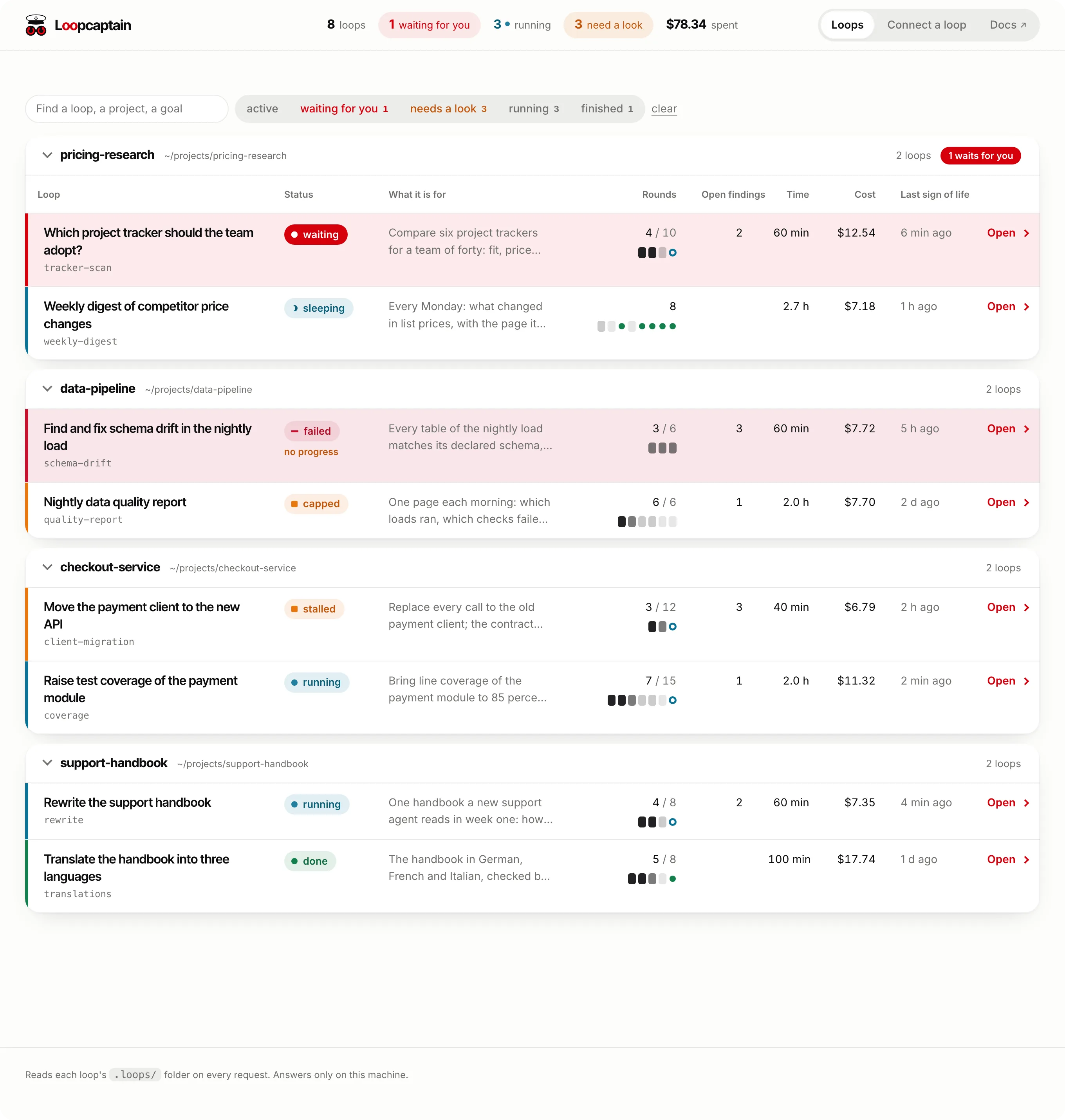
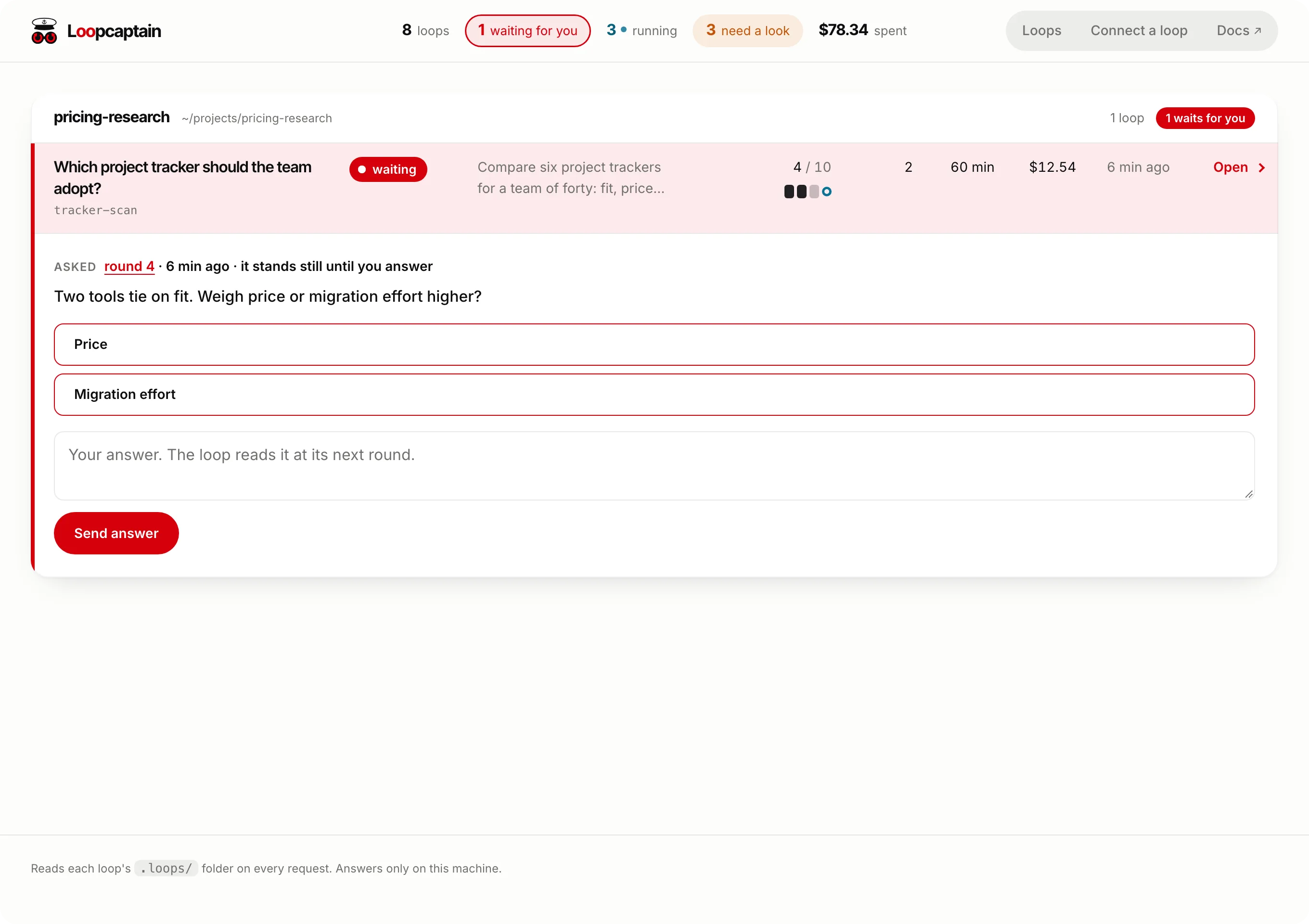
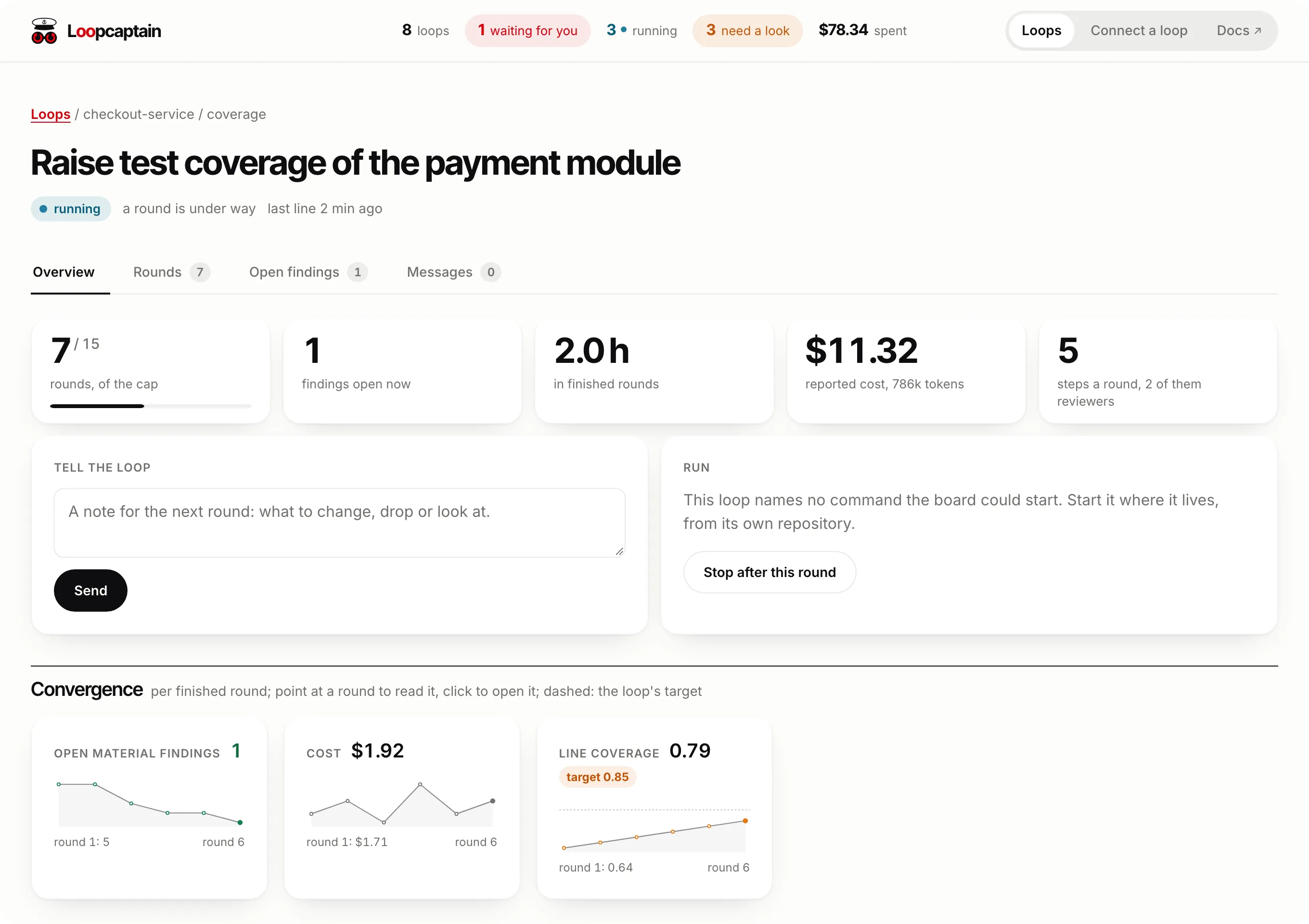
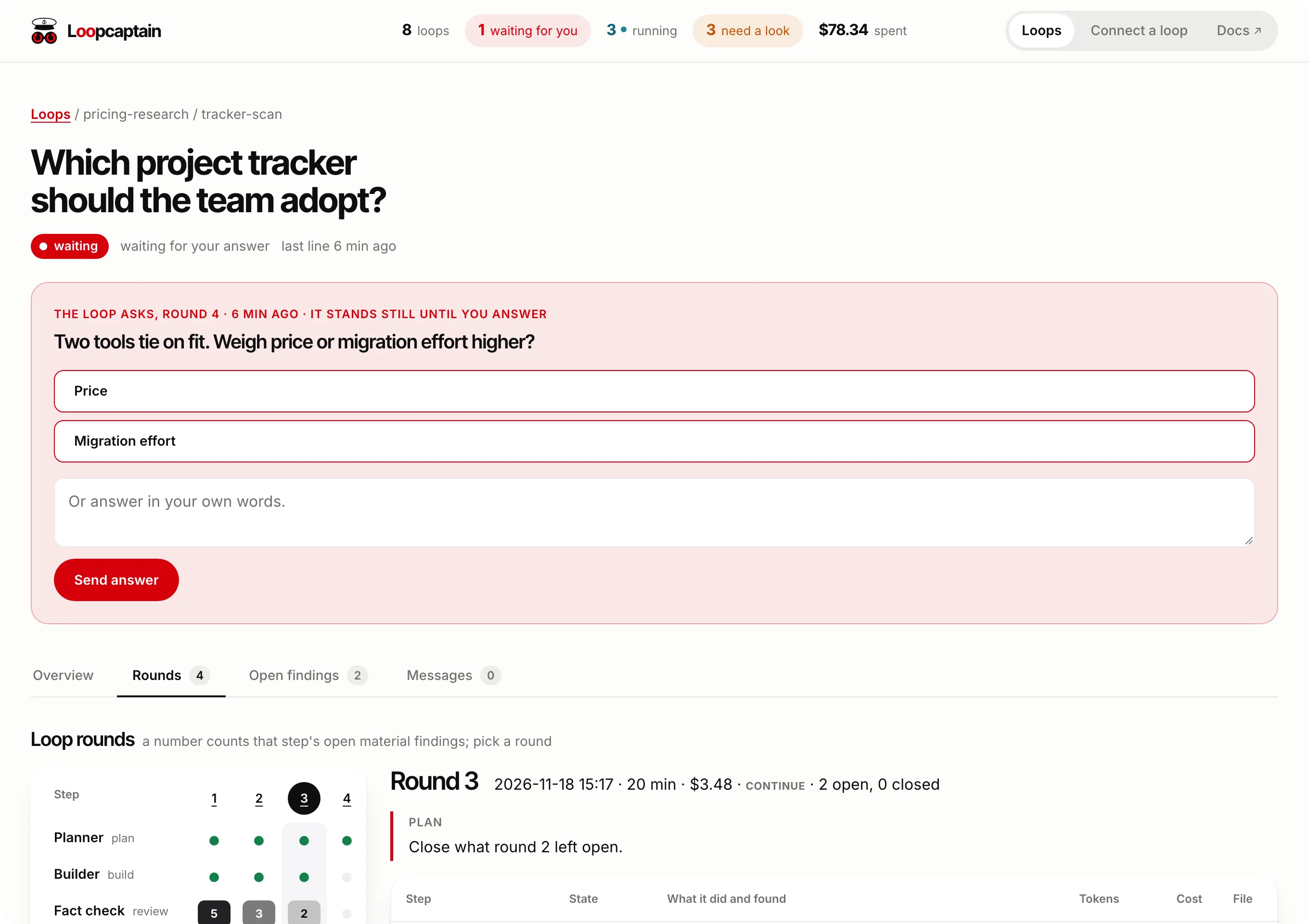
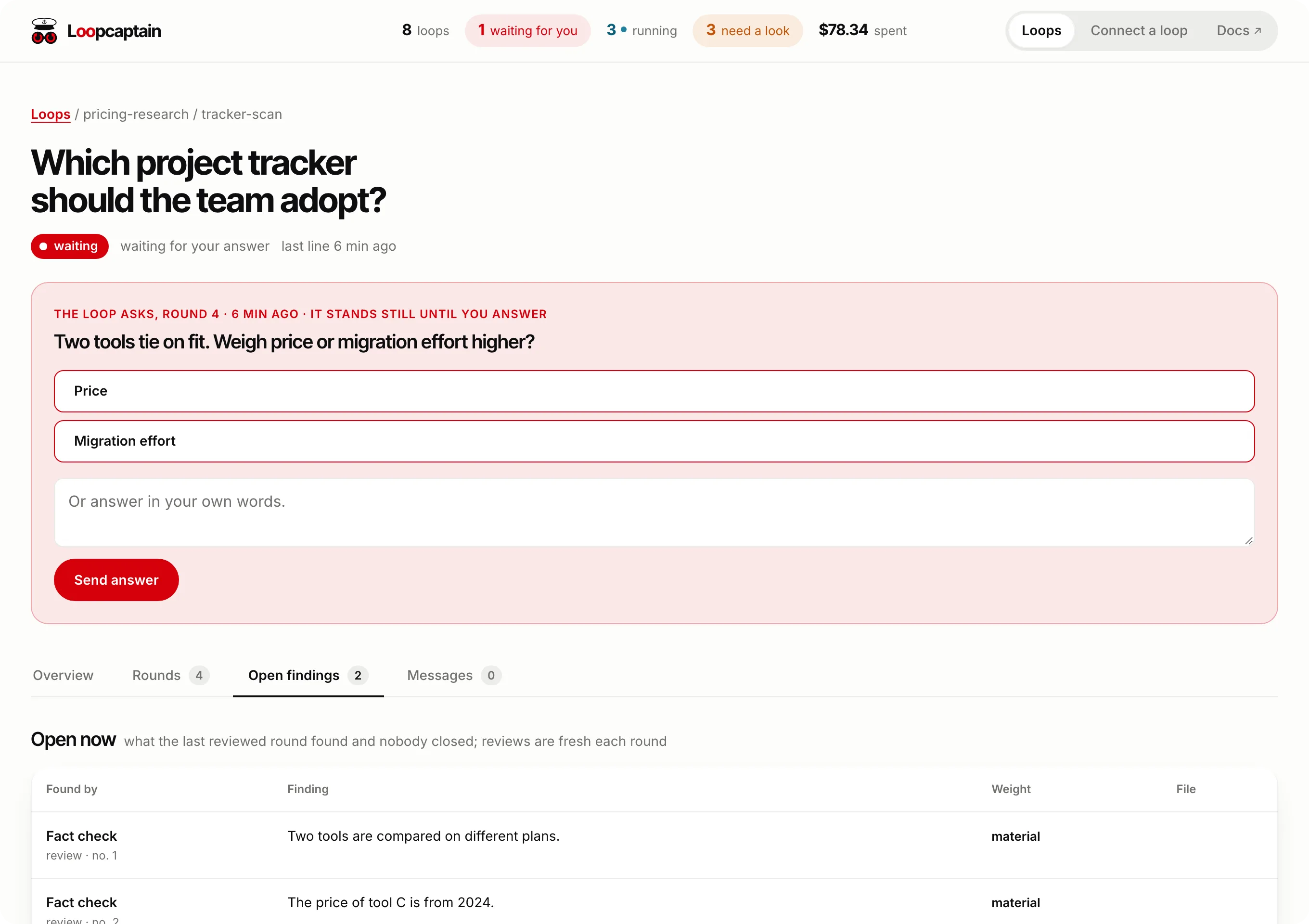
Invented loops, photographed from the board itself: make shots.
Setup
uv tool install loopcaptain    # or put uvx in front of the two lines below
loopcaptain demo               # writes the example loop and puts it on the board
loopcaptain serve              # the board, on this machine only
Open the address serve prints in a browser: it lets that browser in. The
example loop costs nothing, no model and no network: press Start, answer
its question with a button and watch it end done. It needs Python 3.12 or
later, on macOS or Linux, and uv, pipx or pip.
From a checkout: make setup && make demo && make serve.
It works with any loop that can write a file: a script, a Ralph loop, a
long-running session of a coding agent (Claude Code's /loop, Codex's goal
mode, for example), a loop built on an agent framework. None of them is
needed: a loop has no dependency and never imports this repository. The
documentation has
Installation,
Get started and
Setup.
Steer a loop: answer, note, stop, start
- Answer. A loop that asks shows its question on the board, with
buttons where it offered choices. Your answer is one signed line in the
loop's
inbox.jsonl; the loop reads it at its next round. - Note. The same line without a question: a direction for the next round.
- Stop. The loop finishes the round it is in and ends.
loopcaptain doctorchecks that a loop really takes a stop. - Start. The board runs the one command the loop declared in its own
loop.json, without a shell, after you tick it once.
The loop protocol
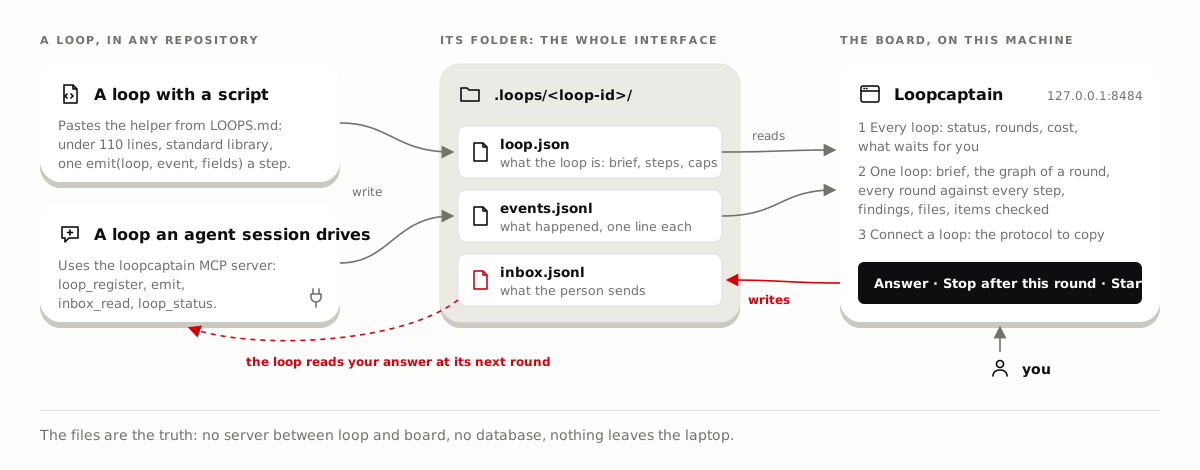
A loop does not import this repository. It writes a few small files into
.loops/<loop-id>/ in its own repository; the board reads them and writes
the person's answers back.
| File | Written by | Holds |
|---|---|---|
loop.json |
the loop | what it is: the brief, the steps of a round, its caps, its start command |
events.jsonl |
the loop, appending | what happened: rounds, steps, findings, cost, metrics, questions |
inbox.jsonl |
the board, signed | what you sent: answers, notes, a stop |
The whole protocol is one page, standard/LOOPS.md. A Python loop pastes a helper of under 110 lines, standard/loops.py; an agent session uses the MCP server, which every coding agent adds its own way: docs/agents.md.
An agent loop runs an agent on one task again and again, until a bar is met
or a cap is reached. One pass is a round: a few steps, usually one that
makes something and others that judge it. A reviewer is such a judging
step: it reads what the round made and lists what is wrong, as findings. A
loop reports by appending one line per thing that happened to
.loops/<loop-id>/events.jsonl. One round, in which a reviewer finds a
fault and the loop asks you what to do:
{"ts": "2026-11-14T21:03:00Z", "event": "round_started", "round": 1, "plan": "Draft the memo"}
{"ts": "2026-11-14T21:09:40Z", "event": "step_finished", "round": 1, "step": "build", "cost": {"usd": 0.34}}
{"ts": "2026-11-14T21:12:10Z", "event": "step_finished", "round": 1, "step": "facts", "findings": [{"id": "1", "text": "The 40 percent has no source", "severity": "material"}]}
{"ts": "2026-11-14T21:12:30Z", "event": "step_finished", "round": 1, "step": "gate", "passed": false, "summary": "One material finding is open"}
{"ts": "2026-11-14T21:12:31Z", "event": "question", "id": "q1", "text": "Drop the figure?", "options": [{"id": "yes", "label": "Drop it"}, {"id": "no", "label": "Find a source"}]}
{"ts": "2026-11-14T21:12:32Z", "event": "round_finished", "round": 1, "verdict": "wait"}
Connect a loop by hand
- A script (Python, shell, anything): paste the helper from standard/LOOPS.md and call it where a round and a step begin and end, or append the JSON lines yourself.
- A Ralph loop or any loop around an agent's command line: the shell
form,
loopcaptain emit <loop> <event> key=value, once per iteration. - A long-running agent session: add the MCP server
(
loopcaptain mcp-config <agent>), and the session reports its rounds through five tools.
standard/AGENTS.md walks an agent through each, and through building a loop from nothing.
Commands
loopcaptain serve                         # the board, 127.0.0.1 only
loopcaptain watch <folder> [--root]       # show a repository, or every one under a folder
loopcaptain demo                          # the example loop, written and watched
loopcaptain validate <repository>         # check a repository's .loops folders
loopcaptain doctor <repository> <loop>    # does the loop take a stop?
loopcaptain mcp-config <agent>            # how your agent adds the MCP server
loopcaptain emit <loop> <event> key=value # one event from a shell loop
From a checkout, put uv run in front, or use the make targets in
AGENTS.md.
How it differs
- A dashboard for one kind of loop watches the loops of its own runner. Loopcaptain watches any loop that writes the protocol's files.
- A session monitor shows an agent's live session and its transcript. Loopcaptain shows what sits above: rounds, steps, findings, verdicts, cost and the question that waits for you.
- A loop runner or control plane runs the loop. Loopcaptain runs none: it is a protocol and a board, and your loop stays your own.
- Agent observability traces model calls. Loopcaptain sends and takes no telemetry; docs/opentelemetry.md maps the protocol onto the GenAI conventions for those who want both.
What it is not
No agent runtime: the board runs no model and schedules nothing; it starts
only the one command a loop declares, after you tick it once. No database:
the files are the truth. No cloud and no login: it answers on 127.0.0.1
only, and to a browser that opened the address serve prints. No transcripts: a loop reports summaries and paths. See
SECURITY.md for what it trusts.
More
AGENTS.md runs the board and changes this repository. docs/ARCHITECTURE.md says why it is built this way. CHANGELOG.md says what changed.
License
Apache License 2.0: use it, change it and ship it, also commercially; keep the licence and the NOTICE, and say what you changed. It comes with a patent grant from every contributor. A contribution is taken under the same licence.
1 maintainer

Metadata
1 maintainer
Release files for loopcaptain 0.9.1
For a detailed explanation of source distributions (sdists) and built distributions (wheels), please see the package formats documentation.
Source distribution (sdist)
| File | Size | Uploaded | Provenance | Actions |
|---|---|---|---|---|
| loopcaptain-0.9.1.tar.gz | 1.8 MB | Without provenance | Details for loopcaptain-0.9.1.tar.gz |
Built distribution (wheel)
| File | Interpreter | ABI | Platform | Actions Reset |
|---|---|---|---|---|
| loopcaptain-0.9.1-py3-none-any.whl | Python 3 | none | any | Details for loopcaptain-0.9.1-py3-none-any.whl |
Total release size: 2.1 MB
Release files / loopcaptain-0.9.1.tar.gz
| Download URL | loopcaptain-0.9.1.tar.gz |
|---|---|
| Size | 1.8 MB |
| Tags | Source |
|
SHA-256 checksum How to use checksums |
bd26dbdc80bc5772ed7bb0492dc2f3ac87b48f9b3ecf0fcb3eae00c6aa0fe388
|
|
BLAKE2b-256 checksum How to use checksums |
809d0d7c54531af9eae9a839f1e79869378e7c5ecc154a47346b70961345d1b5
|
| Upload date | |
|
Uploaded using Trusted Publishing? What is trusted publishing? |
Yes |
| Uploaded via |
uv/0.13.9 {"installer":{"name":"uv","version":"0.13.9","subcommand":["publish"]},"python":null,"implementation":{"name":null,"version":null},"distro":{"name":"Ubuntu","version":"26.04","id":"resolute","libc":null},"system":{"name":null,"release":null},"cpu":null,"openssl_version":null,"setuptools_version":null,"rustc_version":null,"ci":true}
|
Release files / loopcaptain-0.9.1-py3-none-any.whl
| Download URL | loopcaptain-0.9.1-py3-none-any.whl |
|---|---|
| Size | 241.0 kB |
| Tags | Python 3 |
|
SHA-256 checksum How to use checksums |
31d6af49da1a728cd45129f314aaa5e95a764156a1f5ac17e92dc8bca4c2573b
|
|
BLAKE2b-256 checksum How to use checksums |
a15bdd3fa99554fbc62817455d888d3c123302a3f1a95b1955bec10fea8aa5f1
|
| Upload date | |
|
Uploaded using Trusted Publishing? What is trusted publishing? |
Yes |
| Uploaded via |
uv/0.13.9 {"installer":{"name":"uv","version":"0.13.9","subcommand":["publish"]},"python":null,"implementation":{"name":null,"version":null},"distro":{"name":"Ubuntu","version":"26.04","id":"resolute","libc":null},"system":{"name":null,"release":null},"cpu":null,"openssl_version":null,"setuptools_version":null,"rustc_version":null,"ci":true}
|
Security for loopcaptain 0.9.1
Provenance
Provenance describes where a file came from. On PyPI, provenance is shared via attestations, which provide a verifiable record of the build or publishing details. View details, limitations and caveats.
No provenance found
None of the files in this release were uploaded with provenance metadata.
A note on package security
PyPI is a repository for distributing packages, not a service for auditing them. While third-party security researchers and our staff do their best to detect and remove malicious packages, PyPI cannot guarantee the quality, security or suitability of any given package.
To learn more about protecting yourself from malicious actors, visit our package security documentation.














