
apple-silicon-accelerometer
more information: read the article on Medium
it turns out modern macbook pros have an undocumented mems accelerometer + gyroscope managed by the sensor processing unit (spu). this project reads both via iokit hid, along with lid angle and ambient light sensors from the same interface
try it
git clone https://github.com/olvvier/apple-silicon-accelerometer
cd apple-silicon-accelerometer
python3 -m venv .venv && source .venv/bin/activate
pip install -e .[demo]
sudo .venv/bin/python3 motion_live.py
what is this
apple silicon chips (M2/M3/M4/M5) have a hard to find mems IMU (accelerometer + gyroscope) managed by the sensor processing unit (SPU). it's not exposed through any public api or framework. this project reads raw 3-axis acceleration and angular velocity data at ~800hz via iokit hid callbacks.
only tested on macbook pro m3 pro so far - might work on other apple silicon macs but no guarantees
how it works
the sensor lives under AppleSPUHIDDevice in the iokit registry, on vendor usage page 0xFF00. usage 3 is the accelerometer, usage 9 is the gyroscope (same physical IMU, believed to be Bosch BMI286 based on teardowns). the driver is AppleSPUHIDDriver which is part of the sensor processing unit. we open it with IOHIDDeviceCreate and register an asynchronous callback via IOHIDDeviceRegisterInputReportCallback. data comes as 22-byte hid reports with x/y/z as int32 little-endian at byte offsets 6, 10, 14. divide by 65536 to get the value in g (accel) or deg/s (gyro). callback rate is ~100hz (decimated from ~800hz native)
orientation is computed by fusing accel + gyro with a Mahony AHRS quaternion filter and displayed as roll/pitch/yaw gauges
you can verify the device exists on your machine with:
ioreg -l -w0 | grep -A5 AppleSPUHIDDevice
install (beta API)
pip install macimu
if you get externally-managed-environment (homebrew python), use a venv:
python3 -m venv .venv && source .venv/bin/activate && pip install macimu
from macimu import IMU

if __name__ == '__main__':
    with IMU() as imu:
        accel = imu.latest_accel()       # Sample(x, y, z) in g
        gyro = imu.latest_gyro()         # Sample(x, y, z) in deg/s

        for s in imu.read_accel():       # all new samples since last call
            print(s.x, s.y, s.z)
requires root (sudo) because iokit hid device access needs elevated privileges.
note: accelerometer reads ~1g at rest (gravity). use macimu.filters.remove_gravity() to isolate dynamic acceleration.
check if sensor exists (no root needed)
from macimu import IMU
print(IMU.available())   # True on macbook pro m2+
real-time orientation (roll / pitch / yaw)
fuses accel + gyro with a mahony quaternion filter, no math needed on your side
from macimu import IMU

if __name__ == '__main__':
    with IMU(orientation=True) as imu:
        o = imu.orientation()
        print(f"{o.roll:.1f}° {o.pitch:.1f}° {o.yaw:.1f}°")
        print(o.qw, o.qx, o.qy, o.qz)  # raw quaternion
timestamped samples (hardware timestamps from iokit)
each sample includes a precise timestamp from the hid report (mach_absolute_time), not a python-side clock. every report gets its own unique timestamp.
from macimu import IMU

if __name__ == '__main__':
    with IMU() as imu:
        for s in imu.read_accel_timed():
            print(f"t={s.t:.6f}  x={s.x:.3f}  y={s.y:.3f}  z={s.z:.3f}")
streaming with callback
import time
from macimu import IMU

def on_sample(s):
    print(s.x, s.y, s.z)

if __name__ == '__main__':
    with IMU() as imu:
        stop = imu.on_accel(on_sample)  # background thread
        time.sleep(10)
        stop()                          # unregister
sample rate control
IMU(sample_rate=200)  # ~200 hz (preferred way)
IMU(sample_rate=50)   # ~50 hz
IMU(decimation=1)     # ~800 hz (full native rate)
IMU(decimation=8)     # ~100 hz (default)
signal processing (zero-dependency biquad butterworth filters)
from macimu import IMU
from macimu.filters import magnitude, remove_gravity, high_pass, low_pass, peak_detect

if __name__ == '__main__':
    with IMU() as imu:
        samples = imu.read_accel()
        m = magnitude(samples[0].x, samples[0].y, samples[0].z)
        dynamic = remove_gravity(samples)               # kalman filter gravity removal
        smooth = low_pass(samples, 5.0, 100.0)          # 2nd-order butterworth
        taps = high_pass(samples, 10.0, 100.0, order=4) # 4th-order, -24 dB/oct
        mags = [magnitude(s.x, s.y, s.z) for s in samples]
        hits = peak_detect(mags, threshold=1.2)          # detect impacts
mock mode (no root needed, for development / testing)
from macimu import IMU

imu = IMU.mock(duration=10.0, rate=100)  # synthetic sinusoidal data
for s in imu.stream_accel():
    print(s)
record and replay
from macimu import IMU

if __name__ == '__main__':
    # record
    with IMU() as imu:
        imu.record_to("session.csv")
        time.sleep(10)

    # replay (no root needed)
    imu = IMU.from_recording("session.csv")
    for s in imu.stream_accel_timed():
        print(s)
api reference
constructor
IMU(accel=True, gyro=True, als=False, lid=False, orientation=False, decimation=8, sample_rate=None)
class methods (no root needed)
| method | returns | description |
|---|---|---|
IMU.available() |
bool |
check if sensor exists |
IMU.device_info() |
dict |
sensors list, serial, product name |
IMU.mock(duration, rate, noise) |
IMU |
synthetic data for testing |
IMU.from_recording(path) |
IMU |
replay from csv |
reading data
| method | returns | description |
|---|---|---|
imu.read_accel() |
list[Sample] |
new samples since last call (x, y, z in g) |
imu.read_gyro() |
list[Sample] |
new samples since last call (x, y, z in deg/s) |
imu.read_accel_timed() |
list[TimedSample] |
with hardware timestamp (t, x, y, z) |
imu.read_gyro_timed() |
list[TimedSample] |
same for gyro |
imu.latest_accel() |
Sample | None |
most recent sample |
imu.latest_gyro() |
Sample | None |
most recent sample |
imu.read_all() |
dict |
latest from all enabled sensors |
orientation & sensors
| method | returns | description |
|---|---|---|
imu.orientation() |
Orientation | None |
roll, pitch, yaw (deg) + quaternion |
imu.read_lid() |
float | None |
lid angle in degrees |
imu.read_als() |
ALSReading | None |
lux + 4 spectral channels |
streaming
| method | returns | description |
|---|---|---|
imu.stream_accel() |
generator | blocking, yields Sample |
imu.stream_gyro() |
generator | blocking, yields Sample |
imu.stream_accel_timed() |
generator | blocking, yields TimedSample |
imu.stream_gyro_timed() |
generator | blocking, yields TimedSample |
imu.on_accel(callback) |
stop_fn |
background thread, call stop() to end |
imu.on_gyro(callback) |
stop_fn |
background thread, call stop() to end |
lifecycle
| method / property | description |
|---|---|
imu.start() / imu.stop() |
manual lifecycle (or use with IMU() as imu:) |
imu.is_running |
True if worker is active |
imu.effective_sample_rate |
measured hz (or None if not enough data) |
imu.record_to(path) |
start writing samples to csv |
filters (from macimu.filters import ...) -- biquad butterworth, zero external deps
| function | description |
|---|---|
magnitude(x, y, z) |
euclidean magnitude |
remove_gravity(samples, Q, R) |
kalman filter gravity subtraction |
GravityKalman(Q, R) |
real-time gravity estimator (stateful) |
low_pass(samples, cutoff_hz, rate, order=2) |
butterworth low-pass (-12 dB/oct per order of 2) |
high_pass(samples, cutoff_hz, rate, order=2) |
butterworth high-pass |
bandpass(samples, low, high, rate, order=2) |
cascaded hp + lp |
filtfilt_low_pass(samples, cutoff_hz, rate) |
zero-phase lp (no lag, offline only) |
filtfilt_high_pass(samples, cutoff_hz, rate) |
zero-phase hp (no lag, offline only) |
median_filter(samples, window=5) |
spike / outlier removal |
peak_detect(values, threshold, min_spacing) |
find peaks in 1d signal |
rolling_rms(samples, window) |
rolling root-mean-square of magnitude |
exceptions: macimu.SensorNotFound if no SPU device, PermissionError if not root
demo dashboard
git clone https://github.com/olvvier/apple-silicon-accelerometer
cd apple-silicon-accelerometer
python3 -m venv .venv && source .venv/bin/activate
pip install -e .[demo]
sudo .venv/bin/python3 motion_live.py
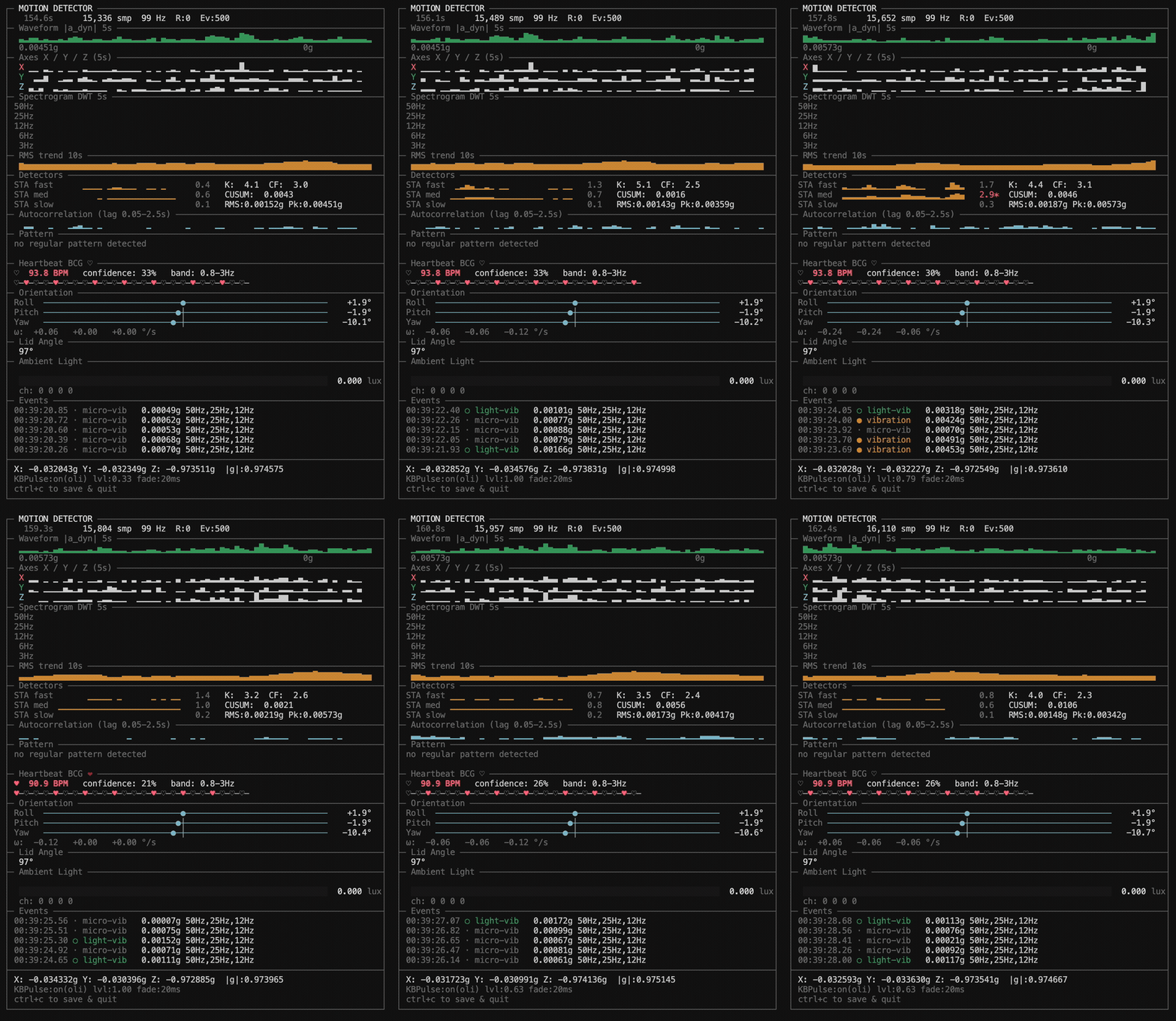
the demo includes vibration detection, orientation gauges, experimental heartbeat (bcg), lid angle, ambient light, and optional keyboard flash
keyboard flash mode (bundled KBPulse)
motion_live.py can flash the keyboard backlight from vibration intensity in near realtime.
the repo now vendors KBPulse, including a prebuilt apple silicon binary at KBPulse/bin/KBPulse.
run as usual:
sudo python3 motion_live.py
optional overrides:
sudo python3 motion_live.py --no-kbpulse
sudo python3 motion_live.py --kbpulse-bin /path/to/KBPulse
with uv
If you have uv/uvx installed, you can also just
sudo uvx git+https://github.com/olvvier/apple-silicon-accelerometer.git
code structure
- macimu/ - python package (
pip install macimu): high-level IMU class + low-level iokit bindings, shared memory ring buffers - motion_live.py - demo app: vibration detection, heartbeat bcg, terminal ui
- KBPulse/ - vendored keyboard backlight driver code + binary (
KBPulse/bin/KBPulse)
heartbeat demo
place your wrists on the laptop near the trackpad and wait 10-20 seconds for the signal to stabilize. this uses ballistocardiography - the mechanical vibrations from your heartbeat transmitted through your arms into the chassis. experimental, not reliable, just a fun use-case to show what the sensor can pick up. the bcg bandpass is 0.8-3hz and bpm is estimated via autocorrelation on the filtered signal
notes
- experimental / undocumented AppleSPU hid path
- requires sudo
- may break on future macos updates
- use at your own risk
- not for medical use
tested on
- macbook pro m3 pro, macos 15.6.1
- python 3.14
known incompatible
- intel macs (no spu)
- m1 macbook pro (2020)
- mac studio m4 max
license
MIT
not affiliated with Apple or any employer
1 maintainer

Metadata
1 maintainer
Release files for macimu 0.2.0
For a detailed explanation of source distributions (sdists) and built distributions (wheels), please see the package formats documentation.
Source distribution (sdist)
| File | Size | Uploaded | Provenance | |
|---|---|---|---|---|
| macimu-0.2.0.tar.gz | 22.3 kB | Without provenance | Details |
Built distribution (wheel)
| File | Interpreter | ABI | Platform | Reset |
|---|---|---|---|---|
| macimu-0.2.0-py3-none-any.whl | Python 3 | none | any | Details |
Total release size: 42.1 kB
Release files / macimu-0.2.0.tar.gz
| Download URL | macimu-0.2.0.tar.gz |
|---|---|
| Size | 22.3 kB |
| Tags | Source |
|
SHA-256 checksum How to use checksums |
6fc7737ef75357de18d95e2d0ffe240b96763a704345a7e799d396ed3967189c
|
|
BLAKE2b-256 checksum How to use checksums |
41b6172b8e4435e5451c1157974ffe7f1f9267c4e1f38406d2466f1e5e88981a
|
| Upload date | |
|
Uploaded using Trusted Publishing? What is trusted publishing? |
No |
| Uploaded via |
twine/6.2.0 CPython/3.14.3
|
Release files / macimu-0.2.0-py3-none-any.whl
| Download URL | macimu-0.2.0-py3-none-any.whl |
|---|---|
| Size | 19.9 kB |
| Tags | Python 3 |
|
SHA-256 checksum How to use checksums |
70dfd9f0c8897bb816ebe85a89f5b781945b6929b79649e1e8e5c68151467c3c
|
|
BLAKE2b-256 checksum How to use checksums |
41975b9329654a04732df3b1fafb34a666b3de65ed31198b5eb49ac6a1b2f394
|
| Upload date | |
|
Uploaded using Trusted Publishing? What is trusted publishing? |
No |
| Uploaded via |
twine/6.2.0 CPython/3.14.3
|
Security for macimu 0.2.0
Provenance
Provenance describes where a file came from. On PyPI, provenance is shared via attestations, which provide a verifiable record of the build or publishing details. View details, limitations and caveats.
No provenance found
None of the files in this release were uploaded with provenance metadata.
A note on package security
PyPI is a repository for distributing packages, not a service for auditing them. While third-party security researchers and our staff do their best to detect and remove malicious packages, PyPI cannot guarantee the quality, security or suitability of any given package.














