
maf-sandbox-codeact



Experimental. Releases before 1.0 may change or remove APIs. Importing this package emits
MafSandboxCodeactExperimentalWarning.
Give an agent one execute_code tool. The model writes Python statements, the sandbox runs them, and the tool returns content items for completion, an ok or failed verdict when an exit status is available, and the execution report. Programs must print results; a final expression is not echoed.
This is an independent package for Microsoft Agent Framework. It uses the maf-sandbox protocol and has no backend dependency.
Quickstart
pip install maf-sandbox-codeact
from maf_sandbox_codeact import make_codeact_tools

tools = make_codeact_tools(
    router,
    "data-analyst",
    context,
    image="mcr.microsoft.com/devcontainers/python:3.13-bookworm",
)
The host supplies the router and CallerContext. With no configured backend the factory returns []. Unsupported requirements are refused before attachment.
The default path requests a backend-owned python-portable-v1 channel, preferring exec. This profile promises Python 3.11+ with json, math, re, sys and types; it promises no other imports or retained state. The exec channel verifies CPython and owns program.py, the interpreter and any host-tool transport. Source text is file content, never part of the command line. See channel selection and migration.
Use the Docker sample, ACAS sample or WSLC sample for complete applications.
Optional channels
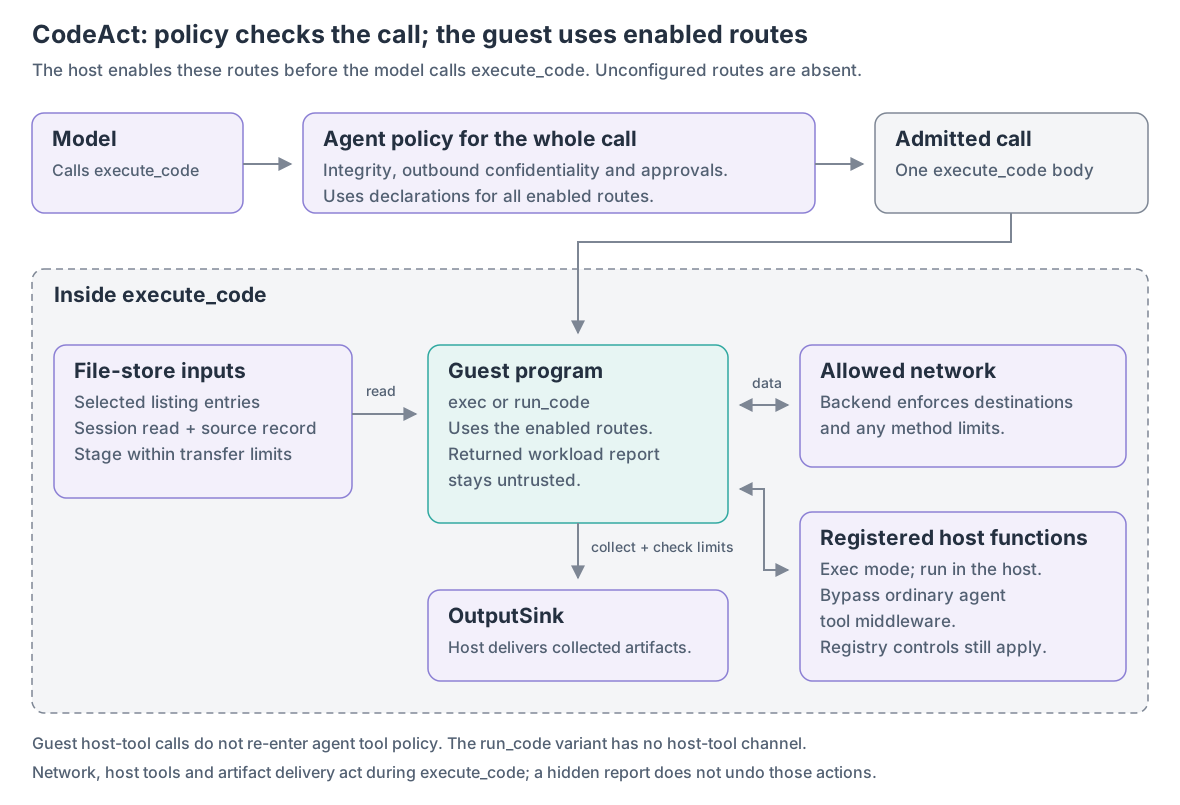
All four channels below are off by default. The host enables them when building the tool.
| Setting | What it enables |
|---|---|
file_store=store |
A files argument selecting caller-visible input files. |
output_sink=sink, outputs=... |
Collection and delivery of named output files. |
host_tools=registry |
Calls from guest Python to registered host functions through a supporting program channel. |
egress_allow=(...) |
Network requests to named destinations. |
These channels operate during execute_code. Hiding its final report does not undo host calls, network requests or artifact delivery.
Input and output files
Inputs must appear in CallerContext.list_files. They are staged under their listed names, so a program can open data/sales.csv. The listing controls which files are shared; it does not make their contents trustworthy.
Pass file_store_provenance=record to recheck the same FileStoreProvenance record used by the host's file_store_provenance_middleware around each input read. The read folds the recorded integrity with the listing's label; a record change during the read leaves integrity unestablished. Set requires_file_integrity=SourceIntegrity.TRUSTED to stop the call before staging or execution if any selected file's read-time integrity is weaker or unestablished. Both options default to None, preserving listing-only labels and allowing reads without an integrity requirement.
Choose one output mode:
| Mode | Names come from |
|---|---|
NONE |
No output collection. This is the default. |
DECLARED |
The model's outputs argument, checked before execution. |
MANIFEST |
The program's outputs.json, read after execution. |
Both collection modes require a sink and FILES_OUT. They collect literal paths and do not require FILES_LIST. The manifest consumes one file slot and part of the byte budget, so that mode needs at least two output slots.
from maf_sandbox_codeact import CodeactOutputs, make_codeact_tools

tools = make_codeact_tools(
    router,
    "data-analyst",
    context,
    file_store=store,
    output_sink=sink,
    outputs=CodeactOutputs.DECLARED,
    image="mcr.microsoft.com/devcontainers/python:3.13-bookworm",
)
files_in and files_out bound shared-file count, individual bytes and total bytes. Shared inputs default to 8 MiB per file, 24 MiB total and 63 files, leaving room for the default 8 MiB program and its staging file within a 32 MiB/64-file backend ceiling. Explicit limits are preserved and the complete channel demand is checked without clamping; larger programs or host-tool transport traffic can require a backend with larger ceilings. On the automatic channel path, program=ProgramRequirements(max_program_bytes=8 * 1024 * 1024, host_tool_timeout_seconds=30) from maf_sandbox configures source bytes and callback time separately. A missing declared output is reported. Artifacts carry no guest-selected media type; the host decides how to handle them.
Keep the output sink separate from the agent's writable input store. Otherwise guest code could overwrite files through a channel that bypasses the host's file-write approval. See the files sample.
With withhold_guest_output=True, a sink can supply locate=lambda name: f".tool-results/execute_code/{name}" to report a fixed landing folder in the Saved and not-written lists. Have deliver write to the same location and return it in LandedArtifact.name or handle. The pure synchronous locator receives only validated declared names, normalized as the sink requests; it must never depend on guest content or delivery state. A mismatched receipt falls back to the declared name and logs a warning. The default locator preserves existing results, and per_call sinks retain their folder-only reporting. See the withholding contract for the information this mode still reveals.
Host functions and network access
Register host functions before passing the registry to the factory. Reading its combined policy seals it against later registration.
from maf_sandbox import HostToolRegistry, TransferLimits

registry = HostToolRegistry(
    max_host_tool_calls_per_run=32,
    response_limits=TransferLimits(
        max_bytes_per_file=64 * 1024,
        max_total_bytes=1024 * 1024,
        max_files=32,
    ),
)
registry.register(exchange_rate)
exchange_rate is a host-defined function. Its body runs with host authority and bypasses ordinary agent middleware. Configure declarations, permitted identities and approval policy before exposing it. Registering a user-authority function makes the enclosing tool approval-gated.
A nonempty registry requires HOST_TOOLS and an explicit supporting program channel. Docker, ACAS and Docker Sandboxes supply the exec channel, which adds EXEC, FILES_IN and FILES_OUT internally. WSLC supports programs without host tools. The exec image needs the POSIX launcher utilities, including sh and nohup. Hyperlight native host tools remain pending.
Transport traffic counts toward backend transfer limits. Set response limits to fit your functions; broad defaults can make the tool fail attachment. Model-named files live separately from transport files. Without a registry, program.py is reserved.
Network access is closed unless egress_allow names hosts. An allowed host can receive any data the program can read. A method-scoped EgressRule also requires EGRESS_METHODS and support for every requested token. Docker and WSLC enforce it with a configured iron-proxy image; Docker Sandboxes, Hyperlight and ACAS declare finite supported token sets. See the HTTP method contract for backend limits. GET-only rules can still send data through queries, headers and request bodies.
See host-tool controls for registration, identities and limits.
Disable host functions when FIDES is enabled
Pass host_tools_enabled=False to make_codeact_tools and, if constructing a spec separately, codeact_sandbox_spec. CodeAct ignores any supplied registry without reading or sealing it. It requests no HOST_TOOLS, advertises no host functions and installs no host-tool channel; Python computation remains available. The default is True, preserving registry behavior. The switch is host configuration and never a model tool argument.
Use the same trusted setting that installs FIDES middleware. CodeAct does not infer that setting from tool metadata or the current call's security context:
from agent_framework import Agent
from agent_framework.security import (
    LabelTrackingFunctionMiddleware,
    PolicyEnforcementFunctionMiddleware,
)
from maf_sandbox_codeact import make_codeact_tools

fides_enabled = True
codeact_tools = make_codeact_tools(
    router,
    "data-analyst",
    context,
    host_tools=registry,
    host_tools_enabled=not fides_enabled,
    image="mcr.microsoft.com/devcontainers/python:3.13-bookworm",
)
middleware = (
    [LabelTrackingFunctionMiddleware(), PolicyEnforcementFunctionMiddleware()]
    if fides_enabled
    else []
)
agent = Agent(client=client, tools=[sensitive_tool, *codeact_tools], middleware=middleware)
The host supplies sensitive_tool as an ordinary agent function tool with its FIDES declarations. Direct calls still pass through that middleware; generated code cannot reach the function through CodeAct's disabled channel. File, artifact and network settings remain independent.
The setting is captured when building tools. To change it, stop admission through the old tool surface, await or cancel its active calls and complete cleanup, dispose its CodeAct sandboxes, then rebuild and replace the tools and middleware together. Changing the configuration variable alone does not revoke an existing tool. The router refuses reuse of a known sandbox with a different host-tool enablement contract; hosts must also retire old surfaces and instances across processes. This option disables nested calls and does not implement per-host-tool FIDES mediation.
Runtime backends
Use CodeactRuntime to select run_code instead of command execution. The host must verify that the backend evaluates Python statements and returns their output. The required instructions describe the modules and facilities available to the model.
from maf_sandbox_codeact import CodeactRuntime, codeact_sandbox_spec, make_codeact_tools

runtime = CodeactRuntime(
    instructions="Python statements with json and math. No subprocess or network modules."
)
spec = codeact_sandbox_spec(runtime=runtime)
tools = make_codeact_tools(router, "data-analyst", context, runtime=runtime)
The stdout-only profile requires RUN_CODE. It submits source directly and uses no inbound file slot, but source bytes still count toward the input byte limits. There is no automatic fallback between variants.
File channels require a verified absolute POSIX guest_work_dir. Programs receive guest_call_path and use it with open; model-facing names remain relative. By default the runtime must provide os.makedirs for fresh call directories.
Use use_call_directory=False only for a prepared base that cannot create directories. That mode requires at least reset cleanup. The Hyperlight package supplies matching instructions for its /output base.
Runtime profiles do not support host-tool registries. Changing the execution variant, instructions or storage contract requires disposal or a new sandbox key.
Results and labels
Both output modes use the result contract. Completion, the exit verdict and fixed host explanations are trusted. A call with no exit status has completed=False and no verdict. Program output and variable diagnostics remain untrusted. The ordinary report includes stdout, available stderr and a nonzero exit code. With the host-tool transport, program stderr is merged into stdout; a separate note: comes from the transport.
FIDES may hide the report while the conversation is trusted. Hidden content still affects confidentiality. The host controls whether later tools may accept it. See information flow.
withhold_guest_output=True removes guest-authored text from the report. It requires CodeactOutputs.DECLARED and a sink. Completion and the verdict remain readable, alongside separate trusted route guidance so the model can learn how to read saved output through host file tools. Variable status details remain untrusted.
This mode omits sink display text and guest-selected filenames. Exit success and whether declared files landed still depend on the program. The trusted verdict exposes exit success deliberately; withholding does not make variable diagnostics trusted or eliminate every data channel.
Calls and cleanup
Calls run one at a time in each sandbox, including collection and cleanup. exec_timeout_seconds defaults to 120. Runtime deadlines include the backend queue; a queued timeout means the program did not start.
Core disposes after each call by default. A host can permit snapshot reset, or accept possible leftover state by explicitly choosing reclaim on a supporting backend.
CodeAct makes no call-directory confinement claim. Programs can access other guest paths and leave processes running. Choose the isolation floor and image for everything the program may read, including shared files and network responses.
The CodeAct guide covers execution, withholding and cleanup in detail.
Maintained by SOKOLAI BV.
1 maintainer

Metadata
1 maintainer
Release files for maf-sandbox-codeact 0.23.0
For a detailed explanation of source distributions (sdists) and built distributions (wheels), please see the package formats documentation.
Source distribution (sdist)
| File | Size | Uploaded | |
|---|---|---|---|
| maf_sandbox_codeact-0.23.0.tar.gz | 42.7 kB | Details |
Built distribution (wheel)
| File | Interpreter | ABI | Platform | Reset |
|---|---|---|---|---|
| maf_sandbox_codeact-0.23.0-py3-none-any.whl | Python 3 | none | any | Details |
Total release size: 85.8 kB
Release files / maf_sandbox_codeact-0.23.0.tar.gz
| Download URL | maf_sandbox_codeact-0.23.0.tar.gz |
|---|---|
| Size | 42.7 kB |
| Tags | Source |
|
SHA-256 checksum How to use checksums |
dd8ab0ef82cdfc2db9a195db1b8867ee110830bc0ea27b333160e42cf369839f
|
|
BLAKE2b-256 checksum How to use checksums |
4f04a146406bb8931d0a1e0c8119b01c7a620c75e78f33e903ca94991a5403ea
|
| Upload date | |
|
Uploaded using Trusted Publishing? What is trusted publishing? |
Yes |
| Uploaded via |
twine/7.0.0 CPython/3.13.14
|
Provenance
Provenance describes where a file came from. On PyPI, provenance is shared via attestations, which provide a verifiable record of the build or publishing details. View details, limitations and caveats.


PyPI Publish Attestation
PyPI verified that this artifact, at this checksum, originated from the publisher listed below.
Signed by GitHub Actions, verified by PyPI on Oct 11, 2026.
Transparency logRelease files / maf_sandbox_codeact-0.23.0-py3-none-any.whl
| Download URL | maf_sandbox_codeact-0.23.0-py3-none-any.whl |
|---|---|
| Size | 43.1 kB |
| Tags | Python 3 |
|
SHA-256 checksum How to use checksums |
3de6d206bf06bb09969491521986c56d7778f647a75d99a423b9861d71b95338
|
|
BLAKE2b-256 checksum How to use checksums |
19e0052733f8efbec0a254152ab4c9228bdec95b84d516e1a3142e395f21227e
|
| Upload date | |
|
Uploaded using Trusted Publishing? What is trusted publishing? |
Yes |
| Uploaded via |
twine/7.0.0 CPython/3.13.14
|
Provenance
Provenance describes where a file came from. On PyPI, provenance is shared via attestations, which provide a verifiable record of the build or publishing details. View details, limitations and caveats.
PyPI Publish Attestation
PyPI verified that this artifact, at this checksum, originated from the publisher listed below.
Signed by GitHub Actions, verified by PyPI on Oct 11, 2026.
Transparency log













