Headless magpylib editing engine for GUI/LLM frontends (e.g. a VS Code extension backend).
Project description
magpylib-studio
Headless magpylib editing engine plus a VS Code extension built on it — a GUI and LLM studio for magnetic scenes. The engine owns a magpylib scene and exposes everything a frontend needs over a tiny JSON-RPC protocol on stdio; the presentation layer (VS Code webview, Solara, a CLI…) is a thin client.
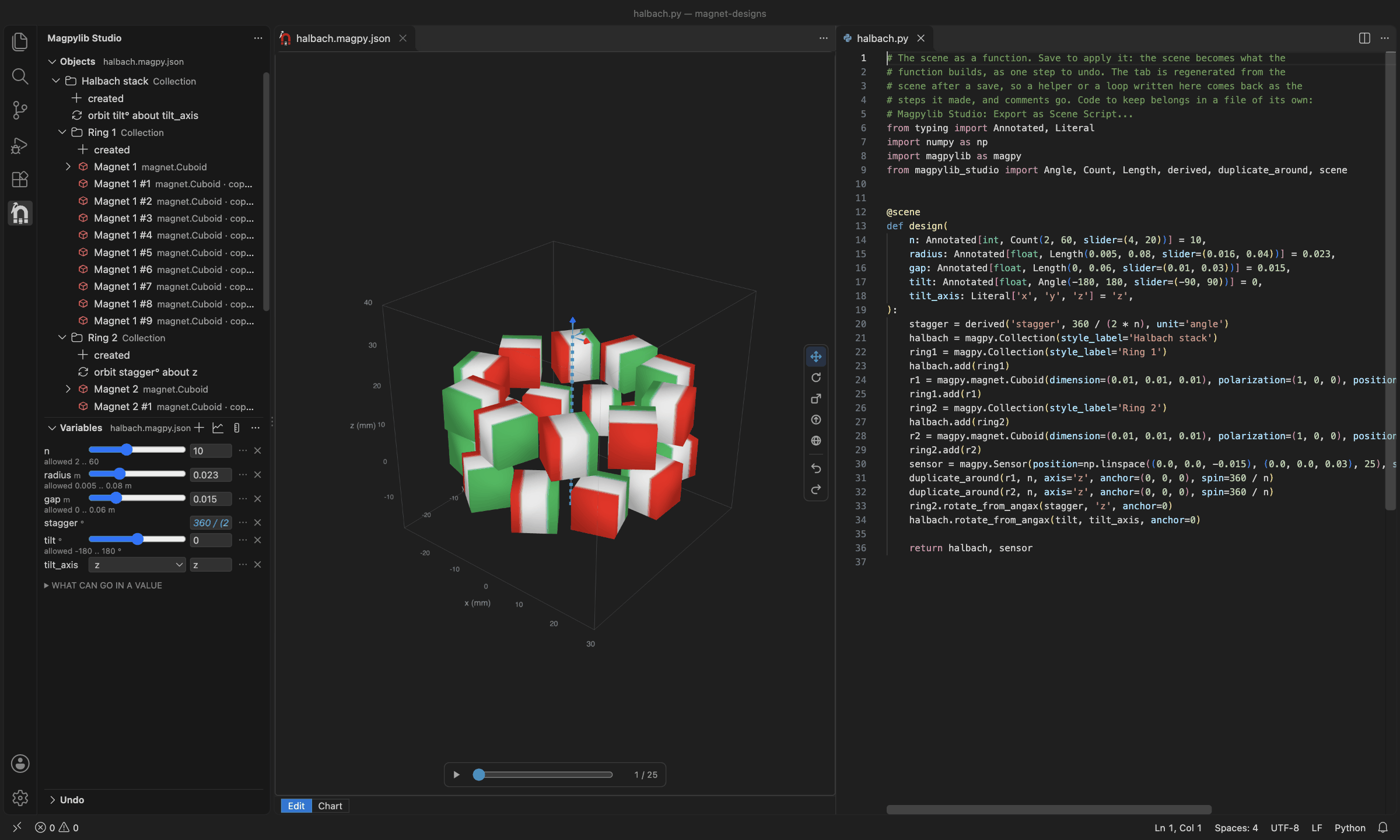
The VS Code side is in vscode-extension/ — scene tree
with the construction history in it, schema-driven inspector, variables with
sliders, 3D view, field maps and sweeps, an editable script tab, and Copilot
chat tools.
The halbach example: twenty magnets from two create steps and two circular
patterns. Dragging n rebuilds both rings; the script tab on the right is the
same scene, and saving an edit to it rebuilds the scene from what you wrote.
Try it out
code --install-extension magpylib.magpylib-studio-vscode
That is the whole install — the Python side is not a second step you do first.
Open a folder, click the magpylib icon in the activity bar and press Load
Example Scene; the first time the extension needs the engine it offers
Install the Engine, which either offers you the interpreter the Python
extension already selected — named, because installing into someone else's
interpreter is not the same act as making one — or makes a .venv in the
workspace, installs magpylib-studio into it and points
magpylib-studio.pythonPath at it for you. With uv present it fetches a
matching Python too, so even the ≥ 3.11 floor is not something to arrange in
advance.
Full walkthrough in the extension README. To work on the extension rather than use it, see Development.
Install the engine on its own
pip install magpylib-studio
That is enough: the engine works with released magpylib (≥ 5.2). The
optional property-tree branch adds a first-class style API and
path-valued physics properties (current=[100, 200, 300]):
pip install "magpylib @ git+https://github.com/magpylib/magpylib@feat/improve-style"
magpylib_studio/style_compat.py detects which one you have. On released
magpylib it reproduces the four style operations the engine needs from
style.update() / style.as_dict(), and falls back to a generated copy of the
branch's JSON Schema (style_schemas.json) — the two style trees are the same
shape, so the inspector keeps real widgets (enum dropdowns, ranges, colour
pickers) either way. The test suite runs against both.
Development
git clone https://github.com/magpylib/magpylib-studio.git
cd magpylib-studio
# the engine
uv venv --python 3.13 .venv
VIRTUAL_ENV=$PWD/.venv uv pip install -e ".[dev]"
.venv/bin/python -m pytest -q
# the extension (from vscode-extension/)
npm install
npm run compile # tsc + eslint + webview, contribution and version checks
npm test # thirteen tests in a real Extension Development Host
Then open the repo root in VS Code and press F5 — not the
vscode-extension/ folder: the launch config is at the root so the engine stays
in the workspace you can edit, and F5 compiles before it launches. A second
window opens, the Extension Development Host, with sandbox/ as its workspace.
Hooks run on every push via pre-commit.ci (.pre-commit-config.yaml), and
locally with pre-commit run --all-files: ruff and prettier for formatting,
ruff for linting (the ruleset is pinned in pyproject.toml, because ruff's
defaults move), plus workflow and pyproject validation. The one commit that
only reformats is listed in .git-blame-ignore-revs;
git config blame.ignoreRevsFile .git-blame-ignore-revs makes local blame skip
it, as GitHub already does.
Design decisions
- The document is a log, and the object tree is a projection of it.
doc["events"]holds everything that built the scene —create,remove,reparent, the transforms and the patterns — and every build folds it from the start, sodoc["objects"]is regenerated rather than stored. Strip it from a document and the log reconstructs the same scene, ids and field included. Editing an early event therefore re-applies everything after it for free; what it breaks is reported rather than blocking the edit. - What a thing is is edited; what happened to it is appended. An
object's type, parameters and style live on its
createevent and are changed in place — dragging a slider must not write history — while moves, rotations, removals and reparents go on the end. That one distinction is what keeps the log finite and meaningful. - Transforms are recorded magpylib calls, not derived poses. The log holds
move,rotate_from_angax, … as they were made, so magpylib owns every semantic: paths, anchors,start, and group transforms carrying a subtree. - Scenes are parametric. Any numeric value may be an expression over the
document's variables (
"=360/n"), evaluated from its AST against an allow-list — nevereval, because a document is something you open from someone else. A variable is not always a quantity: one bounded byoptionsholds a name ("z"for an axis), which gets a dropdown for the same reason min/max gets a slider, and is enforced the same way.sweep()re-folds the scene once per value of a variable, which is affordable because a rebuild is milliseconds. - One schema contract. The same JSON Schema drives the inspector widgets and the LLM tool inputs.
- Validation is shared. Every edit goes through magpylib, and a bad edit is
reported (
{"ok": false, "error": …}), not raised — so a GUI shows an error and an LLM self-corrects. There is no second validation layer. - The saved file is the document, and it is versioned. A scene saves as
.magpy.json— exactly whatto_dict()returns, so the format the engine works in is the format on disk, with no serializer in between to disagree with it. It carries aversion, because a file outlives the program that wrote it: an older one is migrated, and a newer one is refused rather than read half-way and saved back with the parts we did not understand missing. Fields the engine does not recognise are carried through, which is the only form of forward compatibility a document can actually have. A script is an export, not a save: it loses slider bounds and hidden flags, and nothing else — measured, not assumed. - Document canonical, script generated — and read back two ways.
to_script()emits runnable magpylib code, patterns included (as the loops they mean), folding the log in order rather than declaring everything up front: where an object is created relative to the steps around it is part of the scene, and an object added to an already-patterned group must not end up inside every copy.apply_script()parses it when it is still in that shape, so variables, event order and arrangements survive and the whole document round-trips byte-identically; anything else — a loop of your own, a helper, numpy — is executed withshow()intercepted, asload_script()always did, and what that flattens is reported.
JSON-RPC protocol (stdio)
The host spawns python -m magpylib_studio and exchanges one JSON object per
line — no ports, no framework.
-> {"id": 1, "method": "get_schema", "params": {"object_id": "cube"}}
<- {"id": 1, "result": { ...JSON Schema... }}
<- {"id": 2, "error": {"type": "KeyError", "message": "..."}}
| group | methods |
|---|---|
| inspect | list_objects · get_schema · get_values (style) · get_params (physics) · get_transform · get_history |
| structure | add_object · remove_object · copy_object · move_object (reparent) · set_visible |
| edit | apply_edit (style) · set_param · reset_style |
| transform | move · rotate · set_transform · clear_path · set_pixel_grid |
| patterns | duplicate_around (circular) · duplicate_along (linear; twice = a grid) · mirror |
| variables | get_variables · set_variable · set_variable_bounds · remove_variable · unknown_variables · expression_help · check_expression |
| history | get_events · edit_event · move_event · remove_event · set_rollback |
| view | get_figure (3D) · get_field_figure (along a sensor path) · get_field_map (plane heatmap) · get_sweep_figure |
| field | get_field — summed B/H at points or along a sensor · sweep — the field against a variable |
| undo | undo · redo · goto_history |
| I/O | load_scene · load_script · apply_script · load_captured · list_examples · load_example · clear_scene · to_dict · to_script |
| bulk | batch — many mutating ops in one call, one undo step |
Mutating methods return {"ok": bool, "error"?: str}. Everything is
JSON-serializable in both directions.
Try it:
printf '%s\n' \
'{"id":1,"method":"load_example"}' \
'{"id":2,"method":"list_objects"}' \
'{"id":3,"method":"get_field","params":{"points":[[0,0,0]]}}' \
'{"id":4,"method":"to_script"}' \
| python -m magpylib_studio
Status
The engine is covered by 104 tests against both magpylib versions
(.venv/bin/python -m pytest -q).
The extension is checked at three levels, all wired into npm run compile so
they run before every F5 and before packaging: type-checking and ESLint over
both the host code and the webview scripts; two contribution checks (every
declared command registered, every menu clause matching a context value the tree
can set, every palette entry safe to invoke with no argument); and a DOM harness
that runs a panel's real script against a real engine
(npm run inspect -- halbach). On top of that, npm test runs thirteen
integration tests inside a real Extension Development Host — activation, the
engine subprocess answering through the virtual scene.json, a removal taking a
pattern's copies with it, the script tab applying an edit on save, the engine
being killed mid-session and coming back holding the same scene, and the whole
save/open path: a file that opens back as the same scene, a save that goes to
the file it came from without asking, a document from a newer version being
refused without disturbing the open one, and the crash backup being written and
restorable.
Both suites and the packaging run in CI on every push, the engine against both
magpylib versions — the claim above used to be checked by hand. Pushing a v*
tag builds the .vsix and attaches it to a GitHub release.
Both halves are published: the engine on PyPI (pip install magpylib-studio)
and the extension on the Marketplace under the magpylib publisher. That order
mattered — an extension whose first act is "now go and pip install this git URL"
fails at first contact, before anyone sees a feature — and it is what lets
Install the Engine set the engine up for you rather than tell you to. The
.vsix attached to each release is the same build, for anyone who would rather
install it by hand.
See CONTINUE.md for the current state and what is next.
License
BSD-3-Clause — the same as the other packages built on magpylib (magpylib-force, magpylib-material-response). The core library itself is BSD-2-Clause; its satellites are all 3-clause, and this is one of those. See LICENSE.
Project details
Release history Release notifications | RSS feed
Download files
Download the file for your platform. If you're not sure which to choose, learn more about installing packages.
Source Distribution
Built Distribution
Filter files by name, interpreter, ABI, and platform.
If you're not sure about the file name format, learn more about wheel file names.
Copy a direct link to the current filters
File details
Details for the file magpylib_studio-0.2.0.tar.gz.
File metadata
- Download URL: magpylib_studio-0.2.0.tar.gz
- Upload date:
- Size: 674.3 kB
- Tags: Source
- Uploaded using Trusted Publishing? Yes
- Uploaded via: twine/7.0.0 CPython/3.13.14
File hashes
| Algorithm | Hash digest | |
|---|---|---|
| SHA256 |
208af78c9e4898728dfbd20899243790b5f4ab73bb09d281576557e0f55a849b
|
|
| MD5 |
5360d586ee6a9cba0d6b2218a11673f6
|
|
| BLAKE2b-256 |
98ed61977a665628ee55a4cf31844f6a7bc6d703e62373b349b492a873474720
|
Provenance
The following attestation bundles were made for magpylib_studio-0.2.0.tar.gz:
Publisher:
cd.yml on magpylib/magpylib-studio
-
Statement:
-
Statement type:
https://in-toto.io/Statement/v1 -
Predicate type:
https://docs.pypi.org/attestations/publish/v1 -
Subject name:
magpylib_studio-0.2.0.tar.gz -
Subject digest:
208af78c9e4898728dfbd20899243790b5f4ab73bb09d281576557e0f55a849b - Sigstore transparency entry: 2329870244
- Sigstore integration time:
-
Permalink:
magpylib/magpylib-studio@df1e93a96076382e0579af1290175dd379abbeee -
Branch / Tag:
refs/tags/v0.2.0 - Owner: https://github.com/magpylib
-
Access:
public
-
Token Issuer:
https://token.actions.githubusercontent.com -
Runner Environment:
github-hosted -
Publication workflow:
cd.yml@df1e93a96076382e0579af1290175dd379abbeee -
Trigger Event:
push
-
Statement type:
File details
Details for the file magpylib_studio-0.2.0-py3-none-any.whl.
File metadata
- Download URL: magpylib_studio-0.2.0-py3-none-any.whl
- Upload date:
- Size: 80.3 kB
- Tags: Python 3
- Uploaded using Trusted Publishing? Yes
- Uploaded via: twine/7.0.0 CPython/3.13.14
File hashes
| Algorithm | Hash digest | |
|---|---|---|
| SHA256 |
8fcb9a8a0dd1a73c1d00b464ec14d3dd9a6f314641538a4fa4fa796ae81cf7e0
|
|
| MD5 |
d8e74804f773612fc85444266954f1ff
|
|
| BLAKE2b-256 |
f36c302504c5865cb173b76e1a4c30af4cabe32335ee504fac1c4e07dc37571f
|
Provenance
The following attestation bundles were made for magpylib_studio-0.2.0-py3-none-any.whl:
Publisher:
cd.yml on magpylib/magpylib-studio
-
Statement:
-
Statement type:
https://in-toto.io/Statement/v1 -
Predicate type:
https://docs.pypi.org/attestations/publish/v1 -
Subject name:
magpylib_studio-0.2.0-py3-none-any.whl -
Subject digest:
8fcb9a8a0dd1a73c1d00b464ec14d3dd9a6f314641538a4fa4fa796ae81cf7e0 - Sigstore transparency entry: 2329870364
- Sigstore integration time:
-
Permalink:
magpylib/magpylib-studio@df1e93a96076382e0579af1290175dd379abbeee -
Branch / Tag:
refs/tags/v0.2.0 - Owner: https://github.com/magpylib
-
Access:
public
-
Token Issuer:
https://token.actions.githubusercontent.com -
Runner Environment:
github-hosted -
Publication workflow:
cd.yml@df1e93a96076382e0579af1290175dd379abbeee -
Trigger Event:
push
-
Statement type: