







Weather & Climate Extremes Detection and Tracking
Efficient & scalable climatologies, anomalies, extreme detection, & event tracking for exascale climate data.
marEx computes climatologies and anomalies, identifies extremes, and tracks the resulting events through space and time in geospatial time series. The same calls detect marine and atmospheric heatwaves, cold spells, droughts and subsurface ocean extremes.
Full documentation on ReadTheDocs
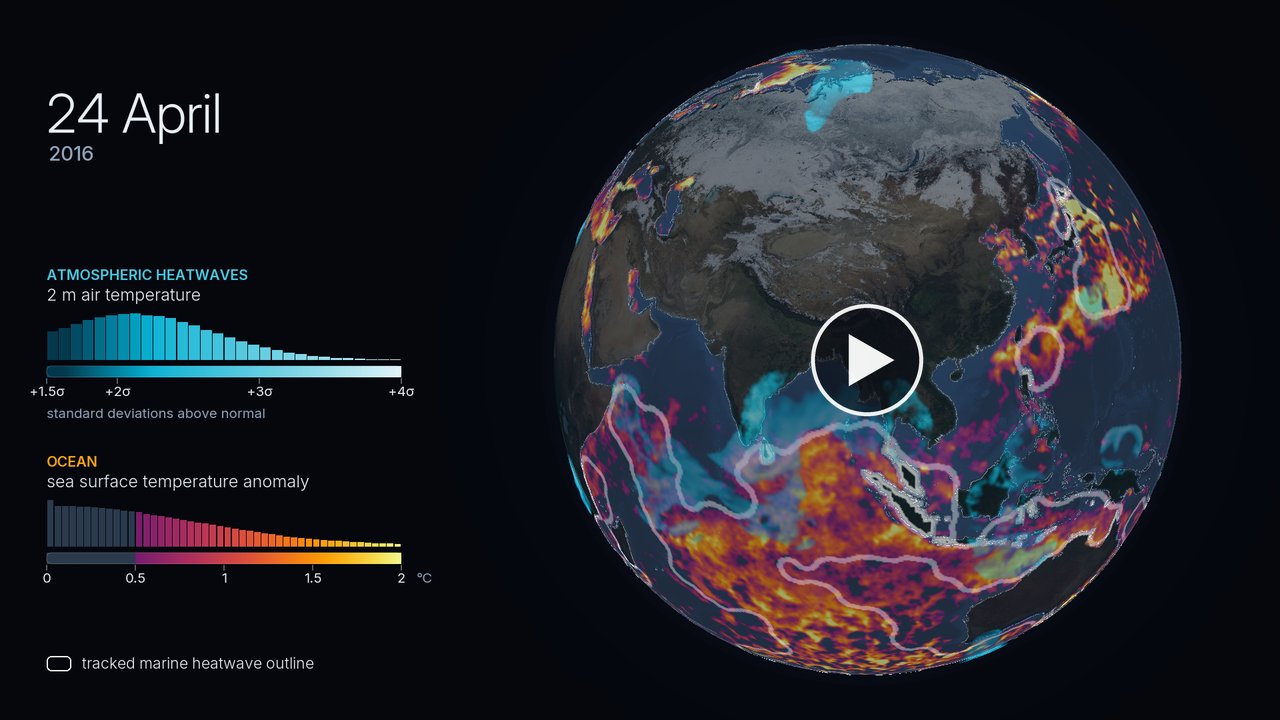
Tracked marine heatwaves (white outlines) and atmospheric heatwaves in 2 m air temperature (cyan) through 2016, over the daily sea surface temperature anomaly. OSTIA SST and ERA5.
Key Features
- High Performance: Process 100+ years of high-resolution daily global data in minutes.
- Multiple Detection Methods: Hobday et al. (2016) and its generalisations, with four anomaly baselines and seasonal or constant-in-time percentile thresholds, on either tail, at daily, sub-daily or monthly cadence.
- Larger-than-Memory: Intelligent chunking, lazy evaluation and on-disk staging compute the global climatologies, percentile thresholds and event tracks of datasets much larger than memory.
- Cloud-Native Scaling: Identical code scales from a laptop to a supercomputer using 1024+ cores.
- Advanced Event Tracking: Follows coherent events as they evolve, split and merge, keeping each event's identity and merge history.
- Universal Grid Support: Regular lat/lon grids and unstructured meshes (FESOM, ICON, MPAS) through one API, with depth or level as an extra dimension in detection.
Core Modules
| Step | Returns | Methods |
|---|---|---|
1. AnomalymarEx.anomaly.compute |
The anomaly field, i.e. the input minus its seasonal climatology (dat_anomaly).With detrend_harmonic, also standardised anomalies and their rolling standard deviation. marEx.anomaly.smoothed_rolling_climatology returns the shifting-baseline climatology itself. |
shifting_baseline, fixed_baseline, detrend_harmonic, detrend_fixed_baseline |
2. ExtremesmarEx.extremes.identify |
A boolean field flagging every extreme cell and time (extreme_events).Also: the percentile threshold of every cell, resolved through the year when seasonal ( thresholds). |
seasonal_percentile or global_percentile, upper or lower tail, exact or histogram percentiles |
3. TrackingmarEx.tracker(...).run() |
An event-ID field labelling each tracked event in space and time (ID_field).Also: each event's area and centroid through time, its start and end, and the full merge history. |
overlap-based merging and splitting, gap filling, area filtering |
marEx.preprocess_data runs steps 1 and 2 in one call. Chained together, from daily SST to tracked marine heatwaves:
import xarray as xr
import marEx

# In a script, run this under `if __name__ == "__main__":` (its worker processes re-import the script).
client = marEx.helper.start_local_cluster(n_workers=4, memory_limit="8GB")

sst = xr.open_dataset("sst_data.nc", chunks={"time": 25}).sst

anomalies = marEx.anomaly.compute(sst, method="shifting_baseline")
extremes = marEx.extremes.identify(anomalies, method="seasonal_percentile", threshold_percentile=95)

events = marEx.tracker(
    extremes.extreme_events,
    extremes.mask,
    R_fill=8,
    area_filter_absolute=100,
    allow_merging=True,
).run()

fig, ax, im = (events.ID_field > 0).mean("time").plotX.single_plot(
    marEx.PlotConfig(var_units="Event Frequency", cmap="hot_r", cperc=[0, 96])
)
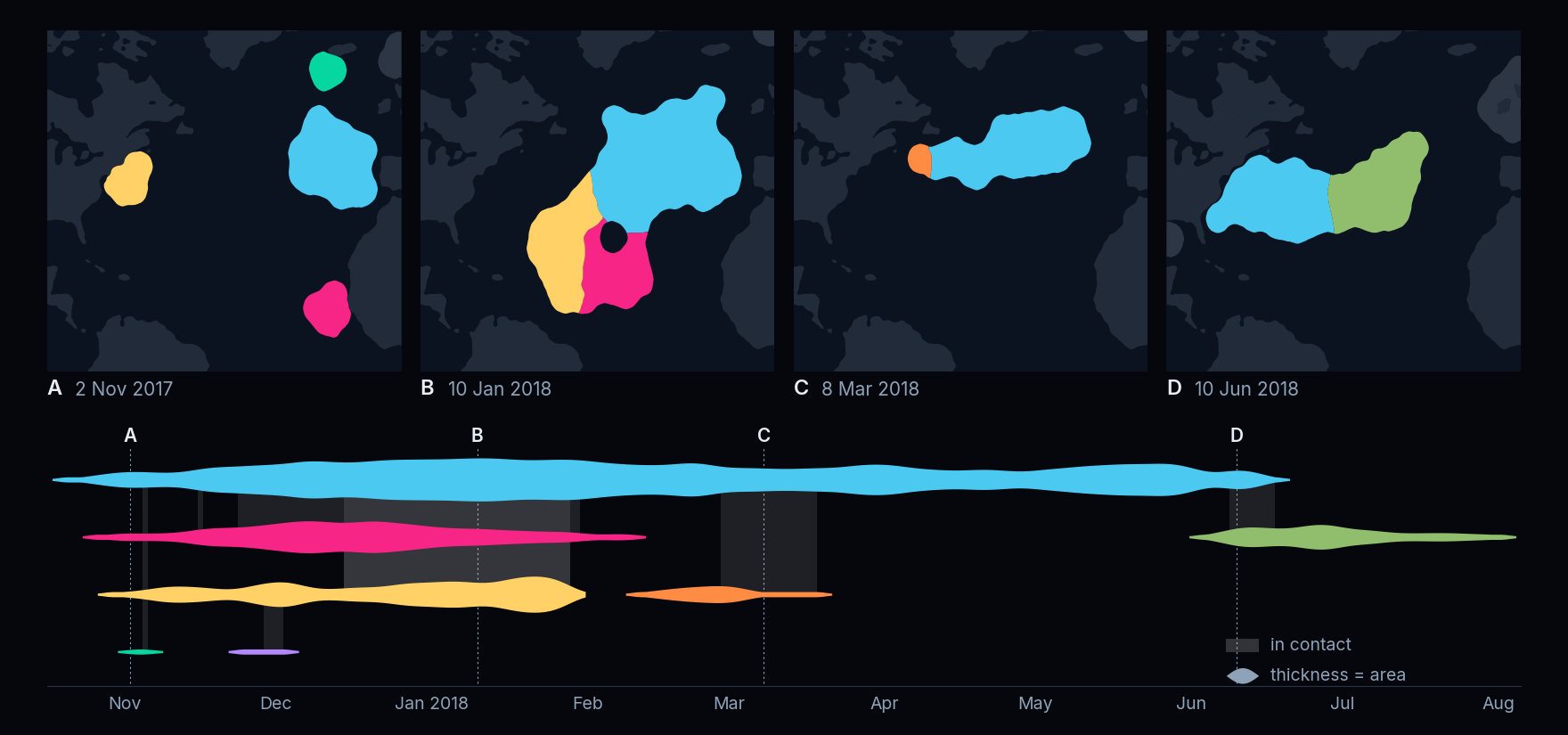
A family of seven tracked marine heatwaves in the North Atlantic, October 2017 to August 2018 (95th percentile, OSTIA SST). Each colour is one event, and ribbon thickness is its area. Grey bands mark when two events touch. The tracker resolves merges and splits there, and each event keeps its identity.
Performance
| Stage | Data | Size | Wall-time |
|---|---|---|---|
| Detect | ICON SST, 14.9 M cells, 30 yr daily | 1.3 TB | 37 min |
| Detect | Global SST 0.25°, 20 yr 6-hourly | 243 GB | 166 min |
| Detect | Global SST 0.25°, 40 yr daily | 122 GB | 61 min |
| Track | Global 0.25°, 20 yr 6-hourly | 91 GB | 139 min |
| Track | ICON, 14.9 M cells, 3 yr daily | 66 GB | 70 min |
| Track | Global 0.25°, 10 yr daily | 16 GB | 27 min |
Sizing guidance is in the performance guide.
Installation
pip install marEx[full,hpc]
For HPC environments and optional dependencies, see the Installation Guide.
Documentation
| Section | What's there |
|---|---|
| Getting Started | Installation and a five-minute quickstart |
| Tutorials | End-to-end notebooks for gridded, regional and unstructured data |
| Applications | Marine and atmospheric heatwaves, wind and precipitation droughts, subsurface ocean extremes and event catalogues |
| User Guide | Anomalies, extremes, dimensions and time, tracking, performance, validation |
| What's New | Changes in 5.0 and the migration table for renamed methods and parameters |
| Why marEx? | The design choices, with a tracking-comparison video |
| API Reference | Every public function and class |
| Troubleshooting | Common issues and solutions |
Development and Validation
I developed the scientific methodology and the implementation of marEx by hand up to and including v4.1 (April 2026), and have since used Claude Code as an aide to help optimise, generalise and test it. Since mid-2026 every change has been checked against reference outputs to round-off precision. The validation page describes what is tested.
Getting Help
- Documentation: guides, tutorials and API reference
- GitHub Issues: bug reports and feature requests
- GitHub Discussions: questions, ideas and community support
When reporting an issue, include marEx.__version__, the Python version and OS, marEx.print_dependency_status(), a minimal reproducible example and the full traceback.
Citation
When using marEx in publications, please cite:
- marEx package: DOI 10.5281/zenodo.16922881
- Hobday et al. (2016): "A hierarchical approach to defining marine heatwaves." Progress in Oceanography 141, 227-238. DOI 10.1016/j.pocean.2015.12.014
License
marEx is licensed under the GNU Affero General Public License v3.0 or later. You can use, study, modify and share it freely. If you distribute a modified version, or run one as a network service, you must release your changes under the same licence. Keep the NOTICE and cite marEx in published work.
The code and documentation are reserved from text and data mining, including AI model training (Art. 4(3) of the EU Directive 2019/790). For other licensing terms, get in touch.
Funding
- The EERIE (European Eddy-Rich ESMs) Project
- The European Union's Horizon Europe research and innovation programme under Grant Agreement No. 101081383
- The Swiss State Secretariat for Education, Research and Innovation (SERI) under contract #22.00366
Contact
For questions, comments, or collaboration opportunities, please contact Aaron Wienkers.
1 maintainer

Metadata
1 maintainer
Release files for marEx 5.0.0
For a detailed explanation of source distributions (sdists) and built distributions (wheels), please see the package formats documentation.
Source distribution (sdist)
| File | Size | Uploaded | Provenance | Actions |
|---|---|---|---|---|
| marex-5.0.0.tar.gz | 17.4 MB | With provenance | Details for marex-5.0.0.tar.gz |
Built distribution (wheel)
| File | Interpreter | ABI | Platform | Actions Reset |
|---|---|---|---|---|
| marex-5.0.0-py3-none-any.whl | Python 3 | none | any | Details for marex-5.0.0-py3-none-any.whl |
Total release size: 17.7 MB
Release files / marex-5.0.0.tar.gz
| Download URL | marex-5.0.0.tar.gz |
|---|---|
| Size | 17.4 MB |
| Tags | Source |
|
SHA-256 checksum How to use checksums |
e6c6892d082f516ffed4321b60ca0b292590ccaca220cad1c7f32bef2fa27aa8
|
|
BLAKE2b-256 checksum How to use checksums |
a5fa7d6bfbc2ca0af201415cf6facf34d6c2239d5548660fe4ff4096d21cc2da
|
| Upload date | |
|
Uploaded using Trusted Publishing? What is trusted publishing? |
Yes |
| Uploaded via |
twine/7.0.0 CPython/3.13.16
|
Provenance
Provenance describes where a file came from. On PyPI, provenance is shared via attestations, which provide a verifiable record of the build or publishing details. View details, limitations and caveats.


PyPI Publish Attestation
PyPI verified that this artifact, at this checksum, originated from the publisher listed below.
Signed by GitHub Actions, verified by PyPI on Nov 1, 2026.
Transparency logRelease files / marex-5.0.0-py3-none-any.whl
| Download URL | marex-5.0.0-py3-none-any.whl |
|---|---|
| Size | 296.6 kB |
| Tags | Python 3 |
|
SHA-256 checksum How to use checksums |
d5a9621d57cd0a3ac246a3e31594391e8a963bd97f82ff34e93f47598bf87f2e
|
|
BLAKE2b-256 checksum How to use checksums |
057fb6f5bc8027459d8f058481bd73efb7f498940c7f734607ee8e9267dce375
|
| Upload date | |
|
Uploaded using Trusted Publishing? What is trusted publishing? |
Yes |
| Uploaded via |
twine/7.0.0 CPython/3.13.16
|
Provenance
Provenance describes where a file came from. On PyPI, provenance is shared via attestations, which provide a verifiable record of the build or publishing details. View details, limitations and caveats.
PyPI Publish Attestation
PyPI verified that this artifact, at this checksum, originated from the publisher listed below.
Signed by GitHub Actions, verified by PyPI on Nov 1, 2026.
Transparency logSecurity for marEx 5.0.0
Provenance
Provenance describes where a file came from. On PyPI, provenance is shared via attestations, which provide a verifiable record of the build or publishing details. View details, limitations and caveats.
Full provenance
Both files in this release have been uploaded with provenance metadata.
Attestation for marex-5.0.0.tar.gz
PyPI Publish Attestation
PyPI verified that this artifact, at this checksum, originated from the publisher listed below.
Signed by GitHub Actions, verified by PyPI on Nov 1, 2026.
Transparency logA note on package security
PyPI is a repository for distributing packages, not a service for auditing them. While third-party security researchers and our staff do their best to detect and remove malicious packages, PyPI cannot guarantee the quality, security or suitability of any given package.
To learn more about protecting yourself from malicious actors, visit our package security documentation.














