
marine-extremes






English | 简体中文
marine-extremes is a Rust-accelerated Python package for detecting marine heatwaves (MHWs), marine cold spells (MCSs), and general scalar marine extremes such as salinity anomalies. It works on 1D station records, 3D surface grids (NOAA OISST, OSTIA), 4D depth-resolved ocean reanalyses (GLORYS, ORAS5, Argo), and multi-calendar CMIP6 simulations.
See docs/marine_extremes_overview.html for an interactive architecture walkthrough.
What it does
- Parallel Rust core with Rayon. Releases the Python GIL (
py.detach()), skips land pixels, and uses afloat32tile fast path (working_dtype="auto") with internalf64accumulation so memory drops by half without precision loss. - Single-pass MHW and MCS detection. Passing
event="both"computes the climatology once and detects upper and lower events together. - Memory-bounded out-of-core streaming. Reads multi-file NetCDF or Zarr globs (for example yearly
sst.day.mean.*.nc) in spatial or depth tiles under a user-definedmemory_limit. - Single-target output across seven formats. Passing
out=...writes one standalone.nc,.mat(v7.3 HDF5 without the 2 GB cap, or v5detectccell layout),.zarr,.npz,.parquet,.feather, or.csvtarget with no sidecar files. - CSR-indexed grid lookup and columnar analytics. Events are stored sorted by flattened grid index alongside
int64CSRgrid_offsetsinside.nc,.mat,.zarr,.npz, and.parquet, giving O(1) lazy disk-backedres.events.sel(...)/isel(...)and zero-scancount_map(). - Multiple baseline definitions. Supports
FixedBaseline(including externalclim_data),DetrendedBaseline(linear or quadratic OLS detrending before climatology and detection),MovingBaseline(sliding multi-year window withclamporshrinkboundaries),FixedThreshold, andExternalClimatology. - Multi-calendar and monthly support. Handles Gregorian and CMIP6
cftimecalendars (standard,proleptic_gregorian,noleap/365_day,360_day,all_leap/366_day) as well asfreq="monthly"detection (Jacox et al., 2020). - Explicit cross-tool compatibility profiles. Choose
compat="standard","m_mhw","m_mhw_python","oliver", or"heatwaveR"to match the quantile rule, threshold inequality, Feb 29 handling, and varianceddofof a specific reference tool. - Edge and sea-ice safeguards. Includes detection-only
max_pad_length,min_valid_fractionfiltering (without NaN bleed during circular smoothing),truncated_start/truncated_endflags, andlower_boundhandling (flag,mask, orfloorwith zero-division protection). - CF-aware input resolution. Built-in lightweight CF metadata resolver (with optional
cf-xarraysupport) infers non-timetime dimensions (valid_time,time_counter,ocean_time), filters*_bnds/grid_mapping/ancillary_variables, resolves CFstandard_nameand marine aliases, and warns on Kelvin vs. Celsiuslower_boundmismatches. - AI agent skill and MCP server. Ships an Agent Skill (skills/marine-extremes/SKILL.md) and an optional local stdio MCP server (
marine-extremes-mcp) with four tools:inspect_dataset,detect_extremes,query_events, andsummarize_result.
Installation
Install prebuilt wheels from PyPI (no Rust toolchain required on Linux, macOS, or Windows):
# Core package (NumPy, Pandas, PyArrow, Xarray)
pip install marine-extremes

# Recommended: include all I/O backends (NetCDF4, HDF5/MAT, Zarr, cftime, Dask, cf-xarray)
pip install "marine-extremes[io]"
Optional dependency groups in pyproject.toml:
marine-extremes[netcdf]:netCDF4,h5netcdf,cftime,daskmarine-extremes[mat]:h5py,scipy(MATLAB v7.3 and v5.mat)marine-extremes[zarr]:zarr>=3.0,cftime,daskmarine-extremes[cf]:cf-xarray(optional CF accessor and custom criteria support)marine-extremes[mcp]:mcp(optional stdio MCP servermarine-extremes-mcpfor AI clients)marine-extremes[io]: all I/O backends (netcdf,mat,zarr,cf; excludesmcp)marine-extremes[dev]:pytest,maturin
To build from source instead (requires a Rust toolchain):
git clone https://github.com/Radianjayjay/marine-extremes.git
cd marine-extremes
pip install maturin
maturin develop --release --extras io,mcp   # omit ,mcp if you do not need the MCP server
Quick start
import marine_extremes as mx

res = mx.detect(
    "data/OISST_1982_2025_r360x180.nc",
    var="sst",
    squeeze_singleton="zlev",        # drop singleton depth dims (e.g., OISST zlev=1)
    event="both",                    # "high" | "low" | "both" (aliases: "mhw" | "mcs")
    baseline=mx.MovingBaseline(window_years=31, center=True, boundary="clamp"),
    lower_bound=-1.8,
    bound_policy="flag",
    working_dtype="auto",            # auto-uses compact float32 tiles for float32/int16 NetCDF
    intensity_dtype="float32",       # halves intensity_ts RAM and disk size
    memory_limit="8GB",
    out="outputs/oisst_mhw.nc",      # .nc | .mat | .zarr | .npz | .parquet | .feather | .csv
)

# O(1) single-grid lookup (lazy disk-backed on .nc / .mat v7.3 / .zarr / .parquet)
df_point = res.events.sel(lat=-42.5, lon=148.0)

# Spatial event count map from CSR offsets (no table scan)
counts = res.events.count_map()

# Full columnar DataFrame
df_all = res.events.to_pandas()

# Reopen any saved output directly
res2 = mx.open("outputs/oisst_mhw.nc")

# Export to standalone MATLAB .mat (v5 detectc cell or v7.3 HDF5) or Zarr
res.to_mat("outputs/oisst_detectc.mat", layout="detectc")
res.to_mat("outputs/oisst_v73.mat", layout="v73")
res.save("outputs/oisst_mhw.zarr")
To run the standalone demo without external data:
python examples/quickstart.py
Use with AI agents (Skill and MCP)
Agent Skill and copy-paste prompts (recommended for coding agents)
If your coding agent can run local Python (Claude Code, Codex, Cursor, Antigravity, Windsurf, OpenCode), install marine-extremes[io] and copy skills/marine-extremes/SKILL.md into its skills directory. When key parameters are not specified up front, the skill inspects the dataset first and prompts via interactive choice cards (or numbered chat options) to fill in mx.detect(...) settings such as climatology baseline (30-year fixed, 30/31-year centered moving, 11-year centered moving, or detrended), compat, physical bounds, precision, and output format, alongside ocean-data safeguards (explicit var on multi-variable files, Kelvin vs. Celsius lower_bound checks, singleton dimensions, and disk-backed streaming):
# From a local clone (keep whichever path matches your agent)
mkdir -p ~/.claude/skills/marine-extremes ~/.codex/skills/marine-extremes
cp skills/marine-extremes/SKILL.md ~/.claude/skills/marine-extremes/SKILL.md
cp skills/marine-extremes/SKILL.md ~/.codex/skills/marine-extremes/SKILL.md

# Or download directly if you installed from PyPI without cloning
curl -fsSL https://raw.githubusercontent.com/Radianjayjay/marine-extremes/main/skills/marine-extremes/SKILL.md \
  -o ~/.claude/skills/marine-extremes/SKILL.md
If you prefer not to install the skill file, paste this prompt into your coding agent:
Use the Python package `marine-extremes` (`import marine_extremes as mx`) to detect MHWs/MCSs on <YOUR_DATA_PATH>.
Inspect dims/units first (pass `var="sst", squeeze_singleton="zlev"` for OISST; convert Kelvin to degC before `lower_bound=-1.8` on OSTIA/ERA5).
Write results to `out="<OUT>.nc"` with `working_dtype="auto", intensity_dtype="float32", memory_limit="4GB"`, and use `res.events.sel(...)` / `count_map()` for queries.
With either the Skill or the MCP server set up, you can ask directly:
"Inspect
sst.day.mean.*.nc, run dual MHW+MCS detection on the 1982-2011 baseline and save results tooutputs/oisst.nc, and list the top 5 longest events near (-42.5, 148.0)."
Optional stdio MCP server (for desktop/chat AI clients)
Install the optional MCP extra (compatible with MCP Python SDK v1 and v2):
pip install "marine-extremes[io,mcp]"
Register the local stdio server in your MCP client config (for example Claude Desktop or Cherry Studio):
{
  "mcpServers": {
    "marine-extremes": {
      "command": "marine-extremes-mcp"
    }
  }
}
If a desktop client does not inherit your Conda/virtualenv PATH, point directly to that environment's Python interpreter instead:
{
  "mcpServers": {
    "marine-extremes": {
      "command": "/path/to/your/env/bin/python",
      "args": ["-m", "marine_extremes.mcp_server"]
    }
  }
}
| MCP tool | Purpose |
|---|---|
inspect_dataset |
Inspect variables, dimensions, 1D coordinate ranges (flagging multidimensional curvilinear coords), CF time calendar, singleton dimensions, and Kelvin vs. Celsius notes before running detection. |
detect_extremes |
Stream detection across fixed, detrended, moving, or fixed-threshold baselines (with optional 1D region slicing) to one out file. Returns compact metadata, warnings, and up to 50 sample rows, and refuses to overwrite input files or non-Zarr directories. |
query_events |
Look up one grid cell in O(1) via CSR coords (nearest numeric or exact string) or indices, or run chunked filters (event type, duration, category, YYYY / YYYY-MM / YYYY-MM-DD dates) with top-k sorting (up to 500 rows) or limit=0 counts. |
summarize_result |
Aggregate pixel coverage, event counts by type, category, and start year, duration stats, and peak absolute intensity in chunks without loading the full catalog into memory. |
detect_extremes writes gridded output to out and returns only compact metadata and sample rows, so large arrays stay out of model context. For multi-decade global high-resolution runs (such as 0.25° OISST or OSTIA), run a Python script through the Skill so long detections do not hit MCP client timeouts.
Benchmarks and verification
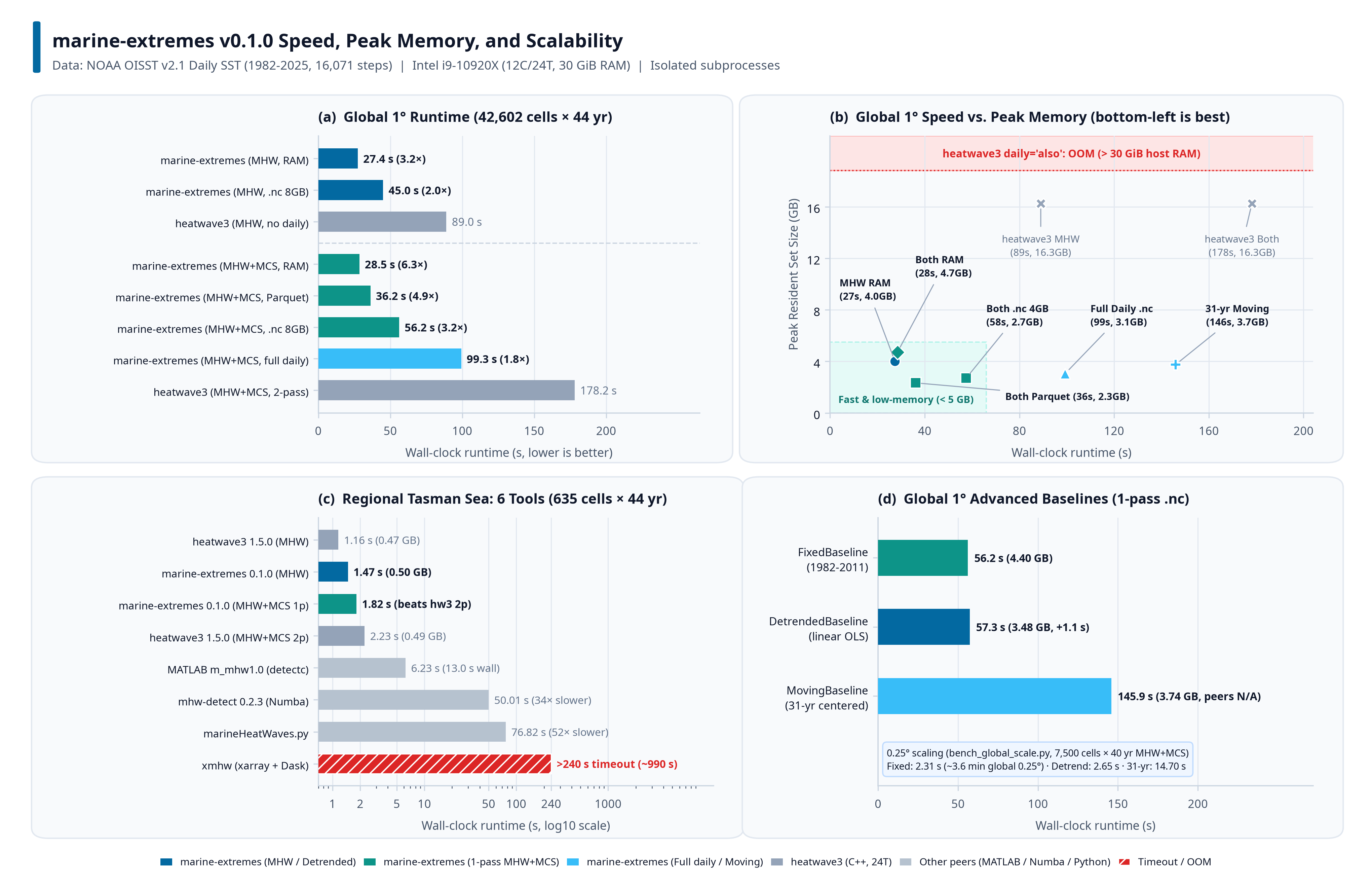
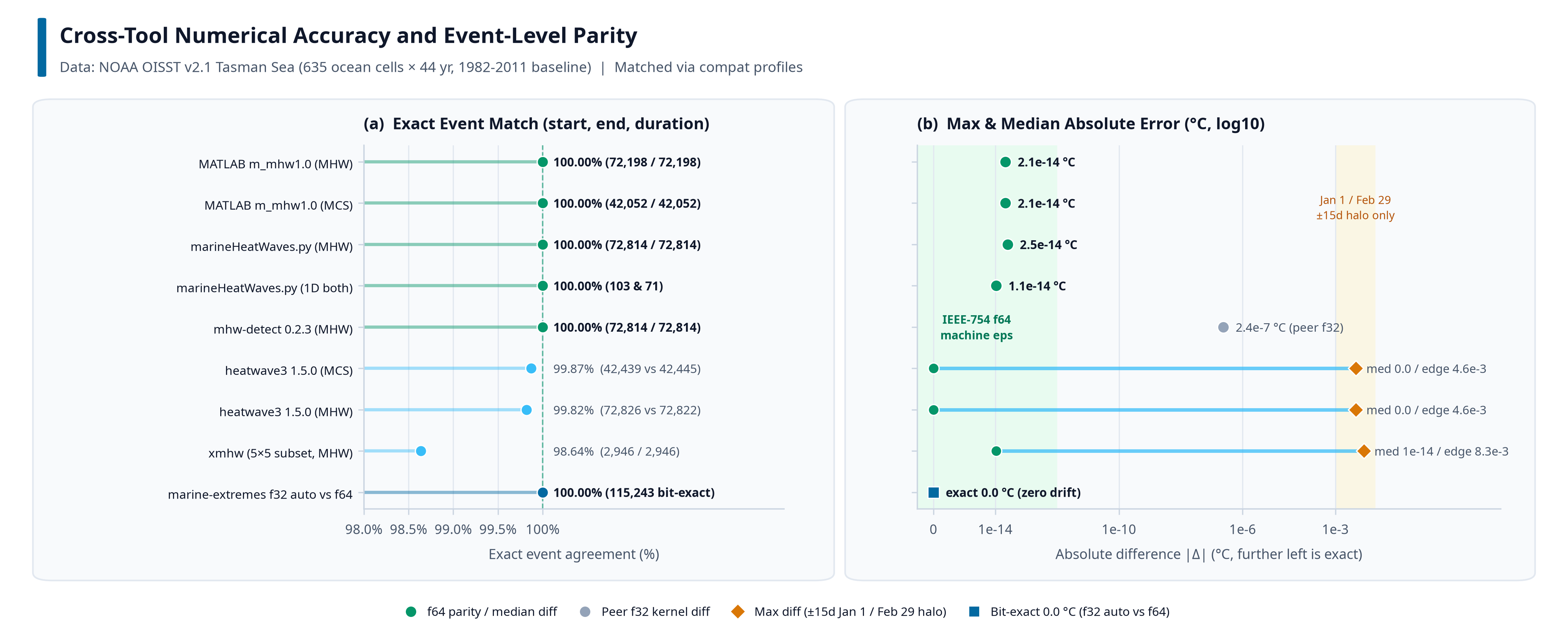
Measured on real NOAA OISST v2.1 daily SST (1982-2025, 16,071 daily steps, 1982-2011 baseline) on Linux (Intel Core i9-10920X, 12C/24T @ 3.5 GHz, 30 GiB RAM) using isolated subprocesses (perf_counter wall time and /usr/bin/time -v peak RSS). Peer versions: heatwave3 1.5.0 (24 threads, roundClm=False), MATLAB R2025b m_mhw1.0 (detectc.m), mhw-detect 0.2.3 (Numba 0.68.1), ecjoliver/marineHeatWaves.py (patched for NumPy 2), and xmhw.
With heatwave3 and xmhw, 290-300 days of the year agree to 0.0 °C; the <= 0.008 °C edge differences sit inside the ±15-day smoothing halo around Jan 1 and Feb 29 because both wrap 1982-01-01 directly to 2011-12-31 in a fixed 366 x n_years matrix and interpolate non-leap Feb 29 before taking the ±5-day window.
Feature comparison
| Capability | marine-extremes |
heatwave3 |
m_mhw1.0 |
heatwaveR |
marineHeatWaves |
xmhw |
mhw-detect |
|---|---|---|---|---|---|---|---|
| Core engine | Rust + Rayon | C++ + OpenMP | MATLAB | R + Rcpp | Python | xarray + Dask | Python + Numba |
| Single-pass MHW + MCS | Yes | No (2 passes) | No (2 passes) | No (2 passes) | No (2 passes) | No (2 passes) | No |
| Memory-bounded streaming | Yes (memory_limit) |
Partial (~16 GB global) | No (in-RAM) | No (1D) | No (1D) | Dask (slow) | Manual mhw-cut |
| Grid dimensions | 1D-4D | 3D-4D | 3D | 1D | 1D | 3D | 3D |
| Baselines | Fixed / Linear / Quad / Moving / Ext | Fixed / Linear | Fixed / Ext | Fixed | Fixed / Ext | Fixed | Fixed / Ext |
| CMIP6 calendars & monthly | Yes (cftime + monthly) |
Gregorian | Gregorian | Gregorian | Ly approx |
Partial | Gregorian |
| Single-target output | .nc/.mat/.zarr/.npz/.parquet/.csv |
.nc/.zarr (multi-file) |
.mat |
R data.frame | Python dict | xarray | .parquet/.csv |
| O(1) grid lookup (CSR) | Yes (lazy disk-backed) | No | Cell array (RAM) | No | No | No | No |
Cross-tool compat profiles |
5 profiles | Fixed (heatwaveR) |
2 (matlab/python) |
Fixed | Fixed | Fixed | Fixed |
Baselines
| Baseline class | Description |
|---|---|
FixedBaseline(start, end, clim_data=None, ...) |
Standard Hobday et al. (2016) fixed climatology period; accepts external clim_data for cross-scenario detection (for example CMIP6 historical baseline applied to SSP projections). |
DetrendedBaseline(method="linear" | "quadratic", start, end, fit_period) |
Fits per-pixel OLS trends (ignoring NaNs), subtracts the long-term trend while keeping the mean level, then runs climatology and detection. Exposes fitted coefficients in res.trend. |
MovingBaseline(window_years=31, center=True, boundary="clamp" | "shrink") |
Sliding multi-year climatology window (such as centered 11-year or 31-year) executed through deduplicated Rust window schedules. |
FixedThreshold(threshold_high, threshold_low, climatology=0.0) |
Scalar or gridded physical or ecological thresholds (such as coral bleaching or salinity limits). |
ExternalClimatology(seas, thresh_high, thresh_low) |
Reuses climatologies from mx.compute_climatology() or external files (doy, (year, doy), or time). |
Output formats
Passing out="path" (or calling res.save("path"), res.to_mat("path"), or res.events.save("path")) infers the format from the file extension (or out_format=...) and writes a single target with no sidecar files:
| Extension | Contents | Streaming / lazy lookup | External readers |
|---|---|---|---|
.nc / .nc4 |
Root group: grids, coords, attrs; /events group: event table and grid_offsets |
Streaming + O(1) lazy slice | xarray.open_dataset, MATLAB ncread, CDO, Panoply |
.mat (mat_layout="v73") |
Grids, events struct (Nx1 column vectors), grid_offsets, coords (no 2 GB cap) |
Streaming + O(1) lazy slice | MATLAB load() / matfile(), h5py |
.mat (mat_layout="detectc") |
m_mhw1.0-compatible MHW{i,j} cell plus mclim, m90, m10, mhw_ts, category_ts (2 GB guard) |
Buffered v5 | MATLAB m_mhw1.0 scripts, scipy.io.loadmat |
.zarr |
Single Zarr store: root zstd-chunked grids plus /events subgroup and grid_offsets |
Streaming + O(1) lazy slice | xarray.open_zarr(..., consolidated=False), zarr |
.npz |
Compressed NumPy archive with grids, events, grid_offsets, and metadata |
Buffered | Plain numpy.load() |
.parquet |
Event table only (CSR grid_offsets and coords stored in Parquet footer) |
Streaming + O(1) lazy slice | Pandas, Polars, DuckDB, PyArrow, R Arrow |
.feather / .csv |
Event table only (Feather stores spatial schema metadata; CSV is RFC-4180) | Streaming | Excel, R, Pandas, Polars |
Cross-tool compatibility profiles
| Profile | Quantile | Exceedance | Feb 29 mode | Variance ddof |
Reference tool |
|---|---|---|---|---|---|
"standard" (default) |
Type-7 | > / < |
interp_59_61 |
1 |
Hobday (2016/2018) with sample std |
"m_mhw" |
Type-5 (Hazen) | >= / <= |
interp_59_61 |
1 |
MATLAB m_mhw1.0 (detect.m / detectc.m) |
"m_mhw_python" |
Type-7 | >= / <= |
interp_59_61 |
1 |
Python port of m_mhw |
"oliver" |
Type-7 | > / < |
interp_59_61 |
0 |
ecjoliver/marineHeatWaves.py |
"heatwaveR" |
Type-7 | > / < |
heatwaver_series |
1 |
R heatwaveR / C++ heatwave3 |
Project structure
marine-extremes/
├── Cargo.toml                        # Rust crate config (PyO3 0.30, rust-numpy 0.30, Rayon 1.12)
├── pyproject.toml                    # Python packaging & maturin build config
├── LICENSE                           # MIT License
├── CITATION.cff                      # Citation metadata (GitHub & Zenodo)
├── README.md                         # English documentation (default)
├── README.zh-CN.md                   # Simplified Chinese documentation
├── src/                              # Rust parallel core
│   ├── lib.rs                        # Compiled stateful PyO3 plans (FixedPlan, MovingPlan, CurvesPlan) & f64/f32 dispatch
│   ├── compat.rs                     # Compatibility enums & kernel options
│   ├── quantile.rs                   # Type-7 & Type-5 (Hazen) quantiles
│   ├── baseline.rs                   # OLS detrending, WindowPlan, MovingSchedule, circular smoothing
│   └── detect.rs                     # Padding, threshold scan, transitive gap merge, metrics & categories
├── python/marine_extremes/           # Python orchestration & persistence modules
│   ├── __init__.py                   # Public exports (detect, compute_climatology, open, baselines)
│   ├── api.py                        # Public entry points (detect, compute_climatology)
│   ├── baselines.py                  # Baseline specifications & PreparedBaseline adapters
│   ├── calendar.py                   # Unified Gregorian/cftime encoding, period slicing & date/CF-time codecs
│   ├── catalog.py                    # Canonical EventSchema, EventStore seam & CSR grid-indexed EventCatalog
│   ├── cf.py                         # Built-in lightweight CF resolver & optional cf-xarray enhancement
│   ├── compat.py                     # Cross-tool compatibility presets
│   ├── io_formats.py                 # OutputSpec, ResultSink seam & 8 single-file format adapters
│   ├── mcp_server.py                 # Optional stdio MCP server (4 tools for AI clients)
│   ├── result.py                     # DetectResult container (save, to_mat, open, to_dataset)
│   └── streaming.py                  # Multi-file glob reader, singleton squeeze & memory tiling
├── skills/marine-extremes/SKILL.md   # Agent Skill guide for Claude Code / Codex / Cursor / etc.
├── tests/                            # Unit, CF, MCP, parity, adversarial, streaming & MATLAB R2025b tests
├── examples/quickstart.py            # Standalone runnable quickstart
├── benchmarks/bench_global_scale.py  # Synthetic global-scale throughput benchmark
├── docs/
│   ├── figures/                      # Bilingual README speed & accuracy figures
│   └── marine_extremes_overview.html # Interactive illustrated HTML overview
└── .github/workflows/                # Multi-Python CI & cross-platform PyPI release workflows
Scope
marine-extremes handles point-wise 1D-4D extreme event detection and single-target output. It does not include 3D/4D spatial connected-component object tracking, vertical ocean heat content integration, or vertical subtype classification.
Development and testing
# Rust unit tests
cargo test --lib

# Build release extension and install optional dependencies
maturin develop --release --extras io,mcp,dev

# Full Python test suite (includes MATLAB R2025b checks when installed)
pytest -v

# Synthetic scale benchmark
python benchmarks/bench_global_scale.py
Issues
Small numerical differences between MHW/MCS tools (MATLAB m_mhw1.0, Python marineHeatWaves / xmhw, R heatwaveR, C++ heatwave3) come from different conventions for quantile interpolation (Type-5 Hazen vs. Type-7), threshold inequality (>= vs. >), Feb 29 handling, intensity variance ddof (0 vs. 1), and year-boundary window wrapping. To match a specific reference implementation, pass compat="m_mhw", "oliver", "heatwaveR", or "standard" (see Cross-tool compatibility profiles and Benchmarks and verification).
If you hit a bug, a calendar edge case, or an I/O issue, open a report on GitHub Issues with your marine-extremes version, Python and OS details, and a minimal reproducer.
Contributing
Bug fixes, calendar or I/O adapters, parity tests, and documentation edits are welcome:
- Fork the repository and branch from
main. - Run both the Rust and Python tests locally before opening a pull request:
cargo test --lib
maturin develop --release --extras io,mcp,dev
pytest -v
- Add unit or regression tests under
tests/for behavioral changes or bug fixes. - Open a pull request or start a discussion on GitHub Issues.
Citation
If you use marine-extremes in research or operational work, cite the package alongside the underlying methodology papers (for example Hobday et al., 2016; Hobday et al., 2018; Schlegel et al., 2021):
Ren, J. (2026). marine-extremes: Rust-accelerated detection of marine heatwaves, marine cold spells, and marine extremes (Version 0.1.1) [Computer software]. Zenodo. https://doi.org/10.5281/zenodo.24579203
@software{marine_extremes,
  author    = {Ren, Jie},
  title     = {marine-extremes: Rust-accelerated detection of marine heatwaves, marine cold spells, and marine extremes},
  version   = {0.1.1},
  year      = {2026},
  publisher = {Zenodo},
  doi       = {10.5281/zenodo.24579203},
  url       = {https://github.com/Radianjayjay/marine-extremes}
}
References
- Hobday, A. J., Alexander, L. V., Perkins, S. E., Smale, D. A., Straub, S. C., Oliver, E. C. J., Benthuysen, J. A., Burrows, M. T., Donat, M. G., Feng, M., Holbrook, N. J., Moore, P. J., Scannell, H. A., Sen Gupta, A., & Wernberg, T. (2016). A hierarchical approach to defining marine heatwaves. Progress in Oceanography, 141, 227-238.
- Schlegel, R. W., Oliver, E. C. J., Wernberg, T., & Smit, A. J. (2017). Nearshore and offshore co-occurrences of marine heatwaves and cold-spells. Progress in Oceanography, 151, 189-205.
- Hobday, A. J., Oliver, E. C. J., Sen Gupta, A., Benthuysen, J. A., Burrows, M. T., Donat, M. G., Holbrook, N. J., Moore, P. J., Thomsen, M. S., Wernberg, T., & Smale, D. A. (2018). Categorizing and naming marine heatwaves. Oceanography, 31(2), 162-173.
- Schlegel, R. W., & Smit, A. J. (2018). heatwaveR: A central algorithm for the detection of heatwaves and cold-spells. Journal of Open Source Software, 3(27), 821.
- Oliver, E. C. J., Lago, V., Hobday, A. J., Holbrook, N. J., Ling, S. D., & Mundy, C. N. (2018). Marine heatwaves off eastern Tasmania: Trends, interannual variability, and predictability. Progress in Oceanography, 161, 116-130.
- Zhao, Z., & Marin, M. (2019). A MATLAB toolbox to detect and analyze marine heatwaves. Journal of Open Source Software, 4(33), 1124.
- Jacox, M. G., Alexander, M. A., Bograd, S. J., & Scott, J. D. (2020). Thermal displacement by marine heatwaves. Nature, 584, 82-86.
- Schlegel, R. W., Darmaraki, S., Benthuysen, J. A., Filbee-Dexter, K., & Oliver, E. C. J. (2021). Marine cold-spells. Progress in Oceanography, 198, 102684.
- Reynolds, R. W., Smith, T. M., Liu, C., Chelton, D. B., Casey, K. S., & Schlax, M. G. (2007). Daily high-resolution-blended analyses for sea surface temperature. Journal of Climate, 20(22), 5473-5496.
Author
Jie Ren, South China Sea Institute of Oceanology, Chinese Academy of Sciences / University of Chinese Academy of Sciences.
- Email:
renjie22@mails.ucas.ac.cn - ORCID: 0009-0000-2806-6771
- ResearchGate: Jie Ren
License
MIT License. See LICENSE.
1 maintainer

Metadata
1 maintainer
Release files for marine-extremes 0.1.1
For a detailed explanation of source distributions (sdists) and built distributions (wheels), please see the package formats documentation.
Source distribution (sdist)
| File | Size | Uploaded | Provenance | Actions |
|---|---|---|---|---|
| marine_extremes-0.1.1.tar.gz | 164.7 kB | With provenance | Details for marine_extremes-0.1.1.tar.gz |
Built distributions (wheels)
| File | Actions Reset | |||
|---|---|---|---|---|
| marine_extremes-0.1.1-cp311-abi3-win_amd64.whl | CPython 3.11 | abi3 | Windows x86-64 | Details for marine_extremes-0.1.1-cp311-abi3-win_amd64.whl |
| marine_extremes-0.1.1-cp311-abi3-manylinux2014_x86_64.manylinux_2_17_x86_64.whl | CPython 3.11 | abi3 | Linux glibc 2.17+ x86-64 | Details for marine_extremes-0.1.1-cp311-abi3-manylinux2014_x86_64.manylinux_2_17_x86_64.whl |
| marine_extremes-0.1.1-cp311-abi3-manylinux2014_aarch64.manylinux_2_17_aarch64.whl | CPython 3.11 | abi3 | Linux glibc 2.17+ ARM64 | Details for marine_extremes-0.1.1-cp311-abi3-manylinux2014_aarch64.manylinux_2_17_aarch64.whl |
| marine_extremes-0.1.1-cp311-abi3-macosx_11_0_arm64.whl | CPython 3.11 | abi3 | macOS 11.0+ ARM64 | Details for marine_extremes-0.1.1-cp311-abi3-macosx_11_0_arm64.whl |
| marine_extremes-0.1.1-cp311-abi3-macosx_10_15_x86_64.whl | CPython 3.11 | abi3 | macOS 10.15+ x86-64 | Details for marine_extremes-0.1.1-cp311-abi3-macosx_10_15_x86_64.whl |
Total release size: 2.7 MB
Release files / marine_extremes-0.1.1.tar.gz
| Download URL | marine_extremes-0.1.1.tar.gz |
|---|---|
| Size | 164.7 kB |
| Tags | Source |
|
SHA-256 checksum How to use checksums |
eab692ea00260b84cf5266d95303b41293976ecb719b47540813e66cc2cd32b0
|
|
BLAKE2b-256 checksum How to use checksums |
d33f1493071d457fde8286076d0c666c68664ec3d0e994ee3983bfce50b35cce
|
| Upload date | |
|
Uploaded using Trusted Publishing? What is trusted publishing? |
Yes |
| Uploaded via |
twine/7.0.0 CPython/3.13.16
|
Provenance
Provenance describes where a file came from. On PyPI, provenance is shared via attestations, which provide a verifiable record of the build or publishing details. View details, limitations and caveats.


PyPI Publish Attestation
PyPI verified that this artifact, at this checksum, originated from the publisher listed below.
Signed by GitHub Actions, verified by PyPI on Nov 28, 2026.
Transparency logRelease files / marine_extremes-0.1.1-cp311-abi3-win_amd64.whl
| Download URL | marine_extremes-0.1.1-cp311-abi3-win_amd64.whl |
|---|---|
| Size | 430.0 kB |
| Tags | CPython 3.11 Windows x86-64 abi3 |
|
SHA-256 checksum How to use checksums |
a1e27856d3930bf7df1fae12d8e3adfa06ffb9234d4addc9649c7f69eeb5624e
|
|
BLAKE2b-256 checksum How to use checksums |
64994f6e95f004a1f452a920acbdc3b2814eff3a112d29c14e89209fd0f0b5a2
|
| Upload date | |
|
Uploaded using Trusted Publishing? What is trusted publishing? |
Yes |
| Uploaded via |
twine/7.0.0 CPython/3.13.16
|
Provenance
Provenance describes where a file came from. On PyPI, provenance is shared via attestations, which provide a verifiable record of the build or publishing details. View details, limitations and caveats.
PyPI Publish Attestation
PyPI verified that this artifact, at this checksum, originated from the publisher listed below.
Signed by GitHub Actions, verified by PyPI on Nov 28, 2026.
Transparency logRelease files / marine_extremes-0.1.1-cp311-abi3-manylinux2014_x86_64.manylinux_2_17_x86_64.whl
| Download URL | marine_extremes-0.1.1-cp311-abi3-manylinux2014_x86_64.manylinux_2_17_x86_64.whl |
|---|---|
| Size | 547.8 kB |
| Tags | CPython 3.11 Linux glibc 2.17+ x86-64 abi3 |
|
SHA-256 checksum How to use checksums |
3c092524f9d8d42bfcaecd73e3fba52d2992db00fe04a9dc3a2cbc8250dfe2b0
|
|
BLAKE2b-256 checksum How to use checksums |
830992f084140a0d8f44835211d408a64027643cda293eb04b95d9c0d8845b21
|
| Upload date | |
|
Uploaded using Trusted Publishing? What is trusted publishing? |
Yes |
| Uploaded via |
twine/7.0.0 CPython/3.13.16
|
Provenance
Provenance describes where a file came from. On PyPI, provenance is shared via attestations, which provide a verifiable record of the build or publishing details. View details, limitations and caveats.
PyPI Publish Attestation
PyPI verified that this artifact, at this checksum, originated from the publisher listed below.
Signed by GitHub Actions, verified by PyPI on Nov 28, 2026.
Transparency logRelease files / marine_extremes-0.1.1-cp311-abi3-manylinux2014_aarch64.manylinux_2_17_aarch64.whl
| Download URL | marine_extremes-0.1.1-cp311-abi3-manylinux2014_aarch64.manylinux_2_17_aarch64.whl |
|---|---|
| Size | 534.1 kB |
| Tags | CPython 3.11 Linux glibc 2.17+ ARM64 abi3 |
|
SHA-256 checksum How to use checksums |
2a5eb8c6abceb35ac57bbf220a84361e470d4d4345a8d36f0a5e84ee9ff72dac
|
|
BLAKE2b-256 checksum How to use checksums |
42d48b8d32cbc2c27224ea20f8ca50688bf4b742aa0d991c6ae3ef7eeefb365c
|
| Upload date | |
|
Uploaded using Trusted Publishing? What is trusted publishing? |
Yes |
| Uploaded via |
twine/7.0.0 CPython/3.13.16
|
Provenance
Provenance describes where a file came from. On PyPI, provenance is shared via attestations, which provide a verifiable record of the build or publishing details. View details, limitations and caveats.
PyPI Publish Attestation
PyPI verified that this artifact, at this checksum, originated from the publisher listed below.
Signed by GitHub Actions, verified by PyPI on Nov 28, 2026.
Transparency logRelease files / marine_extremes-0.1.1-cp311-abi3-macosx_11_0_arm64.whl
| Download URL | marine_extremes-0.1.1-cp311-abi3-macosx_11_0_arm64.whl |
|---|---|
| Size | 494.1 kB |
| Tags | CPython 3.11 abi3 macOS 11.0+ ARM64 |
|
SHA-256 checksum How to use checksums |
e160e8b9a708058a398dd0dae092cf50ccb262f1eb479773077e64e8f429ef12
|
|
BLAKE2b-256 checksum How to use checksums |
2b527efdb29ba18b300ea60417f47510430ea3a66f6b34decf7a9730bdd8245c
|
| Upload date | |
|
Uploaded using Trusted Publishing? What is trusted publishing? |
Yes |
| Uploaded via |
twine/7.0.0 CPython/3.13.16
|
Provenance
Provenance describes where a file came from. On PyPI, provenance is shared via attestations, which provide a verifiable record of the build or publishing details. View details, limitations and caveats.
PyPI Publish Attestation
PyPI verified that this artifact, at this checksum, originated from the publisher listed below.
Signed by GitHub Actions, verified by PyPI on Nov 28, 2026.
Transparency logRelease files / marine_extremes-0.1.1-cp311-abi3-macosx_10_15_x86_64.whl
| Download URL | marine_extremes-0.1.1-cp311-abi3-macosx_10_15_x86_64.whl |
|---|---|
| Size | 506.2 kB |
| Tags | CPython 3.11 abi3 macOS 10.15+ x86-64 |
|
SHA-256 checksum How to use checksums |
4d9531dec9c3ce17b0d237adba73046546c4c0ce1536d8000d150d386d9e82e1
|
|
BLAKE2b-256 checksum How to use checksums |
30ec49a7d093cfeb9398be5c2f06b7f82e8e72957d74c2076f6f6fd39666f6e5
|
| Upload date | |
|
Uploaded using Trusted Publishing? What is trusted publishing? |
Yes |
| Uploaded via |
twine/7.0.0 CPython/3.13.16
|
Provenance
Provenance describes where a file came from. On PyPI, provenance is shared via attestations, which provide a verifiable record of the build or publishing details. View details, limitations and caveats.
PyPI Publish Attestation
PyPI verified that this artifact, at this checksum, originated from the publisher listed below.
Signed by GitHub Actions, verified by PyPI on Nov 28, 2026.
Transparency logSecurity for marine-extremes 0.1.1
Provenance
Provenance describes where a file came from. On PyPI, provenance is shared via attestations, which provide a verifiable record of the build or publishing details. View details, limitations and caveats.
Full provenance
All 6 files in this release have been uploaded with provenance metadata.
Attestation for marine_extremes-0.1.1.tar.gz
PyPI Publish Attestation
PyPI verified that this artifact, at this checksum, originated from the publisher listed below.
Signed by GitHub Actions, verified by PyPI on Nov 28, 2026.
Transparency logA note on package security
PyPI is a repository for distributing packages, not a service for auditing them. While third-party security researchers and our staff do their best to detect and remove malicious packages, PyPI cannot guarantee the quality, security or suitability of any given package.
To learn more about protecting yourself from malicious actors, visit our package security documentation.














