
marine-extremes






English | 简体中文
marine-extremes is a Rust-accelerated Python package for detecting upper-tail ("high") and lower-tail ("low") extremes across 1D to 4D scalar ocean variables. For seawater temperature, these correspond to marine heatwaves (MHWs, alias "mhw") and marine cold spells (MCSs, alias "mcs"); the same engine works on salinity, ocean acidity (pH), dissolved oxygen (hypoxia and deoxygenation), carbon dioxide (pCO2 / CO2), and chlorophyll across 1D station records, 3D surface grids (NOAA OISST, OSTIA), 4D depth-resolved reanalyses (GLORYS, ORAS5, Argo), and multi-calendar CMIP6 simulations.
See docs/marine_extremes_overview.html for an interactive architecture walkthrough.
What it does
- Parallel Rust core with Rayon. Releases the Python GIL (
py.detach()), skips land pixels, and uses afloat32tile fast path (working_dtype="auto") with internalf64accumulation so memory drops by half without precision loss. - Single-pass MHW and MCS detection. Setting
event="both"computes the climatology once and detects upper and lower events together. - Memory-bounded out-of-core streaming. Reads multi-file NetCDF or Zarr globs (for example
sst.day.mean.*.nc) in spatial or depth tiles under a chosenmemory_limit, or switches to single-pass pre-read when the raw array fits inside 45% ofmemory_limit. - Single-target output across seven formats. Passing
out=...writes one standalone.nc,.mat(v7.3 HDF5 without the 2 GB cap, or v5detectccell layout),.zarr,.npz,.parquet,.feather, or.csvtarget with no sidecar files. - CSR-indexed grid lookup and columnar analytics. Events are stored sorted by flattened grid index alongside
int64CSRgrid_offsetsinside.nc,.mat,.zarr,.npz, and.parquet, giving O(1) lazy disk-backedres.events.sel(...)/isel(...)and zero-scancount_map(). - Five baseline definitions. Supports
FixedBaseline(including externalclim_data),DetrendedBaseline(linear or quadratic OLS detrending),MovingBaseline(sliding multi-year window withclamporshrinkboundaries),FixedThreshold, andExternalClimatology. - Multi-calendar and monthly support. Handles Gregorian and CMIP6
cftimecalendars (standard,proleptic_gregorian,noleap/365_day,360_day,all_leap/366_day) as well asfreq="monthly"detection (Jacox et al., 2020). - Explicit cross-tool compatibility profiles. Choose
compat="standard","m_mhw","m_mhw_python","oliver", or"heatwaveR"to match the quantile rule, threshold inequality, Feb 29 handling, and varianceddofof a reference tool. - Edge and sea-ice safeguards. Includes detection-only
max_pad_length,min_valid_fractionfiltering (without NaN bleed during circular smoothing),truncated_start/truncated_endflags, andlower_boundhandling (flag,mask, orfloorwith zero-division protection). - CF-aware input resolution. Built-in CF metadata resolver (with optional
cf-xarraysupport) infers non-timedimensions (valid_time,time_counter,ocean_time), skips*_bnds/grid_mapping/ancillary_variables, matchesstandard_nameand marine aliases, and warns on Kelvin vs. Celsiuslower_boundmismatches. - AI agent skill and MCP server. Ships an Agent Skill (skills/marine-extremes/SKILL.md) and an optional local stdio MCP server (
marine-extremes-mcp) with four tools:inspect_dataset,detect_extremes,query_events, andsummarize_result.
Installation
Install prebuilt wheels from PyPI (no Rust toolchain required on Linux, macOS, or Windows):
# Core package (NumPy, Pandas, PyArrow, Xarray)
pip install marine-extremes

# Recommended: include all I/O backends (NetCDF4, HDF5/MAT, Zarr, cftime, Dask, cf-xarray)
pip install "marine-extremes[io]"
On older HPC Linux hosts (glibc < 2.28, such as CentOS 7), pyarrow>=21 has no manylinux2014 wheel and falls back to a slow Arrow C++ source build. Pin pyarrow<21 with binary wheels only:
pip install --only-binary=:all: "pyarrow<21" "marine-extremes[io]"
Optional dependency groups in pyproject.toml:
marine-extremes[netcdf]:netCDF4,h5netcdf,cftime,daskmarine-extremes[mat]:h5py,scipy(MATLAB v7.3 and v5.mat)marine-extremes[zarr]:zarr>=3.0,cftime,daskmarine-extremes[cf]:cf-xarray(optional CF accessor and custom criteria support)marine-extremes[mcp]:mcp(optional stdio MCP servermarine-extremes-mcpfor AI clients)marine-extremes[io]: all I/O backends (netcdf,mat,zarr,cf; excludesmcp)marine-extremes[dev]:pytest,maturin
To build from source instead (requires a Rust toolchain):
git clone https://github.com/Radianjayjay/marine-extremes.git
cd marine-extremes
pip install maturin
maturin develop --release --extras io,mcp   # omit ,mcp if you do not need the MCP server
Quick start
import marine_extremes as mx

res = mx.detect(
    "data/OISST_1982_2025_r360x180.nc",
    var="sst",
    squeeze_singleton="zlev",        # drop singleton depth dims (e.g., OISST zlev=1)
    event="both",                    # "high" | "low" | "both" (aliases: "mhw" | "mcs")
    baseline=mx.MovingBaseline(window_years=31, center=True, boundary="clamp"),
    lower_bound=-1.8,
    bound_policy="flag",
    working_dtype="auto",            # auto-uses compact float32 tiles for float32/int16 NetCDF
    clim_dtype="float32",            # halves 4D MovingBaseline clim/thresh RAM, disk size & write time
    intensity_dtype="float32",       # halves intensity_ts / intensity_high_ts / intensity_low_ts RAM and disk size
    memory_limit="8GB",              # use "10GB" on ~4 GB global 1° inputs for single-pass pre-read
    out="outputs/oisst_mhw.nc",      # .nc | .mat | .zarr | .npz | .parquet | .feather | .csv
)

# Separate high/low intensity grids sit in res.intensity_high_ts and res.intensity_low_ts
# O(1) single-grid lookup (lazy disk-backed on .nc / .mat v7.3 / .zarr / .parquet)
df_point = res.events.sel(lat=-42.5, lon=148.0)

# Spatial event count map from CSR offsets (no table scan)
counts = res.events.count_map()

# Bounded-chunk run summary (safe on multi-million-row catalogs)
stats = res.summary()

# Full columnar DataFrame (small/medium catalogs)
df_all = res.events.to_pandas()

# Reopen any saved output directly
res2 = mx.open("outputs/oisst_mhw.nc")

# Export to standalone MATLAB .mat (v5 detectc cell or v7.3 HDF5) or Zarr
res.to_mat("outputs/oisst_detectc.mat", layout="detectc")
res.to_mat("outputs/oisst_v73.mat", layout="v73")
res.save("outputs/oisst_mhw.zarr")
To run the standalone demo without external data:
python examples/quickstart.py
Use with AI agents (Skill and MCP)
Agent Skill (recommended for coding agents)
For coding agents that can run local Python (Claude Code, Codex, Cursor, Antigravity, Windsurf, OpenCode), install marine-extremes[io] and put skills/marine-extremes/SKILL.md into your agent's skills directory:
# From a local clone (keep whichever path matches your agent)
mkdir -p ~/.claude/skills/marine-extremes ~/.codex/skills/marine-extremes
cp skills/marine-extremes/SKILL.md ~/.claude/skills/marine-extremes/SKILL.md
cp skills/marine-extremes/SKILL.md ~/.codex/skills/marine-extremes/SKILL.md

# Or download directly if you installed from PyPI without cloning
curl -fsSL https://raw.githubusercontent.com/Radianjayjay/marine-extremes/main/skills/marine-extremes/SKILL.md \
  -o ~/.claude/skills/marine-extremes/SKILL.md
Once installed, talk to your agent in plain language without memorizing parameter names:
"Use
marine-extremesto detect MHWs and MCSs from my SST file (or yearly NetCDF folder) atdata/sst_*.nc, and save the output as.nc(or.zarr/.mat/.npz) underoutputs/."
You do not need to mention var, squeeze_singleton, lower_bound, or memory_limit in your prompt. The skill inspects dataset headers and host hardware in one quick pass (without running slow trial detections first), then offers concise choices for climatology baseline, compat preset, physical bounds, precision, output format, and compute target (local background run, SSH compute node, or PBS/Slurm Rayon job or spatial-shard array). For long gridded runs, it writes a standalone script, launches it non-blocking, checks startup, and asks whether to set up periodic progress check-ins; if you already specified all choices or asked for defaults, it runs immediately.
If you have not installed the skill file yet, you can still send a short plain-language request and point the agent to the package:
"Use the Python package
marine-extremes(import marine_extremes as mx) to detect MHWs and MCSs ondata/sst_*.ncand save the result tooutputs/. Inspect the file's variables, units, and time range first, then ask me which baseline, compatibility preset, and output format to use before running."
Optional stdio MCP server (for desktop/chat AI clients)
If your AI client cannot run local Python scripts directly (for example Claude Desktop or Cherry Studio), install the optional MCP extra (compatible with MCP Python SDK v1 and v2):
pip install "marine-extremes[io,mcp]"
Add the local stdio server to your MCP client config:
{
  "mcpServers": {
    "marine-extremes": {
      "command": "marine-extremes-mcp"
    }
  }
}
If a desktop client does not inherit your Conda/virtualenv PATH, point directly to that environment's Python interpreter instead:
{
  "mcpServers": {
    "marine-extremes": {
      "command": "/path/to/your/env/bin/python",
      "args": ["-m", "marine_extremes.mcp_server"]
    }
  }
}
| MCP tool | Purpose |
|---|---|
inspect_dataset |
Inspect variables, dims, 1D coordinate ranges (flagging curvilinear grids), CF calendar, singleton dims, and Kelvin vs. Celsius notes before running detection. |
detect_extremes |
Run streamed detection across fixed, detrended, moving, or fixed-threshold baselines (region slicing, clim_dtype, split intensity_high_ts / intensity_low_ts) into one out file. Returns metadata, warnings, and up to 50 sample rows while refusing to overwrite inputs or non-Zarr dirs. |
query_events |
Look up one grid cell in O(1) via CSR coords or indices, or filter in chunks (type, duration, category, YYYY / YYYY-MM / YYYY-MM-DD dates) with top-k sorting (up to 500 rows) or limit=0 counts. |
summarize_result |
Aggregate pixel coverage, counts by type, category, and start year, duration stats, and peak absolute intensity in bounded chunks without loading the full table. |
detect_extremes writes gridded fields to out and returns compact metadata and sample rows, keeping large arrays out of model context. For multi-decade high-resolution global runs (such as 0.25° OISST or OSTIA), run a Python script via the Skill instead of MCP to avoid client timeouts.
Benchmarks and verification
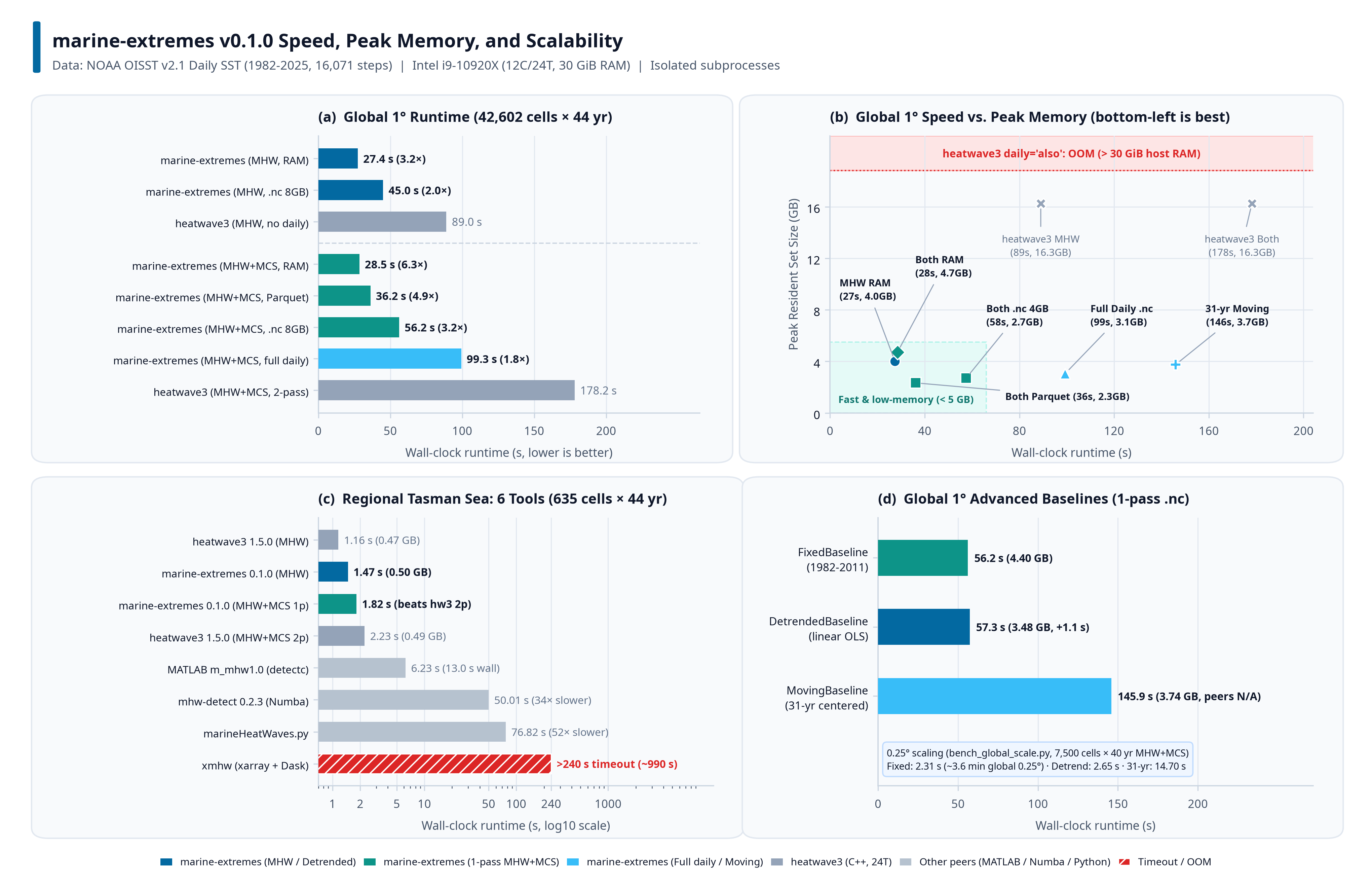
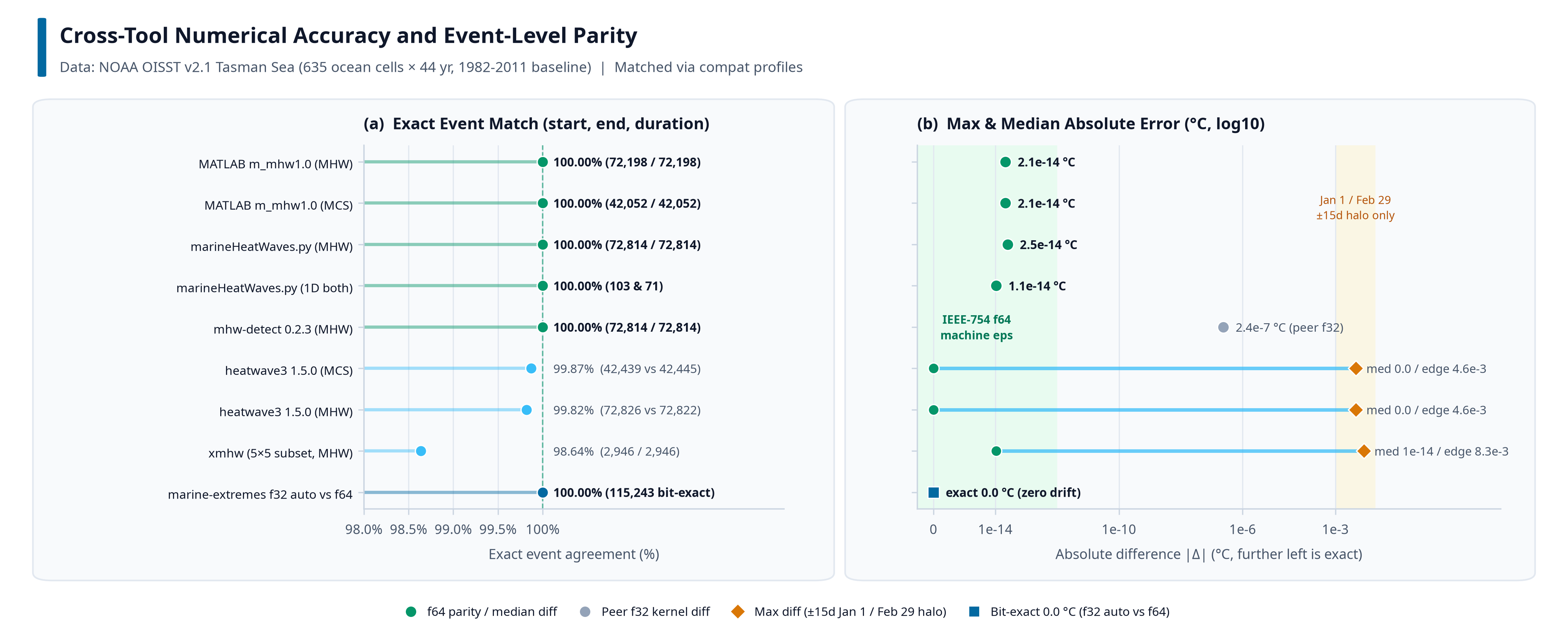
Measured on NOAA OISST v2.1 daily SST (1982-2025, 16,071 daily steps, 42,602 active ocean cells, 1982-2011 baseline) on Linux (Intel Core i9-10920X, 12C/24T @ 3.5 GHz, 30 GiB RAM) using isolated subprocesses (perf_counter wall time and /usr/bin/time -v peak RSS). Peer versions: heatwave3 1.5.0 (24 threads, roundClm=False), MATLAB R2025b m_mhw1.0 (detectc.m), mhw-detect 0.2.3 (Numba 0.68.1), ecjoliver/marineHeatWaves.py (patched for NumPy 2), and xmhw.
With heatwave3 and xmhw, 290-300 days of the year agree to 0.0 °C. The <= 0.008 °C differences sit inside the ±15-day smoothing halo around Jan 1 and Feb 29 because both wrap 1982-01-01 directly to 2011-12-31 in a 366 x n_years matrix and interpolate non-leap Feb 29 before taking the ±5-day window.
v0.1.2 vs. v0.1.0 summary
Workload (OISST 1982-2025, 16071 x 181 x 360) |
v0.1.0 |
v0.1.2 |
Notes |
|---|---|---|---|
Global 1° MHW .nc (8GB / 4GB / 10GB) |
45.0 s (3.83 GB) / 48.1 s (2.32 GB) |
42.5 s (2.72 GB) / 44.9 s (1.72 GB) / 36.8 s |
10GB triggers single-pass pre-read (-18% vs 0.1.0) |
Global 1° MHW+MCS 1-pass .nc (8GB / 4GB / 10GB) |
56.2 s (4.40 GB) / 57.5 s (2.70 GB) |
54.8 s (3.06 GB) / 56.2 s (1.96 GB) / 46.2 s |
26-30% lower streaming Peak RSS (7,554,466 events) |
Global 1° MHW+MCS (RAM 8GB / Parquet 4GB) |
28.5 s (4.72 GB) / 36.2 s (2.33 GB) |
29.2 s (3.76 GB) / 39.0 s (1.69 GB) |
20-27% lower Peak RSS (both_pq: 808 MB) |
Global 1° Full Daily MHW .nc (4GB, float32) |
88.8 s (2.79 GB, 1 int. grid) |
83.8 s (2.31 GB) (1.19 GB file) |
Faster despite 2 intensity grids + CF attrs |
Global 1° Full Daily MHW+MCS (4GB / 10GB clim32) |
99.3 s (3.05 GB, 1 int. grid) |
141.1 s (2.45 GB) / 118.8 s (1.77 GB) |
Writes 3 intensity grids (ts, high_ts, low_ts) |
Global 1° Detrended linear .nc (8GB / 10GB) |
57.3 s (3.48 GB) |
57.6 s (2.61 GB) / 47.8 s (901 MB) |
10GB pre-read cuts runtime by 17% |
Global 1° MovingBaseline 31-yr (.nc, 8GB / 10GB) |
145.9 s (3.74 GB) |
143.2 s (2.43 GB) / 133.5 s (607 MB) |
35% lower streaming RSS |
Global 1° MovingBaseline 11-yr 4D clim32 + Daily (10GB) |
N/A | 213.4 s (.zarr) / 234.3 s (.nc) |
1993-2025 full 4D clim + 3 split daily grids |
Regional Tasman Sea (635 cells, MHW .nc / Both .nc) |
1.70 s / 1.82 s |
1.57 s (0.42 GB) / 1.72 s (0.43 GB) |
f32 vs f64 bit-exact 115,243 / 115,243 (0.0 °C) |
Synthetic bench_global_scale.py (7,500 cells x 40 yr) |
2.31 s / 2.65 s / 14.70 s |
2.34 s / 2.70 s / 14.70 s |
Fixed / Linear Detrend / 31-yr Moving |
Feature comparison
| Capability | marine-extremes |
heatwave3 |
m_mhw1.0 |
heatwaveR |
marineHeatWaves |
xmhw |
mhw-detect |
|---|---|---|---|---|---|---|---|
| Core engine | Rust + Rayon | C++ + OpenMP | MATLAB | R + Rcpp | Python | xarray + Dask | Python + Numba |
| Single-pass MHW + MCS | Yes | No (2 passes) | No (2 passes) | No (2 passes) | No (2 passes) | No (2 passes) | No |
| Memory-bounded streaming | Yes (memory_limit) |
Partial (~16 GB global) | No (in-RAM) | No (1D) | No (1D) | Dask (slow) | Manual mhw-cut |
| Grid dimensions | 1D-4D | 3D-4D | 3D | 1D | 1D | 3D | 3D |
| Baselines | Fixed / Linear / Quad / Moving / Ext | Fixed / Linear | Fixed / Ext | Fixed | Fixed / Ext | Fixed | Fixed / Ext |
| CMIP6 calendars & monthly | Yes (cftime + monthly) |
Gregorian | Gregorian | Gregorian | Ly approx |
Partial | Gregorian |
| Single-target output | .nc/.mat/.zarr/.npz/.parquet/.csv |
.nc/.zarr (multi-file) |
.mat |
R data.frame | Python dict | xarray | .parquet/.csv |
| O(1) grid lookup (CSR) | Yes (lazy disk-backed) | No | Cell array (RAM) | No | No | No | No |
Cross-tool compat profiles |
5 profiles | Fixed (heatwaveR) |
2 (matlab/python) |
Fixed | Fixed | Fixed | Fixed |
Supported inputs
mx.detect(data, ...) and mx.compute_climatology(data, ...) accept seven input forms and normalize them into a labeled array with one time axis and zero or more spatial or depth axes:
| Input form | Example | How it is opened |
|---|---|---|
Single NetCDF file (.nc, .nc4, .cdf) |
"data/OISST_1982_2025.nc" |
Opened lazily with xr.open_dataset; reads CF metadata, packed int16/float32 scaling, and cftime calendars without loading all tiles into memory. |
| Multi-file glob or sequence of paths | "data/sst.*.nc" or ["2020.nc", "2021.nc"] |
Opened lazily along coordinates via xr.open_mfdataset(..., combine="by_coords"). |
| Zarr store or Zarr glob/list | "data/oisst.zarr" |
Opened lazily with xr.open_zarr(..., consolidated=False) (or open_mfdataset with engine="zarr"). |
xarray.DataArray |
ds["sst"] |
Uses the array directly (in-memory NumPy or Dask-backed chunks) with existing dimension names and attributes. |
xarray.Dataset |
xr.open_dataset(...) |
Picks var, or selects the single remaining science variable after excluding CF auxiliary variables (bounds, climatology, ancillary_variables, coordinates, grid_mapping, cell_measures). |
pandas.Series |
pd.Series(sst, index=dates) |
Treated as a 1D station record; uses series.index by default or time=... if supplied. |
numpy.ndarray (1D to N-D) |
arr with time=dates |
Requires explicit 1D time=.... Multi-dimensional arrays auto-match len(time) to axis 0 (Python/CF order) or axis -1 (MATLAB m_mhw order). |
Time coordinates accept numpy.datetime64 ([D], [s], [ms], [us], [ns]), timezone-aware pandas.DatetimeIndex or datetime objects (normalized to naive UTC), xarray.CFTimeIndex, cftime.datetime, undecoded numeric CF coordinates with <unit> since ... metadata, 8-digit YYYYMMDD integers, ISO date strings, and Python datetime.date or datetime.datetime. Timestamps must be strictly increasing with no duplicates or NaT, and freq="daily" rejects multiple timestamps falling on the same calendar day (resample sub-daily inputs to daily first).
Detection parameters
mx.detect(data, **kwargs) accepts the arguments below. mx.compute_climatology(...) accepts the subset covering input selection, baseline, percentiles, smoothing, compat, calendar, working_dtype, and memory_limit, and returns an xr.Dataset without detecting events.
Input, time, and dimension options
| Parameter | Default | Options and meaning |
|---|---|---|
data |
Required | Input path, glob pattern, path sequence, xarray.DataArray, xarray.Dataset, pandas.Series, or numpy.ndarray. |
var |
None |
Exact variable name in the file (for example sst, thetao, so, ph, o2, spco2), CF standard_name, or built-in marine alias ("sst", "temp", "salinity", "chlorophyll", "oxygen"). Optional when only one science variable exists; required for multi-variable datasets such as NOAA OISST (sst, anom, err, ice). |
time |
None |
1D coordinate array of timestamps. Required for raw numpy.ndarray inputs and optional override for pandas.Series. |
time_dim |
"auto" |
Name of the time dimension. "auto" checks CF axis="T", cartesian_axis="T", standard_name="time", CF time units, datetime dtypes, and common names (time, valid_time, time_counter, ocean_time, t, date, dates). |
squeeze_singleton |
False |
Drop length-1 non-time dimensions before detection: False keeps all dims; True drops every length-1 non-time dim; a name (such as "zlev") or list of names drops those specific dims and raises ValueError if their length is not 1. |
calendar |
None |
Override time calendar ("standard", "gregorian", "proleptic_gregorian", "noleap", "365_day", "360_day", "all_leap", "366_day", "julian"). None reads the cftime calendar or assumes Gregorian for datetime64. |
freq |
"daily" |
Time step resolution. "daily" sets Hobday (2016) defaults (window_half_width=5, smooth_width=31, min_duration=5, max_gap=2); "monthly" sets Jacox (2020) defaults (window_half_width=0, smooth_width=1, min_duration=1, max_gap=0). |
detect_period |
None |
Tuple (start, end) (date strings, integer years, or None for open end) limiting the contiguous period over which events and daily grids are computed, independent of the climatology period. None detects over the full input span. |
Event, baseline, and algorithm options
| Parameter | Default | Options and meaning |
|---|---|---|
event |
"high" |
Detection direction ("high", "low", or "both"). The parameter uses variable-neutral names "high" and "low" because the same interface detects salinity, ocean acidity (pH), dissolved oxygen, pCO2/CO2, and chlorophyll extremes alongside temperature: "high" (alias "mhw") finds upper-tail events such as MHWs, high salinity, or high pCO2; "low" (alias "mcs") finds lower-tail events such as MCSs, low salinity, low-pH acidification, or low-oxygen hypoxia; "both" computes climatology once and detects upper and lower events in a single pass. |
baseline |
None |
Climatology specification: None uses the full input span as FixedBaseline(); a 2-tuple (start, end) is shorthand for FixedBaseline(start, end); or pass FixedBaseline, DetrendedBaseline, MovingBaseline, FixedThreshold, or ExternalClimatology. |
pctile_high |
0.90 |
Upper percentile threshold when event is "high" or "both". Accepts [0, 1] (for example 0.90) or (1, 100] (for example 90). Ignored when event="low". |
pctile_low |
0.10 |
Lower percentile threshold when event is "low" or "both". Accepts [0, 1] or (1, 100]. Must satisfy pctile_low < pctile_high when event="both". |
window_half_width |
None |
Pooling half-width around each calendar step (+/- w) when sampling values for climatology and thresholds. None resolves to 5 (11-day window) for "daily" and 0 for "monthly"; must be >= 0. |
smooth_width |
None |
Circular moving-average window width across days of year for smoothing climatology and thresholds. None resolves to 31 for "daily" and 1 (no smoothing) for "monthly"; must be >= 1. |
min_duration |
None |
Minimum consecutive exceeding steps required to form an event. None resolves to 5 for "daily" and 1 for "monthly"; must be >= 1. |
max_gap |
None |
Maximum non-exceeding gap (in steps) merged transitively between consecutive qualifying runs. None resolves to 2 for "daily" and 0 (no merging) for "monthly"; must be >= 0. |
compat |
"standard" |
Reference convention preset ("standard", "m_mhw", "m_mhw_python", "oliver", "heatwaveR") or a custom mx.CompatProfile(...) instance. |
For "low" ("mcs", low pH, low oxygen, low salinity) events, intensity columns (int_max, int_mean, int_cum, int_max_rel_thresh, int_mean_rel_thresh, int_cum_rel_thresh), gridded intensity_ts and intensity_low_ts, and gridded category series (daily_category_ts, event_category_ts) are negative, while int_std, int_var, rate_onset, rate_decline, and category_max are non-negative magnitudes.
Missing-data and physical-bound safeguards
| Parameter | Default | Options and meaning |
|---|---|---|
max_pad_length |
0 |
Maximum internal NaN run length (in steps) linearly interpolated during event detection only (does not fill climatology estimation, leading/trailing NaNs, or longer gaps). 0 disables interpolation. |
min_valid_fraction |
0.0 |
Minimum finite sample fraction (0.0 to 1.0) required in a DOY pool to compute climatology and thresholds (for example 0.5 near seasonal sea ice). Sparse DOYs become NaN without leaking into neighbors during circular smoothing. |
lower_bound |
None |
Physical lower limit in the units of data (such as -1.8 for Celsius seawater freezing point, 271.35 for Kelvin SST, or 0.0 for non-negative salinity, dissolved oxygen, or chlorophyll). Warns if units look Kelvin while lower_bound looks Celsius. |
bound_policy |
"flag" |
Rule when lower_bound is set: "flag" runs normal detection and marks events within 0.05 (or abs(thresh - clim) <= 1e-6) with near_lower_bound=True; "mask" skips steps where clim <= lb + 1e-9 or thresh <= lb + 1e-9; "floor" clamps observations, clim, and thresholds up to lower_bound. |
Returned grids, precision, memory, and output options
| Parameter | Default | Options and meaning |
|---|---|---|
return_clim |
True |
Include clim, thresh_high, and thresh_low in returned/written grids (when produced by the baseline and supported by the output format). |
return_intensity_ts |
True |
Include step-by-step Hobday intensity arrays (value - clim inside active events, 0.0 on non-event ocean steps, NaN on land/missing): combined intensity_ts plus separate intensity_high_ts (when event is "high" or "both") and intensity_low_ts (when event is "low" or "both"). Set False to save memory and disk space. |
return_daily_category_ts |
True |
Include signed int8 Hobday (2018) category grid daily_category_ts (+1 to +4 for high, -1 to -4 for low, 0 non-event, -128 land/missing). |
return_event_category_ts |
False |
Include signed int8 grid event_category_ts filling every step of each event with that event's peak category. |
working_dtype |
"auto" |
Precision of input tile buffers passed to Rust ("auto", "float32", "float64"). "auto" uses float32 buffers when input data or raw CF encoding is float32/float16/int16/uint16 and accumulates internally in f64. |
clim_dtype |
"float64" |
Storage dtype for clim, thresh_high, and thresh_low: "float64" or "float32" ("float32" halves climatology disk size and write time, useful for 4D MovingBaseline cubes). |
intensity_dtype |
"float64" |
Storage dtype for intensity_ts, intensity_high_ts, and intensity_low_ts: "float64" or "float32" (halves intensity array RAM and file size). |
memory_limit |
"4GB" |
Memory budget for spatial tile sizing, given as integer bytes or a string such as "512MB", "4GB", or "8GiB". |
out |
None |
Destination path for single-target output (.nc, .mat, .zarr, .npz, .parquet, .feather, .csv). None keeps results in memory as a DetectResult. |
out_format |
None |
Explicit format override when out lacks a standard suffix: "netcdf" ("nc", "nc4", "netcdf4"), "mat" ("mat73", "matlab"), "mat_detectc" ("mat_cell", "detectc", "mat5"), "zarr", "npz" ("numpy"), "parquet" ("pq"), "feather" ("ipc", "arrow"), or "csv". |
mat_layout |
"v73" |
Layout used when writing .mat: "v73" streams HDF5 v7.3 with no 2 GB cap and O(1) lazy CSR lookup; "detectc" writes a buffered v5 m_mhw1.0 cell layout with a 2 GB limit check. |
Baselines
| Baseline class | Arguments and behavior |
|---|---|
FixedBaseline(start=None, end=None, clim_data=None, clim_time=None, clim_var=None) |
Fixed climatology period (classic Hobday et al., 2016). start and end default to the full series. Pass clim_data (with optional clim_time and clim_var) to derive climatology and thresholds from an external dataset (such as a CMIP6 historical run applied to SSP projections). |
DetrendedBaseline(method="linear", start=None, end=None, fit_period=None) |
Fits per-pixel OLS trends (method="linear" or "quadratic", ignoring NaNs) over fit_period (defaults to the full series), removes the trend while preserving the mean level, runs fixed climatology on (start, end) and detection, and stores regression coefficients in res.trend. |
MovingBaseline(window_years=31, center=True, boundary="clamp", clim_data=None, clim_time=None, clim_var=None) |
Sliding multi-year climatology window (for example 11-year or 31-year). center=True centers the window symmetrically on each year (center=False uses trailing windows). boundary="clamp" keeps constant window_years width near series edges; "shrink" shortens edge windows to available years. Optionally accepts external clim_data, clim_time, and clim_var. |
FixedThreshold(threshold_high=None, threshold_low=None, climatology=0.0) |
Explicit constant or spatial thresholds (float, numpy.ndarray, or xr.DataArray) paired with a reference climatology (scalar or spatial array), suited to fixed coral bleaching or salinity thresholds. |
ExternalClimatology(seas, thresh_high=None, thresh_low=None) |
Reuses precomputed seas, thresh_high, and thresh_low arrays or NetCDF/Zarr file paths laid out by doy, (year, doy), or time. Call ExternalClimatology.from_dataset(clim_ds) to build directly from mx.compute_climatology(...). |
Cross-tool compatibility profiles
Pass a preset name below to compat=..., or construct a custom mx.CompatProfile(quantile_method=..., strict_inequality=..., feb29_mode=..., smooth_nan_policy=..., var_ddof=...):
| Profile | Quantile | Exceedance | Feb 29 mode | Variance ddof |
Reference tool |
|---|---|---|---|---|---|
"standard" (default) |
Type-7 | > / < |
interp_59_61 |
1 |
Hobday (2016/2018) with sample std |
"m_mhw" |
Type-5 (Hazen) | >= / <= |
interp_59_61 |
1 |
MATLAB m_mhw1.0 (detect.m / detectc.m) |
"m_mhw_python" |
Type-7 | >= / <= |
interp_59_61 |
1 |
Python port of m_mhw |
"oliver" |
Type-7 | > / < |
interp_59_61 |
0 |
ecjoliver/marineHeatWaves.py |
"heatwaveR" |
Type-7 | > / < |
heatwaver_series |
1 |
R heatwaveR / C++ heatwave3 |
Output formats
Setting out="path" (or calling res.save("path"), res.to_mat("path"), or res.events.save("path")) infers the format from the suffix (unless out_format=... is given) and writes one self-contained target with no sidecar files:
Extension / out_format |
What it stores and when to use it | Streaming / lazy lookup | External readers |
|---|---|---|---|
out=None (in-memory) |
DetectResult holding gridded xr.DataArray fields and an in-memory EventCatalog; suited to 1D series or small grids. |
In-memory | Python (res.events.to_pandas(), res.to_dataset()) |
.nc / .nc4 / .cdf ("netcdf") |
Recommended default for gridded runs: root group holds grids, coordinates, and run attributes; /events group holds the event catalog and CSR grid_offsets. |
Streaming write + O(1) lazy sel()/isel() |
xarray.open_dataset, MATLAB ncread, CDO, Panoply |
.mat ("mat", mat_layout="v73") |
HDF5-backed MATLAB v7.3 file storing grids, events struct (Nx1 column vectors), grid_offsets, and coordinates without the 2 GB file limit. |
Streaming write + O(1) lazy sel()/isel() |
MATLAB load() / matfile(), h5py |
.mat ("mat_detectc", mat_layout="detectc") |
Buffered MATLAB v5 m_mhw1.0 layout containing MHW{i,j} cell arrays plus mclim, m90, m10, mhw_ts, and category_ts (guarded against the 2 GB v5 limit). |
Buffered v5 | MATLAB m_mhw1.0 scripts, scipy.io.loadmat |
.zarr ("zarr") |
Single Zarr v3 directory store with zstd-compressed gridded arrays at root, /events subgroup, and CSR grid_offsets. |
Streaming write + O(1) lazy sel()/isel() |
xarray.open_zarr(..., consolidated=False), zarr |
.npz ("npz") |
Compressed NumPy archive containing gridded arrays, event columns, grid_offsets, and JSON metadata. |
Buffered | numpy.load() |
.parquet / .pq ("parquet") |
Event catalog only (no gridded time series); embeds CSR grid_offsets and spatial coordinates in Parquet schema metadata. |
Streaming write + O(1) lazy sel()/isel() |
Pandas, Polars, DuckDB, PyArrow, R Arrow |
.feather / .ipc ("feather") |
Event catalog only in Apache Arrow IPC format with embedded spatial schema metadata; zero-copy load into Arrow/Polars. | Streaming write | PyArrow, Polars, R Arrow |
.csv ("csv") |
Plain RFC-4180 CSV event table without gridded arrays or CSR grid_offsets; useful for spreadsheets and quick tabular inspection. |
Streaming write | Excel, R, Pandas, Polars |
Gridded variables and DetectResult fields
Grid-capable outputs (.nc, .mat, .zarr, .npz) store the enabled variables below under the root group with CF long_name, units, and description attributes, matching the fields and res.summary() / res.events.summary() methods on res = mx.detect(...) or mx.open(...). For a 3D surface input (time, lat, lon), clim, thresh_high, and thresh_low are 3D (lat, lon, doy) under FixedBaseline or DetrendedBaseline, and 4D (lat, lon, year, doy) under MovingBaseline because each year has its own moving window; time-series grids stay 3D (lat, lon, time) (or 1D for station inputs, 4D for depth inputs).
| Variable / field | Dimensions | Dtype | Meaning |
|---|---|---|---|
clim |
(*spatial, doy) or (*spatial, year, doy) |
float64 or float32 |
Seasonal climatology per DOY (1..366/365/360 or 1..12), with a year axis when MovingBaseline is used (precision controlled by clim_dtype). |
thresh_high |
Same as clim |
float64 or float32 |
Upper percentile or physical threshold (written when event is "high" or "both"). |
thresh_low |
Same as clim |
float64 or float32 |
Lower percentile or physical threshold (written when event is "low" or "both"). |
intensity_ts |
(*spatial, time) |
float64 or float32 |
Combined Hobday intensity (value - clim) inside active high or low events, 0.0 on non-event active steps, and NaN on land or missing steps (active exceedance overrides opposite-tail gaps; high wins on gap ties; threshold-relative exceedance is stored in event columns int_*_rel_thresh). |
intensity_high_ts |
(*spatial, time) |
float64 or float32 |
High-tail / MHW Hobday intensity (value - clim, positive) inside active high events, 0.0 on non-event steps, and NaN on land/missing (written when event is "high" or "both"). |
intensity_low_ts |
(*spatial, time) |
float64 or float32 |
Low-tail / MCS Hobday intensity (value - clim, negative) inside active low events, 0.0 on non-event steps, and NaN on land/missing/masked steps (written when event is "low" or "both"). |
daily_category_ts |
(*spatial, time) |
int8 |
Hobday (2018) step severity: +1..+4 high, -1..-4 low, 0 non-event, -128 (mx.CATEGORY_MISSING) land/missing via missing_value_code attribute (NetCDF _FillValue is omitted so xarray keeps compact int8 instead of upcasting to float). |
event_category_ts |
(*spatial, time) |
int8 |
Same severity codes assigned across all steps of an event using its peak signed category (enabled via return_event_category_ts=True). |
trend_intercept, trend_slope_per_step, trend_quadratic_per_step2 |
(*spatial) |
float64 |
OLS regression coefficients saved by DetrendedBaseline (res.trend dataset exposes intercept, slope_per_step, quadratic_per_step2). |
grid_offsets |
(n_pixels + 1,) |
int64 |
Internal CSR row offsets written into .nc, .mat v7.3, .zarr, .npz, and .parquet for O(1) res.events.sel(...) and zero-scan count_map(). |
Event catalog columns
Every format writes res.events with the same schema (on-disk spatial columns are omitted for 1D inputs):
| Column | Dtype | Meaning |
|---|---|---|
pixel_idx |
int64 |
0-based flattened index in spatial_shape (row-major order). |
event_type |
dictionary<high, low> |
"high" for upper-tail extremes (such as MHWs, high salinity, or high pCO2/CO2) or "low" for lower-tail extremes (such as MCSs, low salinity, low-pH acidification, or low-oxygen hypoxia). |
<dim>_idx, <dim> |
int32, coord dtype |
Integer index and coordinate value along each spatial/depth dimension in spatial_dims. |
date_start, date_peak, date_end |
Date / string | Date-only midnight timestamp (YYYY-MM-DD 00:00:00) stored uniformly across in-memory results and saved files: datetime64[ns] for Gregorian years 1678 to 2261 (extract years with .dt.year, not .str[:4]), datetime64[s] for Gregorian years outside 1678..2261, and "YYYY-MM-DD" ISO string for non-Gregorian cftime calendars. |
index_start, index_peak, index_end |
int32 |
0-based time-step indices inside detect_period. |
duration |
int32 |
Number of time steps spanned by the event (index_end - index_start + 1). |
int_max, int_mean, int_cum |
float64 |
Peak anomaly (value - clim with largest magnitude), mean anomaly, and cumulative anomaly over finite steps in the event; positive for "high" events and negative for "low" events. |
int_std, int_var |
float64 |
Non-negative standard deviation and variance of value - clim over finite steps in the event (using compat var_ddof). |
int_max_rel_thresh, int_mean_rel_thresh, int_cum_rel_thresh |
float64 |
Peak, mean, and cumulative anomaly relative to the exceedance threshold (value - thresh); positive for "high" events and negative for "low" events. |
rate_onset, rate_decline |
float64 |
Positive magnitude of intensity change rate (units per step) from onset to peak (rate_onset) and from peak to end (rate_decline) for both "high" and "low" events, using half-step neighbor interpolation when open steps exist outside the event. |
category_max |
int8 |
Unsigned peak Hobday (2018) severity category (1 Moderate, 2 Strong, 3 Severe, 4 Extreme) for both "high" and "low" events (gridded daily_category_ts and event_category_ts store +1 to +4 for "high" and -1 to -4 for "low"). |
p_moderate, p_strong, p_severe, p_extreme |
float64 |
Fraction (0.0 to 1.0) of event steps falling in each severity category. |
truncated_start, truncated_end |
bool |
True when the event reaches step 0 or the final step of detect_period. |
near_lower_bound |
bool |
True when lower_bound is set and any event step has value or threshold within 0.05 of lower_bound, or abs(thresh - clim) <= 1e-6. |
Project structure
marine-extremes/
├── Cargo.toml                        # Rust crate config (PyO3 0.30, rust-numpy 0.30, Rayon 1.12)
├── pyproject.toml                    # Python packaging & maturin build config
├── LICENSE                           # MIT License
├── CITATION.cff                      # Citation metadata (GitHub & Zenodo)
├── README.md                         # English documentation (default)
├── README.zh-CN.md                   # Simplified Chinese documentation
├── src/                              # Rust parallel core
│   ├── lib.rs                        # Compiled stateful PyO3 plans (FixedPlan, MovingPlan, CurvesPlan) & f64/f32 dispatch
│   ├── compat.rs                     # Compatibility enums & kernel options
│   ├── quantile.rs                   # Type-7 & Type-5 (Hazen) quantiles
│   ├── baseline.rs                   # OLS detrending, WindowPlan, MovingSchedule, circular smoothing
│   └── detect.rs                     # Padding, threshold scan, transitive gap merge, metrics & categories
├── python/marine_extremes/           # Python orchestration & persistence modules
│   ├── __init__.py                   # Public exports (detect, compute_climatology, open, baselines)
│   ├── api.py                        # Public entry points (detect, compute_climatology)
│   ├── baselines.py                  # Baseline specifications & PreparedBaseline adapters
│   ├── calendar.py                   # Unified Gregorian/cftime encoding, period slicing & date/CF-time codecs
│   ├── catalog.py                    # Canonical EventSchema, EventStore seam & CSR grid-indexed EventCatalog
│   ├── cf.py                         # Built-in lightweight CF resolver & optional cf-xarray support
│   ├── compat.py                     # Cross-tool compatibility presets
│   ├── io_formats.py                 # OutputSpec, ResultSink seam & 8 single-file format adapters
│   ├── mcp_server.py                 # Optional stdio MCP server (4 tools for AI clients)
│   ├── result.py                     # DetectResult container (save, to_mat, open, to_dataset)
│   └── streaming.py                  # Multi-file glob reader, singleton squeeze & memory tiling
├── skills/marine-extremes/SKILL.md   # Agent Skill guide for Claude Code / Codex / Cursor / etc.
├── tests/                            # Unit, CF, MCP, parity, adversarial, streaming & MATLAB R2025b tests
├── examples/quickstart.py            # Standalone runnable quickstart
├── benchmarks/bench_global_scale.py  # Synthetic global-scale throughput benchmark
├── docs/
│   ├── figures/                      # Bilingual README speed & accuracy figures
│   └── marine_extremes_overview.html # Interactive illustrated HTML overview
└── .github/workflows/                # Multi-Python CI & cross-platform PyPI release workflows
Scope
marine-extremes handles point-wise 1D-4D extreme event detection and single-target output. It does not include 3D/4D spatial connected-component object tracking, vertical ocean heat content integration, or vertical subtype classification.
Development and testing
# Rust unit tests
cargo test --lib

# Build release extension and install optional dependencies
maturin develop --release --extras io,mcp,dev

# Full Python test suite (includes MATLAB R2025b checks when installed)
pytest -v

# Synthetic scale benchmark
python benchmarks/bench_global_scale.py
Issues
Small numerical differences between MHW/MCS tools (MATLAB m_mhw1.0, Python marineHeatWaves / xmhw, R heatwaveR, C++ heatwave3) come from different conventions for quantile interpolation (Type-5 Hazen vs. Type-7), threshold inequality (>= vs. >), Feb 29 handling, intensity variance ddof (0 vs. 1), and year-boundary window wrapping. To match a specific reference implementation, pass compat="m_mhw", "oliver", "heatwaveR", or "standard" (see Cross-tool compatibility profiles and Benchmarks and verification).
If you hit a bug, a calendar edge case, or an I/O issue, open a report on GitHub Issues with your marine-extremes version, Python and OS details, and a minimal reproducer.
Contributing
Bug fixes, calendar or I/O adapters, parity tests, and documentation edits are welcome:
- Fork the repository and branch from
main. - Run both the Rust and Python tests locally before opening a pull request:
cargo test --lib
maturin develop --release --extras io,mcp,dev
pytest -v
- Add unit or regression tests under
tests/for behavioral changes or bug fixes. - Open a pull request or start a discussion on GitHub Issues.
Citation
If you use marine-extremes in research or operational work, cite the package alongside the underlying methodology papers (for example Hobday et al., 2016; Hobday et al., 2018; Schlegel et al., 2021):
Ren, J. (2026). marine-extremes: Rust-accelerated detection of marine heatwaves, marine cold spells, and marine extremes (Version 0.1.2) [Computer software]. Zenodo. https://doi.org/10.5281/zenodo.24579203
@software{marine_extremes,
  author    = {Ren, Jie},
  title     = {marine-extremes: Rust-accelerated detection of marine heatwaves, marine cold spells, and marine extremes},
  version   = {0.1.2},
  year      = {2026},
  publisher = {Zenodo},
  doi       = {10.5281/zenodo.24579203},
  url       = {https://github.com/Radianjayjay/marine-extremes}
}
References
- Hobday, A. J., Alexander, L. V., Perkins, S. E., Smale, D. A., Straub, S. C., Oliver, E. C. J., Benthuysen, J. A., Burrows, M. T., Donat, M. G., Feng, M., Holbrook, N. J., Moore, P. J., Scannell, H. A., Sen Gupta, A., & Wernberg, T. (2016). A hierarchical approach to defining marine heatwaves. Progress in Oceanography, 141, 227-238.
- Schlegel, R. W., Oliver, E. C. J., Wernberg, T., & Smit, A. J. (2017). Nearshore and offshore co-occurrences of marine heatwaves and cold-spells. Progress in Oceanography, 151, 189-205.
- Hobday, A. J., Oliver, E. C. J., Sen Gupta, A., Benthuysen, J. A., Burrows, M. T., Donat, M. G., Holbrook, N. J., Moore, P. J., Thomsen, M. S., Wernberg, T., & Smale, D. A. (2018). Categorizing and naming marine heatwaves. Oceanography, 31(2), 162-173.
- Schlegel, R. W., & Smit, A. J. (2018). heatwaveR: A central algorithm for the detection of heatwaves and cold-spells. Journal of Open Source Software, 3(27), 821.
- Oliver, E. C. J., Lago, V., Hobday, A. J., Holbrook, N. J., Ling, S. D., & Mundy, C. N. (2018). Marine heatwaves off eastern Tasmania: Trends, interannual variability, and predictability. Progress in Oceanography, 161, 116-130.
- Zhao, Z., & Marin, M. (2019). A MATLAB toolbox to detect and analyze marine heatwaves. Journal of Open Source Software, 4(33), 1124.
- Jacox, M. G., Alexander, M. A., Bograd, S. J., & Scott, J. D. (2020). Thermal displacement by marine heatwaves. Nature, 584, 82-86.
- Schlegel, R. W., Darmaraki, S., Benthuysen, J. A., Filbee-Dexter, K., & Oliver, E. C. J. (2021). Marine cold-spells. Progress in Oceanography, 198, 102684.
- Reynolds, R. W., Smith, T. M., Liu, C., Chelton, D. B., Casey, K. S., & Schlax, M. G. (2007). Daily high-resolution-blended analyses for sea surface temperature. Journal of Climate, 20(22), 5473-5496.
Author
Jie Ren, South China Sea Institute of Oceanology, Chinese Academy of Sciences / University of Chinese Academy of Sciences.
- Email:
renjie22@mails.ucas.ac.cn - ORCID: 0009-0000-2806-6771
- ResearchGate: Jie Ren
License
MIT License. See LICENSE.
1 maintainer

Metadata
1 maintainer
Release files for marine-extremes 0.1.2
For a detailed explanation of source distributions (sdists) and built distributions (wheels), please see the package formats documentation.
Source distribution (sdist)
| File | Size | Uploaded | Provenance | Actions |
|---|---|---|---|---|
| marine_extremes-0.1.2.tar.gz | 204.7 kB | With provenance | Details for marine_extremes-0.1.2.tar.gz |
Built distributions (wheels)
| File | Actions Reset | |||
|---|---|---|---|---|
| marine_extremes-0.1.2-cp311-abi3-win_amd64.whl | CPython 3.11 | abi3 | Windows x86-64 | Details for marine_extremes-0.1.2-cp311-abi3-win_amd64.whl |
| marine_extremes-0.1.2-cp311-abi3-manylinux2014_x86_64.manylinux_2_17_x86_64.whl | CPython 3.11 | abi3 | Linux glibc 2.17+ x86-64 | Details for marine_extremes-0.1.2-cp311-abi3-manylinux2014_x86_64.manylinux_2_17_x86_64.whl |
| marine_extremes-0.1.2-cp311-abi3-manylinux2014_aarch64.manylinux_2_17_aarch64.whl | CPython 3.11 | abi3 | Linux glibc 2.17+ ARM64 | Details for marine_extremes-0.1.2-cp311-abi3-manylinux2014_aarch64.manylinux_2_17_aarch64.whl |
| marine_extremes-0.1.2-cp311-abi3-macosx_11_0_arm64.whl | CPython 3.11 | abi3 | macOS 11.0+ ARM64 | Details for marine_extremes-0.1.2-cp311-abi3-macosx_11_0_arm64.whl |
| marine_extremes-0.1.2-cp311-abi3-macosx_10_15_x86_64.whl | CPython 3.11 | abi3 | macOS 10.15+ x86-64 | Details for marine_extremes-0.1.2-cp311-abi3-macosx_10_15_x86_64.whl |
Total release size: 2.8 MB
Release files / marine_extremes-0.1.2.tar.gz
| Download URL | marine_extremes-0.1.2.tar.gz |
|---|---|
| Size | 204.7 kB |
| Tags | Source |
|
SHA-256 checksum How to use checksums |
0b664d9900e2c3f0ef61ba80aec1a5db459af7a62d9c52dc99b467a26ad56f48
|
|
BLAKE2b-256 checksum How to use checksums |
e8d39bbd0b6f63f9281c1cd290f578e25368035f884e3da06ab643cb392fc2ce
|
| Upload date | |
|
Uploaded using Trusted Publishing? What is trusted publishing? |
Yes |
| Uploaded via |
twine/7.0.0 CPython/3.13.16
|
Provenance
Provenance describes where a file came from. On PyPI, provenance is shared via attestations, which provide a verifiable record of the build or publishing details. View details, limitations and caveats.


PyPI Publish Attestation
PyPI verified that this artifact, at this checksum, originated from the publisher listed below.
Signed by GitHub Actions, verified by PyPI on Nov 28, 2026.
Transparency logRelease files / marine_extremes-0.1.2-cp311-abi3-win_amd64.whl
| Download URL | marine_extremes-0.1.2-cp311-abi3-win_amd64.whl |
|---|---|
| Size | 454.7 kB |
| Tags | CPython 3.11 Windows x86-64 abi3 |
|
SHA-256 checksum How to use checksums |
bc2fed6efeb500272b1600ae8b47e0733da504781f009d32a3add6cfefc35dd4
|
|
BLAKE2b-256 checksum How to use checksums |
b2ff55986d19a19b17d928d0d934094b66ab7c01a230823e0d4a3a534b236cf0
|
| Upload date | |
|
Uploaded using Trusted Publishing? What is trusted publishing? |
Yes |
| Uploaded via |
twine/7.0.0 CPython/3.13.16
|
Provenance
Provenance describes where a file came from. On PyPI, provenance is shared via attestations, which provide a verifiable record of the build or publishing details. View details, limitations and caveats.
PyPI Publish Attestation
PyPI verified that this artifact, at this checksum, originated from the publisher listed below.
Signed by GitHub Actions, verified by PyPI on Nov 28, 2026.
Transparency logRelease files / marine_extremes-0.1.2-cp311-abi3-manylinux2014_x86_64.manylinux_2_17_x86_64.whl
| Download URL | marine_extremes-0.1.2-cp311-abi3-manylinux2014_x86_64.manylinux_2_17_x86_64.whl |
|---|---|
| Size | 572.1 kB |
| Tags | CPython 3.11 Linux glibc 2.17+ x86-64 abi3 |
|
SHA-256 checksum How to use checksums |
40c96adb3bbac60962fe03ca018b1e2c198282234ca5276d1359934f5b1100ed
|
|
BLAKE2b-256 checksum How to use checksums |
573505634b50c662172a508a1d15d4abc77fd38cd162dcf2c183068f0896b756
|
| Upload date | |
|
Uploaded using Trusted Publishing? What is trusted publishing? |
Yes |
| Uploaded via |
twine/7.0.0 CPython/3.13.16
|
Provenance
Provenance describes where a file came from. On PyPI, provenance is shared via attestations, which provide a verifiable record of the build or publishing details. View details, limitations and caveats.
PyPI Publish Attestation
PyPI verified that this artifact, at this checksum, originated from the publisher listed below.
Signed by GitHub Actions, verified by PyPI on Nov 28, 2026.
Transparency logRelease files / marine_extremes-0.1.2-cp311-abi3-manylinux2014_aarch64.manylinux_2_17_aarch64.whl
| Download URL | marine_extremes-0.1.2-cp311-abi3-manylinux2014_aarch64.manylinux_2_17_aarch64.whl |
|---|---|
| Size | 554.4 kB |
| Tags | CPython 3.11 Linux glibc 2.17+ ARM64 abi3 |
|
SHA-256 checksum How to use checksums |
642cc4cadf8e3b18f3f17e04bce08d536d759a50cd76ff5b59be2daf8d72eca9
|
|
BLAKE2b-256 checksum How to use checksums |
8b509a9c885a57652a1ee6eaa97421c7eed06f0c86279071ca06a62fabce30e3
|
| Upload date | |
|
Uploaded using Trusted Publishing? What is trusted publishing? |
Yes |
| Uploaded via |
twine/7.0.0 CPython/3.13.16
|
Provenance
Provenance describes where a file came from. On PyPI, provenance is shared via attestations, which provide a verifiable record of the build or publishing details. View details, limitations and caveats.
PyPI Publish Attestation
PyPI verified that this artifact, at this checksum, originated from the publisher listed below.
Signed by GitHub Actions, verified by PyPI on Nov 28, 2026.
Transparency logRelease files / marine_extremes-0.1.2-cp311-abi3-macosx_11_0_arm64.whl
| Download URL | marine_extremes-0.1.2-cp311-abi3-macosx_11_0_arm64.whl |
|---|---|
| Size | 517.8 kB |
| Tags | CPython 3.11 abi3 macOS 11.0+ ARM64 |
|
SHA-256 checksum How to use checksums |
51544dc46b9f15807baf205817d4962b1ee94afce7aba80c0aeaf6f24bec84e3
|
|
BLAKE2b-256 checksum How to use checksums |
c7e250bb9b760517b186fa7df9636e0652cedd73660646aedb0578df7d741e5c
|
| Upload date | |
|
Uploaded using Trusted Publishing? What is trusted publishing? |
Yes |
| Uploaded via |
twine/7.0.0 CPython/3.13.16
|
Provenance
Provenance describes where a file came from. On PyPI, provenance is shared via attestations, which provide a verifiable record of the build or publishing details. View details, limitations and caveats.
PyPI Publish Attestation
PyPI verified that this artifact, at this checksum, originated from the publisher listed below.
Signed by GitHub Actions, verified by PyPI on Nov 28, 2026.
Transparency logRelease files / marine_extremes-0.1.2-cp311-abi3-macosx_10_15_x86_64.whl
| Download URL | marine_extremes-0.1.2-cp311-abi3-macosx_10_15_x86_64.whl |
|---|---|
| Size | 529.1 kB |
| Tags | CPython 3.11 abi3 macOS 10.15+ x86-64 |
|
SHA-256 checksum How to use checksums |
1e6770ac082bdfcafad5f28deca35ba77479129c93140be32f9f936275786120
|
|
BLAKE2b-256 checksum How to use checksums |
7d62b0970e410b96a748a2c7439c5eb714b8bfb02287f1c8b7955a517409653e
|
| Upload date | |
|
Uploaded using Trusted Publishing? What is trusted publishing? |
Yes |
| Uploaded via |
twine/7.0.0 CPython/3.13.16
|
Provenance
Provenance describes where a file came from. On PyPI, provenance is shared via attestations, which provide a verifiable record of the build or publishing details. View details, limitations and caveats.
PyPI Publish Attestation
PyPI verified that this artifact, at this checksum, originated from the publisher listed below.
Signed by GitHub Actions, verified by PyPI on Nov 28, 2026.
Transparency logSecurity for marine-extremes 0.1.2
Provenance
Provenance describes where a file came from. On PyPI, provenance is shared via attestations, which provide a verifiable record of the build or publishing details. View details, limitations and caveats.
Full provenance
All 6 files in this release have been uploaded with provenance metadata.
Attestation for marine_extremes-0.1.2.tar.gz
PyPI Publish Attestation
PyPI verified that this artifact, at this checksum, originated from the publisher listed below.
Signed by GitHub Actions, verified by PyPI on Nov 28, 2026.
Transparency logA note on package security
PyPI is a repository for distributing packages, not a service for auditing them. While third-party security researchers and our staff do their best to detect and remove malicious packages, PyPI cannot guarantee the quality, security or suitability of any given package.
To learn more about protecting yourself from malicious actors, visit our package security documentation.














