
Dynamic MDF synthetic market data generator
Verified details
These details have been verified by PyPIProject links
GitHub Statistics
Maintainers

Project description
market-wave

Fast, lightweight synthetic market data from a Dynamic Market Distribution Function.




English | 한국어
market-wave is a Python library for generating synthetic market paths from a
market-wide entry price distribution. It does not create individual
participants. Instead, it models aggregate buy/sell entry intent, resting
order-book depth, probabilistic order cancellation, taker flow, and
execution-driven price movement from probability mass over relative ticks.
It is not a forecasting model. It is a lightweight simulation primitive for experiments, visualization, teaching, and strategy-environment prototyping.
Why market-wave?
- Aggregate intent, not agents: market participants are represented by probability mass over relative ticks, not by individual objects.
- Raw-mass MDF: buy/sell entry intent is built by summing observable tick-level mass, then normalizing directly.
- Separated shape and size: MDFs decide where intent sits; intensity decides how much order flow appears.
- Execution-driven prices: prices stay flat unless trades execute.
- Batch generation: generate many reproducible synthetic paths without
keeping every path in
market.history. - Inspectable state: every step returns a
StepInfosnapshot with MDFs, submitted volume, cancelled volume, executions, order book state, VWAP, spread, and imbalance. - Built-in plotting:
matplotlibis included, with a clean light chart style by default.
Install
pip install market-wave
For dataframe export:
pip install "market-wave[dataframe]"
For local development:
git clone https://github.com/smturtle2/market-wave.git
cd market-wave
uv sync --extra dev
Python >=3.10 is supported.
Quickstart
from market_wave import Market

market = Market(
    initial_price=10_000,
    gap=10,
    popularity=1.0,
    seed=42,
)
steps = market.step(500)

last = steps[-1]
print(last.price_before, "->", last.price_after)
print("entry:", round(sum(last.entry_volume_by_price.values()), 3))
print("executed:", round(last.total_executed_volume, 3))
print("resting bid/ask:", round(sum(last.orderbook_after.bid_volume_by_price.values()), 3), round(sum(last.orderbook_after.ask_volume_by_price.values()), 3))
print("imbalance:", round(last.order_flow_imbalance, 3))
Market.step(n) always returns list[StepInfo] and appends the same objects to
market.history.
For high-volume generation, skip in-memory history:
steps = market.step(512, keep_history=False)

for step in market.stream(512, keep_history=False):
    consume(step)
For simple export workflows, use step.to_dict(), step.to_json(), or
market.history_records().
Example output with seed=42:
9930.0 -> 9930.0
entry: 1.943
executed: 0.715
resting bid/ask: 26.187 25.893
imbalance: -0.119
Smoke Matrix
The simulator is deterministic for a fixed seed, so it is easy to run the same invariants across different market conditions:
from market_wave import Market

cases = [
    ("baseline", dict(initial_price=10_000, gap=10, popularity=1.0, seed=42), 500),
    ("busy", dict(initial_price=10_000, gap=10, popularity=2.5, seed=7), 500),
    ("thin", dict(initial_price=500, gap=5, popularity=0.25, seed=123), 500),
    ("low_price", dict(initial_price=1, gap=1, popularity=3.0, seed=17), 500),
    ("trend_up", dict(initial_price=10_000, gap=10, popularity=1.0, seed=42, regime="trend_up"), 500),
    ("high_vol", dict(initial_price=10_000, gap=10, popularity=1.0, seed=7, regime="high_vol"), 500),
    ("inactive", dict(initial_price=100, gap=1, popularity=0.0, seed=9), 100),
]

for name, kwargs, steps_count in cases:
    market = Market(**kwargs)
    steps = market.step(steps_count)
    prices = [step.price_after for step in steps]
    move_steps = sum(step.price_change != 0 for step in steps)
    exec_steps = sum(step.total_executed_volume > 0 for step in steps)
    print(name, min(prices), max(prices), move_steps, exec_steps, market.state.price)
Recent verification on the current implementation:
baseline  range=  9910.0- 10030.0 unique= 13 moves=229 exec_steps=500 final=  9930.0
busy      range=  9980.0- 10080.0 unique= 11 moves=232 exec_steps=500 final= 10040.0
thin      range=   485.0-   550.0 unique= 14 moves=207 exec_steps=500 final=   485.0
low_price range=     2.0-    24.0 unique= 23 moves=221 exec_steps=500 final=    20.0
trend_up  range=  9980.0- 10330.0 unique= 36 moves=273 exec_steps=500 final= 10330.0
high_vol  range=  9990.0- 10120.0 unique= 14 moves=362 exec_steps=500 final= 10100.0
inactive  range=   100.0-   100.0 unique=  1 moves=  0 exec_steps=  0 final=   100.0
Those runs also checked that current-state MDF projections stay aligned with
state.price_grid, MDFs remain normalized, prices never fall below one tick,
order-book depth stays non-negative, and price changes only occur on steps with
executed volume. Dynamic MDF acceptance also runs seeds 10..19 and checks that
every MDF remains finite, non-negative, normalized, and broad enough not to
collapse to a single price.
Diagnostic note for the current engine: the simulator still has no anchor price or stored
target that pulls paths back to the initial price. Seeded mood, trend,
volatility, microstructure activity, cancellation pressure, and event pressure
evolve each step and reshape the MDFs and visible book. Prices remain
execution-driven, with volatility-aware price discovery when executed flow
reveals one-sided pressure. Treat these ranges, move counts, and
execution counts as regression diagnostics, not claims that generated paths
match any specific real market.
Entry MDF prices are treated as incoming order prices. Buy entry orders arrive as bids, sell entry orders arrive as asks, and they execute only when they overlap existing opposite-side quotes. Executions print at the resting quote price. Unfilled volume remains in the book at the sampled MDF price. Resting orders then leave through probabilistic cancellation: orders at prices that the current same-side entry MDF no longer supports are more likely to shrink or disappear.
MDF note for the current engine: buy/sell MDFs no longer use score softmax updates. The engine builds raw mass at each relative tick from near-market continuity, visible book shortage, front depletion, liquidity pockets, flow pressure, volatility, stress, and microstructure texture. The raw mass is normalized directly, with only a small linear memory mix so the previous shape has inertia without becoming an anchor.
Microstructure note for the current engine: order-book replenishment is shaped by the current entry MDF, resiliency, stress-aware cancellation, event-driven volume bursts, dry-up after cancellation pressure, trend exhaustion, and book-pressure squeeze signals from one-sided visible liquidity. Live order-book totals remain cached by price/side, and lots are coalesced by price/kind.
Visualization
from market_wave import Market

market = Market(
    initial_price=10_000,
    gap=10,
    popularity=1.0,
    seed=42,
)
market.step(500)

fig, ax = market.plot(last=220, orderbook_depth=12)
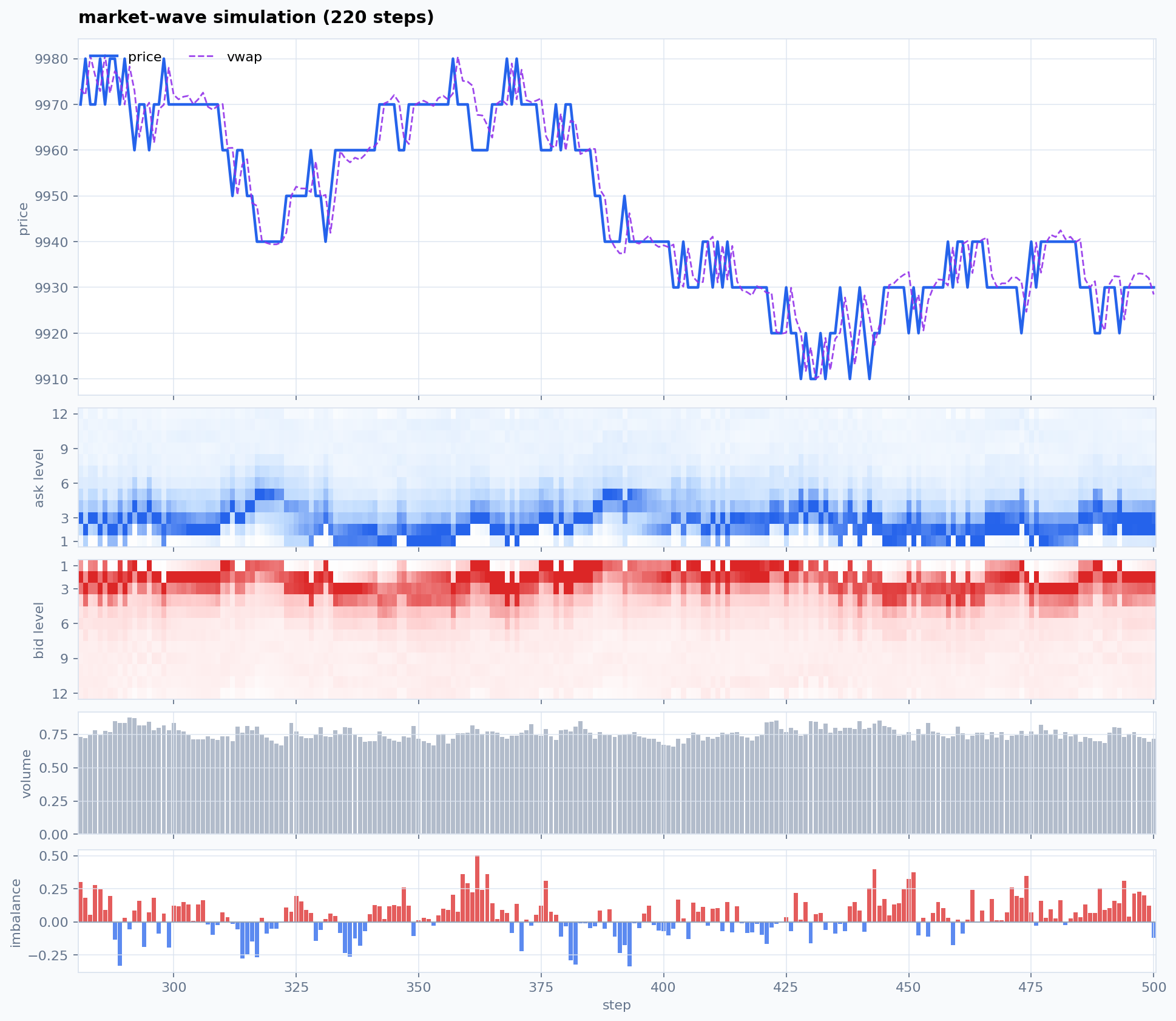
The default market_wave style uses a light multi-panel chart: price/VWAP,
bid and ask orderbook depth heatmaps by simple level, executed volume, and
order-flow imbalance. To keep the legacy three-panel view, pass
orderbook=False.
Dark overlay mode is still available:
fig, ax = market.plot(layout="overlay", style="market_wave_dark")
Synthetic Data
from market_wave import compute_metrics, generate_paths

paths = generate_paths(
    n_paths=100,
    horizon=512,
    config_sampler=lambda path_id: {
        "initial_price": 10_000,
        "gap": 10,
        "popularity": 1.0,
        "seed": 10_000 + path_id,
    },
)

metrics = compute_metrics(paths)
print(metrics.return_std, metrics.volume_mean, metrics.max_drawdown)
print(paths[0].metadata.config_hash)
GeneratedPath.metadata stores seed, config_hash, package version,
regime, and augmentation_strength so synthetic runs can be traced. Pandas is
optional: install market-wave[dataframe] to use to_dataframe().
ValidationMetrics.volatility_clustering_score is computed within each generated
path and aggregated, so independent path boundaries do not affect the diagnostic.
Core Concepts
At every step, the market builds relative ticks around the current price:
relative_tick = (price - current_price) / tick_size
relative_ticks = [-grid_radius, ..., 0, ..., +grid_radius]
The simulator maintains two Market Distribution Functions on that relative grid:
buy_entry_mdfsell_entry_mdf
Each MDF is normalized. It is built from raw tick-level mass:
raw_mass(tick) =
    near_market_continuity
  + book_shortage_or_front_mass
  + local_liquidity_pockets
  + flow_pressure_tail
  + microstructure_texture

proposal = Normalize(raw_mass)
raw_MDF_next = Normalize((1 - memory_mix) * proposal + memory_mix * raw_MDF_prev + floor)
resolved_buy_MDF, resolved_sell_MDF = ResolveOverlap(raw_buy_MDF_next, raw_sell_MDF_next)
MDF_next = Mix(resolved_MDF, CenteredNormalNoise(current_tick))
There is no custom score model, no temperature, and no score softmax path.
mood, trend, volatility, visible liquidity, shortage, recent flow,
and stress reshape the raw MDF directly. Market-adjacent ticks keep nonzero
mass, while shortage/front/liquidity signals can create multiple local pockets
away from the current price.
The public MDF fields are the effective distributions used for sampling. The raw buy/sell judgments stay internal; a small memoryless normal component around the current price is mixed into those two MDFs after buy/sell overlap resolution, immediately before sampling. It is not a third public MDF or a separate noise order path. Before order, cancel, re-quote, or replenishment sampling, buy/sell overlap is resolved with the same local competition rule on every relative tick, so the resolver does not branch on passive/marketable regions or special-case the current tick.
Those relative MDFs are projected onto the pre-trade grid
price_grid = price_before +/- k * gap for order-book formation.
StepInfo.mdf_price_basis records that pre-trade price basis.
MDFs generate aggregate intent. Intensity controls total size. The order book and execution layer then turn that intent into limit flow, taker flow, cancellations, matched volume, and price changes.
Execution Guarantee
Price movement is execution-driven:
- If a step has no executed volume,
price_after == price_before. - If trades execute,
price_afteris derived from that step's execution statistics. The flow term is bounded and cannot move the price by itself when executions print at the previous price. seedmakes the simulation reproducible for the same version and inputs.
This is a simulator, not a market data replay engine and not financial advice.
API Overview
from market_wave import (
    Market,
    generate_paths,
    compute_metrics,
    MarketState,
    IntensityState,
    LatentState,
    MDFState,
    OrderBookState,
    StepInfo,
)
Useful StepInfo fields include:
price_before,price_after,price_changetick_before,tick_after,tick_change,relative_ticksmdf_price_basis,price_gridbuy_entry_mdf,sell_entry_mdfbuy_entry_mdf_by_price,sell_entry_mdf_by_priceentry_volume_by_price,cancelled_volume_by_pricebuy_volume_by_price,sell_volume_by_priceexecuted_volume_by_price,total_executed_volume,trade_countmarket_buy_volume,market_sell_volumevwap_price,best_bid_before,best_ask_before,spread_afterorderbook_before,orderbook_after
buy_volume_by_price and sell_volume_by_price are submitted side-intent maps
keyed by sampled order price, not executed or resting liquidity. market_*
volume fields report the executed incoming buy/sell volume. residual_market_*
fields report incoming buy/sell volume that did not execute and was restable in
the book. Unfilled incoming volume rests in orderbook_after; crossed_market_volume
is kept as a compatibility diagnostic and remains zero in the current
order-book-first engine.
The *_mdf_by_price fields are pre-trade MDF projections keyed by
mdf_price_basis; current Market.state.mdf.*_by_price is reprojected to the
post-trade state price. Examples and public APIs use MDF names only; stale PMF
examples from earlier prototypes should be considered obsolete.
Public Contract and Snapshot Policy
The public import surface is the package __all__: Market, generate_paths,
compute_metrics, generated-path metadata, metrics, and the state dataclasses
shown above. Custom MDF model/protocol types are no longer public API. The
entrypoints are intentionally small, but the observation contract is broad
because StepInfo and MarketState expose detailed simulator diagnostics.
During the current alpha line, existing public names and existing StepInfo /
state fields are kept compatible where practical. New diagnostic fields may be
added in alpha releases. MDF names are the supported public distribution names;
stale PMF names from earlier prototypes are obsolete.
Snapshot mutability: state dataclasses are frozen=True at the attribute level,
but nested dict and list fields are plain mutable containers so to_dict()
and JSON export remain simple. Treat Market.state, StepInfo, and
GeneratedPath.hidden_states as read-only observations. Use Market.snapshot()
when downstream code needs a mutation-safe deep copy of the current state.
Compatibility note: Market.state remains available as the live current-state
attribute for the alpha line. Future releases may add a more explicit read-model
API or deprecation path for code that mutates state containers in place.
Development
uv sync --extra dev --extra dataframe
uv run ruff check .
uv run pytest
uv build
License
MIT
Project details
Verified details
These details have been verified by PyPIProject links
GitHub Statistics
Maintainers
Release history Release notifications | RSS feed


Download files
Download the file for your platform. If you're not sure which to choose, learn more about installing packages.
Source Distribution
Built Distribution
Filter files by name, interpreter, ABI, and platform.
If you're not sure about the file name format, learn more about wheel file names.
Copy a direct link to the current filters
File details
Details for the file market_wave-0.4.3.tar.gz.
File metadata
- Download URL: market_wave-0.4.3.tar.gz
- Upload date:
- Size: 1.8 MB
- Tags: Source
- Uploaded using Trusted Publishing? Yes
- Uploaded via: twine/6.1.0 CPython/3.13.12
File hashes
| Algorithm | Hash digest | |
|---|---|---|
| SHA256 |
00ff29f8b4996c67cb3bd1c1ba8bd8959012337d5b796b3a3f5b1858d113c01d
|
|
| MD5 |
34223411fb2e87052e1132b3d94a3e95
|
|
| BLAKE2b-256 |
35eef09404f0d70882b37bdd784e4fc80fafc6fa92b48048b634ce6a05c68b6a
|
Provenance
The following attestation bundles were made for market_wave-0.4.3.tar.gz:
Publisher:
workflow.yml on smturtle2/market-wave
-
Statement:
-
Statement type:
https://in-toto.io/Statement/v1 -
Predicate type:
https://docs.pypi.org/attestations/publish/v1 -
Subject name:
market_wave-0.4.3.tar.gz -
Subject digest:
00ff29f8b4996c67cb3bd1c1ba8bd8959012337d5b796b3a3f5b1858d113c01d - Sigstore transparency entry: 1400719679
- Sigstore integration time:
-
Permalink:
smturtle2/market-wave@e9599045854aa0ff81b3fa4398f1fd54511dd359 -
Branch / Tag:
refs/tags/v0.4.3 - Owner: https://github.com/smturtle2
-
Access:
public
-
Token Issuer:
https://token.actions.githubusercontent.com -
Runner Environment:
github-hosted -
Publication workflow:
workflow.yml@e9599045854aa0ff81b3fa4398f1fd54511dd359 -
Trigger Event:
push
-
Statement type:
File details
Details for the file market_wave-0.4.3-py3-none-any.whl.
File metadata
- Download URL: market_wave-0.4.3-py3-none-any.whl
- Upload date:
- Size: 47.2 kB
- Tags: Python 3
- Uploaded using Trusted Publishing? Yes
- Uploaded via: twine/6.1.0 CPython/3.13.12
File hashes
| Algorithm | Hash digest | |
|---|---|---|
| SHA256 |
eea8af44158d5f9527a76dbc0e12f03dda2a4952b6fa01a359bb6d966b4b554f
|
|
| MD5 |
2ba7446b3bdc60c540529ac62d4cbc5e
|
|
| BLAKE2b-256 |
97db49c78c3e40492736af0f5097a646fd4e372f8abad6a4ce74cab8beac3054
|
Provenance
The following attestation bundles were made for market_wave-0.4.3-py3-none-any.whl:
Publisher:
workflow.yml on smturtle2/market-wave
-
Statement:
-
Statement type:
https://in-toto.io/Statement/v1 -
Predicate type:
https://docs.pypi.org/attestations/publish/v1 -
Subject name:
market_wave-0.4.3-py3-none-any.whl -
Subject digest:
eea8af44158d5f9527a76dbc0e12f03dda2a4952b6fa01a359bb6d966b4b554f - Sigstore transparency entry: 1400719736
- Sigstore integration time:
-
Permalink:
smturtle2/market-wave@e9599045854aa0ff81b3fa4398f1fd54511dd359 -
Branch / Tag:
refs/tags/v0.4.3 - Owner: https://github.com/smturtle2
-
Access:
public
-
Token Issuer:
https://token.actions.githubusercontent.com -
Runner Environment:
github-hosted -
Publication workflow:
workflow.yml@e9599045854aa0ff81b3fa4398f1fd54511dd359 -
Trigger Event:
push
-
Statement type:






