
A package for computing matrix functions using eigenvalue decomposition.

Project description
Matrix Functions
A Python package for numerically computing matrix functions, with a particular focus on difference equations and analytic continuation of matrices.
Features
- General Matrix Functions – Computes any function of a matrix.
- Numerical Computation – Focuses on floating-point approximations rather than symbolic computation.
- Difference Equations – Provides tools for solving recurrence relations using matrix function techniques.
- Analytic Continuation – Enables non-integer shifts in difference equations using analytic continuation.
- Mathematical Documentation – Each release includes a PDF document explaining the mathematical foundations.
- Pure Python – No compilation required, making installation simple and cross-platform.
Installation
The package is available on PyPI and can be installed with:
pip install matrixfuncs
Usage
The Cayley-Hamilton theorem states that every square matrix is a root of its own characteristic polynomial. From this it follows that $A^n$ is a linear combination of $A^0,\ A,\ A^2,\ \dots,\ A^{n-1}$ and therefore every polynomial in A is such a linear combination:
$$ A^m = \sum_{k=0}^{n-1} \alpha_{mk} A^k $$
It turns out that $\alpha_{mk}$ only depends on the eigenvalues $\lambda_1,\ \dots,\ \lambda_n$. Hence, every matrix function can be expressed in in such a way if the function is analytic in the eigenvalues:
$$ f(A) = \varphi_{ij}^{(k)} A^i f^{(k)}(\lambda_j) $$
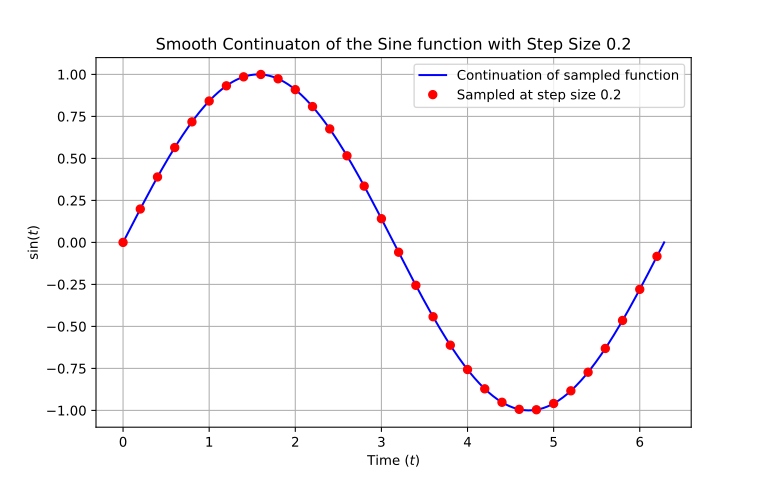
Computing the Sine Function Using Matrix Recurrence Relations
The sine function satisfies the recurrence relation:
$$ sin(x + a) = 2\cos(a) sin(x) - sin(x - a) $$
This allows us to express the sine of a shifted angle using matrix multiplication:
$$ \begin{bmatrix} sin(x + a) \ sin(x) \end{bmatrix} = \begin{bmatrix} 2\cos(a) & -1 \ 1 & 0 \end{bmatrix} \begin{bmatrix} sin(x) \ sin(x - a) \end{bmatrix} $$
Using matrix exponentiation, we can compute (sin(x + na)) efficiently.
Python Implementation
import matrixfuncs as mf
import numpy as np
import matplotlib.pyplot as plt

# Define a transformation matrix based on a unit parameter
unit = 0.2
M = np.array([[2 * np.cos(unit), -1], [1, 0]])

# Generate time steps for evaluation
ts = np.linspace(0, 2 * np.pi, 1000)

# Define the function to be applied to the matrix
f = lambda x: x ** (ts / unit)

# Convert the matrix into a functional array representation
arr = mf.FArray.from_matrix(M)

# Define input vectors for left-hand side and right-hand side multiplications
v0_lhs = np.array([1, 0])  # Left-hand side vector
v0_rhs = np.sin([0, -unit])  # Right-hand side vector

# Compute the function applied to the matrix and evaluate it
vals = v0_lhs @ arr @ v0_rhs  # Compute matrix function application
f_M = vals(f)  # Evaluate the function over the time steps


# Plot the computed function values
fig = plt.figure(figsize=(8, 5))
plt.plot(ts, f_M, 'b-', label='Continuation of sampled function')
plt.plot(unit*np.arange(2*np.pi/unit), np.sin(unit*np.arange(2*np.pi/unit)), 'ro', label=f'Sampled at step size {unit}')
plt.xlabel('Time ($t$)')
plt.ylabel('$\\sin(t)$')
plt.title(f'Smooth Continuaton of the Sine function with Step Size {unit}')
plt.legend()
plt.grid(True)
plt.show(fig)
fig.savefig('sinFromMFunc.png', dpi=200)
Documentation
- A PDF document explaining the mathematical background is included with each release.
- The package includes in-code documentation but no separate programming guide at this time.
Benchmarks & Performance
Currently, the package is focused on numerical accuracy rather than high-performance computing. Future updates will prioritize:
- Stability improvements for larger matrices.
- Optimized numerical methods to reduce floating-point errors.
- Support for large-scale computations.
Future Plans
This package is not yet feature-complete. Future improvements will focus on:
- Enhancing numerical stability.
- Expanding support for larger matrices.
- General optimizations and performance improvements.
Contributing
Contributions are welcome! If you'd like to help improve this package:
- Fork the repository.
- Create a new branch for your changes.
- Submit a pull request with a clear description of your updates.
Areas where contributions could be particularly helpful:
- Performance optimization.
- Expanding function support.
- Adding better documentation.
For feature suggestions or bug reports, please open an issue on GitHub.
License
This project is licensed under the LGPL-3 License. See the LICENSE file for details.
Release history Release notifications | RSS feed


Download files
Download the file for your platform. If you're not sure which to choose, learn more about installing packages.
Source Distribution
Built Distribution
Filter files by name, interpreter, ABI, and platform.
If you're not sure about the file name format, learn more about wheel file names.
Copy a direct link to the current filters
File details
Details for the file matrixfuncs-0.2.0.tar.gz.
File metadata
- Download URL: matrixfuncs-0.2.0.tar.gz
- Upload date:
- Size: 84.2 kB
- Tags: Source
- Uploaded using Trusted Publishing? No
- Uploaded via: twine/6.0.1 CPython/3.13.2
File hashes
| Algorithm | Hash digest | |
|---|---|---|
| SHA256 |
84527d64d098b4062592eeee932185dfb993b366a3e549f7c1437c0fa90432d9
|
|
| MD5 |
f3f740a0ddb255dd010e305ce7ab787c
|
|
| BLAKE2b-256 |
46adc1de914ef684a49f7bb683e3f8a63cf187160fc8e2d5dd5f2790d95ec2e7
|
File details
Details for the file matrixfuncs-0.2.0-py3-none-any.whl.
File metadata
- Download URL: matrixfuncs-0.2.0-py3-none-any.whl
- Upload date:
- Size: 17.8 kB
- Tags: Python 3
- Uploaded using Trusted Publishing? No
- Uploaded via: twine/6.0.1 CPython/3.13.2
File hashes
| Algorithm | Hash digest | |
|---|---|---|
| SHA256 |
c031709046b9cc4247a8408b281158eea930cb7b6cf5b88c3239f1435f8da01f
|
|
| MD5 |
a23ca6cc63c726fc794b3fbba4efe0ba
|
|
| BLAKE2b-256 |
b1f885915778acfecb40116d2fd546855164a7036f2234a0b3925094a520c696
|






