
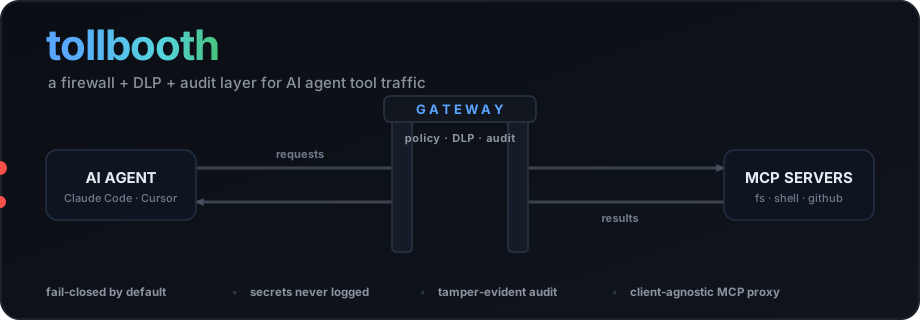





tollbooth sits between any MCP client and the servers it talks to, and enforces security policy, data-loss prevention, and a tamper-evident audit trail on every tool call and result that crosses the boundary.
Your AI agent's tool traffic — filesystem writes, shell exec, web fetches, API calls — flows unmediated today. There is no control point to deny a dangerous call, stop a secret from leaking out through a tool argument, redact a credential before it lands in the model's context, or produce a compliance-grade record of what the agent actually did.
tollbooth is that control point. It's a transparent MCP proxy: your client points at one server (tollbooth), tollbooth wraps the real upstream servers, and the gateway config file is the security boundary.
Caught in the act
A single config turns an unmediated agent into a governed one. The recording below is real tollbooth output — every frame is the live policy + DLP engine answering actual Claude Code hook events (reproduce it yourself with vhs demo/demo.tape):
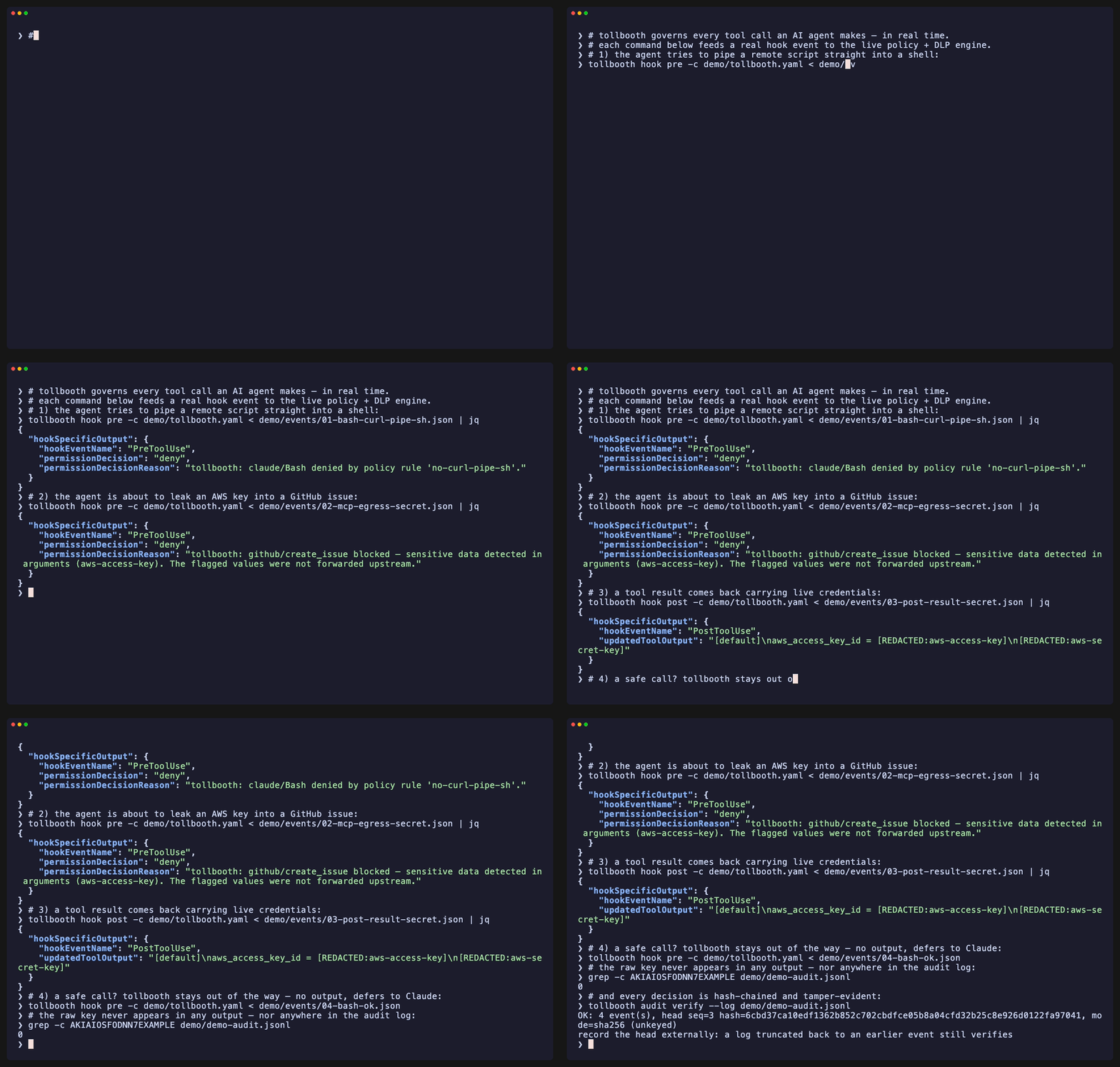
Requests carrying secrets are blocked (egress is the exfil path). Secrets in results are redacted in place so the agent keeps working on real codebases instead of you disabling the control. Safe calls pass straight through, untouched. Every decision is hash-chained into a log you can prove wasn't edited — and the raw secret value appears in none of it.
Prefer text? The same run, line by line.
$ tollbooth hook pre  < curl-pipe-sh.json        # agent pipes a remote script to a shell
  ⛔ deny — "tollbooth: claude/Bash denied by policy rule 'no-curl-pipe-sh'."

$ tollbooth hook pre  < aws-key-to-github.json   # agent leaks an AWS key into a GitHub issue
  ⛔ deny — "github/create_issue blocked — sensitive data detected in arguments
            (aws-access-key). The flagged values were not forwarded upstream."

$ tollbooth hook post < result-with-creds.json   # a tool result comes back carrying creds
  ✏️  updatedToolOutput:
        aws_access_key_id = [REDACTED-IN-TRANSIT:aws-access-key]
        aws_secret_access_key = [REDACTED-IN-TRANSIT:aws-secret-key]

$ tollbooth hook pre  < safe-ls.json             # a safe call — no output, defers to Claude
  (silence)

$ grep -c AKIAIOSFODNN7EXAMPLE demo/demo-audit.jsonl
  0                                              # the raw key is nowhere in the log

$ tollbooth audit verify --log demo/demo-audit.jsonl
  ✅ OK: 4 event(s), head seq=3 hash=8d540adb…, mode=sha256 (unkeyed)
What it stops
| Threat | tollbooth control |
|---|---|
Agent coerced into curl … | sh, rm -rf, etc. |
Policy engine — regex/field rules deny the call before it reaches the upstream |
Path traversal / writes escaping the project (/etc/passwd) |
not_prefix / prefix matchers on argument fields |
| Secret or PAN in a tool argument leaving for an upstream | DLP egress block — the call is stopped, pattern id logged, value never |
| Credential in a tool result entering model context | DLP redaction — [REDACTED-IN-TRANSIT:pattern-id] in place, rest intact |
| Prompt injection in returned tool output | Reference detector plugin — block or annotate (see limitations) |
| Audit log edited, truncated, or reordered to hide activity | Hash-chained JSONL (HMAC-keyed) — audit verify names the break |
| "Just turn the control off so the agent works" pressure | Direction-aware defaults keep agents usable; fail-closed on any internal error |
How it works
client ──tool call──▶ tollbooth ──▶ [ policy → DLP-request → plugins ] ──▶ upstream
client ◀──result──── tollbooth ◀── [ DLP-result → plugins ] ◀──────────── upstream
                          │
                          └──▶ tamper-evident audit log (one event per decision)
One aggregating gateway process is an MCP server to your client and an MCP client to N upstream servers. It exposes the union of upstream tools, namespaced {server}_{tool}, routed through a mapping table (never string-splitting — server names can contain underscores). Absent any policy, behavior is identical to a direct connection.
Install
pip install mcp-tollbooth # or: uv add mcp-tollbooth
Or run it without installing anything:
uvx --from mcp-tollbooth tollbooth --help
The distribution is
mcp-tollbooth(the nametollboothwas taken on PyPI); the command and the import package are bothtollbooth.
Quickstart
git clone https://github.com/Realgagenichols/tollbooth.git
cd tollbooth
uv sync

# 1. Write a gateway config (see examples/tollbooth.yaml) — or bootstrap one
#    from your existing client config:
uv run tollbooth import ~/.claude/claude_desktop_config.json   # or .mcp.json
cp examples/tollbooth.yaml tollbooth.yaml                      # ...or by hand

# 2. Check it
uv run tollbooth validate -c tollbooth.yaml

# 3. Emit the client config block and paste it into your client's MCP config
#    (.mcp.json, claude_desktop_config.json, ...)
uv run tollbooth emit-config -c tollbooth.yaml
Your client then talks to tollbooth run -c tollbooth.yaml, which proxies everything through the pipeline.
Upstream servers
Each entry under servers: is classified by which field it declares — command for a local stdio server (a subprocess) or url for a remote streamable-HTTP server. An entry with neither, or both, is a config error.
servers:
  fs:                                    # stdio: tollbooth launches the subprocess
    command: my-fs-server
    args: [--root, /data]
    env:
      LOG_LEVEL: info
  remote:                                # http: tollbooth connects to the URL
    url: https://api.example.com/mcp
    headers:
      Authorization: Bearer ${REMOTE_TOKEN}
HTTP header values may reference environment variables as ${VAR}, resolved at startup — so tokens live in the environment, never in tollbooth.yaml. A referenced variable that is unset fails closed at startup, naming the variable (never its value). Errors about an HTTP upstream echo only the URL origin (scheme://host[:port]) — never userinfo, path, query, or header content. A dead HTTP upstream returns a clean error for its calls without taking the gateway down. tollbooth import brings both command and url entries in from an existing client config.
OAuth for HTTP upstreams
For servers that require an interactive OAuth grant (rather than a long-lived ${VAR} bearer token), declare an auth block:
servers:
  remote:
    url: https://mcp.example.com/mcp
    auth:
      type: oauth
      scopes: [mcp:read, mcp:write]   # optional
      callback_port: 8765             # optional loopback redirect port (default 8765)
Authenticate once, interactively:
tollbooth auth login remote -c tollbooth.yaml   # opens a browser; stores the token
tollbooth auth status       -c tollbooth.yaml   # shows token presence/expiry (never values)
tollbooth auth logout remote                    # deletes the stored token
Tokens are stored under $XDG_DATA_HOME/tollbooth/oauth/<server>.json (default ~/.local/share/...), file mode 0600 in a 0700 directory. When the gateway runs, a valid token is used as-is and an expired one is refreshed silently — no browser. If no usable token remains (and refresh fails), that upstream fails closed with a clear message to re-run tollbooth auth login; the gateway and other upstreams keep working. Access/refresh tokens are never written to logs, errors, or the audit log.
Policy rules
policy:
  default: deny          # decision when no rule matches (allowlist posture)
  failure_mode: closed   # internal error => block (set `open` to log-and-continue)
  rules:
    - name: block-writes-outside-project
      action: deny       # allow | deny | require-approval
      server: fs         # exact server name or "*"
      tool: write_file   # exact tool name or "*"
      where:             # ALL fields must match; matchers: equals, regex,
        path:            #   prefix, not_prefix (exactly one per field)
          not_prefix: /Users/me/project
Rules are evaluated top-down; the first match decides. require-approval blocks the call with a message naming the rule and how to permit it — distinct from a hard deny, and an extensible enum so a future approval TUI / MCP elicitation slots in without reworking the model.
Gotcha: a rule with a
where:block can only fire when that argument is present in the call. Negative matchers +default: allowcan be bypassed by argument omission — preferdefault: denyfor guard configs.
DLP
Enabled by default (dlp.enabled: true). Direction-aware: a detection in a tool call's arguments blocks the call (egress is the exfil path); a detection in a result is redacted in place as [REDACTED-IN-TRANSIT:{pattern-id}] so the agent keeps working. Overlapping detections resolve to the most specific match. Dict keys and numeric values that would need redaction withhold the whole result instead — nothing sensitive passes because it arrived in an awkward shape.
| Pattern id | Detects |
|---|---|
aws-access-key |
AWS access key IDs (AKIA...) |
aws-secret-key |
AWS secret key assignments |
github-token |
GitHub tokens (ghp_, gho_, ..., github_pat_) |
private-key-pem |
PEM private keys (full block redacted, incl. ENCRYPTED) |
connection-string |
DB URLs with credentials (postgres://user:pass@...) |
api-key-assignment |
Generic api_key=... assignments |
password-assignment |
password:/passwd:/pwd= assignments |
pan |
Payment cards (Visa/MC incl. 2-series/Amex/Discover), Luhn-validated |
ssn |
US Social Security Numbers |
us-phone |
US phone numbers (separators required) |
Override per pattern and direction:
dlp:
  enabled: true
  overrides:
    private-key-pem:
      results: block       # withhold the whole result instead of redacting
    us-phone:
      requests: allow      # this CRM legitimately sends phone numbers
      results: allow
Request actions: block (default) | allow. Result actions: redact (default) | block | allow. Unknown pattern ids or actions fail validation at startup.
Audit log
Point the trail at a file for one JSON event per decision:
audit:
  log: ./tollbooth-audit.jsonl
  record: metadata        # or "full" — see below
{"event": "decision", "call_id": "2a2b0cca…", "path": "request", "server": "fs", "tool": "write_file", "decision": "deny", "reason_id": "block-writes-outside-project", "v": 2, "ts": "2026-06-12T10:00:00+00:00", "seq": 5, "prev": "df412ac5…", "session": "f32a7ae3…"}
DLP decisions are audited by pattern id, never value: a blocked request logs "reason_id": "dlp:pan", a redacted result logs "reason_id": "redacted:aws-access-key". Decisions made because a security check was skipped (fail-open) are tagged fail-open:<stage> — the trail never hides a degraded state. (audit_log: <path> is the pre-M3 spelling and still works.)
Tamper evidence
Every event carries a monotonic seq and prev — the SHA-256 of the previous log line — so edits, deletions, and reordering break the chain, which also spans gateway restarts:
tollbooth audit verify --log tollbooth-audit.jsonl
# OK: 10 event(s), head seq=9 hash=0a8e09b2…, mode=sha256 (unkeyed)
Record the reported head externally: a log truncated back to an earlier event still verifies on its own, but won't match your recorded head. Set TOLLBOOTH_AUDIT_KEY (environment variable, never a flag) to upgrade the chain to HMAC-SHA-256 — then an attacker who can rewrite the whole file still can't forge a valid chain without the key. Verification exit codes: 0 clean, 1 tamper/unreadable finding, 2 usage error.
Payload recording & session replay
By default (record: metadata) no argument or result values are ever written. record: full additionally records post-enforcement payloads only: arguments of allowed requests and result content after redaction — exactly what crossed the boundary. Denied or blocked traffic never has payloads recorded, enforced inside the logger itself.
Each gateway run is a session (with a session-start event carrying the gateway version and a config digest, never config contents). Query and replay the trail:
# Filtered events as JSONL — by server, tool, decision, session, time window
tollbooth audit query --log audit.jsonl --decision deny --since 2026-06-12T00:00:00

# Chronological timeline of one session; renders payloads when recorded,
# degrades to a decision timeline on metadata-only logs
tollbooth audit replay <session-id> --log audit.jsonl
Plugins
Beyond the built-in policy and DLP stages you can load your own interceptors, declared in config as module:factory import specs. Plugins run after the built-ins, in declared order — they can tighten a verdict but never loosen one (the first non-allow decision short-circuits), under the same fail-closed semantics: a plugin that raises at runtime denies the call (or withholds the result).
plugins:
  - plugin: examples.plugins.prompt_injection:create   # importable module:factory
    settings:
      action: annotate    # plugin-specific settings dict, passed to the factory
Loading is fail-fast: an import error, a factory that raises, a name collision with a built-in, or an interceptor implementing neither hook aborts startup naming the plugin (reporting the exception type only — settings values are never echoed). Auto-discovery is deliberately not supported: the config file is the security boundary, so installing a package must never silently insert an interceptor.
Write one against the public API (from tollbooth import ...):
from tollbooth import ToolCall, PolicyResult, Decision, ResultEdit, BlockResult

class TagInternalHosts:
    name = "tag-internal-hosts"          # unique; used in audit reason_ids

    def check_request(self, call: ToolCall) -> PolicyResult:
        # Return DENY/REQUIRE_APPROVAL to short-circuit, or ALLOW to pass.
        if "10.0." in str(call.args.get("url", "")):
            return PolicyResult(decision=Decision.DENY, rule_name=self.name,
                                message="internal host blocked")
        return PolicyResult(decision=Decision.ALLOW, rule_name=None, message="ok")

    def check_result(self, call: ToolCall, content: str) -> ResultEdit:
        # Transform content, or `raise BlockResult(reason_id)` to withhold it.
        return ResultEdit(content=content)

def create(settings: dict) -> "TagInternalHosts":
    return TagInternalHosts()
An interceptor may implement check_request, check_result, or both. Exported types: ToolCall, PolicyResult, ResultEdit, BlockResult, Decision, RequestInterceptor, ResultInterceptor. The shipped examples/plugins/prompt_injection.py is a reference result-path detector — see limitations.
Claude Code hooks
The same policy + DLP engine runs as Claude Code PreToolUse/PostToolUse hooks, governing the client's own tools (Bash, Edit, ...) — not just proxied MCP servers. tollbooth hook pre|post reads the hook event JSON on stdin and answers on stdout:
- pre —
deny→permissionDecision: "deny"naming the rule;require-approval→"ask"with the approvable message;allow→ no output, deferring to Claude Code's own permission prompt (tollbooth never auto-approves). - post — DLP redactions come back via
updatedToolOutput; a per-patternblockoverride replaces the output with a withholding message.
Native tools route as server claude (e.g. a rule for server claude, tool Bash); MCP tools arrive as mcp__{server}__{tool} and route as (server, tool). Any internal error — malformed stdin, broken config, a pipeline crash — fails closed and never echoes input values. Audit events append under Claude's session_id, with cross-process locking so concurrent hook invocations keep the hash chain intact.
tollbooth emit-config --claude-hooks -c tollbooth.yaml # merge into .claude/settings.json
Design decisions that matter
The point of tollbooth isn't that it proxies MCP — it's the judgment calls a security control has to get right:
- Fail-closed by default. Any error in policy, DLP, or redaction denies the call; a result that can't be redacted is withheld. A control that fails open is not a control. Fail-open is an explicit, audited opt-in.
- Detected values never appear in logs or errors. Audit records pattern/rule ids, not matches. Payload recording is opt-in and post-enforcement only — the log holds what crossed the boundary, never blocked secrets.
- Direction-aware DLP — requests block, results redact. Redacting outbound arguments would silently corrupt calls; blocking every result would make agents unusable and get the control disabled. Egress is the true exfil path, so that's where the hard stop lives.
- Tamper evidence is keyed. The hash chain detects edits, deletions, and reordering; with
TOLLBOOTH_AUDIT_KEYset, an attacker who rewrites the whole file still can't forge a valid chain. - The config file is the security boundary. Plugins are explicitly declared
module:factoryspecs with fail-fast loading — never entry-point auto-discovery, so installing a package can't silently insert an interceptor. - Plugins run after built-ins and only tighten. A plugin can never pre-empt a built-in deny; the hook adapter's
allowdefers to the client's own prompt rather than auto-approving.
A deeper writeup — full threat model, rejected alternatives, and the reasoning behind each call — is in Designing a security gateway for AI agents.
Limitations
Stated plainly, because a security tool that overclaims is worse than one that doesn't:
- Prompt-injection detection is a reference, not production-grade. The shipped detector proves the plugin interface; it matches a small set of instruction-override heuristics and will miss real attacks. Treat it as an integration example.
- tollbooth governs tool traffic, not the LLM API itself. It does not see or modify model completions.
- Non-tool MCP traffic (resources, prompts) is proxied transparently but not yet scanned — a later milestone.
- Local, single-process. No graphical UI and no hosted/multi-tenant deployment; tollbooth runs alongside the client.
Architecture
| Module | Responsibility |
|---|---|
main |
CLI: run, emit-config, validate, import, audit verify|query|replay, hook pre|post, auth login|status|logout |
oauth |
OAuth for HTTP upstreams (N2): on-disk token store (0600), loopback callback, fail-closed/interactive provider |
config |
Load + pydantic-validate tollbooth.yaml; emit/import client config |
proxy |
Client-facing MCP server; tool aggregation + namespacing; routes through the pipeline |
upstream |
UpstreamTransport interface + StdioUpstream / HttpUpstream (supervised); build_upstream factory |
policy |
YAML rules, field matchers, first-match-wins, extensible Decision enum |
pipeline |
Ordered interceptor chain (request + result paths); policy and DLP are interceptors |
dlp |
Secrets / PAN (Luhn) / PII patterns; overlap suppression; direction-aware actions |
audit |
Hash-chained JSONL log; opt-in HMAC + payload recording; query/replay |
plugins |
Config-declared interceptor loading + fail-fast validation; documented public API |
hook |
Claude Code hook adapter: stdin event → pipeline → hook decision JSON |
Stack: the official mcp Python SDK, pydantic, and pyyaml — no other runtime dependencies. The project is built spec-first: every feature traces to an RFC 2119 requirement with Given/When/Then scenarios that map directly to tests.
Development
uv run pytest          # 371 tests, incl. real-subprocess gateway + OAuth E2E
uv run ruff check .    # lint
License
MIT © Gage Nichols
1 maintainer

Metadata
1 maintainer
Release files for mcp-tollbooth 0.3.0
For a detailed explanation of source distributions (sdists) and built distributions (wheels), please see the package formats documentation.
Source distribution (sdist)
| File | Size | Uploaded | |
|---|---|---|---|
| mcp_tollbooth-0.3.0.tar.gz | 101.6 kB | Details |
Built distribution (wheel)
| File | Interpreter | ABI | Platform | Reset |
|---|---|---|---|---|
| mcp_tollbooth-0.3.0-py3-none-any.whl | Python 3 | none | any | Details |
Total release size: 162.3 kB
Release files / mcp_tollbooth-0.3.0.tar.gz
| Download URL | mcp_tollbooth-0.3.0.tar.gz |
|---|---|
| Size | 101.6 kB |
| Tags | Source |
|
SHA-256 checksum How to use checksums |
083bd103f043b9f99cb438d393745df463fcaf035f80d25db2e90dbfad264873
|
|
BLAKE2b-256 checksum How to use checksums |
16f4adfde48c0b9500967c69bbfe89db4a6ad7d5bf774e9fcce03936c8ed64d3
|
| Upload date | |
|
Uploaded using Trusted Publishing? What is trusted publishing? |
Yes |
| Uploaded via |
twine/6.1.0 CPython/3.13.14
|
Provenance
Provenance describes where a file came from. On PyPI, provenance is shared via attestations, which provide a verifiable record of the build or publishing details. View details, limitations and caveats.


PyPI Publish Attestation
PyPI verified that this artifact, at this checksum, originated from the publisher listed below.
Signed by GitHub Actions, verified by PyPI on Jul 25, 2026.
Transparency logRelease files / mcp_tollbooth-0.3.0-py3-none-any.whl
| Download URL | mcp_tollbooth-0.3.0-py3-none-any.whl |
|---|---|
| Size | 60.7 kB |
| Tags | Python 3 |
|
SHA-256 checksum How to use checksums |
9be4985706e148a3be783d6fbdab5ac39cc778e18d9865787fe9166e9735e3af
|
|
BLAKE2b-256 checksum How to use checksums |
c0f32ff0d60d8a159c80afac6823e72123044657973249f13871cd075f7130ae
|
| Upload date | |
|
Uploaded using Trusted Publishing? What is trusted publishing? |
Yes |
| Uploaded via |
twine/6.1.0 CPython/3.13.14
|
Provenance
Provenance describes where a file came from. On PyPI, provenance is shared via attestations, which provide a verifiable record of the build or publishing details. View details, limitations and caveats.
PyPI Publish Attestation
PyPI verified that this artifact, at this checksum, originated from the publisher listed below.
Signed by GitHub Actions, verified by PyPI on Jul 25, 2026.
Transparency log













