
mcpo
mcpo is an MCP-to-OpenAPI proxy. It takes any MCP server and serves its tools as a standard OpenAPI HTTP server, with interactive docs and API key auth, so they work with Open WebUI and any other app that speaks OpenAPI.




Why mcpo
Most MCP servers talk over stdio and run as a local process. An app in the browser or on another machine cannot reach them. mcpo runs the MCP server for you and puts plain HTTP in front of it. Every tool gets its own endpoint, its own OpenAPI schema and live docs at /docs, with no glue code.
Open WebUI connects to Streamable HTTP MCP servers natively. Use mcpo for stdio and SSE servers, or when a client only speaks OpenAPI.
Installation
Python
# With uv installed
uvx mcpo --port 8000 --api-key "top-secret" -- your_mcp_server_command

# Or install and run with pip (Python 3.11+)
pip install mcpo
mcpo --port 8000 --api-key "top-secret" -- your_mcp_server_command
For example, with the MCP time server:
uvx mcpo --port 8000 --api-key "top-secret" -- uvx mcp-server-time --local-timezone=America/New_York
Then open http://localhost:8000/docs to try the tools live.
mcpo listens on 127.0.0.1 by default. Add --host 0.0.0.0 when Open WebUI or another client runs on a different machine or in a container.
Docker
docker run -p 8000:8000 ghcr.io/open-webui/mcpo:main --api-key "top-secret" -- your_mcp_server_command
The image listens on all interfaces and runs as a non-root user.
Connect to Open WebUI
Add the mcpo URL as a tool server in Open WebUI. See the Open WebUI integration guide for the steps.
Remote MCP Servers
mcpo also proxies MCP servers that already run over the network.
# SSE
mcpo --port 8000 --api-key "top-secret" --server-type "sse" -- http://127.0.0.1:8001/sse

# Streamable HTTP
mcpo --port 8000 --api-key "top-secret" --server-type "streamable-http" -- http://127.0.0.1:8002/mcp

# With headers for the remote server
mcpo --port 8000 --api-key "top-secret" --server-type "sse" --header '{"Authorization": "Bearer token"}' -- http://127.0.0.1:8001/sse
Config File
Serve several MCP servers from one mcpo instance with a config file in the Claude Desktop format.
mcpo --config /path/to/config.json

# Reload servers automatically when the file changes
mcpo --config /path/to/config.json --hot-reload
{
  "mcpServers": {
    "memory": {
      "command": "npx",
      "args": ["-y", "@modelcontextprotocol/server-memory"]
    },
    "time": {
      "command": "uvx",
      "args": ["mcp-server-time", "--local-timezone=America/New_York"],
      "disabledTools": ["convert_time"] // Disable specific tools if needed
    },
    "mcp_sse": {
      "type": "sse", // Explicitly define type
      "url": "http://127.0.0.1:8001/sse",
      "headers": {
        "Authorization": "Bearer token",
        "X-Custom-Header": "value"
      }
    },
    "mcp_streamable_http": {
      "type": "streamable-http",
      "url": "http://127.0.0.1:8002/mcp"
    } // Streamable HTTP MCP Server
  }
}
Each server gets its own route, such as http://localhost:8000/memory and http://localhost:8000/time, with its own docs at /memory/docs and /time/docs.
| Key | Purpose |
|---|---|
command, args |
Command that starts a local (stdio) server |
env |
Extra environment variables for a local server |
cwd |
Folder a local server starts in |
type |
sse or streamable-http for a remote server |
url, headers |
Address of a remote server and the headers sent to it |
disabledTools |
Tools to hide from the generated API |
oauth |
OAuth settings, see OAuth |
Options
| Option | Purpose |
|---|---|
--host, --port |
Address to listen on (default 127.0.0.1:8000) |
--api-key |
API key that clients send as a bearer token. Also read from MCPO_API_KEY, which keeps it out of the process list |
--strict-auth |
Also protect the docs and OpenAPI schema with the API key |
--server-type |
stdio (default), sse or streamable-http |
--header |
Headers in JSON for a remote server |
--config, --hot-reload |
Config file, and reload it when it changes |
--env, --env-path |
Environment variables for the MCP server |
--cors-allow-origins |
Allowed CORS origins (default *) |
--root-path |
Serve under a subpath behind a reverse proxy, such as /api/mcpo |
--path-prefix |
URL prefix for the server routes |
--ssl-certfile, --ssl-keyfile |
Serve over HTTPS |
--name, --description, --version |
Title, description and version shown in the docs |
--log-level |
DEBUG, INFO, WARNING, ERROR or CRITICAL |
Run mcpo --help for the full list. Setting MCPO_API_KEY through --env or --env-path has no effect.
OAuth
mcpo supports OAuth 2.1 for Streamable HTTP servers that require it. It uses dynamic client registration by default, so most servers need only the server URL.
{
  "mcpServers": {
    "oauth-protected-server": {
      "type": "streamable-http",
      "url": "http://localhost:8000/mcp",
      "oauth": {
        "server_url": "http://localhost:8000"
      }
    }
  }
}
| Option | Purpose |
|---|---|
server_url |
OAuth server base URL (required) |
storage_type |
file (default, persistent) or memory (session only) |
callback_port |
Local port for the OAuth callback (default 3030) |
use_loopback |
Open the browser for sign-in automatically (default true) |
On first connection mcpo registers a client if needed, opens the browser for sign-in, captures the callback and stores the tokens in ~/.mcpo/tokens/. Later requests reuse them.
For a provider without dynamic client registration, register a client with the provider and put its client ID and secret into the client metadata.
{
  "mcpServers": {
    "legacy-oauth-server": {
      "type": "streamable-http",
      "url": "http://api.example.com/mcp",
      "oauth": {
        "server_url": "http://api.example.com",
        "client_metadata": {
          "client_id": "your-client-id",
          "client_secret": "your-client-secret",
          "client_name": "My MCPO Client",
          "redirect_uris": ["http://localhost:3030/callback"]
        }
      }
    }
  }
}
Leave out scope, authorization_endpoint and token_endpoint. mcpo discovers them from the server's OAuth metadata. See the OAuth guide for details.
Development
git clone https://github.com/open-webui/mcpo.git
cd mcpo
uv sync --dev

# Run the tests
uv run pytest

# Run mcpo from your checkout
uv run mcpo --port 8000 -- uvx mcp-server-time --local-timezone=America/New_York
Support
Open an issue or ask on Discord.
Security
Report vulnerabilities privately through GitHub security advisories. See SECURITY.md for the policy.
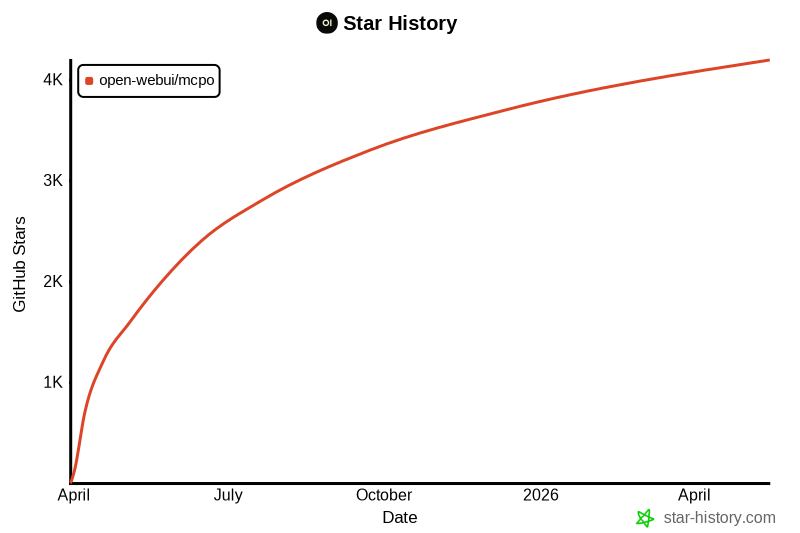
Star History
License
MIT. See LICENSE.
Created by Timothy Jaeryang Baek.
1 maintainer

Metadata
1 maintainer
Release files for mcpo 0.0.21
For a detailed explanation of source distributions (sdists) and built distributions (wheels), please see the package formats documentation.
Source distribution (sdist)
| File | Size | Uploaded | Provenance | Actions |
|---|---|---|---|---|
| mcpo-0.0.21.tar.gz | 115.6 kB | Without provenance | Details for mcpo-0.0.21.tar.gz |
Built distribution (wheel)
| File | Interpreter | ABI | Platform | Actions Reset |
|---|---|---|---|---|
| mcpo-0.0.21-py3-none-any.whl | Python 3 | none | any | Details for mcpo-0.0.21-py3-none-any.whl |
Total release size: 153.8 kB
Release files / mcpo-0.0.21.tar.gz
| Download URL | mcpo-0.0.21.tar.gz |
|---|---|
| Size | 115.6 kB |
| Tags | Source |
|
SHA-256 checksum How to use checksums |
49e8b6497f738ea526585c5b7c01a144792a2c57c1079a21c23bc73bbe5c1e48
|
|
BLAKE2b-256 checksum How to use checksums |
57f17811ea9873f93b8e4f26cc2efe708a26e347127f19203abd7ae163ac204f
|
| Upload date | |
|
Uploaded using Trusted Publishing? What is trusted publishing? |
No |
| Uploaded via |
uv/0.13.10 {"installer":{"name":"uv","version":"0.13.10","subcommand":["publish"]},"python":null,"implementation":{"name":null,"version":null},"distro":{"name":"Ubuntu","version":"26.04","id":"resolute","libc":null},"system":{"name":null,"release":null},"cpu":null,"openssl_version":null,"setuptools_version":null,"rustc_version":null,"ci":true}
|
Release files / mcpo-0.0.21-py3-none-any.whl
| Download URL | mcpo-0.0.21-py3-none-any.whl |
|---|---|
| Size | 38.2 kB |
| Tags | Python 3 |
|
SHA-256 checksum How to use checksums |
6e9f931f7be09db71edf8a18f42e3c7eb384a0719646c49d01581dac206968a0
|
|
BLAKE2b-256 checksum How to use checksums |
2a285bf1b63ffd9ac2fa06f1334997ffa978344fe5e4e1a7cda1bdda9498a13b
|
| Upload date | |
|
Uploaded using Trusted Publishing? What is trusted publishing? |
No |
| Uploaded via |
uv/0.13.10 {"installer":{"name":"uv","version":"0.13.10","subcommand":["publish"]},"python":null,"implementation":{"name":null,"version":null},"distro":{"name":"Ubuntu","version":"26.04","id":"resolute","libc":null},"system":{"name":null,"release":null},"cpu":null,"openssl_version":null,"setuptools_version":null,"rustc_version":null,"ci":true}
|
Security for mcpo 0.0.21
Provenance
Provenance describes where a file came from. On PyPI, provenance is shared via attestations, which provide a verifiable record of the build or publishing details. View details, limitations and caveats.
No provenance found
None of the files in this release were uploaded with provenance metadata.
A note on package security
PyPI is a repository for distributing packages, not a service for auditing them. While third-party security researchers and our staff do their best to detect and remove malicious packages, PyPI cannot guarantee the quality, security or suitability of any given package.
To learn more about protecting yourself from malicious actors, visit our package security documentation.














