
md-reheader
Restore heading hierarchy in markdown documents with a fine-tuned 0.6B LLM.






The problem
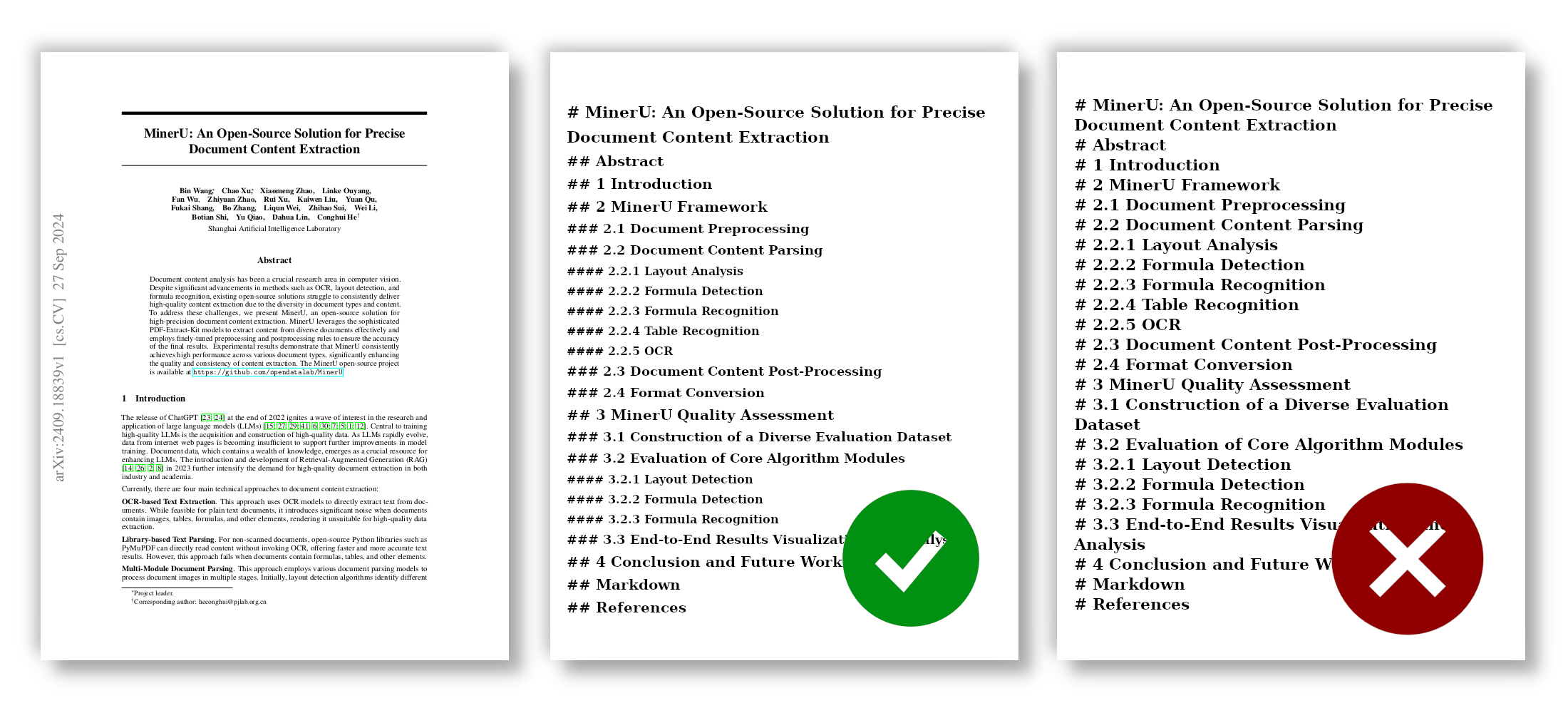
PDF-to-markdown tools like MinerU, Docling, and Marker do great text extraction — then collapse your document structure. Every heading becomes # or ##. TOCs break. RAG chunking breaks. Navigation breaks.
md-reheader fixes it. A 0.6B-parameter Qwen3 fine-tune reads the document and predicts the correct H1–H6 level for every heading in a single forward pass.
Quick start
CLI
pip install md-reheader
rehead --input flat.md --output fixed.md
Auto-detects CUDA. Use --cpu or --gpu to override. Omit --output to stream to stdout — pipe-friendly for integration with other CLIs.
rehead -i flat.md | tee fixed.md               # pipe
rehead -i flat.md --gpu -o out/fixed.md        # creates nested dirs
rehead -i flat.md --force -o existing.md       # overwrite
rehead --help                                   # all flags
Python API
from md_reheader.inference.predict import load_model, reheader_document

model, tokenizer = load_model("joelbarmettler/md-reheader")

flat = open("document.md").read()
fixed = reheader_document(flat, model, tokenizer)
The package handles preprocessing (flattening + body stripping) and postprocessing (applying predicted levels back to the original document) automatically.
Direct transformers usage
import torch
from transformers import AutoModelForCausalLM, AutoTokenizer

tokenizer = AutoTokenizer.from_pretrained("joelbarmettler/md-reheader")
model = AutoModelForCausalLM.from_pretrained(
    "joelbarmettler/md-reheader",
    dtype=torch.bfloat16,
    device_map="auto",
)

messages = [
    {"role": "system", "content": "You are a markdown document structure expert. Given a markdown document with incorrect or flattened heading levels, output each heading with its correct markdown prefix (# for level 1, ## for level 2, etc.), one per line."},
    {"role": "user", "content": "# Introduction\n\nSome text...\n\n# Background\n\nMore text...\n\n# Methods"},
]

input_text = tokenizer.apply_chat_template(
    messages, tokenize=False, add_generation_prompt=True, enable_thinking=False,
)
inputs = tokenizer(input_text, return_tensors="pt").to(model.device)

with torch.no_grad():
    outputs = model.generate(**inputs, max_new_tokens=4096, do_sample=False)

generated = outputs[0][inputs["input_ids"].shape[1]:]
print(tokenizer.decode(generated, skip_special_tokens=True))
Important: pass
enable_thinking=Falsetoapply_chat_template. Without it, the model enters a repetition loop because training used the non-thinking chat format.
Self-host with vLLM
pip install vllm
vllm serve joelbarmettler/md-reheader --dtype bfloat16 --max-model-len 8192
Higher throughput than raw transformers and drop-in OpenAI-compatible clients. On <10 GB cards add --enforce-eager --gpu-memory-utilization 0.70 to skip CUDA-graph allocations.
Remote inference (any OpenAI-compatible endpoint)
Once a server is running, use md-reheader as a thin client — no local weights needed.
rehead -i flat.md -o fixed.md --endpoint http://localhost:8000/v1
rehead -i flat.md -o fixed.md --endpoint https://api.example.com/v1 --api-key sk-xxx
# or set MD_REHEADER_API_KEY in the environment
from md_reheader.inference.remote import reheader_document_remote

fixed = reheader_document_remote(
    open("flat.md").read(),
    endpoint="http://localhost:8000/v1",
    model="joelbarmettler/md-reheader",
)
Identical output to local inference. Preprocessing (flatten + strip) happens client-side; the server just runs the chat completion with chat_template_kwargs={"enable_thinking": false} to match training.
How it works
flat markdown  ──►  flatten headings to #  ──►  strip body to 128+128 tokens
                                                         │
                                                         ▼
        restored markdown  ◄──  apply predicted levels  ◄── Qwen3-0.6B (fine-tuned)
- Extract headings with markdown-it-py — correctly skips code blocks.
- Flatten every heading to
#— the model ignores input levels. - Strip each section's body to its first 128 + last 128 tokens — preserves structural cues, kills context bloat.
- Qwen3-0.6B predicts the correct
#prefix per heading. - Levels get mapped back to the original document.
Evaluation
Benchmarked on 7,321 held-out documents from GitHub markdown and Wikipedia.
| Metric | All-H1 baseline | Heuristic | md-reheader |
|---|---|---|---|
| Exact match | 0.0% | 14.5% | 56.1% |
| Per-heading accuracy | 13.1% | 49.1% | 80.6% |
| Hierarchy preservation | 61.3% | 68.6% | 91.0% |
| Mean absolute error | 1.38 | 0.62 | 0.22 |
Per-level accuracy
| H1 | H2 | H3 | H4 | H5 | H6 | |
|---|---|---|---|---|---|---|
| Accuracy | 77% | 85% | 78% | 68% | 45% | 50% |
H1–H3 land in the 77–85% band; H5/H6 drop but still beat baselines. Most deep-level errors are off-by-one — the relative structure survives.
By document depth
| Max depth | Exact match | Per-heading accuracy | Hierarchy |
|---|---|---|---|
| Depth 2 | 83% | 91% | 95% |
| Depth 3 | 54% | 82% | 90% |
| Depth 4 | 32% | 70% | 88% |
| Depth 5-6 | 33% | 65% | 89% |
By source
| Source | Exact match | Per-heading accuracy |
|---|---|---|
| GitHub markdown | 49.5% | 74.0% |
| Wikipedia | 71.3% | 95.5% |
Speed
| Document size | RTX 4090 (BF16) | CPU (fp32) |
|---|---|---|
| < 1k tokens | 0.4s | 5s |
| 1k–2k tokens | 0.8s | 10s |
| 2k–4k tokens | 1.4s | ~20s |
| 4k–8k tokens | 3.4s | ~60s |
Documents longer than ~8k tokens (after stripping) are truncated from the tail.
Limitations
- Deep nesting (H5/H6) — accuracy drops to 45–50%. Relative structure is preserved; absolute depth gets compressed by 1–2 levels.
- Ambiguous structure — heading levels are subjective. The model learns common conventions; it can't resolve genuine ambiguity.
- Long documents — >8k tokens (after stripping) get truncated. Headings past the cutoff retain their input levels.
- English-centric — trained primarily on English content.
Reproducing training
git clone https://github.com/joelbarmettlerUZH/md-reheader.git
cd md-reheader

uv sync --extra train    # install training dependencies
make download            # download raw data (~150k documents)
make prepare             # strip, flatten, oversample, format
make train               # train on 2x GPU with Axolotl
make eval                # evaluate on test set
The model is a fine-tune of Qwen/Qwen3-0.6B trained on ~197k markdown documents:
- codeparrot/github-code — ~105k markdown files from GitHub repositories
- euirim/goodwiki — ~45k Wikipedia articles
- Deep documents (depth 4+) oversampled 2–8× for class balance
Trained with Axolotl on 2× RTX 4090 using DDP, BF16, 8k sequence length with sample packing.
License
Code and model weights: Apache 2.0. Training data includes Wikipedia content (CC BY-SA 4.0) and GitHub repositories (various open-source licenses).
About
Built and maintained by Joel Barmettler at Souverana — an AI consultancy that helps teams design, fine-tune, evaluate, and ship production LLM systems.
Need a small, self-hosted model that does one job well — like this one? Let's talk → souverana.ch
Citation
@software{barmettler2026mdreheader,
  author = {Barmettler, Joel},
  title  = {md-reheader: Restoring Heading Hierarchy in Markdown Documents},
  year   = {2026},
  url    = {https://github.com/joelbarmettlerUZH/md-reheader}
}
1 maintainer

Metadata
1 maintainer
Release files for md-reheader 0.2.3
For a detailed explanation of source distributions (sdists) and built distributions (wheels), please see the package formats documentation.
Source distribution (sdist)
| File | Size | Uploaded | |
|---|---|---|---|
| md_reheader-0.2.3.tar.gz | 441.3 kB | Details |
Built distribution (wheel)
| File | Interpreter | ABI | Platform | Reset |
|---|---|---|---|---|
| md_reheader-0.2.3-py3-none-any.whl | Python 3 | none | any | Details |
Total release size: 462.9 kB
Release files / md_reheader-0.2.3.tar.gz
| Download URL | md_reheader-0.2.3.tar.gz |
|---|---|
| Size | 441.3 kB |
| Tags | Source |
|
SHA-256 checksum How to use checksums |
1d893ab96f73aaf518b577c483b428f7c2bcf55237a32282778d0a9ad5b78c81
|
|
BLAKE2b-256 checksum How to use checksums |
c9e992bb19899c1d4e51071a5c48cfbabcc031cc1abc5d56b2ff29280f9c0bde
|
| Upload date | |
|
Uploaded using Trusted Publishing? What is trusted publishing? |
Yes |
| Uploaded via |
twine/6.1.0 CPython/3.13.12
|
Provenance
Provenance describes where a file came from. On PyPI, provenance is shared via attestations, which provide a verifiable record of the build or publishing details. View details, limitations and caveats.


PyPI Publish Attestation
PyPI verified that this artifact, at this checksum, originated from the publisher listed below.
Signed by GitHub Actions, verified by PyPI on Jul 11, 2026.
Transparency logRelease files / md_reheader-0.2.3-py3-none-any.whl
| Download URL | md_reheader-0.2.3-py3-none-any.whl |
|---|---|
| Size | 21.6 kB |
| Tags | Python 3 |
|
SHA-256 checksum How to use checksums |
740ff93dafea0b3a4e4debf2d8e7105220e472d05271ab03d69e8b6d8c658fa3
|
|
BLAKE2b-256 checksum How to use checksums |
75ece508da59777179afb9c09f2019ce1ec2abaf3a01b4fc8dc6c4372f8cecd5
|
| Upload date | |
|
Uploaded using Trusted Publishing? What is trusted publishing? |
Yes |
| Uploaded via |
twine/6.1.0 CPython/3.13.12
|
Provenance
Provenance describes where a file came from. On PyPI, provenance is shared via attestations, which provide a verifiable record of the build or publishing details. View details, limitations and caveats.
PyPI Publish Attestation
PyPI verified that this artifact, at this checksum, originated from the publisher listed below.
Signed by GitHub Actions, verified by PyPI on Jul 11, 2026.
Transparency log













