
meiosim
meiosim provides a single, lightweight data structure that bundles genotypes, individual metadata and a genetic map together. It includes the operations breeders and quantitative geneticists reach for most often:
- basic data manipulation,
- simulating meiosis and crosses,
- a ready-to-use Arabidopsis thaliana panel.
Installation
Install meiosim with pip:
pip install meiosim
Quick start
from meiosim import Arabidopsis
import matplotlib.pyplot as plt

# Load 5,000 random SNPs from the 1001 Genomes panel
pop = Arabidopsis(n_SNPs = 5000, seed = 42)

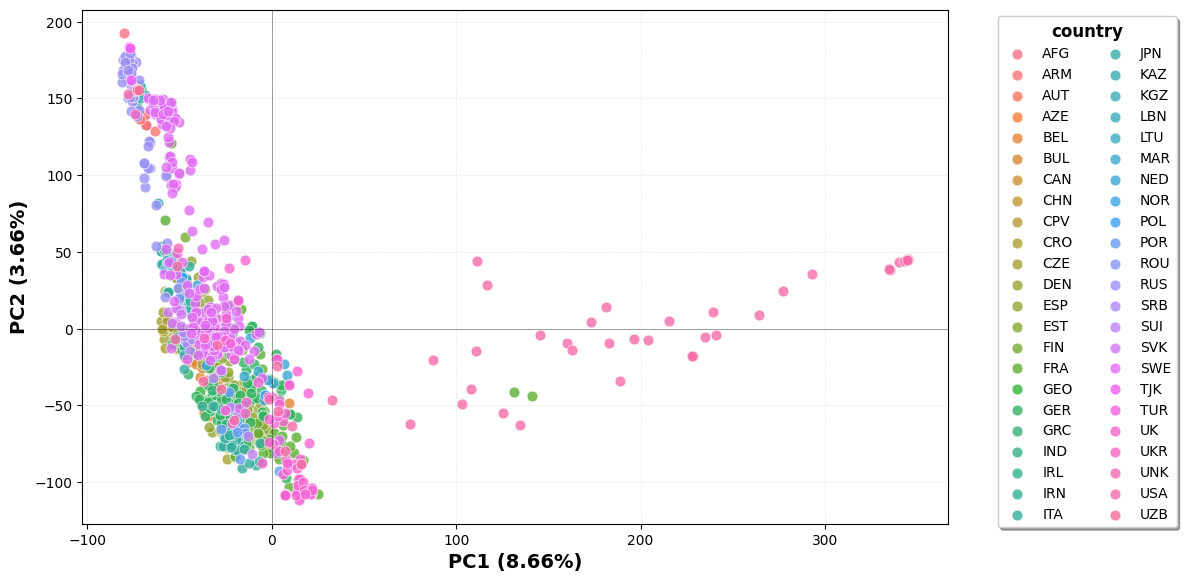
# Visualise population structure
plt.figure(figsize=(12,6))
pop.plot(group="country")
plt.show()
Core concepts
Everything in meiosim revolves around the Population object, which holds three
aligned pieces of data:
| Attribute | Type | Shape | Description |
|---|---|---|---|
genotypes |
np.ndarray |
(n_individuals, n_markers) |
Allele dosage coded 0 / 1 / 2; missing values are -128. |
metadata |
pd.DataFrame |
n_individuals rows |
One row per individual. Columns are free-form. |
map |
pd.DataFrame |
n_markers rows |
Marker map; needs at least chromosome and cM columns. |
On construction, meiosim guarantees three metadata columns:
individual: a primary key for each individual, automatically created as a 16-character SHA-256 fingerprint if absent.sire/dam: parental identifiers, filled in by crossing operations.
Optional attributes appear once you run the relevant method:
phases: a list[hap0, hap1]of two haplotype matrices, created byphasing()and propagated through crossing.phenotypes: apd.DataFrameof trait values.
A shared numpy random generator (rng) makes every stochastic operation reproducible.
The Population API
Constructor
pop = Population(genotypes, metadata, map, seed = 42)
Build a population directly from SNP data. genotypes is a 0/1/2 matrix
(np.nan allowed), metadata and map are DataFrames aligned to the rows and
columns of genotypes respectively.
merge(*populations) (classmethod)
combined = Population.merge(pop_a, pop_b, pop_c)
Stack two or more populations that share an identical map. Metadata is concatenated, genotypes are row-stacked, and phases are merged when all input populations carry them.
subset(on)
Filter individuals in place, on either:
dict: match metadata columns, e.g.{"country": "SWE"}or{"country": ["SWE", "FIN"], "stage": "line"}. Multiple keys are combined withand; multiple values per key withor.list[str]: keep individuals by theirindividualID.list[int]: keep individuals by row index.
pop.subset({"country": "SWE"}).subset(list(range(20)))
split(size)
Randomly partition the markers into two new populations of size and
n_markers - size columns:
snp, qtl = pop.split(2_000) # snp has 2,000 markers, qtl gets the rest
Each individual is preserved in both halves; phases are split alongside.
plot(group=None)
PCA scatter of the population on the first two principal components (genotypes
are mean-imputed first). Pass a metadata column name to group to colour points
by category (a group named "other" is drawn in grey).
pop.plot(group="country")
phasing()
Infer haplotypes and populate self.phases.
⚠️ Designed for fully inbred material: for an actual phasing of heterozygous material, an external tool must be used.
cross(parents=None, selfing=True, n_progeny=1, n_cores=5)
Generate progeny from all pairwise combinations of the chosen parents.
parents— a list of IDs (str) or indices (int), or a single one. Defaults to every individual in the population.selfing— ifTrue, self-crosses are allowed (pairs withp1 <= p2); ifFalse, only distinct pairs are crossed (p1 < p2).n_progeny— offspring produced per cross.n_cores— workers used by the underlying meiosis.
Returns a new Population whose metadata is a pedigree (individual, sire,
dam) and whose phases carry the two inherited gametes.
f1 = founders.cross(selfing=False) # all distinct pairwise crosses
selfing(individual, n_generations, n_cores=5)
Repeatedly self-fertilise one individual to drive it towards homozygosity,
returning the population after n_generations rounds. The original parents are
carried over into the resulting metadata.
line = f1.selfing(id1, n_generations=6)
Multiprocessing
cross, selfing and meiosis use a
ProcessPoolExecutor. On macOS/Windows, set the start method to 'fork'
(where supported) before launching workers, as shown in the example, and run
inside an if __name__ == "__main__": guard.
Arabidopsis dataset
The 1001 genome collection of A. thaliana (The 1001 Genomes Consortium, 2016) filtered on the RegMap panel (Horton et al. 2012, Pisupati et al. 2017) is provided as a resource.
The genetic map is built from the physical map assuming a constant 3.6 cM/Mb, simplifying the recombination landscape described by Salomé et al. (2012).
Phenotypes come from Grimm et al. (2017).
The Arabidopsis constructor base loader reads SNPs, accessions, positions, derives the map and provides phenotypes. Optionally, down-samples to n_SNPs random markers (n_SNPs=0 keeps them all).
| Feature | Reference |
|---|---|
| 1001 Arabidopsis genomes | The 1001 Genomes Consortium (2016). 1,135 Genomes Reveal the Global Pattern of Polymorphism in Arabidopsis thaliana. Cell. |
| 1001 Arabidopsis phenotypes | Grimm et al. (2017). easyGWAS: A Cloud-Based Platform for Comparing the Results of Genome-Wide Association Studies. The Plant Cell. |
| Genetic map | Salomé et al. (2012). The recombination landscape in Arabidopsis thaliana F2 populations. Heredity. |
| RegMap SNP panel | Horton et al. (2012). Genome-wide patterns of genetic variation in worldwide Arabidopsis thaliana accessions from the RegMap panel. Nature Genetics. |
| RegMap SNP panel | Pisupati et al. (2017) - Verification of Arabidopsis stock collections using SNPmatch, a tool for genotyping high-plexed samples |
Citation
Please cite this package as:
Marchal, A., & Raimondi, D. (2026). meiosim - a toolbox to simulate crosses and play with quantitative genetics in Python [Computer software]. Zenodo. https://doi.org/10.5281/zenodo.21134827
Code
The code is available at this address.
License
Copyright © 2026 CNRS, University of Montpellier
This program is free software: you can redistribute it and/or modify it under the terms of the GNU General Public License as published by the Free Software Foundation, either version 3 of the License, or (at your option) any later version.
This program is distributed in the hope that it will be useful, but WITHOUT ANY WARRANTY; without even the implied warranty of MERCHANTABILITY or FITNESS FOR A PARTICULAR PURPOSE. See the GNU General Public License for more details.
You should have received a copy of the GNU General Public License along with this program. If not, see https://www.gnu.org/licenses/.
1 maintainer

Metadata
1 maintainer
Release files for meiosim 0.2.1
For a detailed explanation of source distributions (sdists) and built distributions (wheels), please see the package formats documentation.
Source distribution (sdist)
| File | Size | Uploaded | |
|---|---|---|---|
| meiosim-0.2.1.tar.gz | 29.3 MB | Details |
Built distribution (wheel)
| File | Interpreter | ABI | Platform | Reset |
|---|---|---|---|---|
| meiosim-0.2.1-py3-none-any.whl | Python 3 | none | any | Details |
Total release size: 58.7 MB
Release files / meiosim-0.2.1.tar.gz
| Download URL | meiosim-0.2.1.tar.gz |
|---|---|
| Size | 29.3 MB |
| Tags | Source |
|
SHA-256 checksum How to use checksums |
9f02ed107e2b9d994ccf135255a5ede87987796835926965b730c13c369d2441
|
|
BLAKE2b-256 checksum How to use checksums |
eade21fa9e8b12855ba6748eadde73645acc074f2d151153f17f4e125acc2fd5
|
| Upload date | |
|
Uploaded using Trusted Publishing? What is trusted publishing? |
Yes |
| Uploaded via |
twine/7.0.0 CPython/3.13.14
|
Provenance
Provenance describes where a file came from. On PyPI, provenance is shared via attestations, which provide a verifiable record of the build or publishing details. View details, limitations and caveats.


PyPI Publish Attestation
PyPI verified that this artifact, at this checksum, originated from the publisher listed below.
Signed by GitHub Actions, verified by PyPI on Aug 14, 2026.
Transparency logRelease files / meiosim-0.2.1-py3-none-any.whl
| Download URL | meiosim-0.2.1-py3-none-any.whl |
|---|---|
| Size | 29.3 MB |
| Tags | Python 3 |
|
SHA-256 checksum How to use checksums |
be0c3dc41ffbef3fab79973083a9928283c0836ae0c835146841a1b699b55983
|
|
BLAKE2b-256 checksum How to use checksums |
cb05ac6926ee523fb8c48cf2b15872de4302ee70e9a60488d63c5a72e7d407b7
|
| Upload date | |
|
Uploaded using Trusted Publishing? What is trusted publishing? |
Yes |
| Uploaded via |
twine/7.0.0 CPython/3.13.14
|
Provenance
Provenance describes where a file came from. On PyPI, provenance is shared via attestations, which provide a verifiable record of the build or publishing details. View details, limitations and caveats.
PyPI Publish Attestation
PyPI verified that this artifact, at this checksum, originated from the publisher listed below.
Signed by GitHub Actions, verified by PyPI on Aug 14, 2026.
Transparency log













