
This release is a pre-release and may not be stable for production use.

MemTether
Your AI agents' memory is a file, not a pipeline.
One physical SQLite database, shared by every AI client on your machine via file-level pointers. No cloud. No API fees. No sync. Your memory stays greppable, git-able, and yours.



Quick Start
mcp-name: io.github.lanbass869-cell/memtether
# 1. Install
pip install memtether

# 2. Initialize (creates a demo memory DB)
memtether init

# 3. Connect all detected AI clients (Claude Code, Cursor, Windsurf, etc.)
memtether connect --all
memtether dashboard
This starts the API server and opens the web dashboard in your browser.
Try it:
memtether search "shared memory"
memtether remember "my first shared memory"
memtether stats
Or on Windows, double-click install.bat for one-click setup.
More install options
# From source
git clone https://github.com/MemTether/MemTether.git && cd MemTether && pip install -e .

# With semantic search (local embedding, no cloud)
pip install "memtether[vector]"

# With REST API server
pip install "memtether[server]"

# Docker
docker build -t memtether . && docker run -p 8420:8420 -v ./data:/app/data memtether
docker-compose up
Try it without installing:
python scripts/make_demo_db.py
MEM_DB=~/.memtether/demo.db python mem.py search "shared memory"
Why MemTether
The problem
Memory should be a data format, not a multi-stage pipeline. MemTether treats your agents’ shared memory as a plain SQLite file —
lsit,grepit,gitit, back it up. The symlink is the deploy step.
You use Claude Code for coding, Cursor for refactoring, and Windsurf for exploration. Each has its own memory. Switch tools and your AI forgets everything.
MemTether's answer is simpler than you'd expect: make them all point to the same file.
How it is different
| Common approach | Problem | MemTether approach |
|---|---|---|
| Per-client memory | Switch tools, lose context | File-level pointer: all clients read/write same memory.db |
| Cloud-hosted memory | Privacy + API fees + downtime | Local-first: SQLite on your machine, zero cloud |
| Delete old memories | Cannot trace what was known | Supersession: old memories marked, never deleted |
| Single time axis | Cannot distinguish when true vs when learned | Bi-temporal: dual T/T-prime axes with as-of queries |
| Equal treatment of memories | Useful memories get buried | Q-Value: used memories rank higher |
| Single search path | Misses keyword matches | 4-path recall: vector + FTS5 + literal + entity graph |
| No concurrent protection | Simultaneous writes = data loss | Hubguard: file lock + atomic write |
Feature comparison
| Feature | MemTether | mem0 | cognee | zep |
|---|---|---|---|---|
| Local-first | Yes | No (cloud) | Yes | No (cloud) |
| Cross-client shared | Yes (23) | No | No | No |
| Source attribution | Yes | No | No | Yes |
| Bi-temporal | Yes | No | No | Yes |
| Q-Value ranking | Yes | No | No | No |
| Supersession | Yes | No | No | Yes |
| 4-factor re-ranking | Yes | No | No | No |
| Scaffolds | Yes | No | No | No |
| MCP server | Yes | Yes | Yes | Yes |
| Eval suite included | Yes | Yes | No | No |
| No API key needed | Yes | No | No | No |
| REST API | Yes | Yes | Yes | Yes |
| Docker | Yes | Yes | Yes | Yes |
Full feature list
- Cross-client shared memory: 23 adapters (Claude Code, Cursor, Windsurf, VS Code, Zed, JetBrains, Cline, Roo Code, Kilo Code, Continue, Cody, Amazon Q, Gemini CLI, Neovim, Claude Desktop, Codex, WorkBuddy CN/Intl, CodeBuddy, ZCode, DSH, OpenClaw, Agents-Neutral)
- Source attribution: every memory knows which client wrote it
- Bi-temporal: T (when true) + T-prime (when recorded), as-of queries
- Supersession: old memories marked superseded, never deleted, full audit trail
- Q-Value: usage-based ranking (0.3 + 0.7 x q_value multiplier)
- 4-factor re-ranking: semantic (0.45) + recency (0.25) + frequency (0.05) + importance (0.10), blended 70/30 with RRF
- Deterministic scaffolds: counting/temporal/comparison/aggregation prepended to top result
- Consolidation index: 2708 topics + 315 chains + 37 standing instructions as bonus recall
- FTS5 triggers: SQLite-level full-text sync (INSERT/DELETE/UPDATE triggers)
- Hubguard: cross-process concurrent write lock + atomic write + format fallback
- Conflict detection: 89 quantified conflict patterns
- LLM auto-extraction: extract structured memories from conversation text
- Projection: auto-generates MEMORY.md (3980 char budget) for context injection
- Multi-path search: vector + FTS5 BM25 + literal + entity graph PPR, RRF fused
- Three-layer dedup: supersession-aware, content exact, tag-signature
- Low-confidence rejection: marks results when keyword empty AND vector < 0.50
- TTL expiry: expired conclusions downweighted with annotation
- Self-reference suppression: meta-discussion ranked below answers
Architecture
+---------+   +---------+   +---------+   +---------+
|  Claude |   | Cursor  |   |Windsurf |   | VS Code |  ... 23 adapters
|  Code   |   |         |   |         |   |         |
+----+----+   +----+----+   +----+----+   +----+----+
     |              |              |              |
     +--------------+------+-------+--------------+
                          |
                   +------v------+
                   |  MemTether  |
                   | Memory Hub  |
                   |             |
                   | SQLite      |  <- one physical memory.db
                   | FTS5        |  <- full-text search (triggers)
                   | ChromaDB    |  <- vector search (bge-m3)
                   | Bi-temporal |  <- T + T-prime dual time axes
                   | Q-Value     |  <- usage-based ranking
                   | Hubguard    |  <- concurrent write lock
                   +-------------+
Tech stack
| Component | Technology | Purpose |
|---|---|---|
| Database | SQLite (WAL mode) | Single-file, zero-config |
| Full-text | FTS5 trigram + triggers | O(1) BM25, SQL-level sync |
| Vector | ChromaDB + bge-m3 (1024-dim) | Semantic search, local |
| Fusion | Reciprocal Rank Fusion (K=60) | Merge multi-path results |
| Re-ranking | 4-factor (sem .45 + rec .25 + freq .05 + imp .10) | Z-score + sigmoid |
| Governance | Supersession + bi-temporal + conflict | Never delete |
| Concurrency | Hubguard (file lock + atomic write) | Cross-process safe |
| API | FastAPI REST + MCP server | Any language |
Connect Your Clients
python -m memtether connect --all
python -m memtether verify
python -m memtether detect
python -m memtether selftest
Supported (23): Claude Code, Cursor, Windsurf, VS Code, Zed, JetBrains, Cline, Roo Code, Kilo Code, Continue, Cody, Amazon Q, Gemini CLI, Neovim, Claude Desktop, Codex, WorkBuddy (CN + Intl), CodeBuddy, ZCode, DSH, OpenClaw, Agents-Neutral
Memory Operations
python -m memtether remember "User prefers dark theme" --source claude-code
python -m memtether search "theme preference"
python -m memtether correct <uid> "Updated text"
python -m memtether retire <uid> "No longer relevant"
python -m memtether stats
python -m memtether as-of 2026-09-15 --kind known
python -m memtether rebuild
Benchmarks
LongMemEval (500 questions, full run, 2026-10-02)
| Metric | Score | Notes |
|---|---|---|
| Strict match (global) | 62.6% | 209/334 applicable |
| LLM judge (global) | 55.7% | 264/474 |
| Multi-session strict | 48.8% | 39/80 — above industry avg 27.9% |
| Multi-session LLM judge | 60.0% | 72/120 |
| EAF (Evidence Assembly) | 75.7% | 253/334 strict — multi-session 32.5%→60.0% |
Per-type breakdown
| Type | n | Strict | LLM Judge |
|---|---|---|---|
| knowledge-update | 78 | 76.6% | 62.5% |
| multi-session | 133 | 48.8% | 60.0% |
| single-session-assistant | 56 | 40.4% | 41.1% |
| single-session-preference | 30 | N/A | 43.3% |
| single-session-user | 70 | 86.4% | 85.7% |
| temporal-reasoning | 133 | 60.7% | 40.5% |
Results use our own harness. Not directly comparable with mem0 reported numbers.
Test suite
| Test | Result |
|---|---|
| hard_bench | 62/62 |
| asset_bench | 23/23 |
| pytest | 31/31 |
| e2e_verify | 13/13 |
| refuse_bench | 26/26 |
| concurrent_stress | 4/4 PASS |
Known Limitations
tether_connect detectmay falsely report "not connected" for same-source-different-path configs. Useverifyfor accurate results.- DSH
cordis.patch.ymldeep customizations cannot be safely rewritten. Useplanto preview. - MemTether shares one physical DB via file-level pointers. On Windows this uses NTFS junctions; on macOS/Linux, symlinks. Both are native OS features — no sync daemon needed.
- Semantic search requires optional deps (chromadb, onnxruntime). Without them, degrades to keyword search.
- Windows-first. macOS/Linux should work but not fully tested.
Relationship to Other Projects
- mem0: managed memory with cloud API. MemTether is for people who want everything local.
- cognee: knowledge graph + pipeline. MemTether is lightweight operational memory (SQLite, no Neo4j).
- letta (MemGPT): agent framework. MemTether works with existing agents you already use.
- engram: Go + SQLite + FTS5 + MCP. MemTether adds bi-temporal, source attribution, Q-Value, 23 adapters.
You can use MemTether alongside any of these.
REST API
MemTether includes a built-in REST API server (FastAPI) for non-CLI access:
# Start the API server
memtether dashboard --port 8820
| Endpoint | Method | Description |
|---|---|---|
/health |
GET | Health check |
/remember |
POST | Store a memory |
/search |
POST | Search memories |
/stats |
GET | Memory statistics |
/correct |
POST | Correct/supersede a memory |
/retire |
POST | Retire a memory |
/list |
GET | List recent memories |
/qvalue |
POST | Update Q-Value score |
/dashboard |
GET | Web dashboard |
A web dashboard is available at http://localhost:8820/dashboard when the API server is running.
License
Apache 2.0 - see LICENSE
Contributing
Issues and PRs welcome. See CONTRIBUTING.md.
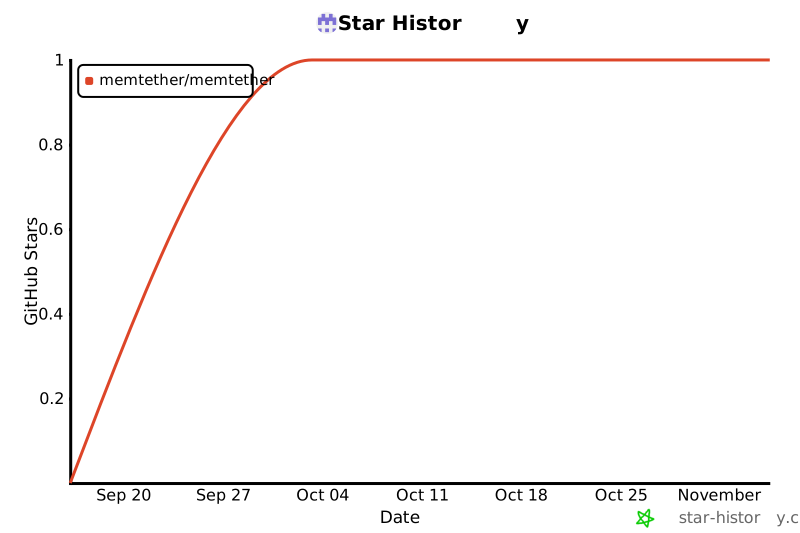
Star History
1 maintainer

Metadata
1 maintainer
Release files for memtether 0.1.0a18
For a detailed explanation of source distributions (sdists) and built distributions (wheels), please see the package formats documentation.
Source distribution (sdist)
| File | Size | Uploaded | Provenance | Actions |
|---|---|---|---|---|
| memtether-0.1.0a18.tar.gz | 483.8 kB | Without provenance | Details for memtether-0.1.0a18.tar.gz |
Built distribution (wheel)
| File | Interpreter | ABI | Platform | Actions Reset |
|---|---|---|---|---|
| memtether-0.1.0a18-py3-none-any.whl | Python 3 | none | any | Details for memtether-0.1.0a18-py3-none-any.whl |
Total release size: 1.0 MB
Release files / memtether-0.1.0a18.tar.gz
| Download URL | memtether-0.1.0a18.tar.gz |
|---|---|
| Size | 483.8 kB |
| Tags | Source |
|
SHA-256 checksum How to use checksums |
19ea44999d43b8724bc4329501326020f0d7f51f702013b068ad169c2066b17e
|
|
BLAKE2b-256 checksum How to use checksums |
a6ccc10caf16fc7554ab6e015e33814b0c5780a7e8b148b5d5dd772152b3579e
|
| Upload date | |
|
Uploaded using Trusted Publishing? What is trusted publishing? |
No |
| Uploaded via |
twine/7.0.0 CPython/3.13.14
|
Release files / memtether-0.1.0a18-py3-none-any.whl
| Download URL | memtether-0.1.0a18-py3-none-any.whl |
|---|---|
| Size | 536.8 kB |
| Tags | Python 3 |
|
SHA-256 checksum How to use checksums |
79e7906805ddf21b74427bc4d669d6b694f70c8f104576185f8549f99b4b6396
|
|
BLAKE2b-256 checksum How to use checksums |
e557692cf72aee6b7da6b4b678e841b81c6f256d9d8e9778efd961d8b9686b1f
|
| Upload date | |
|
Uploaded using Trusted Publishing? What is trusted publishing? |
No |
| Uploaded via |
twine/7.0.0 CPython/3.13.14
|
Security for memtether 0.1.0a18
Provenance
Provenance describes where a file came from. On PyPI, provenance is shared via attestations, which provide a verifiable record of the build or publishing details. View details, limitations and caveats.
No provenance found
None of the files in this release were uploaded with provenance metadata.
A note on package security
PyPI is a repository for distributing packages, not a service for auditing them. While third-party security researchers and our staff do their best to detect and remove malicious packages, PyPI cannot guarantee the quality, security or suitability of any given package.
To learn more about protecting yourself from malicious actors, visit our package security documentation.














