
This release is a pre-release and may not be stable for production use.

MemTether — The AI Memory Court
Your agent remembers things. Who audits what it remembers?
MemTether is the first memory hub where every fact carries a verifiable evidence chain: who wrote it, when it took effect, what it superseded, which conflicts were adjudicated by a human, and a tamper-evident hash chain anyone can verify in their browser — no code, no dependencies.
$ memtether court fact-20261007-abc
+============================================================+
| MEMTETHER MEMORY COURT - CASE FILE                          |
| 1. CONTENT    Clash proxy port is 7897                      |
| 2. TEMPORAL   valid: 10-05 → present | known: 10-05 → now   |
| 3. PROVENANCE #1 remember by=codex → #2 correct by=user     |
| 4. CONFLICTS  case #3: vs fact-...old verdict=superseded    |
| 5. INTEGRITY  chain: PASS (3 anchors, 42 entries hashed)    |
+============================================================+
Under the hood: supersession chains (corrections never delete), bi-temporal timestamps (when facts were true vs when the system learned them), human-adjudicated conflict resolution, and a hash-chained audit log aligned with EU AI Act Article 12 record-keeping requirements.
One physical SQLite database, shared by every AI client via file-level pointers. No cloud. No API fees. No sync daemon. Greppable, git-able, yours — and auditable.
Compared to mem0 (66.6K★), Zep/Graphiti (31.5K★), and agentmemory (29.2K★): those systems either overwrite or delete old values. MemTether's supersession chain preserves the full history with source attribution and Q-Value ranking. EAF retrieval: 75.7% strict on LongMemEval 500Q (paired delta +19.4pp, McNemar p=7.8e-7).
How MemTether compares
| MemTether | memora (731★) | memtrace (486★) | icarus (290★) | mem0 (66K★) | |
|---|---|---|---|---|---|
| Supersession chains (corrections don't delete) | ✅ enforced | ❌ | ❌ | ✅ | ❌ overwrite |
| Evidence chain (tamper-evident, browser-verifiable) | ✅ court CLI + zip | ❌ | ❌ | ❌ | ❌ |
| Human conflict adjudication (decisions on record) | ✅ conflicts CLI | ❌ | ❌ | ❌ | ❌ |
| Bi-temporal (valid_from ≠ recorded_at) | ✅ 100% coverage | ❌ | ✅ graph | ❌ | ❌ |
| Source attribution (who wrote it, enforced) | ✅ registry + reject | ❌ | ❌ | ✅ provenance | ❌ |
| File-level pointer (zero cloud, zero sync daemon) | ✅ | ❌ | ❌ | ❌ | ❌ server |
| Conflict detection (rule-based + human review) | ✅ candidate generator | ❌ | ❌ | ❌ | ❌ |
| MCP server | ✅ | ✅ | ✅ | ❌ | ✅ |
| 23+ client adapters | ✅ auto-detect | ❌ | ❌ | ❌ | ❌ |
| Evaluation integrity framework | ✅ 5 patterns | ❌ | ❌ | ❌ | ❌ |
| CI: 9 jobs / 466 tests | ✅ | ? | ? | ? | ✅ |
| Language | Python | ? | Rust | ? | Python |
'Each cell reflects the feature's presence in the project's public documentation as of 2026-10-07. MemTether's differentiator is not any single feature — it's the combination of all governance dimensions in one local-first deployment.'
Artifact bundle with per-question records.


mcp-name: io.github.lanbass869-cell/memtether

Project page · Install · Docs · Reproduce · 中文文档
Documentation
- Reproduce MemTether - Every claim has a command
- Founding 10 Challenge - 10 spots, 14 days, honest outcomes
- Live site (when GitHub Pages is enabled)
Quick Start
pip install memtether
memtether init    # creates DB + connects all detected AI clients
That's it. MemTether detects Claude Code, Cursor, Windsurf, Codex, Gemini CLI and 18 more clients on your machine, writes MCP config, and verifies.
More install options
# One client at a time
memtether setup claude-code
memtether setup cursor
memtether setup gemini-cli    # run `memtether setup list` for all 23

# With semantic search (local embedding, no cloud):
pip install "memtether[vector]"          # 1. deps (chromadb, onnxruntime)
memtether download-models                # 2. weights (bge-m3-int8 ~560MB, or --profile bge-small-zh ~46MB)
python -m memsearch --rebuild            # 3. build the vector index
# Skip any of these and search gracefully degrades to keyword + BM25.

# With REST API server + web dashboard
pip install "memtether[server]"
memtether dashboard

# Docker
docker-compose up
Why MemTether
The one thing no other memory system does: corrections don't delete
# Monday: Claude Code writes
$ memtether remember "Deploy to port 8080" --source claude-code

# Wednesday: you correct it via Cursor
$ memtether correct fact-xxx "Deploy to port 9090" --reason "port changed"

# Friday: another agent searches
$ memtether search "deploy port" --list
  1. [fact] Deploy to port 9090 (active)          ← current truth
     Old "port 8080" is superseded, not deleted.
     Full chain: memtether timeline fact-xxx
Every memory has valid_from / valid_to (business time) + recorded_at / invalidated_at (system time). You can query "what did the system know on Tuesday?"
How it's different
| MemTether | engram | mem0 | agent-memory | |
|---|---|---|---|---|
| Storage | SQLite via file pointers | SQLite (Go binary) | Cloud API | Markdown files |
| Supersession | ✅ bi-temporal, never delete | ❌ | ⚠️ partial | ✅ |
| Source attribution | ✅ every fact tagged | ❌ | ❌ | ❌ |
| Q-Value feedback | ✅ used memories rank higher | ❌ | ❌ | ❌ |
| Poisoning defense | ✅ OWASP LLM01/02/06 | ❌ | ⚠️ faithfulness check | ❌ |
| Cross-client | ✅ file-level pointers (23 adapters) | ✅ MCP | ✅ API | ✅ CLI |
| Cloud required | ❌ | optional | ✅ | ❌ |
Feature comparison vs cognee / zep / letta
| Feature | MemTether | cognee | zep | letta | Engram* |
|---|---|---|---|---|---|
| Local-first | ✅ | ❌ | ❌ | ⚠️ self-hosted | ✅ |
| Zero config | ✅ | ❌ (Neo4j) | ❌ (Docker) | ⚠️ | ✅ |
| Single file DB | ✅ | ❌ | ❌ | ❌ | ✅ |
| REST API | ✅ (12 endpoints) | ✅ | ✅ | ✅ | ❌ |
| MCP server | ✅ | ❌ | ✅ | ✅ | ❌ |
| Web dashboard | ✅ | ❌ | ✅ | ✅ | ❌ |
| Supersession chain | ✅ | ❌ | ❌ | ⚠️ | ❌ |
| Bi-temporal | ✅ | ❌ | ❌ | ❌ | ✅ |
| Source attribution | ✅ | ❌ | ⚠️ | ❌ | ❌ |
| Q-Value ranking | ✅ | ❌ | ❌ | ❌ | ❌ |
| Poisoning defense | ✅ | ❌ | ❌ | ❌ | ❌ |
| Export as markdown | ✅ | ❌ | ❌ | ❌ | ✅ |
| 23 client adapters | ✅ | ❌ | ❌ | ❌ | ❌ |
| Governance layer | ✅ | ❌ | ⚠️ | ❌ | ❌ |
Architecture
Claude Code ────┐                  ┌──── Cursor
                │   symlink /      │
Codex ──────────┤   junction       ├──── Windsurf
                │                  │
Gemini CLI ─────┤                  ├─── WorkBuddy
                └───────┬──────────┘
                        │
                        ▼
              ┌──────────────────┐
              │   memory.db      │  ← One physical SQLite
              │   (WAL mode)     │
              ├──────────────────┤
              │ FTS5 trigram     │  ← BM25 full-text
              │ ChromaDB + bge-m3│  ← Semantic (optional)
              │ RRF fusion       │  ← Multi-path merge
              │ 4-factor rerank  │  ← Z-score + sigmoid
              │ Supersession     │  ← Never delete
              │ Bi-temporal      │  ← T-axis + T'-axis
              │ Q-Value          │  ← Usage-based ranking
              │ Hubguard         │  ← Concurrent write lock
              │ Poisoning guard  │  ← OWASP LLM defense
              └──────────────────┘
Technical details
| Component | Technology | Purpose |
|---|---|---|
| Database | SQLite (WAL mode) | Single-file, zero-config, cross-platform |
| Full-text | FTS5 trigram + triggers | O(1) BM25 search, SQL-level sync |
| Vector | ChromaDB + bge-m3 (1024-dim) | Semantic search, local embedding |
| Fusion | Reciprocal Rank Fusion (K=60) | Merge multi-path results |
| Re-ranking | 4-factor (sem .45 + rec .25 + freq .05 + imp .10) | Z-score + sigmoid |
| Governance | Supersession + bi-temporal + conflict detection | Never delete |
| Concurrency | Hubguard (file lock + atomic write) | Cross-process safe |
| Security | memtether_guard (OWASP LLM01/02/06) | Poisoning defense |
| API | FastAPI REST (12 endpoints) + MCP server (4 tools) | Any language |
| Packaging | PyPI + Docker + 23 client adapters | pip install memtether |
Connect Your Clients
# All detected clients (recommended)
memtether init

# One at a time
memtether setup claude-code
memtether setup cursor
memtether setup windsurf
memtether setup codex
Supported (23): Claude Code, Claude Desktop, Cursor, Windsurf, VS Code, Zed, JetBrains, Cline, Roo Code, Kilo Code, Continue, Cody, Amazon Q, Gemini CLI, Neovim, Codex CLI, WorkBuddy (CN + Intl), CodeBuddy, ZCode, DSH, OpenClaw, Agents-Neutral
Memory Operations
memtether remember "User prefers dark theme" --source claude-code
memtether search "theme" --list        # L0: one-line + uid
memtether search "theme"               # Full content
memtether correct <uid> "Updated"      # Supersede, never delete
memtether timeline <uid>               # Audit chain
memtether stats
memtether export-md --out ./backup     # Export as markdown
memtether dashboard                    # Web UI
Benchmarks
LongMemEval (500 questions, full run, 2026-10-02)
| Metric | Score | Notes |
|---|---|---|
| Strict match (global) | 62.6% | 209/334 applicable |
| LLM judge (global) | 55.7% | 264/474 |
| Multi-session strict | 48.8% | 39/80 |
| Multi-session LLM judge | 60.0% | 72/120 |
| EAF | 75.7% | 253/334 — multi-session 32.5%→60.0% |
| Type | n | Strict | LLM Judge |
|---|---|---|---|
| knowledge-update | 78 | 76.6% | 62.5% |
| multi-session | 133 | 48.8% | 60.0% |
| single-session-assistant | 56 | 40.4% | 41.1% |
| single-session-preference | 30 | N/A | 43.3% |
| single-session-user | 70 | 86.4% | 85.7% |
| temporal-reasoning | 133 | 60.7% | 40.5% |
Results use our own harness. Not directly comparable with mem0's reported numbers.
Test suite
| Test | Result |
|---|---|
| pytest | 466 passed, 4 skipped (CI runs full tests/ directory) |
| hard_bench | 62/62 |
| e2e_verify | 13/13 |
| refuse_bench | 26/26 (wordform gate; 09-25 calibration; known blind spot: same-form-different-attribute) |
| check_packaging | ✅ |
Security
- Poisoning defense:
memtether_guarddetects prompt injection, code execution, sensitive info (OWASP LLM01/02/06), 12 rules - Input validation: content ≤10K, type whitelist, source format, confidence range, scope whitelist
- Scope isolation:
shared/private/restricted - Concurrency: Hubguard file lock + atomic write (WAL mode)
- SQL: All parameterized. No f-string SQL
Known Limitations
tether_connect detectmay falsely report "not connected" for same-source-different-path configs- DSH deep customizations (
cordis.patch.yml) cannot be safely rewritten — useplanto preview - Semantic search requires optional deps (
chromadb,onnxruntime) — without them, degrades to keyword search - Windows-first. macOS/Linux should work but not fully tested
- Exchange adapters for mem0/zep are experimental — they require the corresponding library installed
REST API
memtether dashboard   # starts server + opens browser
# or: uvicorn api_server:app --port 8820
12 endpoints: /health /remember /search /stats /correct /retire /list /timeline/{uid} /absorb /qvalue /dashboard
Contributing
See CONTRIBUTING.md.
License
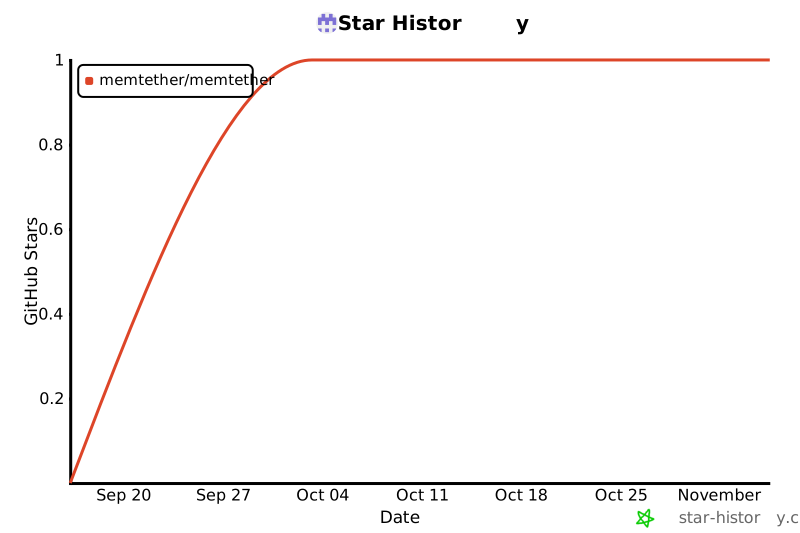
If MemTether helps you, please give it a ⭐ on GitHub — it helps other agents find it.
1 maintainer

Metadata
1 maintainer
Release files for memtether 0.1.0a66
For a detailed explanation of source distributions (sdists) and built distributions (wheels), please see the package formats documentation.
Source distribution (sdist)
| File | Size | Uploaded | Provenance | Actions |
|---|---|---|---|---|
| memtether-0.1.0a66.tar.gz | 357.3 kB | Without provenance | Details for memtether-0.1.0a66.tar.gz |
Built distribution (wheel)
| File | Interpreter | ABI | Platform | Actions Reset |
|---|---|---|---|---|
| memtether-0.1.0a66-py3-none-any.whl | Python 3 | none | any | Details for memtether-0.1.0a66-py3-none-any.whl |
Total release size: 680.7 kB
Release files / memtether-0.1.0a66.tar.gz
| Download URL | memtether-0.1.0a66.tar.gz |
|---|---|
| Size | 357.3 kB |
| Tags | Source |
|
SHA-256 checksum How to use checksums |
7c3d47ea35b8087b7a9a4699f799116fe3c92430ebbf053cd271df6c33dbf72c
|
|
BLAKE2b-256 checksum How to use checksums |
eef6ff7ae0551214ac42bbb45debcf2b591a875cfbb4dc00884afe4cb8be811d
|
| Upload date | |
|
Uploaded using Trusted Publishing? What is trusted publishing? |
No |
| Uploaded via |
twine/7.0.0 CPython/3.13.14
|
Release files / memtether-0.1.0a66-py3-none-any.whl
| Download URL | memtether-0.1.0a66-py3-none-any.whl |
|---|---|
| Size | 323.4 kB |
| Tags | Python 3 |
|
SHA-256 checksum How to use checksums |
55e32e2c5dbdff3461d0e207e9e2e5e7bc71d30761d500bb38cd89e66028cd34
|
|
BLAKE2b-256 checksum How to use checksums |
11bc3fe3632c2cc269f736044fb797797731eb2492a5df02811bcb79032379c4
|
| Upload date | |
|
Uploaded using Trusted Publishing? What is trusted publishing? |
No |
| Uploaded via |
twine/7.0.0 CPython/3.13.14
|
Security for memtether 0.1.0a66
Provenance
Provenance describes where a file came from. On PyPI, provenance is shared via attestations, which provide a verifiable record of the build or publishing details. View details, limitations and caveats.
No provenance found
None of the files in this release were uploaded with provenance metadata.
A note on package security
PyPI is a repository for distributing packages, not a service for auditing them. While third-party security researchers and our staff do their best to detect and remove malicious packages, PyPI cannot guarantee the quality, security or suitability of any given package.
To learn more about protecting yourself from malicious actors, visit our package security documentation.














