
MetaChat
Brief introduction
MetaChat is a Python package to screen metabolic cell communication (MCC) from spatial multi-omics data of transcriptomics and metabolomics. It contains many intuitive visualization and downstream analysis tools, provides a great practical toolbox for biomedical researchers.
Metabolic cell communication
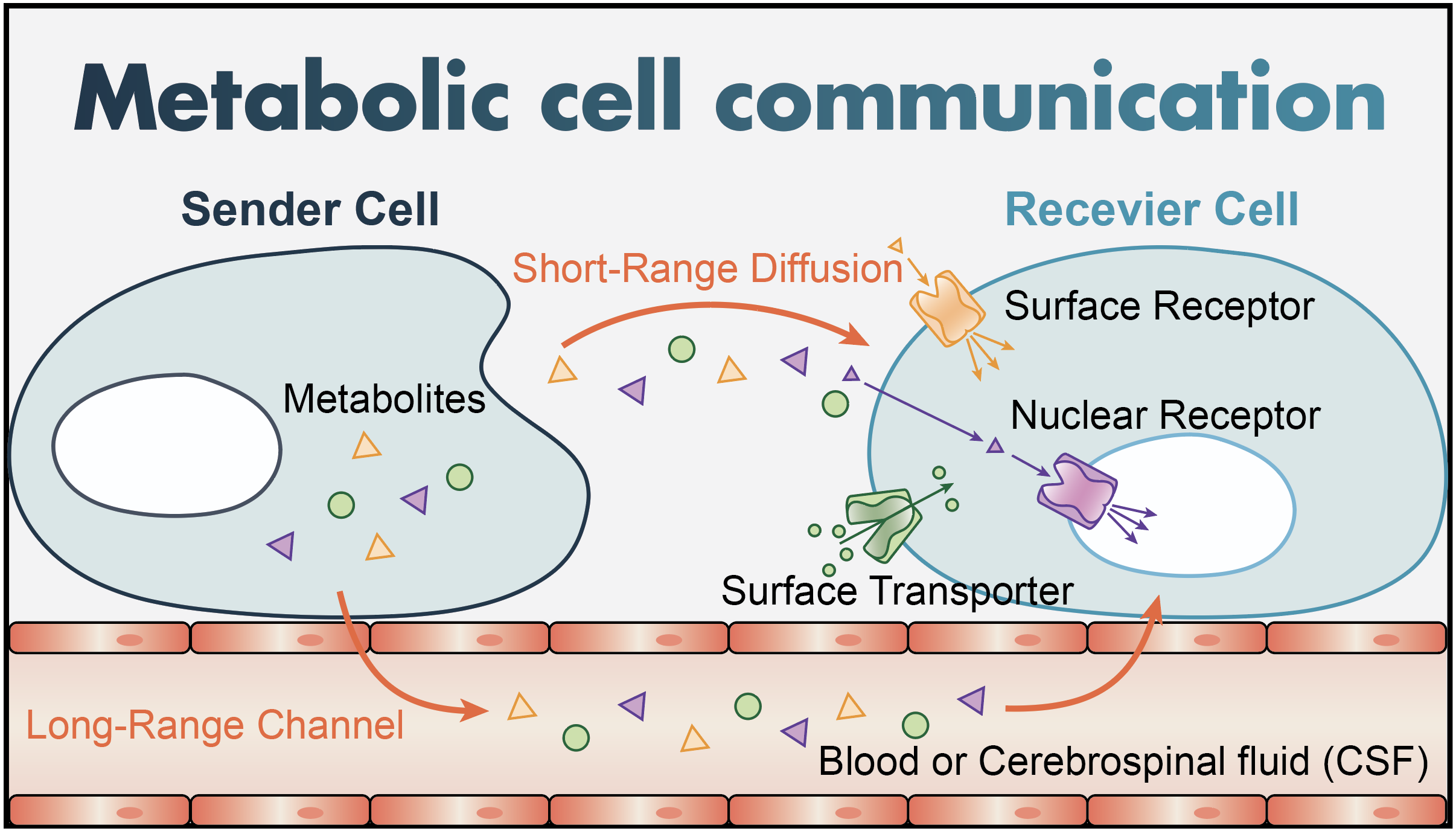
Metabolic cell-cell communication (MCC) occurs when sensor proteins in the receiver cells detect metabolites in their environment, activating intracellular signaling events. There are three major potential sensors of metabolites: surface receptors, nuclear receptors, and transporters. Metabolites secreted from cells are either transported over short-range distances (a few cells) via diffusion through extracellular space, or over long-range distances via the bloodstream and the cerebrospinal fluid (CSF).
MetaChatDB
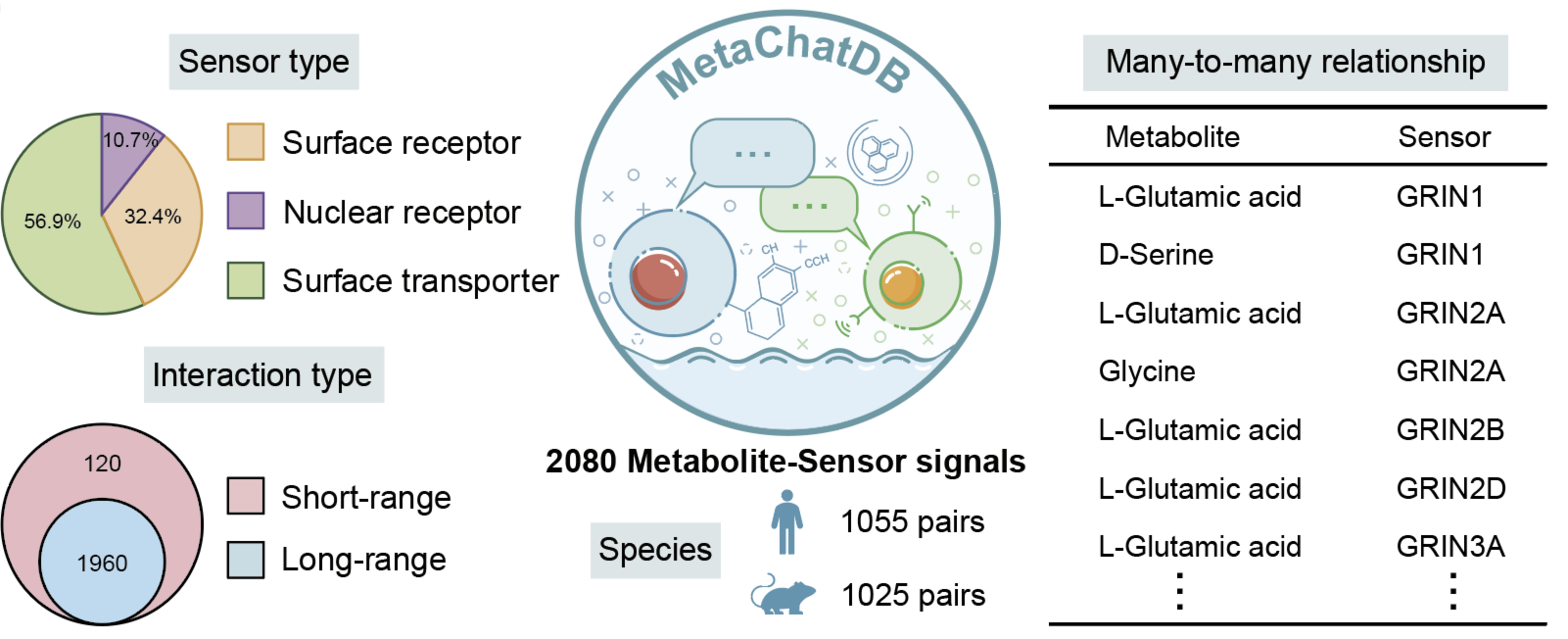
MetaChatDB is a literature-supported database for metabolite-sensor interactions for both human and mouse. All the metabolite-sensor interactions are reported based on peer-reviewed publications. Specifically, we manually build MetaChatDB by integrating three high-quality databases (PDB, HMDB, UniProt) that are being continually updated.
Documentation, and Tutorials
For more basic tutorial and real data examples, please see MetaChat documentation that is available through the link https://metachat.readthedocs.io/en/latest/.
Analysis pipeline
Installation
System requirements
Recommended operating systems: macOS or Linux. MetaChat was developed and tested on Linux and macOS.
Python requirements
MetaChat was developed using python 3.9.
Installation using pip
We suggest setting up MetaChat in a separate mamba or conda environment to prevent conflicts with other software dependencies. Create a new Python environment specifically for MetaChat and install the required libraries within it.
mamba create -n metachat_env python=3.9 r-base=4.3.2
mamba activate metachat_env
pip install metachat
if you use conda, r-base=4.3.2 may not included in the channels. Instead, you can r-base=4.3.1 in conda.
Reference
Luo S., Almet A.A., Zhao W., He C., Tsai Y.-C., Ozaki H., Sugita B.K., Du K., Shen X., Cao Y., Yang Q., Watanabe M., Nie Q.* Screening spatial metabolic communication of cells from spatial multi-omics with MetaChat.
1 maintainer

Metadata
1 maintainer
Release files for metachat 1.0.0
For a detailed explanation of source distributions (sdists) and built distributions (wheels), please see the package formats documentation.
Source distribution (sdist)
| File | Size | Uploaded | Provenance | |
|---|---|---|---|---|
| metachat-1.0.0.tar.gz | 556.3 kB | Without provenance | Details |
Built distribution (wheel)
| File | Interpreter | ABI | Platform | Reset |
|---|---|---|---|---|
| metachat-1.0.0-py3-none-any.whl | Python 3 | none | any | Details |
Total release size: 1.6 MB
Release files / metachat-1.0.0.tar.gz
| Download URL | metachat-1.0.0.tar.gz |
|---|---|
| Size | 556.3 kB |
| Tags | Source |
|
SHA-256 checksum How to use checksums |
4b7bbaa4a017c45766b413804b5cee717206f18c3e94db2e026c1e86ffe1a999
|
|
BLAKE2b-256 checksum How to use checksums |
30cc2603b66bf22a4664e71a639b4f825d0142e916b60ce828b662323272128b
|
| Upload date | |
|
Uploaded using Trusted Publishing? What is trusted publishing? |
No |
| Uploaded via |
twine/6.2.0 CPython/3.9.23
|
Release files / metachat-1.0.0-py3-none-any.whl
| Download URL | metachat-1.0.0-py3-none-any.whl |
|---|---|
| Size | 1.1 MB |
| Tags | Python 3 |
|
SHA-256 checksum How to use checksums |
2de4d7d6c26943c0eb20ee55e9bbafddc779efe330bf9df00ffea8c148652471
|
|
BLAKE2b-256 checksum How to use checksums |
a5ce5b64bb75552ca85dab3fbb32ea4ce68d0a5df067c1195479075d079d729d
|
| Upload date | |
|
Uploaded using Trusted Publishing? What is trusted publishing? |
No |
| Uploaded via |
twine/6.2.0 CPython/3.9.23
|
Security for metachat 1.0.0
Provenance
Provenance describes where a file came from. On PyPI, provenance is shared via attestations, which provide a verifiable record of the build or publishing details. View details, limitations and caveats.
No provenance found
None of the files in this release were uploaded with provenance metadata.
A note on package security
PyPI is a repository for distributing packages, not a service for auditing them. While third-party security researchers and our staff do their best to detect and remove malicious packages, PyPI cannot guarantee the quality, security or suitability of any given package.














