
metalstat

Apple Silicon GPU/CPU/Memory monitoring CLI — like gpustat, but for Metal.
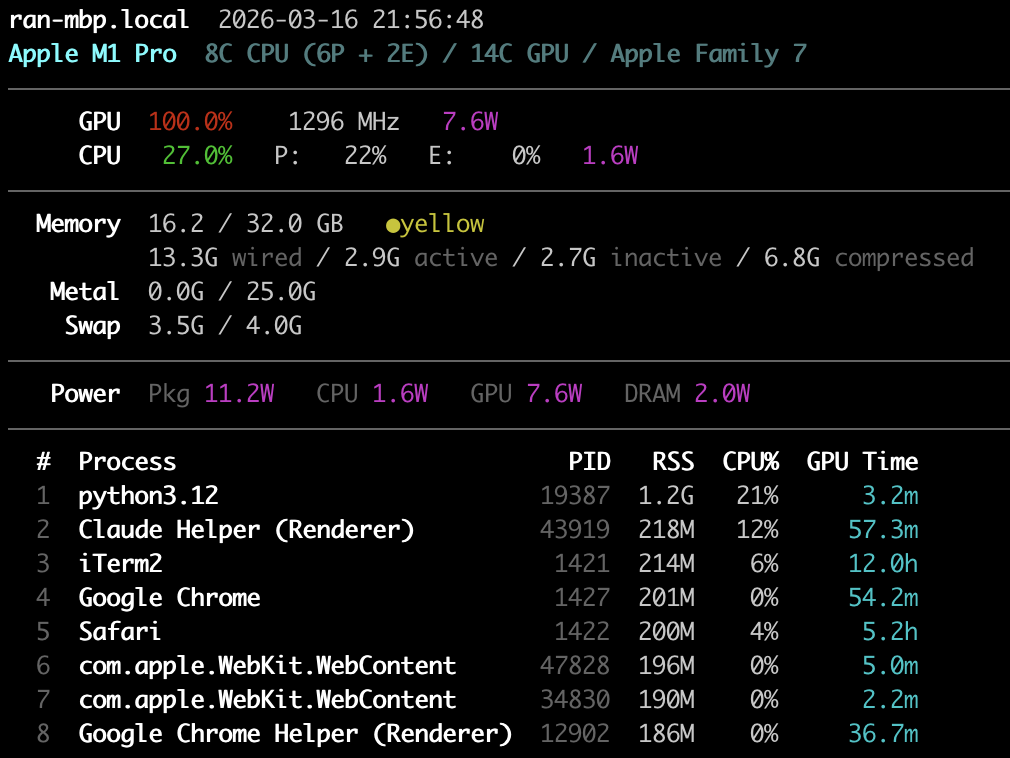
No sudo required. Uses IOReport private API for GPU/power metrics.
Install
pip install metalstat
Or with uv:
uv tool install metalstat
Usage
# One-shot: all metrics + top processes
metalstat -a -p

# Watch mode: refresh every 1s
metalstat -a -i 1

# See all options
metalstat --help
Logging an inference job
Wrap any command with metalstat run to log system metrics while it executes:
metalstat run -o myexp --capture -- ./my_inference --model foo.gguf
Three files land under the -o prefix:
myexp.meta.json— static info (hostname, chip, total memory)myexp.jsonl— per-tick metric samples, streamed while the child runsmyexp.log— child stdout+stderr (only with--capture)
Use the same prefix your experiment uses for its own artifacts and everything
pairs up on disk. metalstat forwards SIGINT/SIGTERM to the child and exits
with the child's exit code.
For ad-hoc composition, three lower-level flags emit JSON directly:
metalstat --jsonl                      # one sample, then exit
metalstat --jsonl -i 1 > run.jsonl     # stream to stdout
metalstat --meta-json > run.meta.json  # static info only
--jsonl always collects CPU, GPU, and power regardless of other flags, so
the schema stays uniform across runs. Each sample line is a flat object:
| field | meaning |
|---|---|
t |
wall-clock time (unix seconds, float) |
elapsed_s |
seconds since first sample in this stream |
gpu_util, gpu_freq_mhz |
GPU utilization (0-100) and frequency |
cpu_util, cpu_p_util, cpu_e_util |
total / P-cluster / E-cluster utilization |
mem_used_gb, mem_wired_gb, mem_active_gb, mem_inactive_gb, mem_compressed_gb |
memory breakdown (GiB, labeled _gb) |
mem_pressure_pct, mem_pressure_level |
memory pressure (green / yellow / red) |
gpu_mem_allocated_gb |
Metal GPU memory currently allocated |
swap_used_gb |
swap in use |
cpu_w, gpu_w, ane_w, dram_w, pkg_w |
power draw per rail (watts) |
All numeric fields are null when unavailable. Every line has the same keys,
so it loads directly into pandas:
import pandas as pd
df = pd.read_json("run.jsonl", lines=True)
df.plot(x="elapsed_s", y=["gpu_util", "cpu_util"])
Sizes suffixed _gb are GiB (1024³ bytes), matching what the formatted view
displays.
Understanding Apple Silicon memory (vs. CUDA)
Apple Silicon uses Unified Memory Architecture (UMA) — the CPU and GPU share a single pool of RAM. There is no separate VRAM. This is fundamentally different from NVIDIA/CUDA where the GPU has its own dedicated memory (e.g. 24GB VRAM on an RTX 4090) and data must be copied between CPU and GPU over PCIe.
What the memory numbers mean
  Memory  15.6 / 32.0 GB   ●green                    ← system memory (shared by CPU + GPU)
          2.7G wired / 12.9G active / ...             ← breakdown by page state
   Metal  3.4G / 25.0G                                ← GPU memory in use / recommended max
System memory (15.6 / 32.0 GB) is the total unified memory usage — CPU and
GPU workloads combined. The breakdown shows:
- Wired: Locked by the kernel, cannot be paged out or compressed
- Active: Recently used pages
- Inactive: Not recently accessed, still in RAM, reclaimable
- Compressed: macOS compresses inactive pages in-memory before swapping to disk
Metal GPU memory (3.4G / 25.0G) shows how much system memory is
currently in use by GPU resources (textures, buffers, ML model weights) across
all processes vs. the recommended maximum. The in-use value is read
system-wide from the IOAccelerator IORegistry node — MTLDevice's own
currentAllocatedSize is per-process and would only see this tool's own
(empty) device. This is the closest equivalent to "VRAM used / VRAM total" on
NVIDIA, but with important differences:
| NVIDIA (CUDA) | Apple Silicon (Metal) | |
|---|---|---|
| GPU memory pool | Dedicated VRAM (fixed) | Shared with CPU (unified) |
| "Total" | Physical VRAM size | recommendedMaxWorkingSetSize (~75% of RAM) |
| Hard limit? | Yes — allocation fails at VRAM cap | No — soft limit, but going over causes swap thrashing |
| Zero-copy CPU↔GPU? | No, must cudaMemcpy |
Yes, CPU and GPU see the same physical pages |
The recommended max (~75% of RAM) is not a hardware limit — Metal will let you allocate beyond it. But exceeding it forces the OS to compress or swap out other memory, degrading performance. This is why a 192GB Mac can load LLMs that would need multiple 80GB A100s: the GPU directly accesses main memory with no copy overhead, but you're sharing that memory budget with the rest of the system.
Pressure (●green / ●yellow / ●red) shows system-wide memory pressure:
- Green (>50% free): Healthy, plenty of headroom
- Yellow (25-50% free): Moderate pressure, compression active
- Red (<25% free): Heavy pressure, swapping likely
Requirements
- macOS on Apple Silicon (M1/M2/M3/M4)
- Python 3.9+
License
MIT
1 maintainer

Metadata
1 maintainer
Release files for metalstat 0.1.6
For a detailed explanation of source distributions (sdists) and built distributions (wheels), please see the package formats documentation.
Source distribution (sdist)
| File | Size | Uploaded | |
|---|---|---|---|
| metalstat-0.1.6.tar.gz | 194.6 kB | Details |
Built distribution (wheel)
| File | Interpreter | ABI | Platform | Reset |
|---|---|---|---|---|
| metalstat-0.1.6-py3-none-any.whl | Python 3 | none | any | Details |
Total release size: 221.2 kB
Release files / metalstat-0.1.6.tar.gz
| Download URL | metalstat-0.1.6.tar.gz |
|---|---|
| Size | 194.6 kB |
| Tags | Source |
|
SHA-256 checksum How to use checksums |
10740c9e623974e64a2cccbcb3faa1cced41f16d9afe47fe5b477e4306b0348c
|
|
BLAKE2b-256 checksum How to use checksums |
a6e95140e11b7da2054f58acd2875baf6aef89804eff3335977019a2cec42917
|
| Upload date | |
|
Uploaded using Trusted Publishing? What is trusted publishing? |
No |
| Uploaded via |
uv/0.6.10
|
Release files / metalstat-0.1.6-py3-none-any.whl
| Download URL | metalstat-0.1.6-py3-none-any.whl |
|---|---|
| Size | 26.6 kB |
| Tags | Python 3 |
|
SHA-256 checksum How to use checksums |
2620c6bb5dfcc2227a77e46ee14701aa858384c6ee04d498ef6ae0132168a76a
|
|
BLAKE2b-256 checksum How to use checksums |
01eeee85f60e97c677fd06346491d81a6d05e05f10bc0278efd94f05df412746
|
| Upload date | |
|
Uploaded using Trusted Publishing? What is trusted publishing? |
No |
| Uploaded via |
uv/0.6.10
|














