
micrograd_hk



A tiny autograd engine built on top of NumPy for fast, matrix-driven backpropagation.
This package implements a minimal Value computation graph (inspired by micrograd), but instead of scalar-by-scalar autograd, everything is vectorized over full NumPy matrices — so training is significantly faster.
It ships with a small MLP / DenseLayer API and a Trainer class supporting several optimizers: SGD, Momentum, RMSProp, Adam, and a custom variant, Adam-M, developed and tuned as part of this project.
✨ Features
- Matrix-first
Valueautograd engine (@,+,-,**,sum,tanh) with full backward-pass support - Simple
DenseLayerandMLPbuilding blocks - Built-in
Trainerwith automatic checkpoint saving/loading - Five optimizers out of the box, including a custom modified Adam
- Optional
tqdmprogress bar during training
📦 Installation
pip install micrograd_hk
To also get the training progress bar:
pip install micrograd_hk[progress]
🚀 Quick Start
from micrograd_hk import Value, DenseLayer, MLP, Trainer

# Build a small MLP: 3 input features -> [8, 8, 1]
m = MLP(shape=[1, 3], nouts=[8, 8, 1])

# Wrap your data and model in a Trainer
loss_evaluator = Trainer(m, xs_matrix, ys_matrix)

# Train using matrix calculations
final_loss, y_pred = loss_evaluator.train(
    lr=0.01,
    iterations=3000,
    optimizer="adam_m",
    iter_stp=None,
    save_checkpoint=True,
)
For lower-level control, MLP and DenseLayer can be used and composed directly.
🧠 Optimizers
Trainer supports the following, selected via the optimizer argument of .train():
| Optimizer | Key |
|---|---|
| SGD | "sgd" |
| Momentum | "momentum" |
| RMSProp | "rmsprop" |
| Adam | "adam" |
| Adam-M | "adam_m" |
Adam (standard)
$$ m_t = \beta_1 m_{t-1} + (1 - \beta_1) g_t \qquad\quad v_t = \beta_2 v_{t-1} + (1 - \beta_2) g_t^2 $$
$$ \hat{m}_t = \frac{m_t}{1 - \beta_1^{t}} \qquad\quad \hat{v}_t = \frac{v_t}{1 - \beta_2^{t}} $$
$$ \theta_t = \theta_{t-1} - \frac{\eta , \hat{m}_t}{\sqrt{\hat{v}_t} + \epsilon} $$
Adam-M (modified — this project)
Adam-M keeps the same moment estimates as Adam, but changes two things: the bias-correction denominators are shifted constants instead of powers of the raw betas, and the step counter t periodically resets every iter_stp steps.
$$ m_t = \beta_1 m_{t-1} + (1 - \beta_1) g_t \qquad\quad v_t = \beta_2 v_{t-1} + (1 - \beta_2) g_t^2 $$
$$ \hat{m}_t = \frac{m_t}{1.5 - \beta_1^{t}} \qquad\quad \hat{v}_t = \frac{v_t}{2.5 - \beta_2^{t}} $$
$$ \theta_t = \theta_{t-1} - \frac{\eta , \hat{m}_t}{\sqrt{\hat{v}_t} + \epsilon} $$
$$ \text{if } iter_stp \text{ is set and } t > iter_stp: \quad t \leftarrow 1 $$
Reference implementation:
def adam_m(self, iter_stp, beta1=0.9, beta2=0.999, eps=1e-8):
    """Adam-M Variant with periodic counter resets."""
    self.t += 1
    if iter_stp is not None and self.t > iter_stp:
        self.t = 1  # Reset counter back to 1

    for p in self.mlp.parameters():
        p.momentum = p.momentum * beta1 + (1.0 - beta1) * p.grad
        p.velocity = (beta2 * p.velocity) + (1.0 - beta2) * (p.grad ** 2)

        momentum_corrected = p.momentum / (1.5 - beta1 ** self.t)
        velocity_corrected = p.velocity / (2.5 - beta2 ** self.t)

        p.data -= (self.lr * momentum_corrected) / (np.sqrt(velocity_corrected) + eps)
The periodic reset keeps the bias-correction terms from decaying all the way to 1 over long training runs, which in testing gave Adam-M steadier convergence on longer runs compared to standard Adam.
📊 Benchmarks
Adam vs. Adam-M, trained on the same model and data (test.py, using matplotlib):
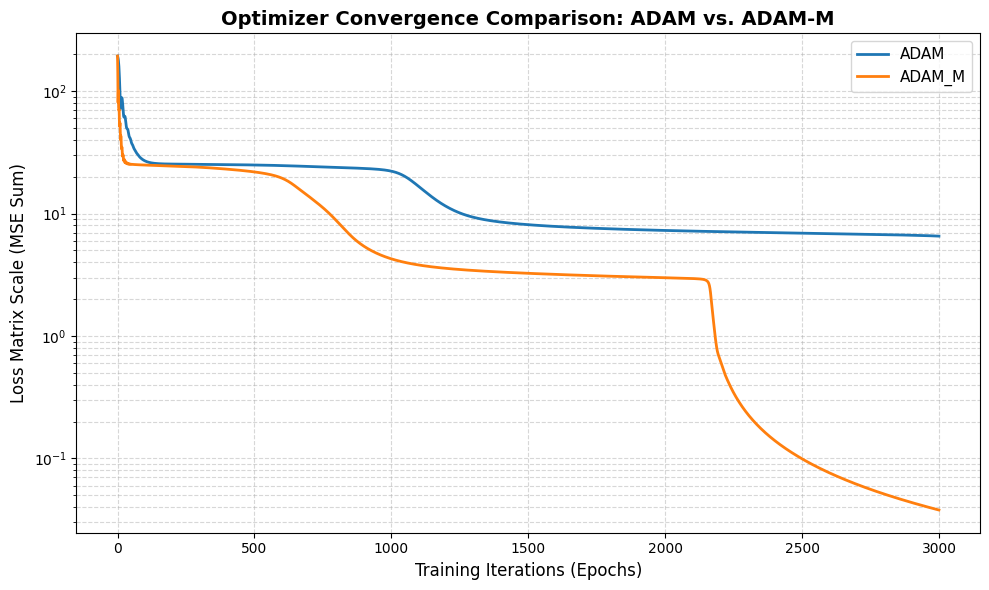
Generated by the optimizer comparison script — both optimizers are trained on identical, deep-copied model initializations so the comparison is apples-to-apples.
🧩 Saving & Loading Models
Training checkpoints are saved automatically when save_checkpoint=True:
final_loss, y_pred = loss_evaluator.train(
    lr=0.01,
    iterations=3000,
    optimizer="adam_m",
    save_checkpoint=True,
    save_filename="trained_mlp.pkl",
)
To reload a trained model into a fresh architecture:
from micrograd_hk import MLP, Trainer

blueprint = MLP(shape=[1, 3], nouts=[8, 8, 1])
model = Trainer.load_model("trained_mlp.pkl", blueprint)
📄 License
MIT © Hariom Lohat
1 maintainer

Metadata
1 maintainer
Release files for micrograd-hk 0.1.1
For a detailed explanation of source distributions (sdists) and built distributions (wheels), please see the package formats documentation.
Source distribution (sdist)
| File | Size | Uploaded | |
|---|---|---|---|
| micrograd_hk-0.1.1.tar.gz | 73.2 kB | Details |
Built distribution (wheel)
| File | Interpreter | ABI | Platform | Reset |
|---|---|---|---|---|
| micrograd_hk-0.1.1-py3-none-any.whl | Python 3 | none | any | Details |
Total release size: 84.8 kB
Release files / micrograd_hk-0.1.1.tar.gz
| Download URL | micrograd_hk-0.1.1.tar.gz |
|---|---|
| Size | 73.2 kB |
| Tags | Source |
|
SHA-256 checksum How to use checksums |
109cc604c10818b77ded45771ae1feef3c1ab2e80c78fd3ee357b1255abf67f4
|
|
BLAKE2b-256 checksum How to use checksums |
09d2e3e715519bca7776516b2f275afa3d32a74b21ccf7e348539c34fbcbff0a
|
| Upload date | |
|
Uploaded using Trusted Publishing? What is trusted publishing? |
No |
| Uploaded via |
twine/6.2.0 CPython/3.13.14
|
Release files / micrograd_hk-0.1.1-py3-none-any.whl
| Download URL | micrograd_hk-0.1.1-py3-none-any.whl |
|---|---|
| Size | 11.6 kB |
| Tags | Python 3 |
|
SHA-256 checksum How to use checksums |
a4a229c57779c18fe6f8dfee41b80582af40f536e0a015af3b846443c1867b8b
|
|
BLAKE2b-256 checksum How to use checksums |
45c7a320471ed391e29bf0fa0975b2e9f876bcbfa71224c4dc9a5d0a1e4fbaef
|
| Upload date | |
|
Uploaded using Trusted Publishing? What is trusted publishing? |
No |
| Uploaded via |
twine/6.2.0 CPython/3.13.14
|













