
MindGlide
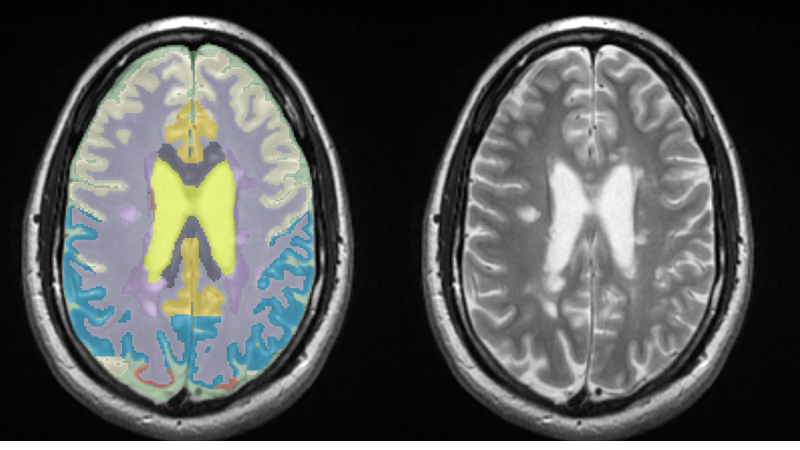
Brain MRI segmentation for multiple sclerosis — any modality, any quality.
Built with PyTorch + MONAI, trained on >23 000 scans. Nature Communications (2025)




Get started
pip install git+https://github.com/MS-PINPOINT/mindGlide.git
mindglide -i scan.nii.gz -o scan_seg.nii.gz
That's it. Python ≥ 3.9; runs on GPU (seconds per scan) or CPU (a few minutes) —
picked automatically. The trained model (~123 MB) downloads and caches on first
run. Point -i at a folder to segment every NIfTI file in it:
mindglide -i scans/ -o segs/ # writes segs/<name>_seg.nii.gz for every scan
(python -m mindglide … works too.)
No scan at hand? Try the public MNI152 template:
curl -O https://templateflow.s3.amazonaws.com/tpl-MNI152NLin2009cAsym/tpl-MNI152NLin2009cAsym_res-01_T1w.nii.gz
mindglide -i tpl-MNI152NLin2009cAsym_res-01_T1w.nii.gz -o mni_seg.nii.gz
To get per-region volumes (mm³) as a CSV:
mindglide-volumes scan_seg.nii.gz --out-csv scan_volumes.csv
Options
| Option | Meaning |
|---|---|
--device {auto,cpu,cuda,mps} |
Compute device (default: auto — a working GPU if present, else CPU). |
--sw-batch-size N |
Sliding-window batch size (default 4). Lower it if the GPU runs out of memory. |
--model-path FILE |
Use a local .pt checkpoint instead of the automatic download (offline use). |
--resume |
Folder mode: skip scans already segmented in the output folder. |
--no-klc |
Keep all connected components (skip largest-component cleanup). |
--no-reorient |
Skip internal RAS re-orientation. Output always matches the input scan's grid. |
Output labels
| Code | Structure | Code | Structure |
|---|---|---|---|
| 0 | Background | 10 | Optic_chiasm |
| 1 | CSF | 11 | Cerebellar_vermis |
| 2 | Ventricles_3_4_5 | 12 | Corpus_callosum |
| 3 | DGM | 13 | White_matter |
| 4 | Pons | 14 | Frontal_lobe_GM |
| 5 | Brainstem | 15 | Limbic_cortex_GM |
| 6 | Cerebellum | 16 | Parietal_lobe_GM |
| 7 | Temporal_lobe | 17 | Occipital_lobe_GM |
| 8 | Temporal_horn_lateral_ventricle | 18 | Lesion |
| 9 | Lateral_ventricle | 19 | Ventral_diencephalon |
Troubleshooting
"Warning: not using the GPU — … this PyTorch build cannot run on it" —
the default pip PyTorch wheels no longer include kernels for older GPUs
(e.g. Pascal cards: GTX 10xx, Quadro P series). MindGlide falls back to CPU
automatically. To use such a GPU, install a compatible PyTorch first:
pip install "torch==2.6.0+cu118" --index-url https://download.pytorch.org/whl/cu118
pip install git+https://github.com/MS-PINPOINT/mindGlide.git
GPU out of memory — try --sw-batch-size 1, or --device cpu.
Apple Silicon — auto uses MPS when available. If an operation is
unsupported, run with --device cpu or set PYTORCH_ENABLE_MPS_FALLBACK=1.
Offline / air-gapped machines — download
the checkpoint once
and pass --model-path /path/to/model.pt (or set MODEL_PATH).
Model cache location — the auto-downloaded model lives in the Hugging Face
cache (~/.cache/huggingface by default); set HF_HOME to move it.
Docker / Apptainer
Build once (model weights are baked in, so the container works offline):
git clone https://github.com/MS-PINPOINT/mindGlide.git
cd mindGlide
docker build -t mindglide .
Run (drop --gpus all on CPU-only hosts; --user makes the output files owned
by you rather than the container user):
docker run --gpus all --ipc=host --user $(id -u):$(id -g) -v /data:/data \
  mindglide -i /data/scan.nii.gz -o /data/scan_seg.nii.gz
For Apptainer/Singularity on HPC:
apptainer build mindglide.sif docker-daemon://mindglide:latest
apptainer run --nv -B /data:/data mindglide.sif -i /data/scan.nii.gz -o /data/scan_seg.nii.gz
Model weights
The checkpoint (_20240404_conjurer_trained_dice_7733.pt) is downloaded
automatically from
Hugging Face: MS-PINPOINT/mindglide
on first run. Additional and legacy checkpoints are archived in the same
repository. Models were trained on the datasets described in the
paper.
From a source checkout you can also fetch the weights as a git submodule (requires Git LFS):
git submodule update --init --recursive
git submodule foreach 'git lfs pull'
Development & tests
git clone https://github.com/MS-PINPOINT/mindGlide.git
cd mindGlide
pip install -e ".[test]"

pytest                          # fast unit tests (seconds, no model download)
MINDGLIDE_RUN_SLOW=1 pytest -v  # + end-to-end on a public MNI scan (CPU, and GPU if present)
The original container-based training/fine-tuning pipeline was retired from
the main branch and is preserved at the
legacy-container
tag.
Citation
If you use MindGlide, please cite:
Goebl P, Wingrove J, Abdelmannan O, et al. Enabling new insights from old scans by repurposing clinical MRI archives for multiple sclerosis research. Nature Communications. 2025;16(1):3149. doi:10.1038/s41467-025-58274-8
BibTeX
@article{Goebl2025,
    author = {Goebl, Philipp and Wingrove, Jed and Abdelmannan, Omar and {Brito Vega}, Barbara and Stutters, Jonathan and Ramos, {Silvia Da Graca} and Kenway, Owain and Rossor, Thomas and Wassmer, Evangeline and Arnold, Douglas L. and Collins, Louis and Hemingway, Cheryl and Narayanan, Sridar and Chataway, Jeremy and Chard, Declan and Iglesias, {Juan Eugenio} and Barkhof, Frederik and Parker, Geoffrey J. M. and Oxtoby, Neil P. and Hacohen, Yael and Thompson, Alan and Alexander, Daniel C. and Ciccarelli, Olga and Eshaghi, Arman},
    title = {Enabling new insights from old scans by repurposing clinical {MRI} archives for multiple sclerosis research},
    journal = {Nature Communications},
    volume = {16},
    number = {1},
    pages = {3149},
    year = {2025},
    month = apr,
    doi = {10.1038/s41467-025-58274-8},
    pmid = {40195318},
    pmcid = {PMC11976987}
}
Acknowledgements
This study/project is funded by the UK National Institute for Health and Social Care (NIHR) Advanced Fellowship to Arman Eshaghi (Award ID: NIHR302495). The views expressed are those of the author(s) and not necessarily those of the NIHR or the Department of Health and Social Care.

1 maintainer

Download files
Download the file for your platform. If you're not sure which to choose, learn more about installing packages.
Source Distribution
Built Distribution
Filter files by name, interpreter, ABI, and platform.
If you're not sure about the file name format, learn more about wheel file names.
Copy a direct link to the current filters
File details
Details for the file mindglide-1.2.0.tar.gz.
File metadata
- Download URL: mindglide-1.2.0.tar.gz
- Upload date:
- Size: 27.9 kB
- Tags: Source
- Uploaded using Trusted Publishing? Yes
- Uploaded via:
twine/7.0.0 CPython/3.13.14
File hashes
| Algorithm | Hash digest | |
|---|---|---|
| SHA256 |
8a27ab24d412b34319b586e83a93da4798caf2ab5b4c67ac0376b1d2c982bc02
|
|
| MD5 |
c9246063891b154ee0194ff40c9a32e6
|
|
| BLAKE2b-256 |
5c928e3c1d08871227a07bc2c9480a6294a7c668095aa5748f569f0e5b130685
|
Provenance
The following attestation bundles were made for mindglide-1.2.0.tar.gz:
Publisher:
publish.yml on MS-PINPOINT/mindGlide
-
Statement:
-
Statement type:
https://in-toto.io/Statement/v1 -
Predicate type:
https://docs.pypi.org/attestations/publish/v1 -
Subject name:
mindglide-1.2.0.tar.gz -
Subject digest:
8a27ab24d412b34319b586e83a93da4798caf2ab5b4c67ac0376b1d2c982bc02 - Sigstore transparency entry: 2449996595
- Sigstore integration time:
-
Permalink:
MS-PINPOINT/mindGlide@63c3edf7de91ad05c834801a68c64bfd050f4d5f -
Branch / Tag:
refs/tags/v1.2.0 - Owner: https://github.com/MS-PINPOINT
-
Access:
public
-
Token Issuer:
https://token.actions.githubusercontent.com -
Runner Environment:
github-hosted -
Publication workflow:
publish.yml@63c3edf7de91ad05c834801a68c64bfd050f4d5f -
Trigger Event:
release
-
Statement type:
File details
Details for the file mindglide-1.2.0-py3-none-any.whl.
File metadata
- Download URL: mindglide-1.2.0-py3-none-any.whl
- Upload date:
- Size: 20.7 kB
- Tags: Python 3
- Uploaded using Trusted Publishing? Yes
- Uploaded via:
twine/7.0.0 CPython/3.13.14
File hashes
| Algorithm | Hash digest | |
|---|---|---|
| SHA256 |
19cdb8d67b810423e6fcf6e1db8c5d80ef4fda58d1cd86781dd928cb26382f7b
|
|
| MD5 |
d6d1ead1221b723c057715a173ee62bb
|
|
| BLAKE2b-256 |
6f057cbf683070dc932497c56244d88c01deb626920bd042b88d536ed96f0b19
|
Provenance
The following attestation bundles were made for mindglide-1.2.0-py3-none-any.whl:
Publisher:
publish.yml on MS-PINPOINT/mindGlide
-
Statement:
-
Statement type:
https://in-toto.io/Statement/v1 -
Predicate type:
https://docs.pypi.org/attestations/publish/v1 -
Subject name:
mindglide-1.2.0-py3-none-any.whl -
Subject digest:
19cdb8d67b810423e6fcf6e1db8c5d80ef4fda58d1cd86781dd928cb26382f7b - Sigstore transparency entry: 2449996651
- Sigstore integration time:
-
Permalink:
MS-PINPOINT/mindGlide@63c3edf7de91ad05c834801a68c64bfd050f4d5f -
Branch / Tag:
refs/tags/v1.2.0 - Owner: https://github.com/MS-PINPOINT
-
Access:
public
-
Token Issuer:
https://token.actions.githubusercontent.com -
Runner Environment:
github-hosted -
Publication workflow:
publish.yml@63c3edf7de91ad05c834801a68c64bfd050f4d5f -
Trigger Event:
release
-
Statement type:







