
A single Python module, with no dependencies, producing an SVG image of a chart with one or more plotted lines

Project description
minilineplot
minilineplot.py is a single Python module, with no dependencies, producing an SVG image of a chart with one or more plotted lines.
The chart has a left vertical axis and a bottom horizontal axis, grid lines are possible,
Two classes are defined.
Line, containing x,y points which creates a line to be plotted
Axis which creates the axis, and to which Line objects can be added.
The Axis class has methods to create an svg string suitable for embedding in an html document it can also create an svg image, either as a bytes object, or saved to a file.
Line
Arguments (and attributes)
values a list of x,y tuples, x and y being integers or floats.
color an SVG color of the line, such as 'blue'.
stroke line width, 1 for a thin line, default is 3.
label A label string for a key, if not given, the key will not be drawn
x values should be increasing values, and any outside of the xmin and xmax values set into the Axis object will not cause an error, but will not be plotted.
y values should be values between the ymin and ymax Axis attributes, if any are outside then a ValueError will be raised when the SVG image is created.
Instead of a list, the values argument could also be a deque holding (x,y) tuples, which may be useful if measurements are being appended and a maximum number of points are to be retained.
color is an SVG color, using standard strings such as
Color Names: "red", "blue" etc.
Hex Codes: "#FF0000" for red.
RGB/RGBA: "rgb(255,0,0)" or "rgba(255,0,0,0.5)" (with opacity).
HSL/HSLA: "hsl(0,100%,50%)" or "hsla(0,100%,50%,0.5)" (hue, saturation, lightness, alpha)
Axis
Arguments (and attributes)
lines list of Line objects
fontsize default 24
imagewidth default 800
imageheight default 600
xstrings an optional list of strings used as the x axis values, use for text values such as months, etc.,
If xstrings is left empty, the following two arguments will define the x axis text
xformat default string ".1f" Sets how the x axis numbers are formatted.
xintervals default 5, the interval spacing of values along the x axis, 5 would be five intervals and six values.
The above values are ignored if xstrings is populated, intervals are taken from the number of strings.
xmin default 0, the minimum plotted x value
xmax default 100, the maximum plotted x value
xmin and xmax can be set manually, either as class arguments, or setting the attributes after an Axis object is instantiated. They can also be set automatically by calling the auto_x() method.
If xstrings is set with strings, xmin should be set to the value corresponding to the first string, and xmax to the value corresponding to the last string, this aligns values with the axis strings.
ystrings an optional list of strings used as the y axis values.
If ystrings is left empty, the following two arguments will define the y axis text
yformat default string ".1f" Sets how the y axis numbers are formatted.
yintervals default 5, the interval spacing of values along the y axis, 5 would be five intervals and six values.
The above values are ignored if ystrings is populated, intervals are taken from the number of strings.
ymin default 0, the minimum y value
ymax default 100, the maximum y value
title default empty string. If given this will be printed at the top of the chart.
description default empty string. If given this will be printed at the bottom of the chart.
verticalgrid default 1
0 is no vertical grid lines, 1 is a line for every x axis interval, 2 is a line for every second interval etc.,
horizontalgrid default 1
0 is no horizontal grid lines, 1 is a line for every y axis interval, 2 is a line for every second interval etc.,
The following colors are SVG colors, using standard strings
gridcol default "grey" Color of the chart grid
axiscol default "black" Color of axis, title and description
chartbackcol default "white" the background colour of the chart
backcol default "white" The background colour of the whole image
xformat and yformat are strings describing how numbers are printed, for example the string ".2f" gives a number to two decimal places.
If chart text starts overlapping, either decrease font size, or increase the image size while keeping fontsize the same.
All arguments are also object attributes, and can be changed as required.
Methods
auto_x()
If xstrings has a value this does nothing, just returns. Otherwise it inspects the lines and auto chooses x axis values which it sets into self.xmax, self.xmin, self.xformat and self.xintervals.
This could be useful for generated line data, or for initiall viewing after which better values could be chosen.
auto_y()
If ystrings has a value this does nothing, just returns. Otherwise it inspects the lines and auto chooses y axis values which it sets into self.ymax, self.ymin, self.yformat and self.yintervals.
auto_time_x(hourspan = 4, localtime = True)
If this is called, all x values should be times in seconds since the epoch, such as that returned by time.time().
hourspan should be the number of hours to display along the x axis with a value from 1 to 48. The hours shown will be the given span of hours up to the latest value. So the latest measurement will be shown.
This method sets self.xmax, self.xmin to the appropriate seconds values, and self.xstrings to display strings along the x axis as hours. These will be local hours if localtime is True, or UTC hours if False. So it could be used to produce a chart as measurements are created with (time.time(), y) tuples.
The following methods produce the SVG chart.
to_string(xml_declaration = False)
Returns a string SVG object. If xml_declaration is True, an xml tag will be included in the returned string which is usually required when creating an svg image file but not required if embedding the code directly into an html document.
to_bytes(xml_declaration = True)
Returns a bytes SVG object.
to_file(filepath)
Saves the plot to an svg image file
To install, either use Pypi, or simply copy minilineplot.py to your own project files. The code is public domain.
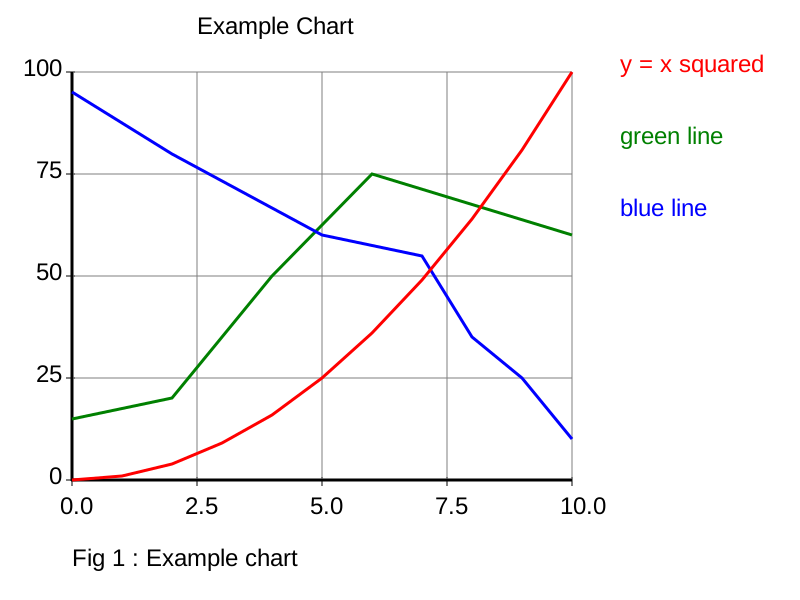
A typical example might be:
line1 = Line(values = [(0,15), (2,20), (4, 50), (6, 75), (10, 60)],
             color = "green",
             label = "green line")
line2 = Line(values = [(0,95), (2,80), (5, 60), (7, 55), (8, 35), (9, 25), (10, 10)],
            color = "blue",
            label = "blue line")
line3 = Line(values = list((x,x**2) for x in range(11)),
            color = "red",
            label = "y = x squared")
example = Axis( [line1, line2, line3],
                title = "Example Chart",
                description = "Fig 1 : Example chart")
example.auto_x()
example.auto_y()
example.to_file("test.svg")


Download files
Download the file for your platform. If you're not sure which to choose, learn more about installing packages.
Source Distribution
Built Distribution
Filter files by name, interpreter, ABI, and platform.
If you're not sure about the file name format, learn more about wheel file names.
Copy a direct link to the current filters
File details
Details for the file minilineplot-0.0.7.tar.gz.
File metadata
- Download URL: minilineplot-0.0.7.tar.gz
- Upload date:
- Size: 10.5 kB
- Tags: Source
- Uploaded using Trusted Publishing? No
- Uploaded via: python-requests/2.32.5
File hashes
| Algorithm | Hash digest | |
|---|---|---|
| SHA256 |
12b4e4c1b7c5686f431d88d36ad8a39920fe6396378004c2e1a96607e706bfcf
|
|
| MD5 |
8b8a4e2058992f979ec2f92c945fe044
|
|
| BLAKE2b-256 |
a3e5124f92b9a59760a6058b3d9fe8087eb9861b687ea3c1d16b45b30f038826
|
File details
Details for the file minilineplot-0.0.7-py3-none-any.whl.
File metadata
- Download URL: minilineplot-0.0.7-py3-none-any.whl
- Upload date:
- Size: 11.3 kB
- Tags: Python 3
- Uploaded using Trusted Publishing? No
- Uploaded via: python-requests/2.32.5
File hashes
| Algorithm | Hash digest | |
|---|---|---|
| SHA256 |
4b3afae0405da95ca7096b9e3cabc99edbae63f3d22cbcaab9c09e4a36a5b308
|
|
| MD5 |
8e2e666995585b80a31ddb7093089740
|
|
| BLAKE2b-256 |
468993b17e40fd6490f419126f0f371874fcd8397464036d2f9516788d91d77a
|






