





PyPI package · Install & train · Bring your own GPU · Measured result
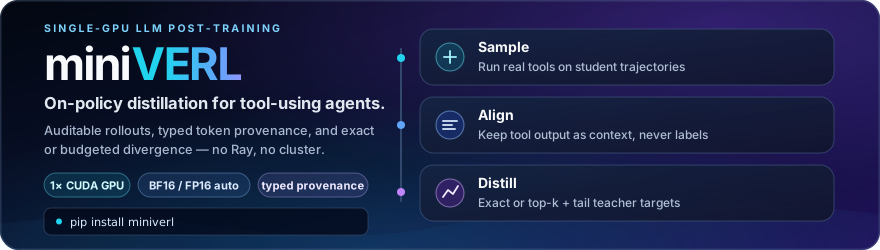
A compact, auditable training stack for tool-using agents on one personal GPU.
PyPI v0.2.5 is the stable release; main is development and may be ahead.
miniVERL is a compact, auditable training lab for teaching a small language model from its own multi-turn tool trajectories. It runs real tools, keeps token provenance explicit, and applies teacher distributional targets only where they belong — without Ray or a GPU cluster. There is no device-name allowlist: use the NVIDIA CUDA card you have, then choose a model pair and sequence budget that fit it.
python -m pip install miniverl            # lightweight core
miniverl doctor
python -m pip install "miniverl[train]"   # add the local training stack
miniverl demo --output runs/demo          # no network, no GPU, ~50 s on a laptop CPU
The base install is the torch-free core (doctor, validate, inspect,
report, schemas and the Python API). The train extra adds torch,
Transformers and PEFT because demo performs real optimization.
This split is intentional: pip install miniverl is enough to inspect and
validate artifacts without downloading a multi-gigabyte ML stack; use
pip install "miniverl[train]" whenever the goal is training or evaluation.
What it makes inspectable
- Policy truth: strict OPD takes one update from each freshly sampled parameter version; explicit replay keeps the rollout version visible, and stale teacher targets are rejected.
- Token truth: tool output stays context, while only typed assistant spans can enter the loss.
- Budget truth: exact full-vocabulary objectives and compressed
top-k + tailobjectives are named and reported separately.
Run the local demo · Train on your GPU · Inspect the measured result · Read the math
Why miniVERL exists
On-policy distillation is conceptually small and operationally fiddly. The student samples a trajectory, the teacher scores exactly the states the student visited, and you update on token-level distributional supervision. Four things go wrong in practice, and all four are silent:
- You train on tool output. The environment's response is context, not a label. One wrong mask and the model learns to hallucinate tool results.
- You are off by one. The distribution that predicts token
jlives at positionj - 1. Get it wrong and the loss still goes down. - You are not actually on-policy. Reuse a teacher cache across a policy update and you are doing offline KD while calling it OPD.
- You cannot afford the logits. A
[batch, seq_len, 152k]tensor does not fit on a consumer card, so the interesting configurations become the ones you cannot run.
miniVERL makes each of those a checked property rather than a comment, and keeps the whole lifecycle in one readable single-GPU process.
What is implemented
| Area | Status |
|---|---|
| Student-sampled multi-turn rollouts with real tool execution | yes |
Strict per-token provenance (system / user / assistant_* / tool_result) |
yes, validated on every read and write |
| Exact full-vocabulary forward KL, reverse KL, beta-JSD | yes, checked against brute-force references |
Compressed top-k + tail KL and JSD |
yes; the unsmoothed coarse-graining has a proven lower-bound relationship to the exact loss |
| Privileged-context teacher with an explicit alignment map | yes |
| Frozen standard PEFT teacher adapters with provenance and competence gates | yes |
| Single-GPU CUDA path with automatic bf16/fp16 selection | yes; device-name-agnostic CUDA path, measured reference on an RTX 4080 |
resident and swap memory strategies, auto resolution |
yes, with an equivalence test |
| Versioned, checksummed, pickle-free teacher-target cache | yes |
| SFT / offline KD / strict OPD / explicitly labeled replay behind one trainer | yes |
| Calculator, JSON-navigation and SQLite environments | yes, deterministic with exact verifiers |
| Exact checkpoint/resume | yes, asserted parameter-for-parameter |
| Self-contained offline HTML report with token-level divergence | yes |
| Ray, FSDP, DeepSpeed, vLLM, VLMs, cross-tokenizer, PPO/GRPO | no — see limitations |
Measured result: protocol-aligned OPD matches SFT
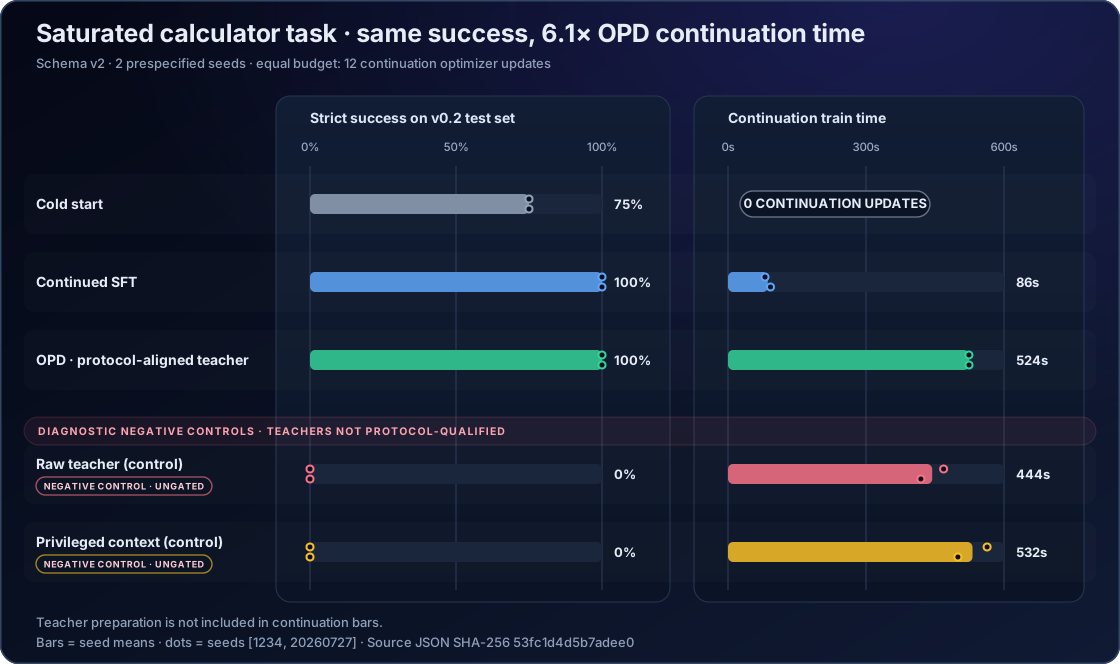
[!IMPORTANT] The supported protocol-aligned OPD path reached 100% in both seeds and matched continued SFT. The primary schema-v2 comparison uses two prespecified seeds, equal optimizer updates, and the saturated
hardcalculator split. The protocol-naive rows are diagnostic negative controls, not recommended configurations:
| role | arm | seed 1234 | seed 20260727 |
|---|---|---|---|
| starting point | cold start | 75.0% | 75.0% |
| baseline | continued SFT | 100.0% | 100.0% |
| supported OPD | protocol-aligned teacher | 100.0% | 100.0% |
| diagnostic control | raw teacher without tool-protocol training | 0.0% | 0.0% |
| diagnostic control | answer-privileged, protocol-naive teacher | 0.0% | 0.0% |
The public, immutable protocol-teacher adapter is the default in the single-GPU recipe. It passed an independently prespecified policy-competence gate before this benchmark was inspected. Both controls completed normally and measured 0% in both seeds; they were neither configuration failures nor crashes. Both used the ambiguous historical protocol-v1 prompt, so 0% cannot be attributed solely to intrinsic teacher behaviour; it diagnoses the missing qualification gate in that setup.
The historical gate and benchmark reused the same 24-task v0.2 test set.
Candidate A was prespecified and passed first try (no fallback tuning), but the
set was not untouched. Future selection uses eval; reporting uses test.
See limitations.
OPD only ties SFT and takes 6.1× as much continuation time here (523.8 s versus 86.4 s). The task saturates; two seeds support neither significance nor a general OPD advantage. See the full result and legacy transcript diagnosis.
| Artifact | Role |
|---|---|
| Default recipe | protocol-qualified default |
| Schema-v2 benchmark | frozen five-arm result |
| Raw-teacher recipe | historical control; not default |
Historical 481-second raw-teacher smoke (schema v1)
On RTX 4080, 16 updates took 481 s, peaked at 4.25/4.76 GiB allocated/reserved, and moved 12-task success from 0% to 100%. Cold start did most of it (first OPD batch: 83.3%); this proves the pipeline, not OPD over SFT. Trace.
Local toy demo
No network, no GPU, no downloads. Both models are small transformers built from the config, the tokenizer is a reversible ~190-entry toy tokenizer, and the calculator environment generates and grades its own tasks.
python -m pip install ".[train]"       # from the cloned repository; CPU torch is enough
miniverl doctor                        # what can this machine run?
miniverl demo --output runs/demo
It runs the real pipeline — student rollouts, tool execution, teacher scoring of exactly those states, a compressed top-k cache with provenance checks, and a masked reverse-KL update on assistant tokens only — then prints where every artifact landed and what to run next:
demo complete  runs/demo
 mode              opd (genuine on-policy distillation)
 optimizer steps   132
 parameter version 132
 rollout iterations 13
 wall clock        52.9 s
 token provenance  45597 of 226383 tokens trainable (20%); 180786 are context
                   and can never be a target
 teacher cache     735 scored positions, 131.6 KiB on disk, 2.0x smaller than
                   a dense fp16 dump
 task success      0.0% -> 0.0% (greedy, held-out eval split)

This demo proves the machinery, not capability.
At this size the toy student learns the tool-call format and not the
arithmetic, so 0% here is the expected outcome, not a failure.
For a CPU run that does learn (measured 0.0% -> 91.7% in 192 s):
  miniverl train recipes/toy_cpu.yaml
That last line is not a promise, it is a measurement:
recipes/toy_cpu.yaml takes 192 s on a CPU and moves held-out greedy task
success from 0.0% to 91.7% on 24 tasks, over 600 supervised cold-start steps
plus 40 on-policy distillation cycles. It is also seed-sensitive at this
model size: the same 600-step budget gives 81.2% with run.seed: 1234 and 0.0%
with run.seed: 20260727. That variance is exactly why the toy backend is a
machinery harness and capability numbers come from the GPU recipe.
miniverl inspect is the one worth running first. It prints the provenance
table, which is the whole point of the project:
tokens by span type (only assistant_* can enter the loss)
+---------------------------------------------+
| span type           | tokens | in loss      |
|---------------------+--------+--------------|
| system              |    776 | no (context) |
| tool_result         |    685 | no (context) |
| user                |    318 | no (context) |
| assistant_tool_call |    153 | yes          |
| assistant_text      |     85 | yes          |
| assistant_final     |     25 | yes          |
+---------------------------------------------+
The toy backend is a machinery harness, not a capability demonstration. Its
models are too small to solve anything beyond the easy split. Capability
numbers come from the GPU recipe.
Single-GPU quickstart
The default recipe uses device: auto and dtype: auto: bf16-capable cards use
bf16, while older CUDA cards such as Titan V use fp16. RTX 3070, Titan V,
RTX 4080 and RTX 5090-class cards all enter the same code path; only the
RTX 4080 result is measured here. Exact fit is governed by VRAM, model sizes,
drivers and token budgets, not the card's marketing name. See the
single-GPU guide before changing the recipe.
git clone https://github.com/DaoyuanLi2816/mini-verl.git
cd mini-verl
python -m pip install torch --index-url https://download.pytorch.org/whl/cu130
python -m pip install ".[train,cuda]"

miniverl doctor                                                   # confirms CUDA + bitsandbytes
miniverl validate recipes/qwen_consumer_gpu_calc.yaml
miniverl train    recipes/qwen_consumer_gpu_calc.yaml --dry-run   # nothing is downloaded
miniverl train    recipes/qwen_consumer_gpu_calc.yaml
miniverl report   runs/<run-id> --out runs/<run-id>/report.html
The recipe pins both revisions:
| role | model | revision | license |
|---|---|---|---|
| student | Qwen/Qwen3-0.6B |
c1899de289a04d12100db370d81485cdf75e47ca |
Apache-2.0 |
| teacher | Qwen/Qwen3-1.7B |
70d244cc86ccca08cf5af4e1e306ecf908b1ad5e |
Apache-2.0 |
Their tokenizer.json files are byte-identical
(sha256 aeb13307a71acd8fe81861d94ad54ab689df773318809eed3cbe794b4492dae4).
New runs compare structural identity; old artifacts use the legacy fixed-probe
behavioural fingerprint.
The recipe also pins the protocol-teacher adapter
at revision 23323751318135484c06c043b1f9b9e7016dd89f and requires its recorded
strict policy success to be at least 50% before allocating the teacher.
Architecture
flowchart LR
  A["student pi_theta<br/>QLoRA, resident"] -->|sample| B["RolloutRunner<br/>agent/loop.py"]
  B -->|tool call| C["ToolEnvironment<br/>calculator / jsonnav / sqlite"]
  C -->|observation| B
  B -->|typed token spans| D["Trajectory<br/>schemas/trajectory.py"]
  D -->|select_positions| E["AlignmentMap<br/>trajectory/alignment.py"]
  E -->|score those exact states| F["LocalTeacherScorer<br/>teachers/local.py"]
  F -->|top-k + tail| G["TeacherCache<br/>cache/store.py"]
  F --> H["chunked_selected_position_loss<br/>losses/chunked.py"]
  G --> H
  H -->|masked KL on assistant tokens| A
Layer boundaries are strict, and the first layer never imports torch:
schemas/,trajectory/,config/,agent/protocol.py— pure data, masks, validation.losses/— torch numerics, no model knowledge.models/— backends and the architecture adapter.environments/,agent/— task and tool semantics.training/,teachers/,cache/,selection/— orchestration.evaluation/,reporting/— measurement.cli.py— a thin shell that calls one library function per command.
See docs/design.md.
Exact versus top-k + tail
Two clearly named classes of objective, because conflating them is how distillation results become unreproducible.
exact_full_vocab materializes the complete [chunk, V] teacher and student
distributions and computes the real divergence. Affordable when V is small (the
toy backend) or when the teacher stays resident and the distribution is rebuilt
one chunk at a time. Guarded by loss.exact_max_vocab (default 8192) so it can
never silently try to persist a [positions, 152k] tensor.
bucketed_topk_tail coarse-grains the vocabulary into the teacher's top-k
tokens plus one aggregate tail bucket, then computes the divergence between the
two K+1 category distributions. This is not full-vocabulary KL. The
data-processing lower-bound theorem applies to the unsmoothed coarse-graining;
the finite implementation floors and renormalizes non-empty tails, so it is
described as an epsilon-smoothed objective rather than claiming the theorem
literally for every input. When k == V, the empty tail bypasses smoothing and
the implementation reproduces the exact objective to 1e-9 in float64 tests.
The functions are named bucketed_forward_kl, bucketed_reverse_kl and
bucketed_jsd so that no call site can pretend otherwise.
What the compression actually buys is teacher-side storage and the ability to
evict the teacher from VRAM. It does not proportionally reduce teacher FLOPs:
the teacher still runs a full forward pass to produce the hidden states. Reports
therefore say teacher_queried_position_ratio, never "teacher compute saved".
Top-k + tail targets are not a new idea — TRL's ServerDistillationTrainer has
loss_top_k with an optional tail bucket. See docs/math.md.
Tool-token masking
Every trajectory is a flat token sequence plus a partition into typed spans. The three masks are stored and re-derived from the spans on every read; a file whose mask disagrees with its spans is rejected rather than trained on.
from miniverl.trajectory.io import read_trajectories

traj = read_trajectories("runs/demo/trajectories.jsonl")[0]
print(traj.token_counts_by_span_type())
# {'system': 194, 'user': 40, 'assistant_tool_call': 38, 'tool_result': 34, 'assistant_final': 7}
print(sum(traj.model_generated_mask))  # only assistant_* tokens are trainable
Context segments own the trailing <|im_start|>assistant\n header, so a model
span begins at exactly the first sampled token and no forced scaffolding token is
ever a target. Position 0 can never be a target. Both are enforced, not
documented — see tests/unit/test_token_provenance.py.
Benchmark results
Every number below was produced by the commands in
docs/benchmarking.md on the hardware recorded in each
result file. Nothing is estimated or extrapolated.
- RTX 4080, real models —
docs/rtx4080-baselines.mdhas measured peak VRAM, decode throughput, the full-recipe run, the two-seed schema-v2 protocol-teacher comparison, and the preserved legacy comparison. - CPU, toy models —
recipes/toy_cpu.yamlmoves task success from 0.0% to 91.7% in 192 s, andbenchmarks/results/holds the legacy equal-update parity run. The parity run's accuracy differences are within noise; it exists to show that all seven arms run to completion under identical budgets, not to rank them. Seebenchmarks/README.mdfor why the toy backend cannot rank methods.
Installation
| Layer | Install | What you get |
|---|---|---|
| Core | python -m pip install . |
doctor, validate, inspect, report, cache, the schemas and the Python API. No torch. |
| Training | python -m pip install ".[train]" |
demo, train, eval, benchmark. Adds torch, transformers, peft, accelerate. |
| 4-bit | python -m pip install ".[cuda]" |
bitsandbytes, for NF4 QLoRA and the 8-bit optimizer. |
| Development | python -m pip install ".[dev]" |
pytest, hypothesis, ruff, mypy, build, twine. |
The published-package equivalents are miniverl, miniverl[train],
miniverl[cuda] and miniverl[dev]. Core Python 3.10–3.13 is tested without
torch. The full CPU ML suite and Transformers 4.51.x/5.x compatibility rows run
on Python 3.12; GPU paths are opt-in and were measured locally on Python 3.12.
Install the CUDA build of torch that matches your driver separately; the PyPI wheel is CPU-only on some platforms:
pip install torch --index-url https://download.pytorch.org/whl/cu130
A missing extra never produces a traceback:
$ miniverl demo --output runs/demo
error miniverl demo requires the optional dependency 'torch', which is not installed.
hint  pip install "miniverl[train]"
Strict offline execution
All model-loading commands use the same no-network contract:
miniverl train <recipe> --offline
miniverl benchmark <benchmark.yaml> --offline
miniverl eval --run <run-dir> --offline
miniverl export-adapter --run <run-dir> --out <adapter-dir> --offline
In this mode, the base model, tokenizer and every adapter file must already be
at a local path or in the Hugging Face cache. miniVERL permits no HTTP,
metadata, ETag or Hub API request and does not fall back to online resolution.
A Hub teacher adapter is resolved once at its pinned revision; PEFT then loads
the exact local snapshot whose config, weights, manifest and checksums were
validated. A cache miss prints the immutable identity and the exact hf download preload command.
Python API
The public surface is deliberately small.
from miniverl.config import RunConfig
from miniverl.trainer import OPDTrainer

config = RunConfig.from_yaml("recipes/toy_cpu.yaml")
with OPDTrainer.from_config(config) as trainer:
    result = trainer.train()

print(result.run_dir, result.global_step, result.eval["success_rate"])
A custom environment
Subclass ToolEnvironment, register it, and every recipe key works unchanged.
examples/custom_environment/ is a complete, runnable example.
reset(task) is authoritative: it is called exactly once per episode, and its
Observation.text plus state_id enter the trajectory. user_prompt(task) is
only a compatibility helper; the runner does not call it a second time.
from miniverl.environments import ToolEnvironment, ToolSpec
from miniverl.environments.registry import register


@register
class ReverseEnvironment(ToolEnvironment):
    name = "reverse"

    def tool_specs(self) -> list[ToolSpec]:
        return [
            ToolSpec(
                name="reverse",
                description="Reverse a string.",
                parameters={"text": "string to reverse"},
                required=("text",),
                example={"text": "abc"},
            )
        ]

    # reset / step / verify / generate_task / oracle_actions follow; see the example.
A custom teacher
Implement TeacherScorer.score and return supervision for the aligned positions.
examples/custom_teacher/ shows a scorer that sharpens a local model's
distribution before handing it over, and asserts that the result still trains.
For a standard frozen PEFT teacher adapter, including the Qwen3 protocol-SFT
recipe, export command, compatibility checks and policy-competence gate, see
docs/teacher-adapters.md.
Limitations
The short version; the full list is in docs/limitations.md.
- Same tokenizer only. Cross-tokenizer distillation is rejected with an error.
- One trajectory per forward pass —
gradient_accumulation_stepsis the batch size. The current release has no padded batching. swapis unavailable for quantized models, because bitsandbytes parameters are pinned to the device they were quantized on.- Only Qwen3 and Qwen2 architectures are tested. Others may work through the architecture adapter; nothing here claims they do.
- The primary GPU comparison has two prespecified seeds; legacy GPU artifacts are single-seed. No statistical significance is claimed.
- On the measured machine, decoding is kernel-launch bound rather than compute bound, so throughput figures are platform-specific.
Reproducibility
Every run writes manifest.json with the miniVERL version, git commit, Python
and OS, torch/CUDA/driver versions, GPU model and VRAM, model ids and resolved
revisions, tokenizer fingerprint, seeds, precision, quantization, memory
strategy, loss mode, top-k, policy version, and a measurement_status block
recording whether each result was measured, simulated or not run. It records no
usernames, hostnames, home paths, or environment variables beyond a short
allowlist of ones that change numerics — asserted by a test.
File-backed runs also separate exact submitted bytes, canonical validated
logic, the v0.2 resume compatibility layer, and runtime-resolved choices.
Writable runs move atomically through ready, running, and one terminal
status (completed, failed, interrupted, or closed_before_training).
One process lock covers construction, training/resume, standalone checkpoint
selection and evaluation, and automatic report generation. Public evaluation
and checkpoint calls cannot enter while training owns the model.
After reset, every built-in verifier maps arbitrary strings to a bounded
result rather than leaking parser/numeric exceptions; protocol-v2 prompts use
environment-specific, verifier-format-valid final examples. Shareable reports,
summaries, benchmark exports and portable manifests redact semantic secret
keys, URL credentials and private cross-platform paths; private run artifacts
still retain the local state required for exact resume.
See docs/reproducibility.md and the concise
compatibility policy.
Roadmap
Not implemented, not promised, listed so the scope is unambiguous: cross-tokenizer distillation, padded multi-sequence batching, entropy-aware divergence mixing (arXiv:2603.07079), additional model families, more environments, and multi-GPU. For anything at cluster scale, use verl.
Acknowledgement and disclaimer
miniVERL is an independent project and is not affiliated with or endorsed by the verl project, ByteDance, or Volcano Engine. It is not a drop-in replacement for verl.
The name is a nod to the problem space, not a claim of compatibility. verl is an
excellent, much larger system that also implements on-policy distillation and
multi-turn tool use — at cluster scale, with Ray. If you have a cluster, use it.
miniVERL exists for the case where you have one personal GPU and want to read
every line of what is happening. That can be an older 12 GiB card or a current
high-end card; the repository claims measured performance only for hardware it
actually ran. See docs/comparisons.md.
Citation
@software{miniverl2026,
  title   = {miniVERL: On-policy distillation for tool-using agents on one GPU},
  author  = {Li, Daoyuan},
  year    = {2026},
  url     = {https://github.com/DaoyuanLi2816/mini-verl},
  license = {Apache-2.0}
}
See CITATION.cff and CHANGELOG.md. Contributions: CONTRIBUTING.md. Security: SECURITY.md.
License
Apache-2.0. See LICENSE and THIRD_PARTY_NOTICES.md.
Chinese translation: README.zh-CN.md.
1 maintainer

Download files
Download the file for your platform. If you're not sure which to choose, learn more about installing packages.
Source Distribution
Built Distribution
Filter files by name, interpreter, ABI, and platform.
If you're not sure about the file name format, learn more about wheel file names.
Copy a direct link to the current filters
File details
Details for the file miniverl-0.2.5.tar.gz.
File metadata
- Download URL: miniverl-0.2.5.tar.gz
- Upload date:
- Size: 580.0 kB
- Tags: Source
- Uploaded using Trusted Publishing? Yes
- Uploaded via: twine/6.1.0 CPython/3.13.14
File hashes
| Algorithm | Hash digest | |
|---|---|---|
| SHA256 |
d30bb07ebca676a3960d4b5c46075a8a2e13e58629b96984e30f8f7bab67dce0
|
|
| MD5 |
e589ed5f85a9697587436ed21ed6b59d
|
|
| BLAKE2b-256 |
d72daf61763636e3be2b76154b1daea707c2cfc7de135879f19d868e16074609
|
Provenance
The following attestation bundles were made for miniverl-0.2.5.tar.gz:
Publisher:
release.yml on DaoyuanLi2816/mini-verl
-
Statement:
-
Statement type:
https://in-toto.io/Statement/v1 -
Predicate type:
https://docs.pypi.org/attestations/publish/v1 -
Subject name:
miniverl-0.2.5.tar.gz -
Subject digest:
d30bb07ebca676a3960d4b5c46075a8a2e13e58629b96984e30f8f7bab67dce0 - Sigstore transparency entry: 2299353462
- Sigstore integration time:
-
Permalink:
DaoyuanLi2816/mini-verl@a9a84510741b4ade8a405c100affdf1caed55ae6 -
Branch / Tag:
refs/tags/v0.2.5 - Owner: https://github.com/DaoyuanLi2816
-
Access:
public
-
Token Issuer:
https://token.actions.githubusercontent.com -
Runner Environment:
github-hosted -
Publication workflow:
release.yml@a9a84510741b4ade8a405c100affdf1caed55ae6 -
Trigger Event:
push
-
Statement type:
File details
Details for the file miniverl-0.2.5-py3-none-any.whl.
File metadata
- Download URL: miniverl-0.2.5-py3-none-any.whl
- Upload date:
- Size: 241.9 kB
- Tags: Python 3
- Uploaded using Trusted Publishing? Yes
- Uploaded via: twine/6.1.0 CPython/3.13.14
File hashes
| Algorithm | Hash digest | |
|---|---|---|
| SHA256 |
70c98284bce151fc74b508047b354929846efb71c3fe8f451c0d0ba1bec48e9d
|
|
| MD5 |
50bcf3a423ccdf681c14e7fea97b1e5e
|
|
| BLAKE2b-256 |
8c2109033d58a0abe786f69cadc31a10a8e3319c896feab4cc9e7607f91807c1
|
Provenance
The following attestation bundles were made for miniverl-0.2.5-py3-none-any.whl:
Publisher:
release.yml on DaoyuanLi2816/mini-verl
-
Statement:
-
Statement type:
https://in-toto.io/Statement/v1 -
Predicate type:
https://docs.pypi.org/attestations/publish/v1 -
Subject name:
miniverl-0.2.5-py3-none-any.whl -
Subject digest:
70c98284bce151fc74b508047b354929846efb71c3fe8f451c0d0ba1bec48e9d - Sigstore transparency entry: 2299353592
- Sigstore integration time:
-
Permalink:
DaoyuanLi2816/mini-verl@a9a84510741b4ade8a405c100affdf1caed55ae6 -
Branch / Tag:
refs/tags/v0.2.5 - Owner: https://github.com/DaoyuanLi2816
-
Access:
public
-
Token Issuer:
https://token.actions.githubusercontent.com -
Runner Environment:
github-hosted -
Publication workflow:
release.yml@a9a84510741b4ade8a405c100affdf1caed55ae6 -
Trigger Event:
push
-
Statement type:







