





PyPI · Stable docs · Development docs · 中文
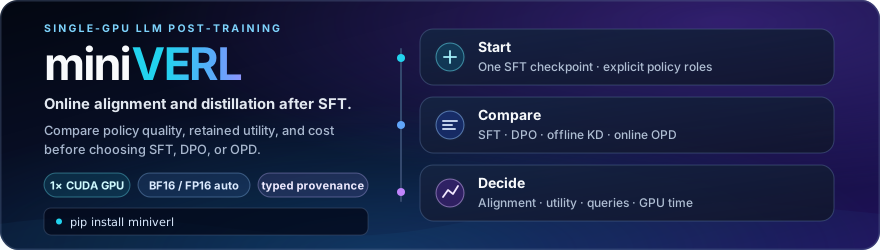
miniVERL is a local, inspectable runtime for a documented subset of single-GPU LLM alignment and distillation. It keeps rollout provenance, assistant-only loss masks, teacher targets, update budgets and run artifacts explicit, then exports portable artifacts through a fail-closed bridge to one pinned upstream verl profile.
PyPI v0.6.3 is stable; main is development. The CUDA path has no GPU-name
allowlist, but fit depends on the model pair, context budget, kernels and VRAM.
miniVERL is independent from verl and does not claim distributed execution or
full algorithmic compatibility.
Install and run the 60-second demo
python -m pip install "miniverl[train]"
miniverl doctor
miniverl demo --output runs/demo
miniverl inspect runs/demo
The demo is deterministic, needs no network or GPU, and performs a real toy
optimization in about 50 seconds on the measured laptop CPU. For inspection,
schemas and reports without the ML stack, use pip install miniverl. For CUDA
training, install the matching CUDA-enabled PyTorch wheel first, then install
miniverl[train,cuda]; the extra does not select a CUDA PyTorch build. See the
single-GPU guide.
Three paths
| Path | Start with | Concrete artifact | Next |
|---|---|---|---|
| Align — compare SFT, DPO, KD and OPD only when the pilot evidence supports the cost | miniverl pilot recipes/alignment_policy_conditioned_qwen.yaml |
alignment-card.json |
Alignment Lab |
| Distill locally — strict OPD, shared backbones and padded trajectory updates on one CUDA GPU | miniverl train recipes/qwen_consumer_gpu_shared.yaml --dry-run |
config.resolved.yaml plus a revision-pinned PEFT adapter |
Bring your own GPU |
| Scale out — import a documented profile, convert Parquet, export a bundle and run bridge checks | miniverl bridge doctor scaleout-bundle |
provenance/compatibility-report.json |
Verified verl artifact bridge |
The bridge is a verified artifact bridge: a pinned config/data/model parse-load smoke at miniVERL-defined compatibility Level 3. It has never run a distributed verl job, and no OPD-to-PPO semantic parity is claimed.
The import is deliberately not generic YAML conversion. If dataset or
environment, teacher identity, objective, or schedule semantics are missing,
import-verl writes <stem>.import-report.json and a non-executable
<stem>.template.yaml with status: needs_user_input. It never silently
substitutes calculator tasks or an unqualified same-base teacher. An unresolved
${...} value can never reach an accepted recipe, outputs are stem-specific,
an input file can never also be an output file, and an existing output family
is replaced only with an explicit --overwrite. Publication is transactional
with in-process rollback, not multi-file crash atomicity.
An exported bundle is untrusted input. bridge doctor inspects its reward
scaffold statically with ast.parse and never executes it unless you pass
--trust-and-import-reward-code — class bases, metaclass=, annotations and
type-parameter bounds are audited too, because all of them run at import.
Adapter weights are validated past the header, a malformed extension sidecar
fails the conversion instead of being read as empty, and dataset conversion
streams row groups rather than materializing the table. What a bundle claims
is reported separately from what was recomputed locally: its own SHA256SUMS
can only prove internal consistency. Tokenizer, safetensors and privacy results
each report how far verification actually got rather than a single pass or fail.
One measured alignment result
Alignment Lab v1 is a saturated tool-policy case study, not a broad safety benchmark. The shared SFT checkpoint already achieved 100% policy compliance and 100% retained tool utility in all three seeds. No continuation method improved it; continued SFT and both OPD variants retained measured regressions.
| continuation | alignment | tool utility | teacher queries | GPU time |
|---|---|---|---|---|
| continued SFT | 94.4% | 88.9% | — | 3.9 s |
| DPO | 100.0% | 100.0% | — | 8.6 s |
| offline soft distillation | 100.0% | 100.0% | 100.0% | 26.6 s |
| standard OPD | 98.6% | 97.2% | 100.0% | 76.7 s |
| verifier-gated OPD | 97.9% | 95.8% | 46.8% | 66.0 s |
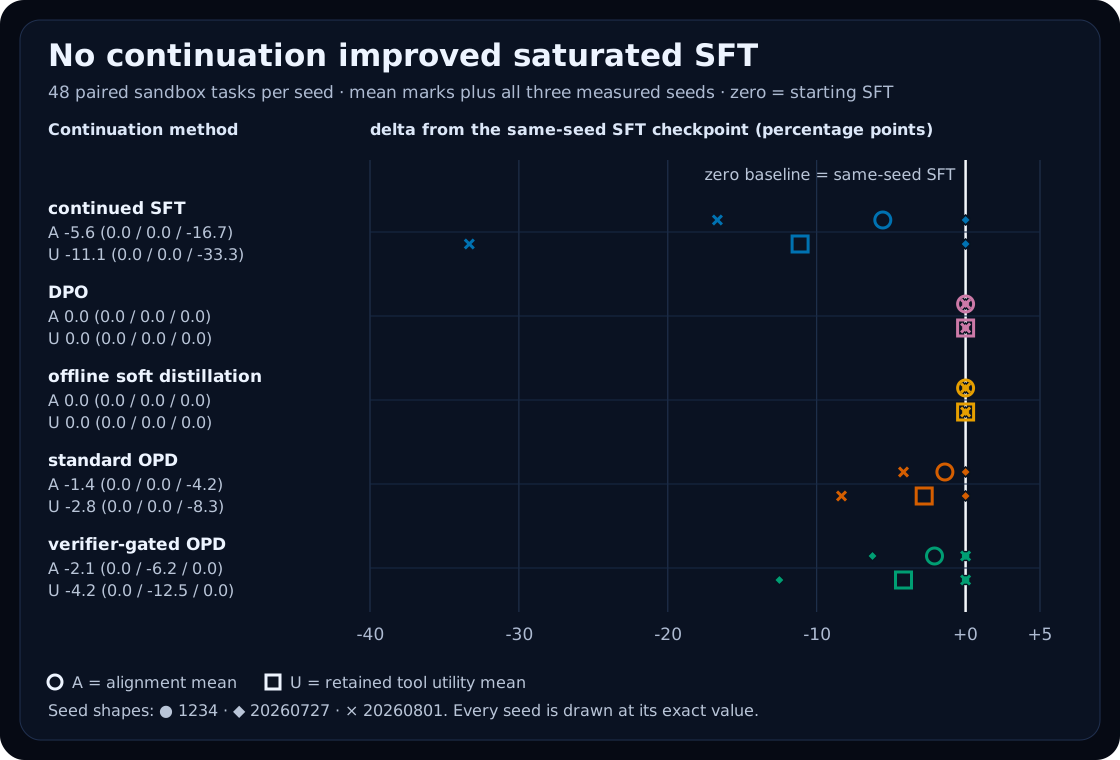
The two sandbox safety checks tied at zero while utility still regressed. IFEval, XSTest, HarmBench and RewardBench were not executed. “Preference win rate” is a deterministic Minipolicy paired outcome, not human preference. Read the study, seed-level values and limitations.
One measured systems result
On one RTX 4080 with Qwen3-0.6B and eight fixed SQLite trajectories, physical batch 4 improved update throughput from 2.369 to 3.866 trajectories/s in the dual-model runtime. The shared-backbone batch-4 cell used 2.227 GiB peak reserved memory versus 3.035 GiB for dual model, while running 10.1% slower. All 12 preregistered equivalence comparisons passed. These are one-workload, one-machine measurements, not promises for other GPUs.
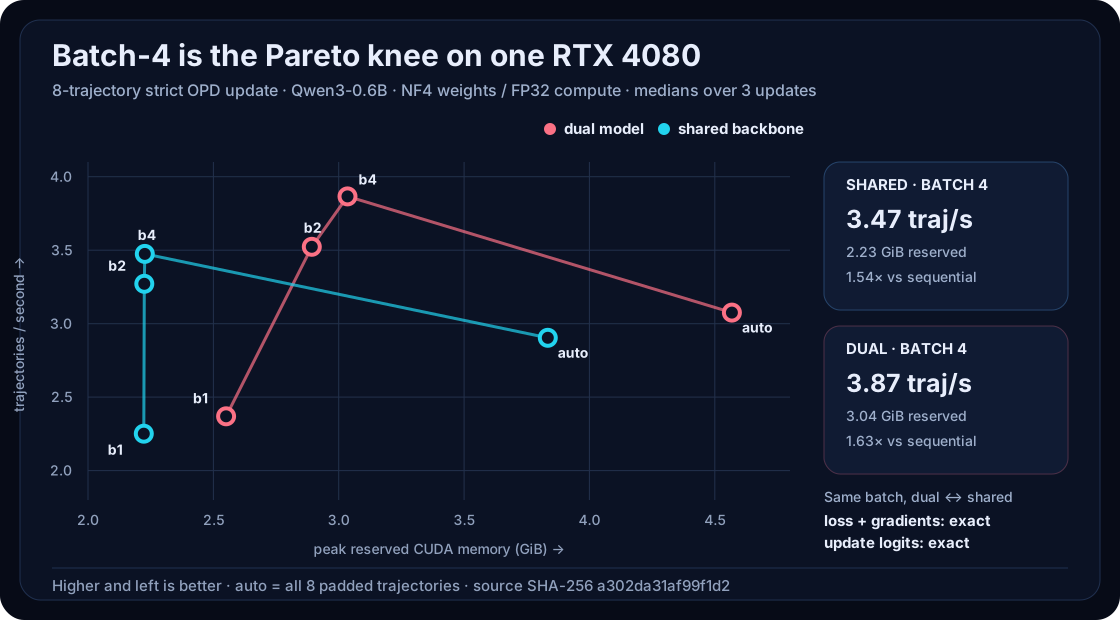
Consumer Runtime v1 methods and caveats
Compatibility boundary
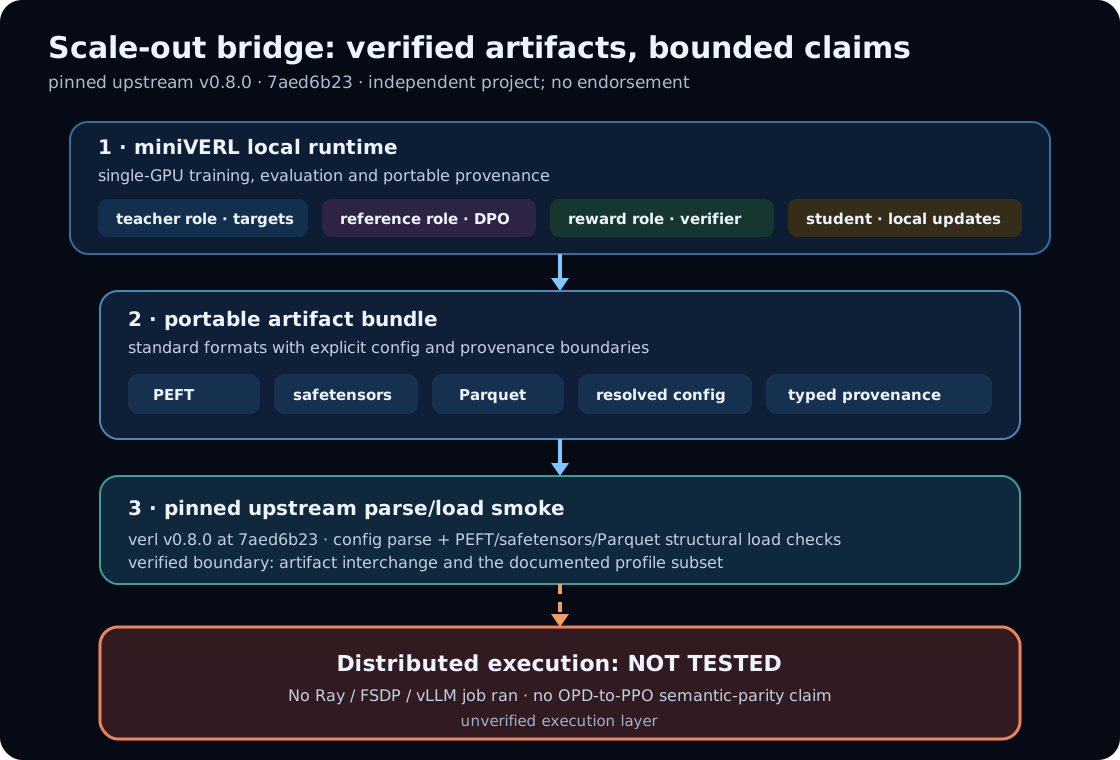
The bridge targets official verl v0.8.0 at commit 7aed6b23 and uses the
term miniVERL-defined compatibility Level 3. That means a checksummed
standard-artifact bundle plus pinned upstream config-parse/model-data-load
smoke—not arbitrary verl YAML or a completed distributed job.
Current exported bundles are intentionally launchable: false: the base
snapshot is absent, the reward implementation fails closed, and required user
mappings remain placeholders. The generated entry point is therefore
launch.template.sh. Readiness is reported as separate facts for artifact
completeness, parse/load smoke, reward completeness, launchability,
distributed execution and algorithm-semantic parity. The target is a
PPO/reward scaffold, not an executable continuation of miniVERL OPD semantics.
Detailed studies and preserved negative evidence
- RecoveryBench v1: frozen-student KD
outperformed much slower fresh-state OPD on the preregistered primary view;
the verifier gate remained
insufficient_evidence. - Alignment Lab v1: the starting SFT checkpoint was at the ceiling, so no positive OPD result is claimed.
- Calculator benchmark: both negative controls completed normally and measured 0% strict success. They were not configuration failures. Because they used the historical ambiguous protocol-v1 prompt, their failure cannot be attributed solely to intrinsic teacher behavior.
- Consumer Runtime v1: padded update batches and shared adapters preserve the measured one-update objective within declared tolerances; rollout generation remains sequential.
- Limitations, math, reproducibility and compatibility policy.
New runs establish tokenizer compatibility through structural identity. The legacy behavioral fingerprint—token IDs for one fixed probe plus metadata—is only a migration fallback for older artifacts and is not an identity proof.
Scope
miniVERL supports one local CUDA process. It does not implement or wrap Ray, FSDP, Megatron, PPO, GRPO or a distributed launcher. The public studies cover small Qwen3 models, deterministic tool environments and one RTX 4080; they do not establish cross-model, cross-task, cross-GPU or broad safety generality.
git clone https://github.com/DaoyuanLi2816/mini-verl.git
cd mini-verl
python -m pip install -e ".[dev]"
pytest -q -m "not gpu and not network"
Apache-2.0 licensed. See CONTRIBUTING.md and SECURITY.md. Project records: default GPU recipe, frozen calculator JSON, changelog, citation and license.
1 maintainer

Download files
Download the file for your platform. If you're not sure which to choose, learn more about installing packages.
Source Distribution
Built Distribution
Filter files by name, interpreter, ABI, and platform.
If you're not sure about the file name format, learn more about wheel file names.
Copy a direct link to the current filters
File details
Details for the file miniverl-0.6.3.tar.gz.
File metadata
- Download URL: miniverl-0.6.3.tar.gz
- Upload date:
- Size: 1.1 MB
- Tags: Source
- Uploaded using Trusted Publishing? Yes
- Uploaded via: twine/6.1.0 CPython/3.13.14
File hashes
| Algorithm | Hash digest | |
|---|---|---|
| SHA256 |
b93d2fad63432ecd680b72fe0bf79f6b0be212af1aab82780ed8e31636edeefe
|
|
| MD5 |
f6bc97a2ab59cb9932653bd682a23c71
|
|
| BLAKE2b-256 |
b739e0a07be536cf9347d6b5545a5b66b117d8977ef53ab61ef6e8454324ec05
|
Provenance
The following attestation bundles were made for miniverl-0.6.3.tar.gz:
Publisher:
release.yml on DaoyuanLi2816/mini-verl
-
Statement:
-
Statement type:
https://in-toto.io/Statement/v1 -
Predicate type:
https://docs.pypi.org/attestations/publish/v1 -
Subject name:
miniverl-0.6.3.tar.gz -
Subject digest:
b93d2fad63432ecd680b72fe0bf79f6b0be212af1aab82780ed8e31636edeefe - Sigstore transparency entry: 2357565103
- Sigstore integration time:
-
Permalink:
DaoyuanLi2816/mini-verl@005a4549da713716e64c3ae80ff55fb131519f79 -
Branch / Tag:
refs/tags/v0.6.3 - Owner: https://github.com/DaoyuanLi2816
-
Access:
public
-
Token Issuer:
https://token.actions.githubusercontent.com -
Runner Environment:
github-hosted -
Publication workflow:
release.yml@005a4549da713716e64c3ae80ff55fb131519f79 -
Trigger Event:
push
-
Statement type:
File details
Details for the file miniverl-0.6.3-py3-none-any.whl.
File metadata
- Download URL: miniverl-0.6.3-py3-none-any.whl
- Upload date:
- Size: 351.4 kB
- Tags: Python 3
- Uploaded using Trusted Publishing? Yes
- Uploaded via: twine/6.1.0 CPython/3.13.14
File hashes
| Algorithm | Hash digest | |
|---|---|---|
| SHA256 |
1c620c310e8e4156f515d52128a0f26a037096347a2bc105c63f173e6563f5e0
|
|
| MD5 |
8e50d5e8938fb281fa30afefe39cd16b
|
|
| BLAKE2b-256 |
efcbe2b56865b2de05480392cb9cb894b97158e4445a922e2ed148a5816fe6e9
|
Provenance
The following attestation bundles were made for miniverl-0.6.3-py3-none-any.whl:
Publisher:
release.yml on DaoyuanLi2816/mini-verl
-
Statement:
-
Statement type:
https://in-toto.io/Statement/v1 -
Predicate type:
https://docs.pypi.org/attestations/publish/v1 -
Subject name:
miniverl-0.6.3-py3-none-any.whl -
Subject digest:
1c620c310e8e4156f515d52128a0f26a037096347a2bc105c63f173e6563f5e0 - Sigstore transparency entry: 2357565312
- Sigstore integration time:
-
Permalink:
DaoyuanLi2816/mini-verl@005a4549da713716e64c3ae80ff55fb131519f79 -
Branch / Tag:
refs/tags/v0.6.3 - Owner: https://github.com/DaoyuanLi2816
-
Access:
public
-
Token Issuer:
https://token.actions.githubusercontent.com -
Runner Environment:
github-hosted -
Publication workflow:
release.yml@005a4549da713716e64c3ae80ff55fb131519f79 -
Trigger Event:
push
-
Statement type:







