



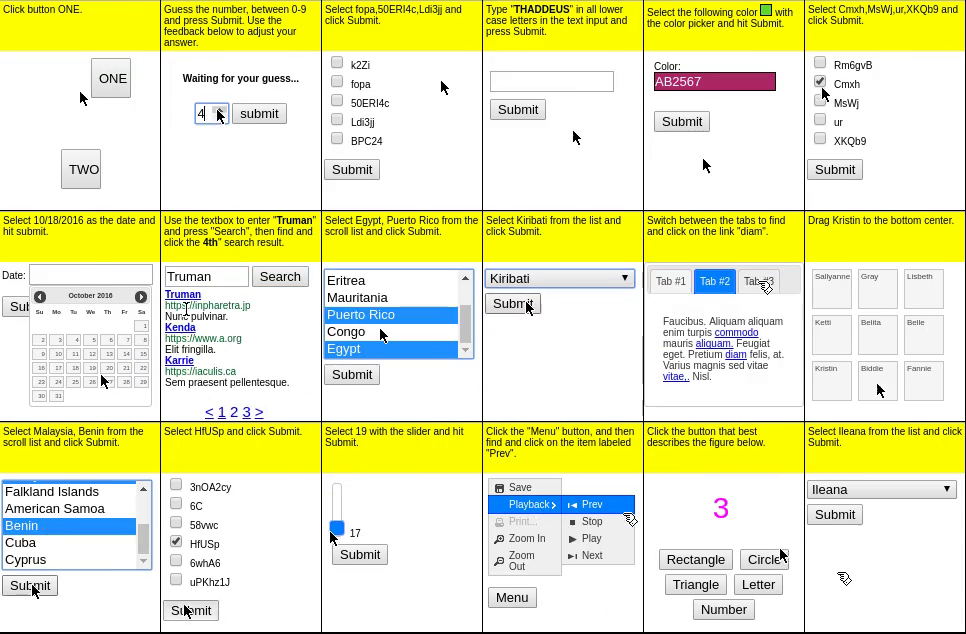
The MiniWoB++ (Mini World of Bits++) library contains a collection of over 100 web interaction environments, along with JavaScript and Python interfaces for programmatically interacting with them. The Python interface follows the Gymnasium API and uses Selenium WebDriver to perform actions on the web browser.
MiniWoB++ is an extension of the OpenAI MiniWoB benchmark, and was introduced in the paper Reinforcement Learning on Web Interfaces using Workflow-Guided Exploration.
The documentation website is at miniwob.farama.org. Development on MiniWoB++ is currently ongoing to bring it up to Farama Standards for mature projects, and will be maintained long term after this point. See the Project Roadmap for more details. If you'd like to help out, you can join our discord server here: https://discord.gg/PfR7a79FpQ.
Installation
MiniWoB++ supports Python 3.10+ on Linux and macOS.
Installing the MiniWoB++ Library
To install the MiniWoB++ library, use pip install miniwob.
Installing Chrome/Chromium and ChromeDriver
We strongly recommend using Chrome or Chromium as the web browser, as other browsers may render the environments differently.
The MiniWoB++ Python interface uses Selenium,
which interacts with the browser via the WebDriver API.
Follow one of the
instruction methods
to install ChromeDriver. The simplest method is to
download ChromeDriver with the matching version,
unzip it, and then add the directory containing the chromedriver executable to the PATH environment variable:
export PATH=$PATH:/path/to/chromedriver
For Chromium, the driver may also be available in a software package; for example, in Debian/Ubuntu:
sudo apt install chromium-driver
The browser and ChromeDriver versions must match. If more than one Chrome or
ChromeDriver installation is available, set MINIWOB_CHROME_BINARY and
MINIWOB_CHROMEDRIVER together to the matching executables before starting
MiniWoB++:
export MINIWOB_CHROME_BINARY=/path/to/chrome
export MINIWOB_CHROMEDRIVER=/path/to/chromedriver
Both variables must be set together. If neither variable is set, Selenium uses its normal browser and driver discovery behavior.
Example Usage
The following code performs a deterministic action on the
click-test-2 environment.
import time
import gymnasium
import miniwob
from miniwob.action import ActionTypes

gymnasium.register_envs(miniwob)

env = gymnasium.make('miniwob/click-test-2-v1', render_mode='human')

# Wrap the code in try-finally to ensure proper cleanup.
try:
  # Start a new episode.
  obs, info = env.reset()
  assert obs["utterance"] == "Click button ONE."
  assert obs["fields"] == (("target", "ONE"),)
  time.sleep(2)       # Only here to let you look at the environment.

  # Find the HTML element with text "ONE".
  for element in obs["dom_elements"]:
    if element["text"] == "ONE":
      break

  # Click on the element.
  action = env.unwrapped.create_action(ActionTypes.CLICK_ELEMENT, ref=element["ref"])
  obs, reward, terminated, truncated, info = env.step(action)

  # Check if the action was correct.
  print(reward)      # Should be around 0.8 since 2 seconds has passed.
  assert terminated is True
  time.sleep(2)

finally:
  env.close()
See the documentation for more information.
Environments
The list of the environments that were included in the MiniWoB++ library can be found in the documentation. All environments share the same observation space, while the action space can be configured during environment construction.
Citation
To cite this project please use:
@inproceedings{liu2018reinforcement,
 author = {Evan Zheran Liu and Kelvin Guu and Panupong Pasupat and Tianlin Shi and Percy Liang},
 title = {Reinforcement Learning on Web Interfaces using Workflow-Guided Exploration},
 booktitle = {International Conference on Learning Representations ({ICLR})},
 url = {https://arxiv.org/abs/1802.08802},
 year = {2018},
}


Release files for miniwob 1.1.0
For a detailed explanation of source distributions (sdists) and built distributions (wheels), please see the package formats documentation.
Source distribution (sdist)
| File | Size | Uploaded | |
|---|---|---|---|
| miniwob-1.1.0.tar.gz | 1.6 MB | Details |
Built distribution (wheel)
| File | Interpreter | ABI | Platform | Reset |
|---|---|---|---|---|
| miniwob-1.1.0-py3-none-any.whl | Python 3 | none | any | Details |
Total release size: 3.5 MB
Release files / miniwob-1.1.0.tar.gz
| Download URL | miniwob-1.1.0.tar.gz |
|---|---|
| Size | 1.6 MB |
| Tags | Source |
|
SHA-256 checksum How to use checksums |
37aefd67bcae51ecaf4bd3ba84e33eb904012a3459a7c342b338f81eae187048
|
|
BLAKE2b-256 checksum How to use checksums |
866d6083b1bd580c1a5468a7cd086a48996db715b41e898823d53845c7b4003a
|
| Upload date | |
|
Uploaded using Trusted Publishing? What is trusted publishing? |
Yes |
| Uploaded via |
twine/7.0.0 CPython/3.13.14
|
Provenance
Provenance describes where a file came from. On PyPI, provenance is shared via attestations, which provide a verifiable record of the build or publishing details. View details, limitations and caveats.


PyPI Publish Attestation
PyPI verified that this artifact, at this checksum, originated from the publisher listed below.
Signed by GitHub Actions, verified by PyPI on Aug 13, 2026.
Transparency logRelease files / miniwob-1.1.0-py3-none-any.whl
| Download URL | miniwob-1.1.0-py3-none-any.whl |
|---|---|
| Size | 1.9 MB |
| Tags | Python 3 |
|
SHA-256 checksum How to use checksums |
297006e84219d56ad037e843527ed773a4a82509dc43b6031ec4a3ad3e3e61d9
|
|
BLAKE2b-256 checksum How to use checksums |
fca1a34e0cc33dcba9de00001695979d2b9e3cc2de03bacdf010f045fb084afe
|
| Upload date | |
|
Uploaded using Trusted Publishing? What is trusted publishing? |
Yes |
| Uploaded via |
twine/7.0.0 CPython/3.13.14
|
Provenance
Provenance describes where a file came from. On PyPI, provenance is shared via attestations, which provide a verifiable record of the build or publishing details. View details, limitations and caveats.
PyPI Publish Attestation
PyPI verified that this artifact, at this checksum, originated from the publisher listed below.
Signed by GitHub Actions, verified by PyPI on Aug 13, 2026.
Transparency log













