
MiniWord
A minimal word processor in python. In development but already great.
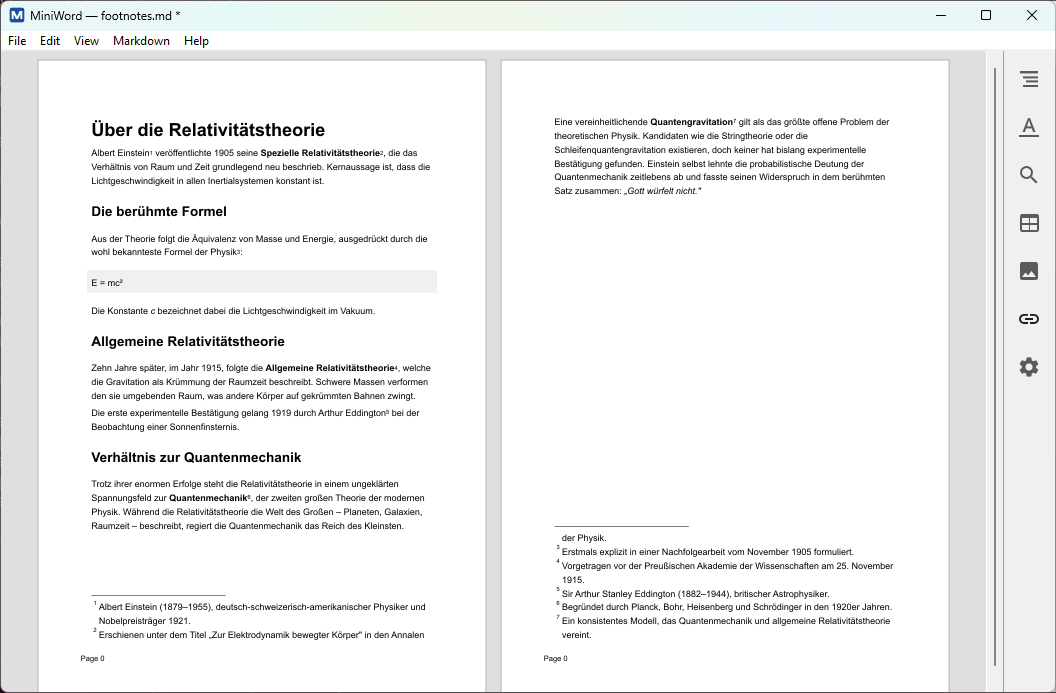
Key Aspects
- Real WYSIWYG editing (no HTML layer, no embedded browser)
- Lightweight and fast startup
- Clean, simple file format (human-readable, diff-friendly, git-friendly, AI-friendly)
- Good Markdown support
- Extensible via Python-plugins
Install from a pre-built package
Pre-built installers for Windows (.exe) and macOS (.dmg) are published on the Releases page for each tagged version, with all dependencies (including the optional extras) already bundled — nothing else to install. On Linux, install from source instead (see below); no separate installer is provided there.
Windows
Download the .exe from the Releases page and run it.
macOS
Download the .dmg from the Releases page, open it, and drag MiniWord.app into your Applications folder.
First launch: MiniWord isn't (yet) signed with a paid Apple Developer ID, so macOS blocks it the first time with "MiniWord can't be opened because Apple cannot check it for malicious software." To allow it, no Terminal needed:
- Double-click MiniWord in Applications once and dismiss the warning.
- Open System Settings → Privacy & Security, scroll down to the Security section.
- Click Open Anyway next to the MiniWord entry, then confirm with your password or Touch ID.
- Open MiniWord again and confirm Open in the dialog that appears.
This is a one-time step per installed version.
Install from source
Miniword is developed under Linux. In principle it should run under Windows and Mac as well.
You always need Python >= 3.9 and wxPython >= 4.0. Further required dependencies vary between platforms — see the per-platform instructions below.
Three optional packages add extra features and are all installed together via the full extra (pip install ".[full]"): uharfbuzz adds ligatures and non-Latin script support, fonttools is needed for non-Latin scripts specifically on Windows, and mistune enables richer Markdown import (without it, a built-in parser handles the common subset).
Running without installation
python miniword.py
Alternatively, double-click miniword.py in your file explorer.
Linux
Install system dependencies:
sudo apt install python3-wxgtk4.0 fontconfig
Then install miniword (this also pulls in cairocffi):
cd miniword
pip install .
For ligature support, non-Latin scripts, and richer Markdown import, install with the full extra instead:
pip install ".[full]"
If you want to register MiniWord to the desktop (you probably will):
cp miniword/icons/miniword.svg ~/.local/share/icons/
cp miniword.desktop ~/.local/share/applications/
Windows
cd miniword
pip install ".[full]"   # full installs uharfbuzz, fonttools, mistune: ligatures, non-Latin scripts, richer Markdown import
wxPython bundled libcairo-2.dll up through 4.2.1, so pip install . alone was enough for cairocffi to bind to it. wxPython >=4.2.2 dropped the bundled DLL (an upstream regression, reported at wxWidgets/Phoenix), so on those versions install a Cairo runtime yourself first, e.g. the GTK3 runtime for Windows.
(Advanced: alternatively, download just libcairo-2.dll from wxWidgets/Phoenix's packaging assets and drop it into your installed wx package folder, e.g. site-packages/wx/.)
If you skip this and see an error mentioning a missing libcairo-2.dll, install a Cairo runtime as described above (or downgrade to wxPython<4.2.2).
MiniWord stores its configuration and plugins in %APPDATA%\miniword\ (e.g. C:\Users\<you>\AppData\Roaming\miniword\).
Note that MiniWord is not yet optimised for Windows. While it mostly works, the GUI is less polished and startup takes a bit longer.
macOS
fontconfig must be installed via Homebrew:
brew install fontconfig
Then install miniword (this also pulls in cairocffi):
cd miniword
pip install ".[full]"   # full installs uharfbuzz, mistune: ligatures, non-Latin scripts, richer Markdown import
MiniWord stores its configuration and plugins in ~/Library/Application Support/miniword/.
Note that MiniWord is not yet optimised for macOS (tested on Apple Silicon; Intel Macs are untested). While it works, some GUI elements aren't as polished as on Linux.
Hacking
Run the full test suite:
python test_all.py
Run tests for a single module:
python runtests.py miniword/layout/pagegen.py
Run a specific test or demo:
python runtests.py miniword/ui/searchtool.py test_00
python runtests.py miniword/texteditor/textcanvas.py demo_00
Plugins
MiniWord is extensible via Python plugins. To install a plugin, copy the .py file into the plugins directory for your platform:
| Platform | Plugins directory |
|---|---|
| Linux | ~/.config/miniword/plugins/ |
| macOS | ~/Library/Application Support/miniword/plugins/ |
| Windows | %APPDATA%\miniword\plugins\ |
Example plugins are provided in the examples/ directory:
| File | Description |
|---|---|
wordcount.py |
Shows a live word count |
txtfilter.py |
Filter for importing plain text files |
To install all example plugins on Linux:
mkdir -p ~/.config/miniword/plugins
cp examples/*.py ~/.config/miniword/plugins
License
This project is licensed under the GNU General Public License v3.0 - see LICENSE for details. Contact me if you need something else.
1 maintainer

Metadata
1 maintainer
Release files for miniword 0.2.0
For a detailed explanation of source distributions (sdists) and built distributions (wheels), please see the package formats documentation.
Source distribution (sdist)
| File | Size | Uploaded | |
|---|---|---|---|
| miniword-0.2.0.tar.gz | 385.0 kB | Details |
Built distribution (wheel)
| File | Interpreter | ABI | Platform | Reset |
|---|---|---|---|---|
| miniword-0.2.0-py3-none-any.whl | Python 3 | none | any | Details |
Total release size: 817.0 kB
Release files / miniword-0.2.0.tar.gz
| Download URL | miniword-0.2.0.tar.gz |
|---|---|
| Size | 385.0 kB |
| Tags | Source |
|
SHA-256 checksum How to use checksums |
a2386ed8a2dcf2d23aa88ac0475e9dd65723d65a8789b432acf00f94980012c3
|
|
BLAKE2b-256 checksum How to use checksums |
1f914db3e65dfe01d5942f03e5f1ea502ac24991f2ead769e64979e052ff9f07
|
| Upload date | |
|
Uploaded using Trusted Publishing? What is trusted publishing? |
Yes |
| Uploaded via |
twine/7.0.0 CPython/3.13.14
|
Provenance
Provenance describes where a file came from. On PyPI, provenance is shared via attestations, which provide a verifiable record of the build or publishing details. View details, limitations and caveats.


PyPI Publish Attestation
PyPI verified that this artifact, at this checksum, originated from the publisher listed below.
Signed by GitHub Actions, verified by PyPI on Oct 6, 2026.
Transparency logRelease files / miniword-0.2.0-py3-none-any.whl
| Download URL | miniword-0.2.0-py3-none-any.whl |
|---|---|
| Size | 432.0 kB |
| Tags | Python 3 |
|
SHA-256 checksum How to use checksums |
17fdd9cb2405d1eab3fee849124aab71e04652c856e8eb59fc51f8f3fafe0c59
|
|
BLAKE2b-256 checksum How to use checksums |
a568278710f19ed7467337407ce757bdb7b7a5b5faf72b61ac8fc1eb985f48dd
|
| Upload date | |
|
Uploaded using Trusted Publishing? What is trusted publishing? |
Yes |
| Uploaded via |
twine/7.0.0 CPython/3.13.14
|
Provenance
Provenance describes where a file came from. On PyPI, provenance is shared via attestations, which provide a verifiable record of the build or publishing details. View details, limitations and caveats.
PyPI Publish Attestation
PyPI verified that this artifact, at this checksum, originated from the publisher listed below.
Signed by GitHub Actions, verified by PyPI on Oct 6, 2026.
Transparency log













