

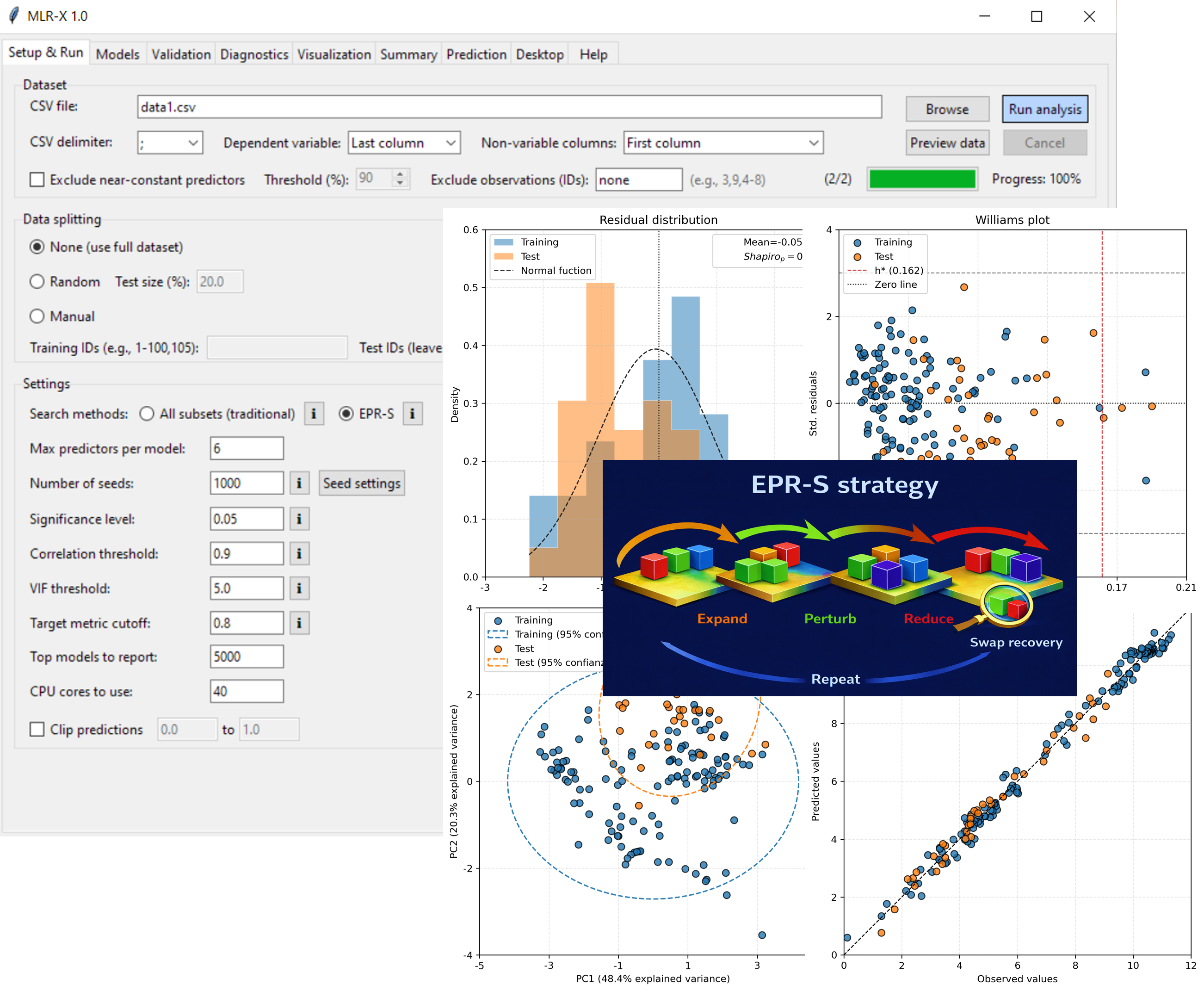
MLR-X is a cross-platform software package for multiple linear regression designed for low- and high-dimensional data, integrating model fitting, subset selection, validation, diagnostic analysis, and prediction into a unified workflow.
The software includes an implementation of EPR-C3, a reproducible heuristic search strategy based on Expand, Perturb, Reduce, and C3 refinement. This strategy explores the MLR model space while enforcing statistical admissibility constraints, including coefficient-significance thresholds, multicollinearity control, and pairwise-correlation filtering.
MLR-X provides a comprehensive set of internal and external validation metrics, applicability-domain assessment, and graphical diagnostics, enabling rigorous model evaluation and interpretation. Results are automatically compiled into structured, export-ready reports suitable for research and publication.
Install
pip install mlr-x
Run
Launch GUI mode:
mlrx
Run CLI mode:
mlrx <config.conf>
Or
mlrx <config.conf> [--onlyIV]
Helpful parameters:
--version: show the version and exit.--model: select a model identifier for requested outputs.--outputs: define which outputs to generate (for example:diagnostics,visualization,summary).pdf,png,tiff, andsvgare export formats used for visualization outputs.--noruns: use an existing results file from the configuration output path.--onlyIVand--onlyEV: execute internal or external validation only, respectively, using models from an existing results file at the configured output path. Both options skip model search and require that the results file already exists.
Example:
python MLRX.py example.conf --model 1 --outputs summary
Requirements
- Python 3.10+
On Linux, install GUI dependencies if needed:
sudo apt-get install python3-tk
sudo apt-get install xvfb
Prebuilt binaries
You can also download standalone binaries from the official release:
Available platforms:
- Windows 10/11 (64-bit)
- macOS X (Arm64)
- Ubuntu 20.04 (x86-64)
How to cite
If you use MLR-X, please cite the software:
- Alcázar, Jackson J. (2026). "MLR-X 1.0 software. Available at: https://jacksonalcazar.github.io/MLR-X/".
If you use the EPR-C3 method, please cite the published article:
- Alcázar, Jackson J. EPR-C3: A deterministic constraint-aware heuristic for high-dimensional subset selection in multiple linear regression. Int J Data Sci Anal 22, 311 (2026). https://doi.org/10.1007/s41060-026-01298-0.
1 maintainer

Metadata
1 maintainer
Release files for mlr-x 1.0.9
For a detailed explanation of source distributions (sdists) and built distributions (wheels), please see the package formats documentation.
Source distribution (sdist)
| File | Size | Uploaded | Provenance | Actions |
|---|---|---|---|---|
| mlr_x-1.0.9.tar.gz | 240.9 kB | Without provenance | Details for mlr_x-1.0.9.tar.gz |
Built distribution (wheel)
| File | Interpreter | ABI | Platform | Actions Reset |
|---|---|---|---|---|
| mlr_x-1.0.9-py3-none-any.whl | Python 3 | none | any | Details for mlr_x-1.0.9-py3-none-any.whl |
Total release size: 484.8 kB
Release files / mlr_x-1.0.9.tar.gz
| Download URL | mlr_x-1.0.9.tar.gz |
|---|---|
| Size | 240.9 kB |
| Tags | Source |
|
SHA-256 checksum How to use checksums |
ceb754b9d043b9dca67902e24baeab6328a58c1a3c9c5691ac8cb3f6013773ad
|
|
BLAKE2b-256 checksum How to use checksums |
59fb3767985cc3f0b0c0fe6a2bf4b3fe1a6436e6509ff8bd7eacc69444c392cc
|
| Upload date | |
|
Uploaded using Trusted Publishing? What is trusted publishing? |
No |
| Uploaded via |
twine/6.1.0 CPython/3.8.20
|
Release files / mlr_x-1.0.9-py3-none-any.whl
| Download URL | mlr_x-1.0.9-py3-none-any.whl |
|---|---|
| Size | 243.9 kB |
| Tags | Python 3 |
|
SHA-256 checksum How to use checksums |
2242aa507817844565fcba46b2c390633a23cedb3e0d2cb9159b2e5680c203b4
|
|
BLAKE2b-256 checksum How to use checksums |
a95d14a3712f3bb2309051e1ac2eb2ece9a1a2a1a76da95b61a30ad626b5a704
|
| Upload date | |
|
Uploaded using Trusted Publishing? What is trusted publishing? |
No |
| Uploaded via |
twine/6.1.0 CPython/3.8.20
|
Security for mlr-x 1.0.9
Provenance
Provenance describes where a file came from. On PyPI, provenance is shared via attestations, which provide a verifiable record of the build or publishing details. View details, limitations and caveats.
No provenance found
None of the files in this release were uploaded with provenance metadata.
A note on package security
PyPI is a repository for distributing packages, not a service for auditing them. While third-party security researchers and our staff do their best to detect and remove malicious packages, PyPI cannot guarantee the quality, security or suitability of any given package.
To learn more about protecting yourself from malicious actors, visit our package security documentation.














