
DSpark + DFlash speculative decoding (semi-autoregressive / block-diffusion drafting) for Apple Silicon via MLX

Project description

DeepSeek's DSpark and z-lab's DFlash speculative decoding — running natively on Apple Silicon via MLX.
Lossless drafters that make Gemma-4 12B and Qwen3-4B faster on a Mac — same output, with a built-in
DSpark-vs-DFlash head-to-head (DSpark ~1.6× / ~1.4×; DFlash up to ~2.1× on code/math).




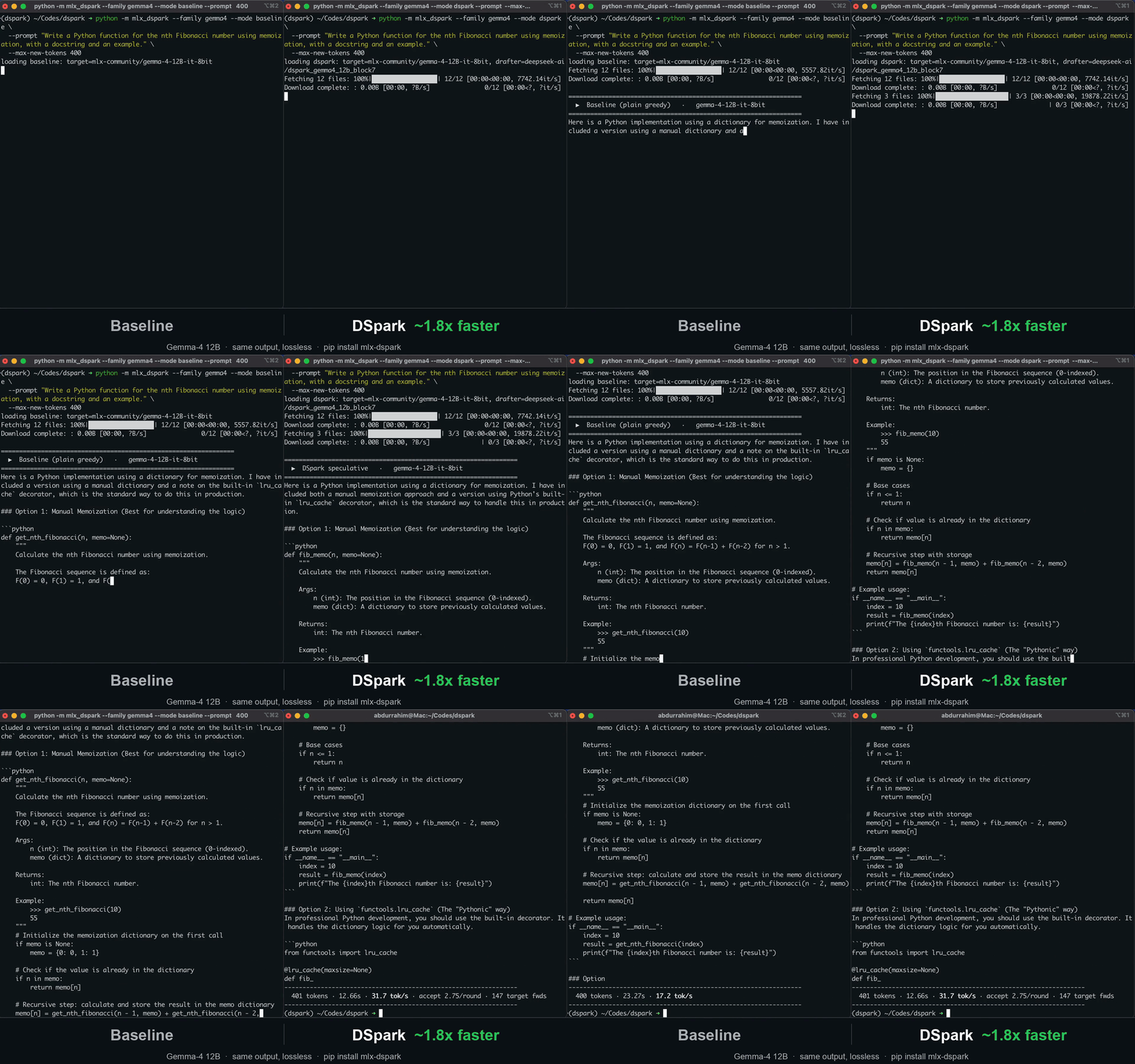
mlx-dspark runs two EAGLE-family speculative-decoding drafters natively on Apple Silicon: DeepSeek's
DSpark (semi-autoregressive, from the DeepSpec codebase,
used to accelerate DeepSeek-V4) and z-lab's DFlash (block diffusion). Both are lossless — the
target verifies every token, so output is identical to normal decoding — and run under one verify loop,
so you can benchmark them head-to-head. pip install mlx-dspark (full setup in Install).
Supported families — pick a drafter with --mode dspark (default) or --mode dflash:
| family | target (instruct, 8-bit) | DSpark drafter (--mode dspark) |
DFlash drafter (--mode dflash) |
RAM |
|---|---|---|---|---|
gemma4 |
gemma-4-12B-it-8bit |
deepseek-ai/dspark_gemma4_12b_block7 |
z-lab/gemma4-12B-it-DFlash |
~32 GB+ |
qwen3 |
Qwen3-4B-8bit |
deepseek-ai/dspark_qwen3_4b_block7 |
z-lab/Qwen3-4B-DFlash-b16 |
~16 GB |
The two drafters have different trade-offs (DSpark's Markov head wins open chat; DFlash's block-16
wins code/math) — see DSpark vs DFlash for the head-to-head. Any other
z-lab DFlash adapter (e.g. Qwen3-8B-DFlash-b16) runs too — see
Run any z-lab DFlash adapter.
How it works
- A parallel backbone (5 Gemma-4 layers) consumes the target model's hidden states
(tapped at layers
[5,17,29,41,46], EAGLE3-style) and proposes a 7-token block at once. - A rank-256 Markov head adds a previous-token correction, sampled sequentially — the only sequential cost, which kills "suffix decay" cheaply.
- A confidence head scores each draft position (optional adaptive block length).
- The target verifies every token, so output is greedy-correct by construction (identical to plain greedy decoding, up to floating-point tie-breaking on near-ties).
The drafter is loaded 1:1 from the HF checkpoint and quantized to 4-bit by default (~1.8 GB) so it's cheap to run every round.
(That's DSpark. DFlash — --mode dflash — is a different drafter: a block-diffusion model that
denoises a whole 16-token block in one parallel pass and reuses the target's own embed/lm-head. Same
lossless verify loop, different trade-offs — see DSpark vs DFlash.)
Install
pip install mlx-dspark # or: uv pip install mlx-dspark
Apple Silicon + Python ≥ 3.10. Model weights download from the Hugging Face cache on first use (none bundled).
From source (dev):
git clone https://github.com/ARahim3/mlx-dspark && cd mlx-dspark
uv venv --python 3.12 && source .venv/bin/activate
uv pip install -e ".[dev]"
Use
# CLI — pick a family (downloads drafter + instruct target on first run)
python -m mlx_dspark --family qwen3  --prompt "Explain how rainbows form."
python -m mlx_dspark --family gemma4 --prompt "Explain how rainbows form." --max-new-tokens 256

# side-by-side demo: baseline (plain target) vs dspark (record each, stack)
python -m mlx_dspark --family qwen3 --mode baseline --prompt "..." --max-new-tokens 400
python -m mlx_dspark --family qwen3 --mode dspark   --prompt "..." --max-new-tokens 400

# z-lab DFlash drafter instead (--max-draft 0 = full 16-block; best on code/math)
python -m mlx_dspark --mode dflash --family gemma4 --max-draft 0 --prompt "Write a binary search."

# sampled (not greedy) — lossless wrt the target at temperature T (works for dspark and dflash)
python -m mlx_dspark --family qwen3 --prompt "Write a short poem." --temperature 1.0 --seed 0
from mlx_dspark import load_pair, speculative_generate

target, tok, drafter, cfg = load_pair("qwen3")   # or "gemma4"
res = speculative_generate(target, tok, drafter, "Explain how rainbows form.")
print(res.text, res.mean_accept_len, res.tokens_per_sec)
Run z-lab's DFlash drafter instead (block-diffusion; strongest on code/math at the full block):
from mlx_dspark import load_dflash_pair, dflash_generate

target, tok, drafter, cfg = load_dflash_pair("gemma4")          # drafter bound to the target's head
res = dflash_generate(target, tok, drafter, "Write a binary search in Python.")  # max_draft_tokens=None = full 16-block
print(res.text, res.mean_accept_len, res.tokens_per_sec)
Results (M4 Pro, warm; 8-bit instruct target, 4-bit drafter)
DSpark vs the official MLX tools running the same model (mlx_lm.generate / mlx_vlm.generate),
at its cap=2 optimum:
| family | drafter d_0 |
accept len | baseline (official) | mlx-dspark | speedup |
|---|---|---|---|---|---|
| Gemma-4 12B | ~82% | ~2.5 | 18.4 tok/s | ~30 tok/s | ~1.6× (≤2× on code/math) |
| Qwen3-4B | ~85% | ~2.25 | 52.9 tok/s | ~73 tok/s | ~1.4× |
DFlash (z-lab) trades the other way — its block-16 denoise shines on structured content. On Gemma-4 12B, full-block DFlash reaches ~2.1× on code/math (accepted length ~6.0), while DSpark's Markov head keeps the lead on open chat (1.65×). They're complementary:
| Gemma-4 12B (vs greedy ≈17.3 tok/s) | chat | code | math |
|---|---|---|---|
| DSpark (cap 2) | 1.65× (acc 2.45) | 1.89× (2.78) | 1.89× (2.86) |
| DFlash (full 16) | 0.98× (2.68) | 2.10× (5.95) | 2.12× (6.20) |
Full per-method table + analysis in DSpark vs DFlash.
All paths produce identical output to plain decoding — they're just faster (divergence from
sequential greedy happens only at logit-margin≈0 ties). (python benchmark.py's in-harness greedy
baseline is ~5% slower than the official tools, so DSpark shows a slightly higher ~1.73× / ~1.45× —
we quote the conservative number.)
What to expect on Apple Silicon (the speedup ceiling)
These numbers are in line with the DSpark paper. The paper's headline is 60–85% (V4-Flash) / 57–78% (V4-Pro) per-user speedup = ~1.57–1.85×, measured in batched production serving vs an MTP-1 baseline (where the confidence scheduler's job is avoiding batch-capacity waste). Our ~1.4–1.6× single-user vs the official tools sits in/near that band — Gemma-4 12B lands inside it; the smaller Qwen3-4B is a touch below because its cheaper verify leaves less to amortize. The "2–4×" you may have seen elsewhere comes from other speculative-decoding papers on datacenter GPUs with greedy baselines, not from DSpark's own claims.
Why it can't go much higher here: speculative decoding amortizes a memory-bound single-token
decode across the K tokens verified in one forward. On a datacenter GPU that arbitrage is huge
(parallel verify is nearly free, so speedup ≈ acceptance length). On an M-series chip it is much
weaker — verify cost grows with the number of tokens (measured ≈ +14 ms/token for Gemma-4 12B,
+1.5 ms/token for Qwen3-4B; multi-token verify drops out of the fast quantized GEMV path). With the
cost model tok/s ≈ A / (drafter + 0.035 + slope·C), even a perfect drafter accepting the whole
7-token block tops out around ~2.2× here. The binding limiter is acceptance length, set by the
drafter↔target match — not drafter quantization (4/8-bit/bf16 drafter all give identical
acceptance; 4-bit is simply fastest).
Greedy vs sampling. The default (temperature 0) is greedy: exact argmax-match verification,
output byte-identical to greedy decoding. --temperature > 0 switches to the paper's actual method
(§2.1) — speculative sampling: draft tokens are sampled and accepted with prob min(1, p/q),
rejections resample from the residual norm(max(0, p−q)), so the output is an exact sample from
the target at temperature T (lossless). It accepts a bit more per round (greedy's exact-match is
the strictest rule), but on M-series the verify cost still keeps cap≈2 optimal, where that extra
acceptance lives mostly in the unreached tail — so net speed is ≈ the greedy ratio. Use it when you
want sampled output, not for extra speed.
Target choice matters
The drafter is trained against a specific instruct model — use the matching instruct target
(gemma-4-12B-it / Qwen3-4B), not the base model (base gave d_0 ~47% vs 82%). Higher target
precision raises acceptance a little; a bf16 target is not a speed win on M-series — verify
dominates and roughly doubles, outpacing the small acceptance gain.
Target precision is a speed/quality knob. Since verify dominates, a 4-bit target gives the highest absolute throughput (and fits ≤24 GB Macs) — but the spec ratio shrinks (cheap verify = less to amortize) and it's a lower-quality model:
| family | 8-bit target (default) | 4-bit target |
|---|---|---|
| gemma4 | greedy 17.5 → spec 30 tok/s (1.73×) | greedy 30.6 → spec 34–38 tok/s (1.1–1.25×) |
| qwen3 | greedy 49.8 → spec 73 tok/s (1.45×) | greedy 82 → spec 96–103 tok/s (1.17–1.26×) |
So: 8-bit for the biggest spec benefit + best quality; 4-bit for max absolute speed or small RAM
(--target mlx-community/gemma-4-12B-it-4bit). Drafter stays 4-bit either way.
Tuning
DSpark (--mode dspark): the target verify cost grows per token and the marginal draft token
rarely survives, so the measured optimum for both families is --max-draft 2 (default) — higher
caps verify more tokens for little extra acceptance and are slower. The drafter only runs its lm_head
- Markov head over these
cappositions (the backbone stays full-width for faithful bidirectional block attention).--max-draft <block>(full 7) is faithful but slower.--confidence-threshold 0.6instead truncates the block adaptively via the drafter's confidence head.
DFlash (--mode dflash): the trade-off flips with content. Use --max-draft 0 (full 16-block,
its native design point) on code/math, where acceptance reaches ~6 and the long block stays fast;
use a short cap (--max-draft 2) on open chat, where the block doesn't fill and the full block
becomes a net loss. Both --temperature (lossless sampling) and greedy are supported, same as DSpark.
DSpark vs DFlash / EAGLE3
These are three drafters from the same DeepSpec codebase, all EAGLE-family (a tiny drafter that consumes the target's hidden states, not a standalone draft LLM). They differ only in how the block is drafted:
- EAGLE3 — autoregressive (token-by-token): high quality but draft latency grows with block size.
- DFlash — parallel (whole block in one pass): fast, but suffix decay (later positions are predicted independently and collide).
- DSpark — semi-autoregressive: the DFlash backbone + a cheap rank-256 Markov head that injects token-to-token dependency, fixing suffix decay at ~0.6 ms/round. A strict upgrade of DFlash.
Per the paper (accepted length, full block, temp=1.0), DSpark beats the DeepSpec DFlash by +16–18%
and EAGLE3 by +27–31%. DFlash and EAGLE3 are already in mlx-vlm for Gemma-4; this is the first
MLX port of DSpark — and it also runs z-lab's original DFlash drafters (see below).
Run z-lab's original DFlash too (--mode dflash)
The DSpark loader already runs DeepSpec's dflash_*_block7 as-is (same *DSparkModel arch with
markov_rank=0). But z-lab's original DFlash (Chen et al.,
arXiv:2602.06036, MIT) is a different design: block diffusion —
a Qwen3-style backbone that reuses the target's embed/lm-head and denoises a whole block of 16
mask tokens in one parallel pass. mlx-dspark now loads those published checkpoints natively and runs
them through the same lossless verify loop, so you can benchmark the two head-to-head on one target/Mac:
python -m mlx_dspark --mode dflash --max-draft 0 --prompt "..."                  # gemma4, full 16-block (its sweet spot)
python -m mlx_dspark --mode dflash --family qwen3 --max-draft 0 --prompt "..."   # Qwen3-4B DFlash
python -m mlx_dspark --mode dflash --max-draft 0 --temperature 1.0 --prompt "..."  # lossless sampling
Built-in presets: gemma4 (z-lab/gemma4-12B-it-DFlash) and qwen3 (z-lab/Qwen3-4B-DFlash-b16).
Greedy by default; --temperature > 0 switches to lossless speculative sampling (exact sample from
target@T). For any other z-lab adapter, see Run any z-lab DFlash adapter.
Head-to-head, measured on-device (gemma-4-12B-it-8bit, M4 Pro, warm, greedy/lossless, 4 prompts/domain — accepted length / tok·s; greedy baseline ≈ 17.3 tok/s):
| method | chat | code | math |
|---|---|---|---|
| DSpark (cap 2) | 2.45 / 28.5 | 2.78 / 32.8 | 2.86 / 32.4 |
| z-lab DFlash (cap 2) | 2.15 / 24.2 | 2.76 / 31.3 | 2.71 / 29.6 |
| z-lab DFlash (full 16) | 2.68 / 16.9 | 5.95 / 36.6 | 6.20 / 36.3 |
The two are complementary, and it lines up with the paper's framing:
- DFlash's block-16 wins structured content on both axes — accepted length ~6.0 on code/math (DSpark's block-7 tops out ~2.8) and ~2.1× throughput, because high acceptance amortizes the 16-wide verify.
- DSpark wins open chat — its rank-256 Markov head fixes suffix decay, so chat accepts 2.45 at 1.65×; DFlash's block never fills on unpredictable text (full-16 chat is ~0.98×, a slight loss).
- On a single-user Mac the long block only converts to wall-clock when acceptance is high (verify cost grows per token here) — DFlash's design target is the cheap-verify batched-serving regime.
DFlash is greedy-lossless to the same standard as DSpark (it diverges from sequential greedy only at the same fp-margin≈0 ties). On Qwen3-4B DFlash also runs (full-block accept ~3.3 on code) but the speedup is smaller — Qwen3-4B's cheap verify leaves little to amortize, the same reason DSpark is only ~1.4× there.
Run any z-lab DFlash adapter
The presets cover gemma4 + qwen3, but every z-lab DFlash checkpoint shares this architecture and
loads the same way — point load_dflash at the drafter repo and load_target at its matched instruct
target (z-lab names them to match, e.g. Qwen3-8B-DFlash-b16 ↔ Qwen3-8B), then bind:
from mlx_dspark import load_target, load_dflash, dflash_generate

target, tok  = load_target("mlx-community/Qwen3-8B-8bit")    # the matched instruct target
drafter, cfg = load_dflash("z-lab/Qwen3-8B-DFlash-b16")      # any z-lab DFlash repo (downloads on first use)
drafter.bind(target.model)                                   # DFlash reuses the target's embed + lm-head
res = dflash_generate(target, tok, drafter, "Explain quicksort.", max_draft_tokens=None)  # None = full block
print(res.text, res.mean_accept_len, res.tokens_per_sec)
The only requirement is a target whose hidden size matches the drafter's (the drafter has no embed/lm-head
of its own — it reuses the target's). Validated on dense Gemma-4 and Qwen3 targets (sliding-window
attention + tied/untied heads handled). z-lab also ships MoE / linear-attention variants (Qwen3.5-*,
gpt-oss-*, …) — those targets use a gated-delta KV rollback this port doesn't wire yet, so they may need
extra cache handling; PRs welcome.
License
MIT — see LICENSE. This is an independent MLX port of the inference path of
DeepSeek's DSpark drafter; see NOTICE for attribution. No model weights are bundled.


Download files
Download the file for your platform. If you're not sure which to choose, learn more about installing packages.
Source Distribution
Built Distribution
Filter files by name, interpreter, ABI, and platform.
If you're not sure about the file name format, learn more about wheel file names.
Copy a direct link to the current filters
File details
Details for the file mlx_dspark-0.0.3.tar.gz.
File metadata
- Download URL: mlx_dspark-0.0.3.tar.gz
- Upload date:
- Size: 6.2 MB
- Tags: Source
- Uploaded using Trusted Publishing? No
- Uploaded via: uv/0.11.14 {"installer":{"name":"uv","version":"0.11.14","subcommand":["publish"]},"python":null,"implementation":{"name":null,"version":null},"distro":{"name":"macOS","version":null,"id":null,"libc":null},"system":{"name":null,"release":null},"cpu":null,"openssl_version":null,"setuptools_version":null,"rustc_version":null,"ci":null}
File hashes
| Algorithm | Hash digest | |
|---|---|---|
| SHA256 |
a5d0a9682e706db8e952143e748fa717e64995eb2073efb7ba8b06517c1b4ea6
|
|
| MD5 |
9ea923e9335548c80ee6d4a976f8a0e1
|
|
| BLAKE2b-256 |
88e6eab7f3e66d5f8fc01d9865abfc5b97f6c1cf954234b66ba2dfb4825634b2
|
File details
Details for the file mlx_dspark-0.0.3-py3-none-any.whl.
File metadata
- Download URL: mlx_dspark-0.0.3-py3-none-any.whl
- Upload date:
- Size: 30.9 kB
- Tags: Python 3
- Uploaded using Trusted Publishing? No
- Uploaded via: uv/0.11.14 {"installer":{"name":"uv","version":"0.11.14","subcommand":["publish"]},"python":null,"implementation":{"name":null,"version":null},"distro":{"name":"macOS","version":null,"id":null,"libc":null},"system":{"name":null,"release":null},"cpu":null,"openssl_version":null,"setuptools_version":null,"rustc_version":null,"ci":null}
File hashes
| Algorithm | Hash digest | |
|---|---|---|
| SHA256 |
ce7e70e84e474ec3749f3cd228261afcb0cd913495421ef74ff9700e5782350d
|
|
| MD5 |
67c0e49601003431d4f49a51b678aca4
|
|
| BLAKE2b-256 |
7ac6241fb6f796145935e44bcfed76858952ed4f62d8ba818ab77b289cb0cbfd
|






