
mofstructure
A Python toolkit for topology, porosity and building-unit analysis of metal-organic frameworks




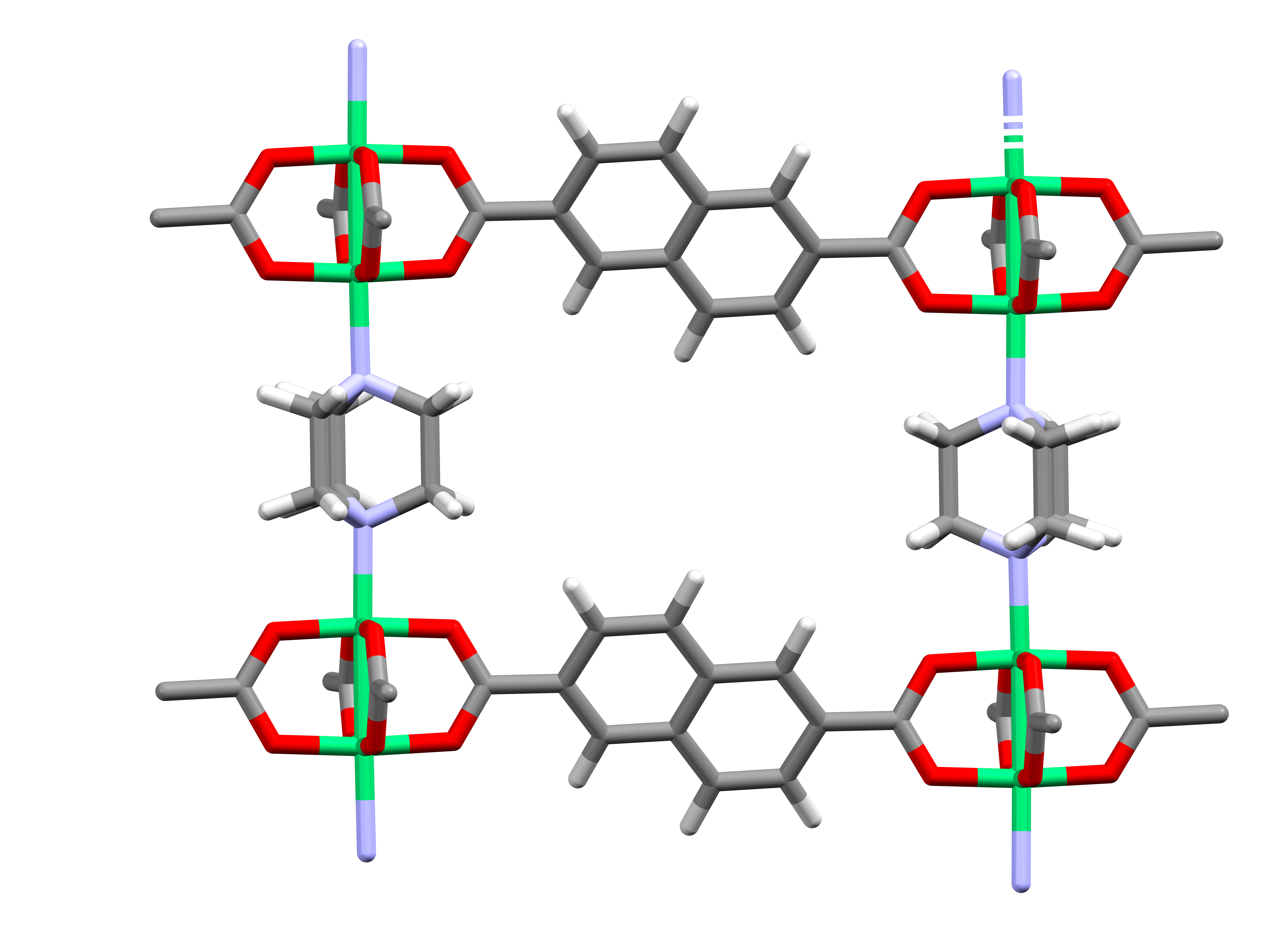
mofstructure takes a crystal structure and answers the questions that usually
follow: what is it built from, how porous is it, and what net does it form.
It works on metal-organic frameworks, and also on covalent organic frameworks
and zeolites, from CIF or any other format ASE can read.
from mofstructure import structure

mof = structure.MOFstructure(filename='UiO-66.cif')

mof.get_porosity()                 # PLD, LCD, surface area, void fraction
mof.get_sbu()                      # metal and organic secondary building units
mof.get_topology()                 # RCSR net symbol, dimensionality, TD10
mof.get_oms()                      # open metal sites
Contents
- Features
- Installation
- Requirements
- Command line
- Python API
- Output reference
- Documentation
- Contributing
- Citation
- License
- Author
Features
| Capability | What you get |
|---|---|
| Topology | RCSR net symbol via Systre, net dimensionality, TD10 density, a reproducible topology hash |
| Porosity | Pore limiting diameter, largest cavity diameter, accessible surface area and volume, channel count |
| Guest removal | Unbound solvent stripped automatically before every analysis |
| Deconstruction | Metal clusters, organic ligands, metal SBUs and organic SBUs as separate structures |
| Cheminformatics | SMILES, InChI and InChIKey for every building unit, plus IUPAC ligand names where known |
| SBU characterisation | SBU type (paddlewheel, rod-like, UiO-66-like and others) and metal coordination number |
| Open metal sites | Detection and local coordination environment of undercoordinated metals |
| Periodic wrapping | Fragments split across cell boundaries reassembled into whole molecules |
Installation
From PyPI:
pip install mofstructure
From source, for the development version:
git clone https://github.com/bafgreat/mofstructure.git
cd mofstructure
pip install .
Requirements
Python 3.10 or newer. Dependencies install automatically, with two things worth knowing about:
- Java is required for topology only. Systre runs on the JVM, and the jar
ships with the package.
mofstructurelooks for a JRE that you configure explicitly, then forjdk4py, then forjavaon yourPATH. Every other feature works without it. - RDKit is optional. OpenBabel handles the cheminformatics by default;
install
rdkitonly if you want the alternative code path.
Command line
Each command accepts a single structure file or a folder of them.
Deconstruct one structure
mofstructure structure.cif                       # writes to ./MOF_building_units
mofstructure structure.cif path/to/results
Build a database from a folder
mofstructure_database cif_folder                 # writes to ./MOFDb
mofstructure_database cif_folder -s path/to/results
mofstructure_database cif_folder -t              # include topology
Results land in MOFDb/Structure_Data as JSON, one file per analysis, plus a
CSV summary of the porosity. Structures already present are skipped, so an
interrupted run resumes where it stopped. Delete the output folder to force a
recomputation.
Individual analyses
Use these when you only need one thing and want it to run fast.
mofstructure_building_units cif_folder           # deconstruction only
mofstructure_porosity cif_folder                 # porosity only
mofstructure_oms cif_folder                      # open metal sites only
mofstructure_porosity accepts a custom probe radius, cycle count and radii
file:
mofstructure_porosity cif_folder -pr 1.5 -ns 20000 -rf rad.rad
Topology from the command line
mofstructure_topology structure.cif
mofstructure_topology net.cgd
mofstructure_topology ./folder
The net depends on how you define a node, and three definitions are available. The same framework can legitimately give a different net under each.
mofstructure_topology structure.cif --method all_node
mofstructure_topology ./folder --method ligand_cluster
mofstructure_topology ./folder --method sbus
For large datasets, write results to disk in batches:
mofstructure_topology ./folder --flush-every 100
Python API
MOFstructure is the single entry point. Guests are removed internally, so a
structure containing solvent needs no preparation.
from mofstructure import structure

mof = structure.MOFstructure(filename='UiO-66.cif')
# or pass an ASE atoms object directly
# mof = structure.MOFstructure(ase_atoms=atoms)

guest_free = mof.remove_guest()
Porosity
import pandas as pd

pores = mof.get_porosity(probe_radius=1.86, number_of_steps=5000, high_accuracy=True)
pd.DataFrame(pores, index=[0]).to_csv('pore.csv')
A structure that Zeo++ cannot analyse returns an empty dictionary rather than raising, so a batch job is never interrupted by one difficult framework.
Building units
metal_sbus, organic_sbus = mof.get_sbu(wrap_system=True, cheminfo=True, add_dummy=False)
organic_ligands = mof.get_ligands(wrap_system=True, cheminfo=True, add_dummy=False)
With cheminfo=True, OpenBabel identifiers are attached to each fragment's
.info dictionary:
for i, sbu in enumerate(metal_sbus):
    smi = sbu.info['smi']
    inchi = sbu.info['inchi']
    inchikey = sbu.info['inchikey']
    n_points = len(sbu.info['point_of_extension'])   # SBUs only
    sbu_type = sbu.info['sbu_type']                  # metal SBUs only
    sbu.write(f'metal_sbu_{i}.cif')
add_dummy=True marks the points of extension with dummy atoms, which makes the
cut positions explicit and easy to cap with hydrogen. Use it for SBUs only,
never when deconstructing into ligands and clusters.
Ligand names
Building units carry identifiers but not names. To name a ligand, look it up from its SMILES against the database that ships with the package:
from mofstructure.filetyper import load_iupac_names
from mofstructure.mofdeconstructor import lookup_iupac_name

iupac_names = load_iupac_names()

_, ligands = mof.get_ligands()
for ligand in ligands:
    print(lookup_iupac_name(ligand.info['smi'], iupac_names))
# terephthalic acid
lookup_iupac_name saturates the open valences left by deconstruction and
matches on InChIKey and canonical SMILES, so the fragment does not have to be
the neutral parent molecule. It returns None for a ligand that is not in the
database. mofstructure_database does this for you and stores the result in
the ligand_names field of ligands_data.json.
Topology from Python
topology = mof.get_topology()
print(topology['topology'], topology['dimension'])
For finer control, drive Systre directly:
from ase.io import read
from mofstructure.systre import identify_topology

identify_topology('net.cgd', input_is_cgd=True)      # from a CGD file
identify_topology('UiO-66.cif', method='all_node')   # from a structure file
identify_topology(read('UiO-66.cif'))                # from ASE atoms
Open metal sites
print(mof.get_oms())
Output reference
get_topology() returns:
| Key | Meaning |
|---|---|
topology |
RCSR net symbol, or UNKNOWN when Systre finds no match |
dimension |
Periodicity of the net (0, 1, 2 or 3) |
td10 |
Topological density from Systre |
topology_hash |
Stable hash of the relaxed net, for indexing and duplicate detection |
cgd |
CRYSTAL2 text of the relaxed net |
get_porosity() returns:
| Key | Meaning |
|---|---|
PLD_A |
Pore limiting diameter, the largest sphere that can diffuse through |
LCD_A |
Largest cavity diameter, the largest sphere that fits anywhere inside |
lfpd_A |
Largest free sphere along the percolation path |
AV_A^3, AV_Volume_fraction |
Accessible volume and void fraction |
ASA_A^2, ASA_m^2/cm^3 |
Accessible surface area |
Number_of_channels |
Number of distinct channels |
Custom atomic radii can be supplied through a .rad file, one element per line.
The extension must be .rad or the defaults are used silently:
Mg 0.66
O 1.84
Documentation
Full documentation is at docs. Release history is in CHANGELOG.md.
Contributing
Issues and pull requests are welcome. See CONTRIBUTING.md for development setup and what to include in a report.
Most problems are specific to one framework rather than general, so please attach the structure file when reporting one. A CIF that reproduces the problem is worth more than any description of it.
Roadmap
- SBU deconstruction and topological analysis of covalent organic frameworks.
Citation
If mofstructure contributes to your work, please cite:
@article{wonanke2026fairmofs,
  title={FAIR-MOFs: Structure-centred synthesis inference from three-dimensional
         structures of metal-organic frameworks},
  author={Wonanke, Dinga and Heine, Thomas and Longa, Antonio and others},
  year={2026},
  doi={10.21203/rs.3.rs-8375247/v1}
}
License
Released under the MIT License. See LICENSE.
Author
mofstructure is developed by Dinga Wonanke.
1 maintainer

Download files
Download the file for your platform. If you're not sure which to choose, learn more about installing packages.
Source Distribution
Built Distribution
Filter files by name, interpreter, ABI, and platform.
If you're not sure about the file name format, learn more about wheel file names.
Copy a direct link to the current filters
File details
Details for the file mofstructure-0.1.8.7.tar.gz.
File metadata
- Download URL: mofstructure-0.1.8.7.tar.gz
- Upload date:
- Size: 3.5 MB
- Tags: Source
- Uploaded using Trusted Publishing? No
- Uploaded via:
poetry/2.4.1 CPython/3.14.6 Darwin/25.5.0
File hashes
| Algorithm | Hash digest | |
|---|---|---|
| SHA256 |
16327ba5ceeac7311843c0f1484273092a55d11ad8ce4ba1870a16482e7ee223
|
|
| MD5 |
527b4aba7dedd369e77cdddc763c8f17
|
|
| BLAKE2b-256 |
5d54c38c956b9873fbe6f5067e1c6f7af2a219564c5c6ab0216ade32f01aa570
|
File details
Details for the file mofstructure-0.1.8.7-py3-none-any.whl.
File metadata
- Download URL: mofstructure-0.1.8.7-py3-none-any.whl
- Upload date:
- Size: 3.5 MB
- Tags: Python 3
- Uploaded using Trusted Publishing? No
- Uploaded via:
poetry/2.4.1 CPython/3.14.6 Darwin/25.5.0
File hashes
| Algorithm | Hash digest | |
|---|---|---|
| SHA256 |
490cf54017253b684b1f7e958856f7d1ae8c55501a9ca7d1e76ab7d51d6753f2
|
|
| MD5 |
a24a6603fbc4753a47a7cb13c57b47e9
|
|
| BLAKE2b-256 |
4cf3d93d1ebb561274046da02d81c8978420680acac010b2bfa0794efe73fa9b
|







