
This release is a pre-release and may not be stable for production use.
MOLT
Thermally aware, memory-efficient QLoRA fine-tuning for consumer NVIDIA GPUs.





MOLT provides a Windows-first workflow to prepare data, validate workload fit, fine-tune supported local language models, safely resume interrupted runs, and export adapters. It includes hardware telemetry, thermal controls, verified checkpointing, and experimental optimized execution paths.
Latest release: 0.11.0a4 · Source-available research alpha.
Install the versioned release below; main may include unreleased changes.
Validate workloads before production use.
Current evidence
On the development RTX 4060 Laptop GPU, six-pair matched diagnostic screens produced the following means against the tested Unsloth configuration:
| Model family | Training time | Board energy | PyTorch allocator peak |
|---|---|---|---|
| Qwen | 38.42% lower | 21.90% lower | 8.13% lower |
| Llama-family | 46.54% lower | 39.23% lower | 5.66% lower |
| Gemma | 73.38% lower | 47.51% lower | 0.47% lower |
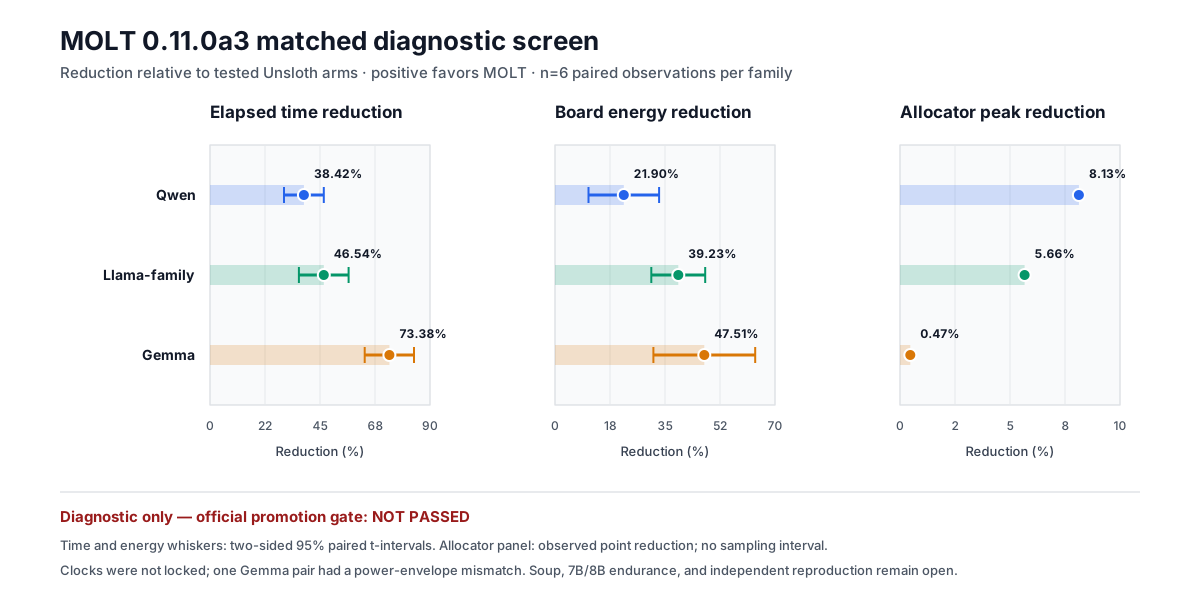
See the calculation method and machine-readable aggregate.
Every recorded pair favored MOLT for elapsed time and energy. These results are diagnostic evidence, not a universal performance claim: graphics clocks were not locked, one Gemma competitor arm had a power-limit transient, Soup has not yet been compared, and 7B/8B endurance and independent reproduction remain open.
Public documentation covers supported interfaces, observable behavior, and reproducible measurements. Internal optimization rationale and development profiling records are not part of the documented API.
Requirements
- Windows 10 or Windows 11, 64-bit
- Python 3.12
- A supported NVIDIA GPU and compatible driver
- Git for source installation
- Internet access and several GB of free disk space during installation
Model weights and datasets are not downloaded automatically.
Installation
Option 1: PyPI
Open PowerShell and create an isolated environment:
py -3.12 -m venv .venv
.\.venv\Scripts\Activate.ps1
python -m pip install --upgrade pip
Install the supported CUDA build of PyTorch first, then MOLT:
python -m pip install torch==2.8.0 --index-url https://download.pytorch.org/whl/cu128
python -m pip install "moltengine[qlora,data,windows-fusion]==0.11.0a4"
Verify the installation:
molt --version
molt doctor
Option 2: Reproducible source installation
git clone --branch v0.11.0-alpha.4 --depth 1 https://github.com/PraveenNimilka/MOLT.git
Set-Location MOLT
powershell -NoProfile -ExecutionPolicy Bypass -File .\install.ps1
.\.venv\Scripts\molt.exe doctor
The installer creates a project-local environment, uses the locked dependency set, verifies the downloaded bootstrap script, checks CUDA backward execution, and checks the optimized backend when enabled. It does not modify GPU drivers, antivirus settings, fan curves, or persistent power settings.
To omit the optional optimized backend:
powershell -NoProfile -ExecutionPolicy Bypass -File .\install.ps1 -EagerOnly
See the complete installation guide for troubleshooting.
First training run
1. Check the machine
molt doctor
molt info
Resolve any reported CUDA or optional-dependency error before continuing.
2. Prepare a local model
Download a supported Hugging Face-format Qwen, Llama-family, or Gemma-family model into a local directory. Review and accept the model's own license.
Example layout:
C:\Models\Qwen2.5-0.5B\
  config.json
  tokenizer.json
  model.safetensors
3. Prepare training data
MOLT accepts UTF-8 .txt, .jsonl, and .parquet. Common text, chat
messages, and prompt/completion records are recognized.
molt prepare C:\Data\training.jsonl `
  --model C:\Models\Qwen2.5-0.5B `
  --output C:\MoltRuns\prepared
The output directory contains prepared token data and a starter training.json.
MOLT will not overwrite an existing preparation directory.
4. Run a two-step fit test
molt fit-test --config C:\MoltRuns\prepared\training.json
This validates real forward, backward, and optimizer steps at the configured geometry. It is not an endurance test.
5. Validate without allocating the full workload
molt train --config C:\MoltRuns\prepared\training.json --dry-run
6. Start training
molt train --config C:\MoltRuns\prepared\training.json
Start with a small context and step count. Model fit depends on architecture, rank, context, batch size, precision, optimizer, and available VRAM.
7. Inspect or resume
molt runs
molt resume
MOLT stages checkpoints before publication and verifies their recorded hashes before loading. Integrity checks do not make an untrusted checkpoint authentic.
8. Evaluate and export
molt evaluate --help
molt export --help
QLoRA runs can export a PEFT-compatible safetensors adapter. The original base model is still required for inference.
Experimental scratch pretraining is limited to MOLT's compact native causal decoder configuration. It is not presented as a general pretraining framework for arbitrary third-party architectures.
Operating safely
- Treat models, datasets, configuration files, and checkpoints as untrusted.
- Do not enable third-party remote model code unless you trust its publisher.
- Keep important checkpoints backed up outside the active run directory.
- Use
molt optimize-gpuonly after reading its prompt and requirements; MOLT never changes clock settings implicitly. - Do not treat a dry run or dependency check as proof that a model fits in VRAM.
- Do not publish private paths, data, credentials, or model weights in bug reports.
Report vulnerabilities through GitHub's private security-advisory workflow. See SECURITY.md.
CLI overview
molt --help
molt prepare --help
molt fit-test --help
molt train --help
molt resume --help
molt export --help
The stable customer path is:
install -> doctor -> prepare -> fit-test -> train -> evaluate -> export
Research and benchmark commands are experimental and can change between alpha releases.
Release boundary
- Automated tests cover the public runtime and verify that the checked-in benchmark figure matches its data. See the release checks for results.
- Static source scanning found no high-severity issue.
- The auditable Python dependency set has no known reported vulnerability.
- GitHub Actions are commit-pinned and PyPI publishing uses short-lived OIDC.
- The final controlled-clock, Soup, large-model endurance, and independent comparison gates are not complete.
Read the 0.11.0a4 release notes, CLI reference, support policy, and licensing boundary. Dependency attribution and branding rules are recorded in THIRD_PARTY_NOTICES.md and TRADEMARKS.md.
License
Current MOLT source is available under the PolyForm Shield License 1.0.0. It is source-available, not OSI open source, and restricts use to provide a product that competes with the licensor. Models, datasets, and dependencies retain their own licenses. Public Python packages can be inspected; the license is a legal boundary, not technical copy prevention. Obtain qualified legal advice for commercial reliance.
1 maintainer

Download files
Download the file for your platform. If you're not sure which to choose, learn more about installing packages.
Source Distribution
Built Distribution
Filter files by name, interpreter, ABI, and platform.
If you're not sure about the file name format, learn more about wheel file names.
Copy a direct link to the current filters
File details
Details for the file moltengine-0.11.0a4.tar.gz.
File metadata
- Download URL: moltengine-0.11.0a4.tar.gz
- Upload date:
- Size: 124.9 kB
- Tags: Source
- Uploaded using Trusted Publishing? Yes
- Uploaded via:
twine/7.0.0 CPython/3.13.14
File hashes
| Algorithm | Hash digest | |
|---|---|---|
| SHA256 |
38261db04fcf16482f81823d0f7790c9272136ea3430fdc763e5a39b4fc3d490
|
|
| MD5 |
5ee1c8f2377f3355832c4cae4fea6958
|
|
| BLAKE2b-256 |
72b634833e10f8a0c54aabbedfb436608db82d3668882b94f6f5efb7e08af43e
|
Provenance
The following attestation bundles were made for moltengine-0.11.0a4.tar.gz:
Publisher:
publish.yml on PraveenNimilka/MOLT
-
Statement:
-
Statement type:
https://in-toto.io/Statement/v1 -
Predicate type:
https://docs.pypi.org/attestations/publish/v1 -
Subject name:
moltengine-0.11.0a4.tar.gz -
Subject digest:
38261db04fcf16482f81823d0f7790c9272136ea3430fdc763e5a39b4fc3d490 - Sigstore transparency entry: 2753449725
- Sigstore integration time:
-
Permalink:
PraveenNimilka/MOLT@a7bbbf1aa87b16c920b4ae9fd18bc3a9dc616f6a -
Branch / Tag:
refs/tags/v0.11.0-alpha.4 - Owner: https://github.com/PraveenNimilka
-
Access:
public
-
Token Issuer:
https://token.actions.githubusercontent.com -
Runner Environment:
github-hosted -
Publication workflow:
publish.yml@a7bbbf1aa87b16c920b4ae9fd18bc3a9dc616f6a -
Trigger Event:
push
-
Statement type:
File details
Details for the file moltengine-0.11.0a4-py3-none-any.whl.
File metadata
- Download URL: moltengine-0.11.0a4-py3-none-any.whl
- Upload date:
- Size: 164.7 kB
- Tags: Python 3
- Uploaded using Trusted Publishing? Yes
- Uploaded via:
twine/7.0.0 CPython/3.13.14
File hashes
| Algorithm | Hash digest | |
|---|---|---|
| SHA256 |
91fe5b1db4544357aa0200881c9f23c101971cb82a8fda86a237882753e07bfa
|
|
| MD5 |
faf4cf28b59393924a42b1bdddc55f69
|
|
| BLAKE2b-256 |
c267d7c558fb86c88a038e67245a9aee3f02f940d80713c44c83f17b359f2109
|
Provenance
The following attestation bundles were made for moltengine-0.11.0a4-py3-none-any.whl:
Publisher:
publish.yml on PraveenNimilka/MOLT
-
Statement:
-
Statement type:
https://in-toto.io/Statement/v1 -
Predicate type:
https://docs.pypi.org/attestations/publish/v1 -
Subject name:
moltengine-0.11.0a4-py3-none-any.whl -
Subject digest:
91fe5b1db4544357aa0200881c9f23c101971cb82a8fda86a237882753e07bfa - Sigstore transparency entry: 2753449727
- Sigstore integration time:
-
Permalink:
PraveenNimilka/MOLT@a7bbbf1aa87b16c920b4ae9fd18bc3a9dc616f6a -
Branch / Tag:
refs/tags/v0.11.0-alpha.4 - Owner: https://github.com/PraveenNimilka
-
Access:
public
-
Token Issuer:
https://token.actions.githubusercontent.com -
Runner Environment:
github-hosted -
Publication workflow:
publish.yml@a7bbbf1aa87b16c920b4ae9fd18bc3a9dc616f6a -
Trigger Event:
push
-
Statement type:














